Silverado Air Suspension Kits: Full Air Ride Guide
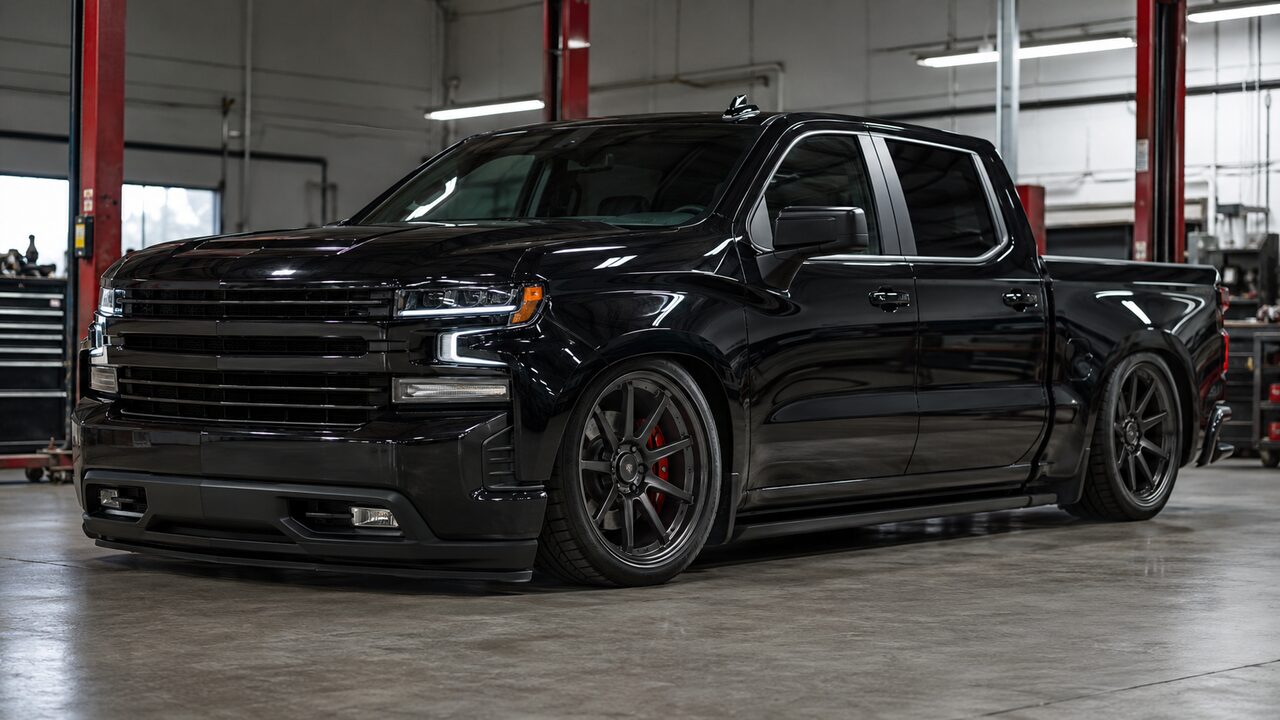
Quick answer: A full Silverado air suspension replaces or substantially changes the factory springs so the truck can raise and lower. It is not the same as a pair of rear helper bags for towing. For a street-driven Silverado 1500, expect a complete four-corner build to require front and rear air springs or air shocks, control arms or brackets, rear suspension links, compressors, a tank, valves, air lines, wiring, controls, alignment, and professional setup. Hardware alone can cost several thousand dollars before installation.
Choosing a Silverado air suspension kit starts with one question: do you want to level the rear under a trailer, or do you want adjustable ride height at all four corners? Those are different systems. This guide covers complete aftermarket air ride for a lowered or “bagged” Chevrolet Silverado 1500. If your goal is reducing rear sag while keeping the factory leaf springs, use our guide to Silverado 1500 rear air bag kits instead.
Fitment is highly specific. Model year, 2WD or 4WD, control-arm material, cab and bed configuration, wheel and tire size, desired drop, frame modifications, and the intended use of the truck can all change the correct parts. Never order a complete system from a broad listing that does not identify the exact Silverado generation and chassis configuration.
Silverado Air Suspension vs. Rear Helper Bags
| Feature | Full four-corner air ride | Rear helper air bags |
|---|---|---|
| Main purpose | Adjustable stance, lowering and custom ride-height control | Reduce rear sag while towing or hauling |
| Factory springs | May be removed or substantially altered | Normally retained |
| Front suspension | Air springs or air shocks and related hardware | Usually unchanged |
| Rear suspension | Often converted to a linked system with air springs | Air bags supplement the leaf springs |
| Air management | Tank, compressor or compressors, manifold, controller and sensors | Manual fill valves or an optional compressor |
| Installation | Advanced; may require cutting, welding or chassis setup | Often a vehicle-specific bolt-on job |
| Best buyer | Street-truck, custom-build or show-truck owner | Towing and hauling owner |
Neither system increases the Silverado’s payload, Gross Vehicle Weight Rating, axle ratings, tire capacity, hitch rating, or legal towing limit. Full air ride is primarily a suspension and stance conversion. Helper bags are load-leveling equipment.
What a Complete Silverado Air Ride System Needs
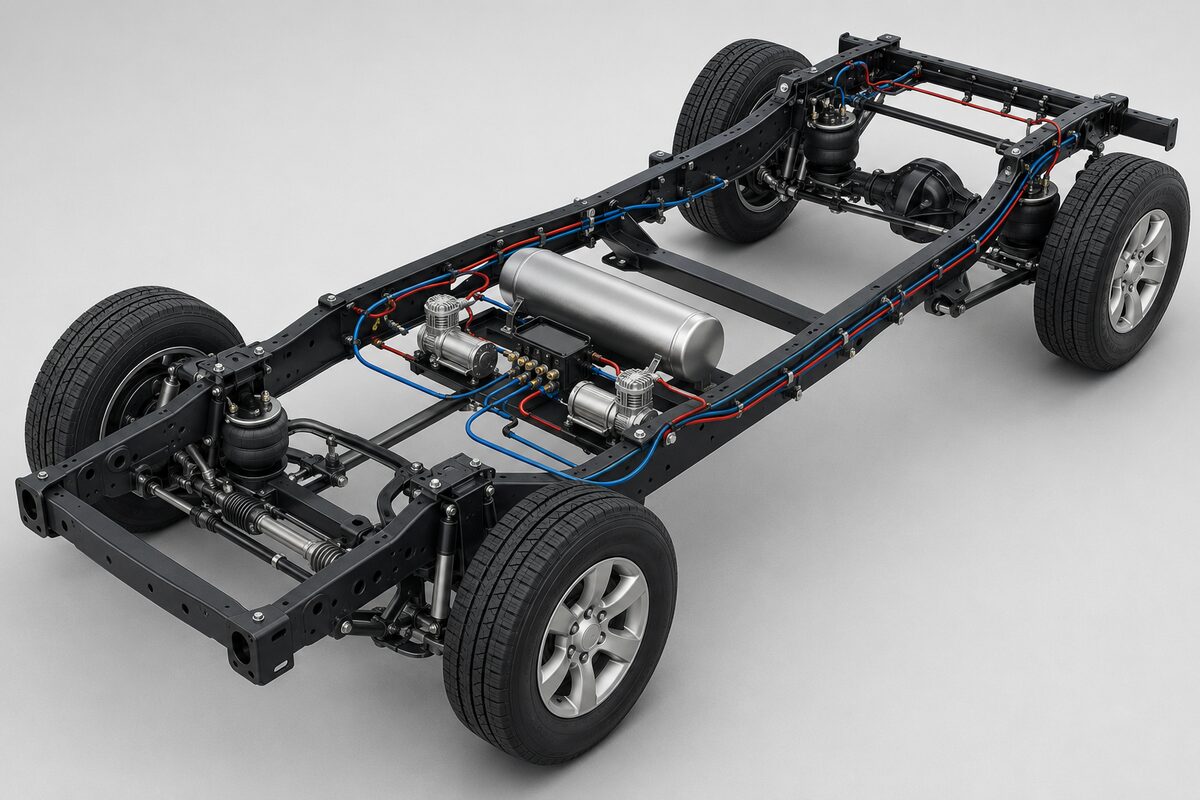
A product described as an “air suspension kit” may contain only the front suspension, only rear bags, or only the compressor and controls. A usable four-corner build normally requires all of the following:
- Front air springs or air shocks: These replace the front coil springs or integrate the air spring and damper into a purpose-built assembly.
- Front control arms and mounts: Some systems use stock arms; others need tubular arms, revised mounts, or clearance changes to achieve the intended drop safely.
- Rear air springs and dampers: The rear bags must be matched to the suspension geometry and usable travel.
- Rear locating system: A complete conversion commonly replaces the leaf springs with a four-link or another engineered link arrangement that controls axle movement.
- Air tank and compressor system: The tank stores compressed air, while one or two compressors restore pressure after height adjustments.
- Valve manifold and controller: These direct air to each corner. More advanced management can use pressure sensors, height sensors, presets, or both.
- Lines, fittings, wiring and protection: Routing must avoid exhaust heat, sharp edges, suspension movement, road debris, and tire contact.
Confirm whether a suspension package includes air management. Several premium “complete” chassis systems include the front and rear suspension hardware but still require the tank, compressors, valves and electronic controller to be selected separately.
Silverado Air Suspension Kits by Generation
1999–2006 Silverado 1500 and 2007 Classic
This GMT800 generation has established complete-system support, especially for 2WD street trucks. A full conversion may combine front air shocks or separate bags and shocks with new control arms, plus a rear four-link that replaces the leaf springs. The 2007 Silverado Classic belongs to this earlier chassis family and should not be ordered as if it were a new-body 2007 truck.
As a current market reference, the manufacturer’s 1999–2006 Silverado system specification lists front and rear air-suspension hardware, control arms and a rear link conversion. Check the current contents carefully because air management, brakes, sway bars, notches, and other supporting parts may be separate.
2007–2013 Silverado 1500
The 2007–2013 generation has the strongest search demand in this cluster and a broad aftermarket. Search results include front-only kits, rear-only kits, complete front-and-rear packages, and universal management systems. A low advertised price often means you are viewing only one part of the conversion.
Control-arm type and drivetrain matter. Some complete systems cover a wider 2007–2016 range but specify particular factory arm designs and 2WD or 4WD applications. The official 2007–2016 complete-system listing, for example, identifies front and rear air shocks, front tubular upper arms and a bolt-on rear four-link. Use that level of specification as the minimum standard when comparing any 2008 Silverado air suspension kit.
2014–2018 Silverado 1500
For 2014–2018 trucks, verify whether the original lower control arms are cast steel, stamped steel, or aluminum. A kit designed around one arm configuration may not fit another. Do not rely only on the model year or a marketplace compatibility badge.
The manufacturer’s 2014–2018 Silverado fitment details separate applications by factory control-arm design and describe a package with front and rear air shocks, upper control arms and a rear four-link. That does not make it universal: drivetrain, existing modifications and the truck’s exact suspension still need confirmation.
2019–2026 Silverado 1500
Current-generation trucks require extra caution because product listings mix full air ride, rear helper bags, lowering links, management components, and kits for trucks with or without Adaptive Ride Control. Trail Boss, ZR2, composite mono-leaf and conventional multi-leaf configurations can require different hardware.
Do not assume that a 2019–2026 “air suspension kit” converts all four corners. Many readily available listings are rear load-support products, which belong to the helper-bag category. For a true four-corner build, obtain a written parts list from a specialist that identifies the exact front system, rear axle-locating hardware, dampers, travel limits, management, wheel clearance and alignment plan.
What About Silverado EV Air Suspension?
The Silverado EV is a separate platform. Certain versions use factory Air Ride Adaptive Suspension with automatic load leveling and selectable ride heights. That factory system is not an aftermarket “bagged Silverado 1500” conversion, and conventional Silverado 1500 kits do not apply.
Chevrolet’s official Air Ride Adaptive Suspension instructions explain the available height controls and operating limits. Use the EV’s VIN-specific owner information before changing links, sensors, wheels, suspension calibration, or ride height.
How Much Does Silverado Air Ride Cost?
A complete build costs much more than a basic rear air bag kit. In July 2026, premium generation-specific suspension-hardware packages were advertised at roughly $5,900 to $7,350 before optional air management, installation, alignment, wheels, tires, fabrication, taxes and supporting modifications. Less expensive combinations exist, but compare what is actually included rather than comparing product names.
| Budget item | What can change the price |
|---|---|
| Front and rear suspension hardware | Generation, control arms, drivetrain, shock type, rear link design and included sway bars |
| Air management | Single or dual compressors, tank size, pressure-only or height-based control, number of presets |
| Installation | Bolt-on work versus cutting, welding, bed removal, frame clearance and custom fabrication |
| Supporting parts | Notches, crossmembers, driveshaft clearance, brake-line changes, exhaust work and bump stops |
| Final setup | Leak testing, wiring, calibration, corner-height setup and wheel alignment |
| Wheels and tires | Offset, diameter, tire width, fender clearance and intended aired-out height |
For a broader labor and hardware breakdown, see our guide to the cost of installing aftermarket air suspension. Ask every shop for an itemized quote that distinguishes suspension hardware, management, fabrication, alignment and optional upgrades.
Is Full Air Ride Right for Your Silverado?
| Choose full air ride if… | Choose another solution if… |
|---|---|
| You want an adjustable lowered stance | You only need to level trailer tongue weight |
| You accept a multi-component custom system | You want the simplest possible suspension |
| You have budget for correct installation and setup | You expect a low-cost bolt-on appearance change |
| Your wheels, tires and body clearance are planned together | You regularly need maximum stock-like suspension travel off road |
| You will maintain air lines, fittings, compressors and electrical components | You do not want additional pneumatic or electrical maintenance |
If fixed-height performance matters more than parking-height adjustment, compare coilovers and complete air suspension before buying. Air ride can work well on a street truck, but it adds compressors, valves, fittings, lines and controls that a conventional spring or coilover setup does not need.
Installation and Safety Checks
- Confirm the exact chassis. Record the model year, Classic or new-body designation, 1500 versus HD, 2WD or 4WD, cab, bed and factory suspension configuration.
- Define the target ride heights. The truck needs safe suspension travel at driving height, not just an attractive aired-out parking position.
- Plan wheel and tire clearance. Check the fenders, inner wheelhouses, control arms, frame, brake hoses and steering through the full height and steering range.
- Protect the pneumatic system. Air lines need clean cuts, correct fittings, heat protection, secure mounting and enough slack for suspension movement without rubbing.
- Wire it correctly. Compressors require suitable wire gauge, relays, fuses, grounding and moisture-resistant connections according to the supplied instructions.
- Leak-test every connection. A slow leak can make the compressor cycle excessively, drain the battery and leave the truck at an unsafe height.
- Align at the intended driving height. Camber, caster and toe can change as the truck moves through its height range. The alignment must correspond to the normal road setting.
A four-corner conversion is not a beginner installation. Cutting or welding the frame, changing axle-locating components, modifying brake or fuel-line routing, or checking driveshaft clearance should be handled by a qualified fabrication and alignment shop. Never work under a truck supported only by a jack, and never drive at a height that causes tire contact, steering interference, insufficient suspension travel or unstable alignment.
Frequently Asked Questions
What is the best air suspension for a Silverado 1500?
The best system is a generation- and chassis-specific package that covers both suspension hardware and compatible air management. For a custom street truck, prioritize documented fitment, safe driving-height geometry, replacement-part availability and installer support over the lowest advertised price.
Can you put air ride on a 2007–2013 Silverado?
Yes. Complete front-and-rear systems and individual components are available for many 2007–2013 Silverado 1500 configurations. Verify 2WD or 4WD, factory control arms, rear suspension design, wheel clearance and whether air management is included.
Does a full air suspension help with towing?
Not automatically. A custom lowered four-corner system is designed primarily for stance and ride-height control. If towing and rear sag are the main concerns, vehicle-specific helper air bags that retain the factory leaf springs are normally the more appropriate category. Neither option increases the truck’s rated capacities.
Can a Silverado be driven when fully lowered?
Only if the system designer explicitly provides a safe driving range at that height. An aired-out parking height may leave inadequate ground clearance, suspension travel, steering clearance or alignment. Use the documented driving preset, not the lowest position, on public roads.
Do complete air ride kits include compressors and a tank?
Not always. Some “complete” packages refer only to the front and rear suspension hardware. Check for compressors, tank, manifold, controller, sensors, wiring, air line and fittings before comparing prices.
Final Recommendation
For a Silverado 1500 built around adjustable ride height and a lowered street stance, choose a complete system designed for the exact chassis rather than assembling unrelated universal parts. The 1999–2006, 2007–2013 and 2014–2018 generations have established full-system options, while 2019–2026 trucks need especially careful verification to separate true four-corner conversions from rear helper bags.
Start with the truck’s VIN-level configuration, choose the intended driving and parking heights, then have the suspension hardware, air management, wheel clearance and alignment planned as one system. That approach costs more than a basic bag kit, but it avoids the most expensive mistake: buying components that cannot work safely together.