
BMW X5 Air Suspension Problems: Causes and Fixes
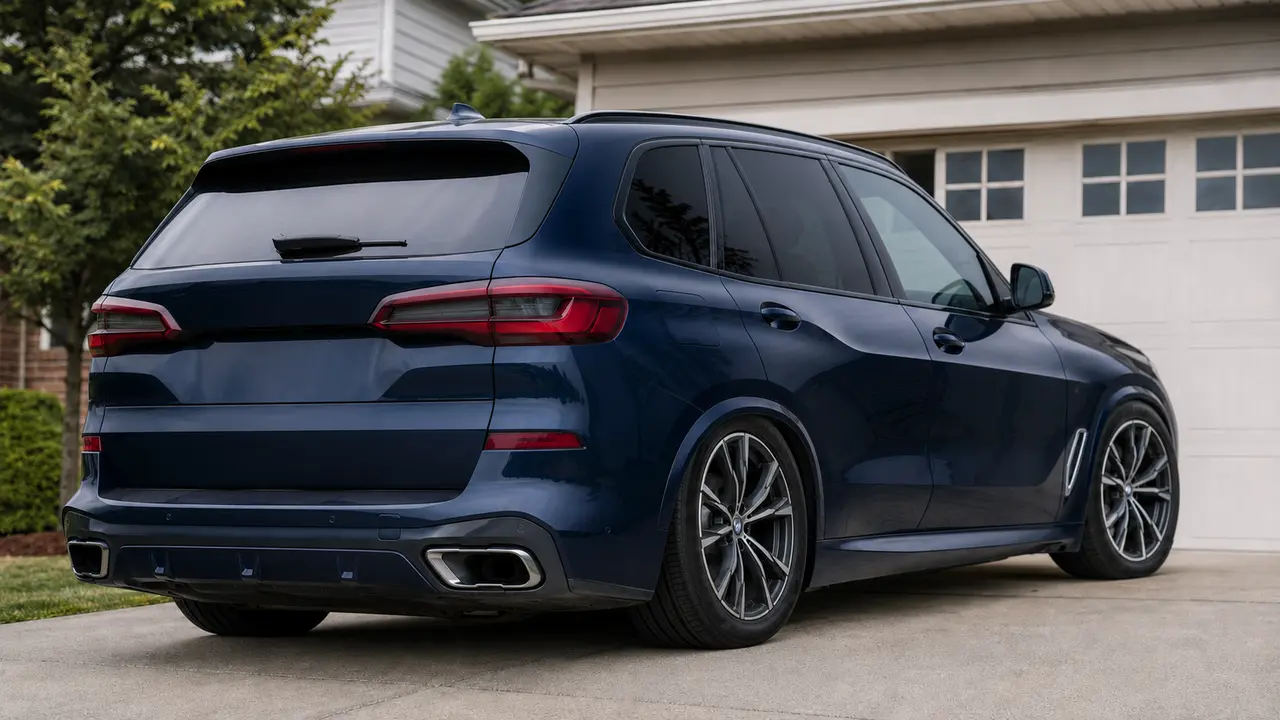
BMW X5 air suspension problems usually come from an air leak, a compressor or power-supply fault, a valve-block issue, or incorrect ride-height information from a sensor or linkage. A rear corner that sinks while parked points more strongly toward lost air pressure, while an X5 that stays low and never runs the compressor needs electrical and fault-code checks before parts are replaced.
First confirm that your X5 actually has air suspension. Equipment varies by generation, model year, powertrain, seating configuration, package, and market. Some X5s use steel springs, some have rear self-leveling air springs, and some G05 models have an adjustable two-axle system. The correct diagnosis starts with the VIN-specific equipment and fault codes—not a universal reset sequence.
Quick diagnostic rule: if the X5 rises after startup but drops again while parked, look for a leak or pressure escaping through a valve. If it will not rise and the compressor is silent, check stored faults, battery voltage, the correct fuse/relay circuit, wiring, and compressor command. If it sits unevenly but retains pressure, inspect ride-height sensor data and linkages.
Does Every BMW X5 Have Air Suspension?
No. “BMW X5 air suspension” describes several systems rather than one standard feature fitted to every vehicle. Enter the 17-digit VIN in the BMW digital owner’s manual lookup and check the installed equipment before following any operating or service procedure.
| Generation | Model years | Air-suspension reality | Diagnostic implication |
|---|---|---|---|
| E53 | 2000–2006 | Some configurations used self-leveling air suspension; equipment was not universal | Use the exact build and system layout rather than later G05 instructions |
| E70 | 2007–2013 | Rear self-leveling air suspension appeared on applicable configurations | Expect rear-circuit diagnosis, but confirm the actual option and components |
| F15 | 2014–2018 | Some models and packages used rear-axle self-leveling air springs | One- or two-side rear sag is a common diagnostic starting point, not proof of a failed bag |
| G05 | 2019–present | Adaptive two-axle air suspension was available on applicable models and years | Front and rear circuits, selectable height, sensors, software, and service mode may all matter |
Adaptive M Suspension and air suspension are not interchangeable terms. Adaptive M Suspension primarily changes damper behavior, while an equipped two-axle air system uses air springs and can control ride height. An “adaptive” label alone does not prove that the X5 has air springs.
BMW X5 Air Suspension Symptoms and First Checks
| Symptom | More likely branches | Best first check |
|---|---|---|
| One rear corner drops overnight | Air spring, line, fitting, or corner valve leakage | Measure ride height before and after parking; inspect that circuit for leaks |
| Both rear corners sit low | Shared air supply, valve block, compressor, electrical fault, or two leaks | Scan the suspension module and check whether the compressor is commanded |
| X5 rises after startup, then sinks later | Air escaping while parked | Find the pressure-loss path before condemning the compressor |
| Compressor runs frequently or for a long time | Leak, weak compressor, restricted dryer/intake, or valve issue | Leak-test first, then evaluate compressor output and duty cycle |
| Compressor never runs | Fuse, relay, wiring, voltage, module command, thermal protection, or failed compressor | Read BMW-specific faults and test the circuit using the correct wiring information |
| Vehicle sits high, low, or uneven without obvious pressure loss | Height sensor, linkage, calibration, valve control, or software fault | Compare requested height with live sensor values |
| Chassis or self-leveling warning | Pneumatic, electrical, sensor, communication, or software fault | Record the exact message and scan all relevant chassis modules |
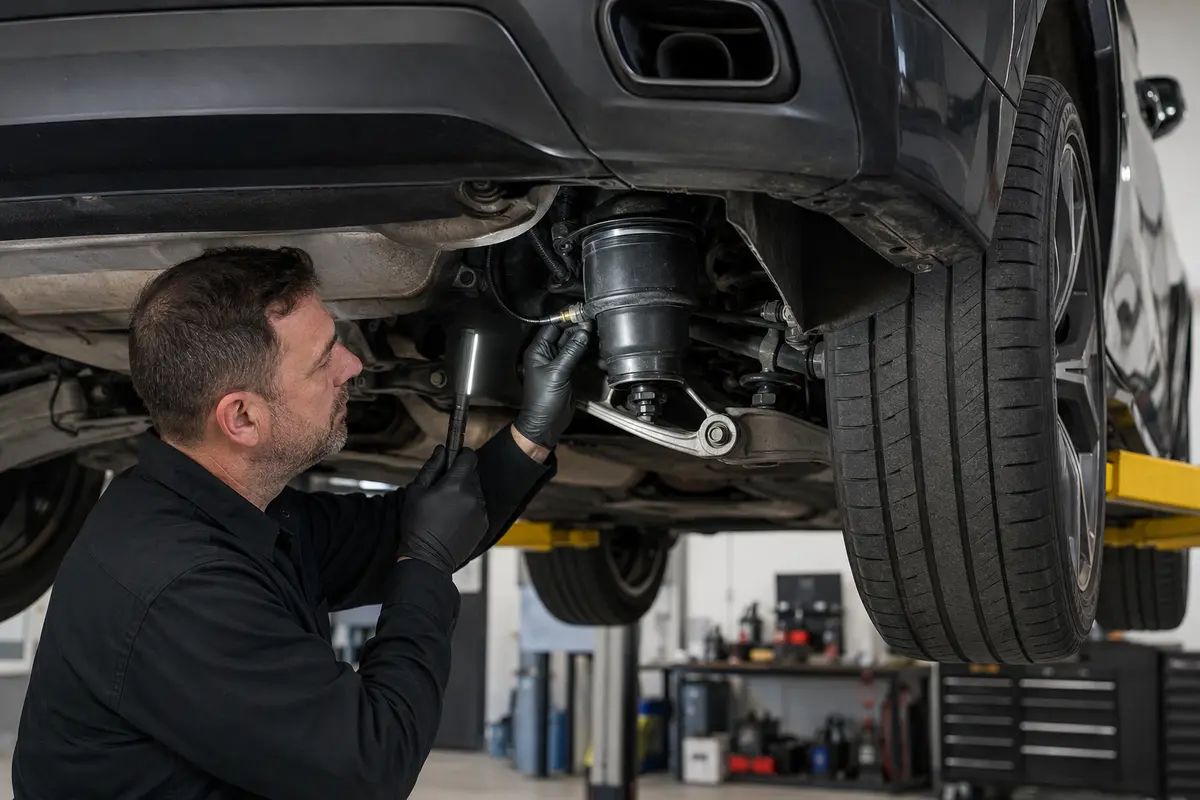
7 Common BMW X5 Air Suspension Problems
1. Leaking Rear Air Spring or Air Strut
Rubber air springs flex and roll as the suspension moves. Age, dirt, road salt, temperature, abrasion, and repeated movement can eventually create small cracks. A leak may be easiest to notice after the X5 sits for several hours because the corner loses height without the compressor correcting it.
A low corner does not prove the spring itself is leaking. Air can also escape through its line connection, seal, valve, or another part of that circuit. Confirm where bubbles form or isolate the circuit before ordering a spring. Do not patch a load-bearing air spring with tire sealant, glue, or an external repair.
2. Damaged Air Line or Leaking Fitting
A pneumatic line can rub, kink, suffer impact damage, or leak where it enters a connector. Incorrect line preparation during an earlier repair can also prevent an internal seal from holding pressure. Examine accessible routing points and connections, but never disconnect a line while the suspension is pressurized.
Our complete air-suspension leak-testing process explains ride-height measurement, external bubble testing, and circuit isolation. Use the X5’s service procedure for depressurization and line repair rather than treating factory pneumatic tubing like a household air hose.
3. Compressor Overwork or Failure
A compressor may become noisy, run too long, overheat, build pressure slowly, or stop operating. However, the compressor is often a secondary victim: a leaking spring or line forces it to replace lost air repeatedly until its duty cycle becomes excessive.
Do not install a compressor before checking for pressure loss, adequate supply voltage, the correct fuse and relay circuit, wiring integrity, control commands, and restrictions. Follow the separate sequence for testing an air-suspension compressor if the electrical or air-supply branch remains suspect.
4. Valve Block or Internal Pressure Leak
The valve block directs air between the compressor, reservoir where equipped, and suspension circuits. An internal leak or a valve that does not seal can let one side fall, allow both rear corners to sink, or move pressure without leaving an obvious external bubble trail.
Because a valve-block problem can imitate a leaking air spring, stance alone is not enough to choose the part. A technician may need to monitor pressure and isolate circuits. Replacing the block and both springs at the same time without testing can become an expensive guess.
5. Ride-Height Sensor or Linkage Fault
Ride-height sensors tell the control system how the body sits relative to the suspension. A damaged sensor, disconnected or bent control rod, corroded connector, or implausible signal can make the system request the wrong correction or disable leveling.
Inspect the linkages before assuming the sensor itself has failed. Compare live left/right height values with physical measurements. After certain sensor, linkage, control-arm, or air-suspension repairs, the vehicle may require an approved ride-height calibration using BMW-capable equipment.
6. Fuse, Relay, Wiring, or Low-Voltage Problem
A silent compressor may have no power, no ground, no module command, or a protection shutdown. Battery voltage also matters because modern chassis modules can restrict functions when electrical supply is inadequate. Read faults before disconnecting the battery or clearing anything.
Fuse positions and circuit layouts vary. Use the fuse assignment and wiring information for the exact VIN; do not copy a fuse number from a different X5 generation. If a replacement fuse opens again, stop replacing it and diagnose the current draw or short circuit.
7. Calibration, Control-Module, or Software Fault
Not every self-leveling warning is caused by a leaking component. Incorrect calibration, implausible sensor data, communication faults, or model-specific software issues can produce warnings or abnormal height behavior. This is why a BMW-capable vehicle test is more useful than a basic engine-code reader.
Do not use random entered measurements to “level” the vehicle. Calibration requires the specified setup, level surface, tire pressures, measurements, electrical support, and software procedure. A false value can make a mechanically sound X5 sit incorrectly.
How to Diagnose an X5 That Is Sagging or Will Not Rise
- Verify the installed system. Check the VIN-specific manual and equipment list. Note whether the X5 has rear-only self-leveling or adjustable two-axle air suspension.
- Record the exact symptom. Photograph the stance and write down the warning message, outside temperature, parking time, and whether one corner, one axle, or the whole vehicle is affected.
- Measure before clearing codes. On level ground, measure vertically from each wheel center to a consistent point on the wheel arch. Repeat after several hours or overnight.
- Run a BMW-capable vehicle scan. Record chassis and self-leveling faults plus requested/actual height, sensor values, pressure data where available, and compressor commands. A generic OBD-II reader may see only engine-related codes.
- Inspect accessible components. Look for damaged bellows, rubbed lines, loose connectors, sensor rods, corrosion, and prior repair errors. Keep clear because the body can move automatically.
- Separate leak from supply failure. An overnight drop favors pressure loss. No compressor response requires electrical and command tests. Long compressor operation calls for leak checks before output testing.
- Confirm the failed part. Use bubble testing, live data, circuit isolation, voltage tests, and pressure/output tests as appropriate. Then follow BMW’s depressurization, replacement, filling, and calibration instructions.
Before buying, verify that the tool supports the suspension/chassis module and service functions for your exact X5 generation and model year. “BMW compatible” does not automatically mean it can read EHC/VDP data or perform ride-height calibration.
Will a Reset Fix BMW X5 Air Suspension?
A reset cannot seal an air leak, restore a worn compressor, repair a sensor linkage, or fix damaged wiring. Switching the vehicle off and restarting it may allow a temporary retry, but a warning that returns still needs diagnosis. Disconnecting the battery or pulling random fuses can erase useful evidence and create additional faults.
Jacking mode is also not a reset. It temporarily suspends automatic leveling on compatible two-axle systems before lifting. If you need to raise the vehicle for service, follow the separate instructions for BMW X5 jacking mode and air-suspension deactivation. Never work beneath an X5 supported only by its air suspension or a jack.
Can You Drive With a Sagging BMW X5?
Do not drive if the body is close to a tire, a tire rubs, one corner is severely collapsed, the vehicle is resting on its bump stops, steering or braking feels abnormal, or the dashboard instructs you to stop. Arrange professional assistance or towing.
Even when the X5 rises after startup, continued driving with a leak can make the compressor run repeatedly and turn one repair into two. It can also alter headlight aim and suspension geometry while the vehicle sits at the wrong height. Address the cause promptly rather than relying on the compressor to refill the system every trip.
Repair the Failed Component or Convert to Coil Springs?
For an X5 that is otherwise in good condition, repairing the confirmed pneumatic or electrical fault preserves self-leveling and the vehicle’s intended suspension behavior. A coil-spring conversion may be available for certain older rear-air applications, but it is not a universal solution for every generation or two-axle system.
A conversion must be engineered for the exact chassis and may require coding or a warning-message solution. Consider load leveling, ride quality, insurance or inspection rules, resale expectations, parts support, and the total installed cost. For repair-budget planning without duplicating prices here, see the component ranges in our factory air-suspension replacement cost guide.
Frequently Asked Questions
Why does my BMW X5 rear suspension drop overnight?
Air is probably escaping from a rear spring, line, fitting, valve block, or check valve. The side that drops helps identify the affected circuit but does not prove which part failed. Measure the height and test for leakage before replacing the air spring.
Why is one side of my BMW X5 lower than the other?
A corner-specific leak is common, but a valve problem, ride-height sensor or linkage fault, damaged suspension component, or incorrect calibration can produce a similar stance. Compare physical measurements with live sensor data.
Does a BMW X5 have air suspension or Adaptive M Suspension?
It can have either, depending on its equipment. Adaptive M Suspension controls damping and is not automatically an air-spring system. Applicable G05 models could be equipped with adaptive two-axle air suspension, while some earlier X5s used rear self-leveling air springs. Check the VIN-specific equipment.
Is there a BMW X5 air-suspension recall?
Do not assume a forum report or service bulletin means every X5 has an open recall. Campaigns are VIN- and production-specific. Enter the vehicle’s VIN in the official BMW safety and emission recall checker or ask a BMW center to verify open campaigns.
How long do BMW X5 air springs last?
There is no reliable universal age or mileage. Climate, contamination, loads, road conditions, suspension movement, storage, and component quality all affect life. Watch for overnight sag, cracks, repeated compressor operation, and slow height changes rather than replacing them at an invented interval. Our guide to air-spring lifespan and failure signs explains those factors.
Use the Symptom to Choose the Test
A parked X5 that sinks needs pressure-loss testing; a low X5 with a silent compressor needs electrical and control checks; abnormal height without air loss needs sensor, linkage, calibration, and software diagnosis. Verify the installed system, preserve the fault data, and confirm the failed component before authorizing parts. That sequence is more reliable than replacing both air springs, the compressor, and the valve block based only on how the vehicle looks.


