Jeep Wrangler Lift Kit: Best Height, Types & Fitment
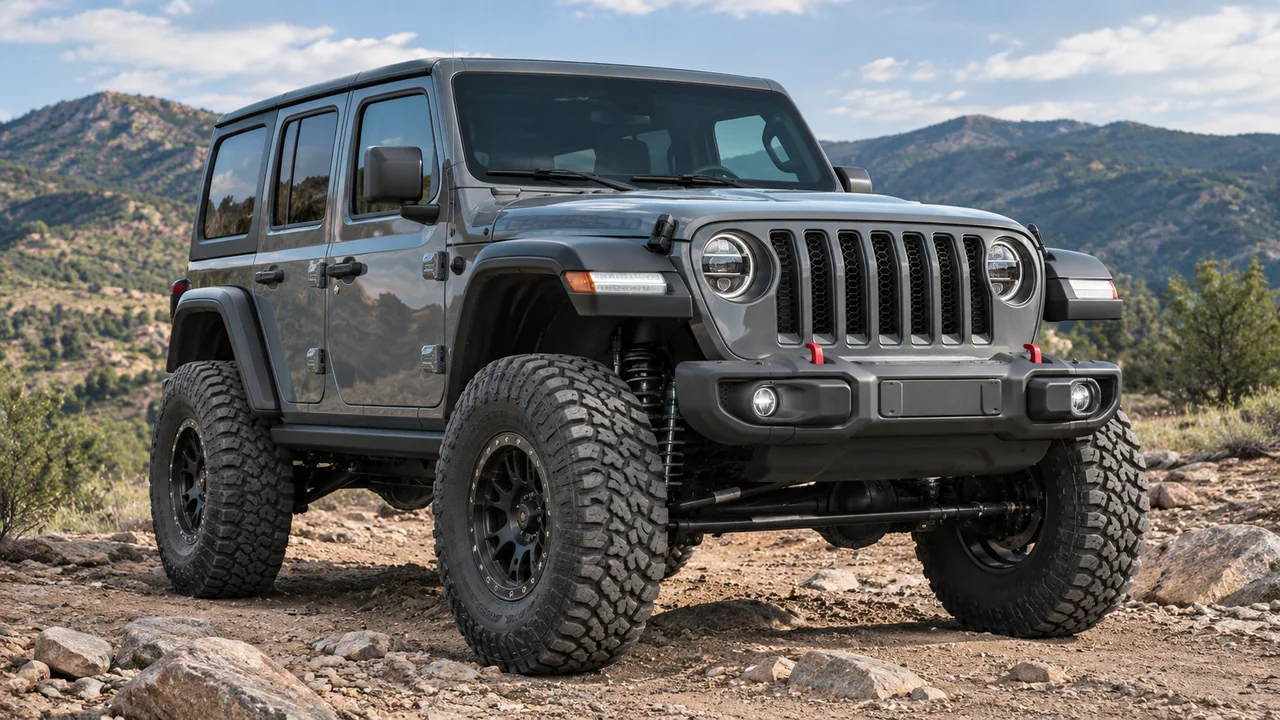
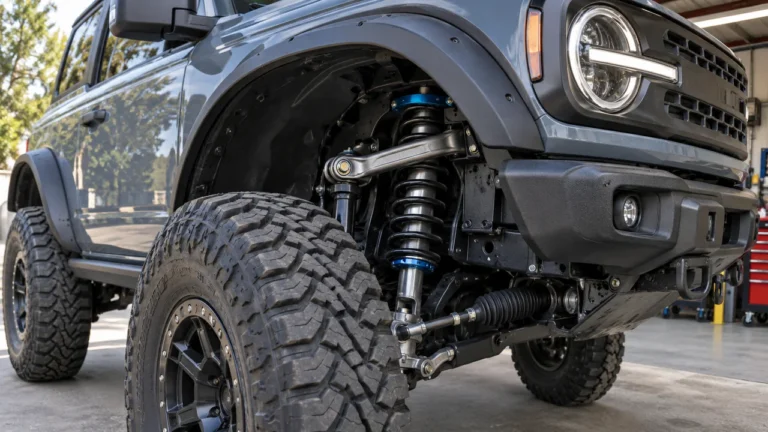
A Jeep Wrangler lift kit should be chosen by chassis generation, actual tire clearance and the way the Jeep will be driven—not simply by the biggest lift number in a listing. For a mostly stock JK or JL that spends its week on pavement and its weekends on moderate trails, a well-matched 2–2.5-inch suspension kit is often the sensible starting point. A 3–3.5-inch system gives a more ambitious build room to develop, but calls for closer attention to axle position, caster and driveline travel. A 4-inch-plus lift is a different project, with a different budget.
That recommendation has exceptions worth knowing before you order. A Rubicon with high-clearance fenders is not the same starting point as a Sport. A two-door Jeep may gain more actual height from the same coils than an Unlimited. And a 2018 Wrangler could be a JK or a JL—two entirely different kit fitments. Below is a practical way to narrow the choices without buying parts twice.
Which Jeep Wrangler Lift Kit Makes Sense for Your Build?
If you are comparing Jeep Wrangler lift kits right now, begin with your use case. The height ranges below describe suspension lift, not a body lift or the combined height of multiple kits. They are shopping starting points, not guarantees that a particular tire will clear at full articulation.
| Your goal | Sensible starting point | What to verify before buying |
|---|---|---|
| Slightly taller stance; near-stock tire size | Small front level or roughly 1–2-inch lift | Factory rake, shock travel, compatibility with current springs |
| Daily driver with 33s or a carefully planned 35-inch tire setup | Quality 2–2.5-inch suspension lift | Generation and trim, fender clearance, bump stops, wheel backspacing |
| Frequent trail use; 35s or a build moving toward 37s | More complete 3–3.5-inch system | Caster correction, axle centering, brake-hose and driveshaft travel |
| 37s with substantial articulation or a highly modified Jeep | Purpose-designed 4-inch-plus system | Steering geometry, gearing, driveline, axle strength and total cost |
For many drivers, the sweet spot is not the highest kit they can afford. It is the least intrusive system that clears the intended tire through steering lock and suspension compression. A lifted Jeep can look perfect in a parking lot and still destroy a fender liner on its first articulated trail obstacle. Work backward from the tire and the terrain, then check the exact kit instructions.
Jeep Wrangler Lift Kit Fitment by Generation
Wrangler names have remained familiar while the underpinnings have changed substantially. Shopping by model year alone also creates an unusual trap in 2018, when the outgoing JK and incoming JL were both sold. Identify the chassis first; then narrow by body style, engine, trim and equipment.
| Wrangler generation | US model years | Suspension layout | Main lift-kit buying issue |
|---|---|---|---|
| YJ | 1987–1995 | Leaf springs front and rear | Spring packs, shackles and steering changes; not a TJ coil kit |
| TJ / LJ Unlimited | 1997–2006 / 2004–2006 LJ | Coil springs front and rear | Short-wheelbase driveline angles; LJ is a distinct wheelbase |
| JK / JKU Unlimited | 2007–2018 | Coil-sprung solid axles | Two-door vs four-door height; JK parts are not JL parts |
| JL / JLU Unlimited | 2018 onward | Coil-sprung solid axles | Trim, engine and 4xe/392 fitment exclusions |
YJ (1987–1995): Start With the Leaf Springs
The square-headlight YJ is the odd one out here. Its factory leaf springs locate the axles as well as support the vehicle, so a proper suspension lift generally uses vehicle-specific spring packs and associated mounting hardware. It is not a matter of fitting the coil spacers you may have seen on newer Wranglers.
Look for complete front and rear spring provisions, the correct U-bolts and bushings, matched shocks and a steering plan appropriate to the chosen height. A cheap shackle-only approach can change steering and spring behavior without giving the same benefits as a carefully designed spring package. Check any manual-versus-power-steering exclusions in the fitment notes. Also inspect the existing spring mounts and frame before putting new suspension parts on an aging YJ.
TJ and LJ (1997–2006): Coil Springs, but a Short Driveline
The TJ introduced coil springs at both axles. That makes modest spacer or replacement-coil lifts possible, but it does not remove the need to consider axle position and driveshaft angles. The two-door TJ has a short rear driveline; vibration can become an issue as rear suspension height and operating angles increase. Depending on the exact setup, the solution might involve pinion-angle changes, a transfer-case arrangement or a suitable driveshaft—not a universal shopping-list item for every 2-inch kit.
The 2004–2006 TJ Unlimited, commonly called the LJ, has a longer wheelbase. Some parts are shared with TJ applications, but that does not make every TJ package a confirmed LJ fit. If a kit includes control arms, rear track-bar hardware or exhaust-related modifications, read the LJ fitment line rather than assuming it is covered by the word “Wrangler.”
JK and JKU (2007–2018): Two Doors and Four Doors Are Not Interchangeable Assumptions
The JK is a frequent target for 2.5-, 3- and 4-inch lift searches. Its four-door version is the JKU Unlimited. Besides the longer wheelbase, the extra vehicle mass affects how springs sit after installation. One manufacturer’s spring package may be advertised at a different achieved height on a two-door than on a four-door; some brands sell distinct kits for each.
The 2012–2018 3.6L JK also differs from earlier 3.8L versions in packaging. At greater lift and droop, front driveshaft clearance around nearby components deserves particular attention. Do not treat an online comment about “my JK” as enough evidence for your engine and model year. Your kit’s application notes and required supporting parts take priority.
JL and JLU (2018 Onward): Do Not Buy a JK Kit for a 2018 JL
JL Wranglers share the familiar solid-axle architecture but use their own suspension mounting and component designs. A listing marked “2018 Wrangler” is incomplete until you know whether the vehicle is a JK or JL. Check a factory build record, VIN-based catalog or clearly identified chassis details before ordering.
The JL also brings wider differences in engine and trim configuration. A suspension package engineered for a gas-powered four-door Sport may have different spring loads or exclusions from one for a diesel, 4xe or Rubicon 392. An advertised 2-inch gain is not a promise that every JL starts at the same ride height or ends up two inches taller.
Rubicon, 4xe, 392 and Factory 35-Inch Packages
Rubicon is not shorthand for “already lifted by a fixed amount.” Factory axle, wheel, fender and suspension configurations depend on the year and options. Some JL Wranglers came with factory 35-inch-class tire packages such as Xtreme Recon; other stock trims did not. Verify the build in front of you rather than relying on the badge or somebody else’s tire chart.
The 4xe plug-in hybrid adds mass and uses a different packaging arrangement, including high-voltage equipment. A kit suitable for an ordinary 2.0L gas JL is not automatically compatible with a 4xe. The V8-powered Rubicon 392 is another special case with its own front-end loading and product exclusions. Choose a kit that explicitly lists the variant and follow its safety and installation documentation. Avoid disturbing any high-voltage components during suspension work.
An official example of how model-specific this can get is the Jeep Performance Parts 2-inch Wrangler/Gladiator lift family: the published description identifies tuned shocks and vehicle-specific applications, not a single universal kit for every Wrangler ever made. Use the exact part number and latest vehicle fitment to confirm your selection.
Is a 2-Inch, 2.5-Inch, 3-Inch or 4-Inch Lift Better?
Search results make each extra inch sound like a straightforward upgrade. In practice, there is a point where higher springs start demanding more geometry correction and other hardware. Tire size is relevant, but the fender shape, suspension travel, wheel position and load matter just as much.
1–2.5 Inches: The Daily-Driver Range
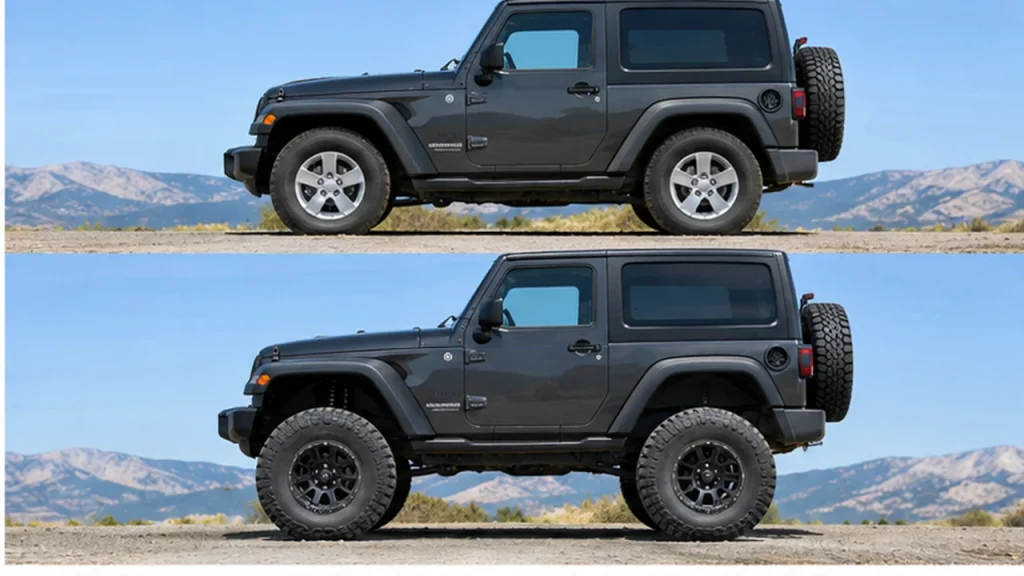
For a relatively lightly modified JK or JL, a low-to-moderate-height system is often the easiest to live with. A quality coil-and-shock package can replace tired parts and maintain useful suspension movement, while a small spacer setup may be sufficient if the stock springs and shocks are still appropriate and the manufacturer approves their reuse.
That does not mean 35-inch tires automatically clear every Wrangler with 2.5 inches of lift. High-fender JL Rubicons, low-fender Sports and older TJs have different packaging. A 35-inch tire also varies in actual diameter and section width between brands. If 35s are your objective, use our dedicated 35-inch tire lift-height guide for the fuller clearance discussion rather than choosing solely from a lift-height label.
3–3.5 Inches: More Trail Range, More Parts to Think About
This is where a basic “four coils and four shocks” package may cease to be a complete answer. Raising the chassis changes control-arm and track-bar geometry, including front caster and how the axles sit beneath the body. A vehicle may need revised control arms or brackets, axle-centering provisions and a closer assessment of shock travel and brake lines. Exactly which parts are required depends on the chassis and kit design.
A three-inch lift can be a sound choice for someone who regularly disconnects the front sway bar off-road and uses meaningful articulation. But the purchase should be based on what the kit controls at full bump and droop—not on a photograph with the tires hanging freely. Ask whether the manufacturer has documented compatibility with your desired tire diameter and wheel backspacing.
4–4.5 Inches: Treat It as a Complete Build
At this height, steering, driveshaft and brake-hose clearance often move from optional questions to major design constraints. A taller spring alone does not explain how caster will be restored, where the axle will sit, or whether the driveshaft can cycle without binding or contacting adjacent parts. The right solution for one JK may be unsuitable for a TJ or JL.
Many 4-inch-plus builds are intended to accommodate 37-inch tires, but lift height is not a reliable substitute for a complete tire-clearance check. Larger tires may also affect the usable gearing, axle loading and braking performance. We cover the tire-specific variables separately in our 37-inch tire lift guide; this article stays focused on choosing the suspension system.
6-Inch Jeep Wrangler Lift Kits: Not the Default Upgrade
A six-inch kit is a specialized choice. It can be reasonable for a Jeep built around a defined off-road target, large tires and appropriate axle and driveline modifications. It is rarely a shortcut to getting 35s onto a daily driver. Tall systems can raise the center of gravity, change steering behavior and amplify the cost of correcting poor geometry.
Before selecting a six-inch package, look for a documented plan for suspension links, steering, bump stops, driveshafts, differential gearing and the brakes. If the seller’s description is mostly a height number with little supporting fitment information, that is a reason to keep shopping.
Why Advertised Lift Height May Not Match the Tape Measure
A 2.5-inch product name does not guarantee exactly 2.5 inches of real lift at all four corners. Factory spring sag, a steel bumper, a winch, a hardtop, recovery gear, a spare tire and even two-door versus four-door weight can change the result. Some kits intentionally retain a little rear-to-front rake, too.
Measure from the wheel-hub center vertically to a repeatable fender reference before and after installation, on a level surface with tires properly inflated. That removes tire diameter from the comparison. Measure all four corners with the same cargo and fuel conditions. The result tells you more about the installed suspension gain than measuring from the ground after switching to taller tires.
Spacer Lift, Coil Spring Lift, Body Lift or Long-Arm System?
These terms describe different ways of changing the Jeep, not quality grades in a neat ranking. A modest spacer lift can suit a particular goal; a poorly configured long-arm system can still drive badly. What matters is whether the components operate together through the intended range of motion.
Coil Spacers and Small Leveling Kits
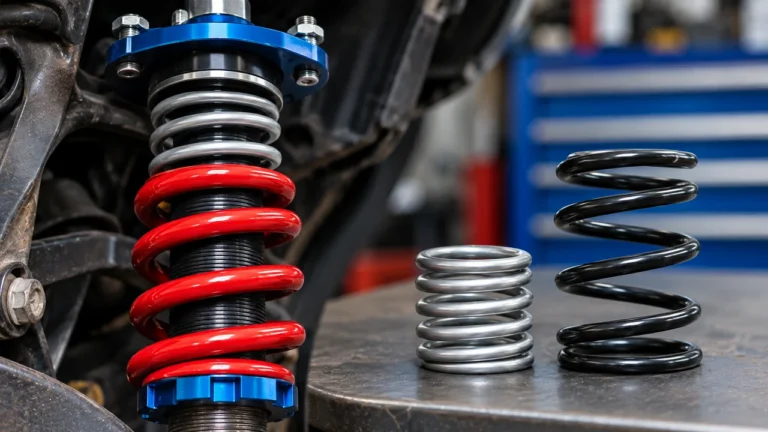
A spacer normally repositions an existing coil spring seat to add static height without replacing the spring itself. On suitable applications, it is a cost-conscious option for correcting a small amount of rake or fitting a moderate tire setup. It does not magically change the spring rate or add shock travel. If the shocks, links or bump-stop arrangement cannot accommodate the new operating position, the rest of the setup needs attention.
A front-only leveling kit also changes the Jeep’s stance rather than raising both ends equally. Check the loaded ride height before assuming factory rake is a defect that needs correcting, especially if you carry gear or tow.
Replacement Coil Spring and Shock Kits
A properly matched spring-and-shock lift can account for vehicle weight, target ride height and usable travel. This is generally the more useful category when the Jeep sees regular trails or the existing springs are tired. Look beyond “premium shocks” in the marketing. Confirm the actual included shock models, compressed and extended lengths, spring application and any required bump-stop changes.
A dual-rate spring label is not a guarantee of a comfortable road ride. Spring design, vehicle load and damper tuning work together; one spring description cannot predict how the whole Wrangler will feel.
Short-Arm and Long-Arm Systems
A short-arm lift retains the general location of the factory control-arm mounts, usually with replacement arms or geometry correction as needed. A long-arm system relocates one or more pivots and uses longer control arms, often changing the way the suspension moves at larger lift heights. Long arms can help manage link geometry on the right build, but they cost more, may reduce clearance in some locations and can require major bracket work.
Do not buy a long-arm kit just because a product page promises “maximum articulation.” The axle must still clear the vehicle, the springs need to stay located, and the dampers and bump stops must control the usable travel.
Body Lifts Are a Separate Decision
A body lift raises the Wrangler’s body above its ladder frame on applications designed for that modification. It may create tire-to-body room without lifting the frame, but it does not change axle ground clearance or add suspension travel. Body mounts, bumpers, wiring and other connections must be accounted for. Our body lift vs suspension lift comparison goes through those distinctions in detail; do not add the two lift measurements together as though they describe one suspension system.
What Should Be Included in a Good Jeep Wrangler Lift Kit?
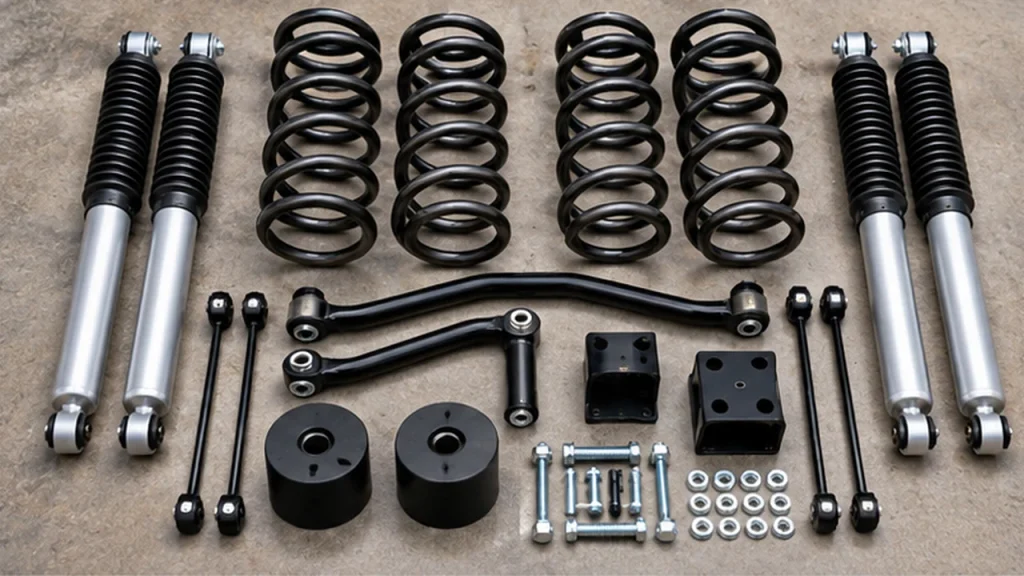
Two boxes can both say “2.5-inch Jeep lift kit” and contain very different hardware. One might include springs and spacers only; another could include shocks, correction arms, track-bar components and bump-stop extensions. Before comparing prices, compare the actual bill of materials against the instructions for your Jeep.
Check the following items against your intended ride height and use. Not every kit needs every item; missing a component is a problem when that particular design requires it.
- Springs or spacers: the correct front and rear parts for the specified engine, trim, two-door or four-door body and expected load.
- Shocks: compatible lengths and mounting hardware, with sufficient compression and extension travel.
- Bump-stop provisions: extensions or other stops where needed to protect shocks, coils, tires and surrounding hardware at full compression.
- Control-arm correction: the specified arms, brackets or adjustments for acceptable caster, axle position and pinion-angle requirements.
- Track-bar solution: an axle-centering and geometry plan appropriate to the front and rear mounting arrangement.
- Sway-bar links and brake-line management: parts and routing that remain safe through the suspension’s full intended travel.
- Driveshaft and exhaust clearance: instructions that identify any required inspection or additional components.
- Installation hardware and documentation: correct fasteners, torque information, vehicle exclusions and a post-install inspection procedure.
Shocks and Bump Stops Must Work as a Pair
Longer shocks do not necessarily create more usable suspension travel. If a shock bottoms out before the axle reaches its intended compression stop, it can be damaged. If it extends farther than the brake hoses, coil retention or driveshaft can safely allow, extra droop becomes a liability. Manufacturers should identify the operating range and any required stop extensions; a competent installer should verify the completed assembly by checking clearance through controlled suspension movement.
Track Bars, Caster and Steering Are Not Decorative Extras
On coil-sprung solid-axle Wranglers, track bars locate the axles laterally. Lifting changes their static angles and can shift an axle off-center. A correctly designed lift might use an adjustable bar, a relocation bracket or another specified correction method. Those parts are not automatically interchangeable: moving a bar mount can also change its relationship to the steering drag link. Our track bar relocation bracket guide covers that choice separately.
Front caster affects how the Jeep tracks and returns to center after a turn. Correcting caster and front driveshaft/pinion relationships can involve competing geometry requirements on some builds. Follow the kit maker’s intended setup and a measured alignment rather than assuming that returning one visual angle to stock solves everything.
Driveshafts, Brake Hoses and Coil Retention
A bigger lift may expose a problem only when the axle is at full droop or one wheel is stuffed and the other extended. The driveshaft can approach a joint’s angular limits, a brake hose can pull tight, or a spring can become unseated. The vehicle may appear normal at static ride height, so these checks cannot be replaced by a driveway photograph.
If a product page says a different front driveshaft is “recommended for high articulation,” investigate what that means for your model, engine and use. The same goes for rear driveline changes on a short-wheelbase TJ. Do not order a generic part solely because another Wrangler owner with a different setup needed it.
Five Fitment Checks Before You Order
The right way to shop is to make a short vehicle profile before opening a dozen tabs. This is especially useful when retailer filters show a part that appears to fit several generations or when a lift has separate variants for different engine weights.
- Identify the chassis and exact configuration. Record YJ, TJ/LJ, JK/JKU or JL/JLU; model year; two- or four-door body; engine; trim; and special packages. Resolve the 2018 JK/JL overlap before purchasing.
- Record the installed tire and intended tire. Include labeled size, actual diameter if available, section width, wheel width, offset and backspacing. A tire name alone is not a complete fitment specification.
- Note what is already modified. Aftermarket control arms, wheel spacers, fenders, track bars, bump stops and driveshafts may conflict with parts in a new kit.
- Account for constant weight. Steel bumpers, winch, roof rack, camping drawers, full-size spare and tools affect spring choice and achieved height.
- Read the specific installation instructions. Confirm part-number fitment and exclusions, required extra purchases, any cutting or welding, steering checks and the post-install alignment procedure.
If a kit’s listing fails one of those checks, do not treat its popularity or review score as a substitute for compatibility. A retailer’s broad “fits Wrangler” label is less useful than the manufacturer’s complete application and instructions.
Jeep Wrangler Lift Kit Cost: Price the Whole Project
Parts prices span a wide range because “lift kit” covers a simple spacer pack and a full suspension system with control arms and tuned dampers. As broad US shopping ranges—not live quotations—a basic spacer approach may cost a few hundred dollars, many complete coil-and-shock systems run from the high hundreds into several thousand, and engineered long-arm builds can be substantially more. Brands, kit completeness and vehicle generation make direct price comparisons difficult.
The expenses that catch people out are often outside the lift-kit box: tires, wheels, alignment, brake-hose or driveshaft work, new fasteners, worn steering parts and occasionally gearing changes. A kit that costs more upfront but includes the geometry corrections you actually need can be cheaper than an inexpensive one that creates a second shopping list.
A shop quote should specify whether it includes the full install, inspection at bump and droop, alignment and any follow-up adjustment. For labor ranges and the cost differences between lift types, see our lift kit installation cost breakdown. This is also the place to compare professional installation with the real tool and time requirements of doing the work yourself.
How to Compare Jeep Wrangler Lift Kit Brands
Brand names are useful for narrowing a search, but a particular kit matters more than the logo. Rough Country has broad entry-level coverage; TeraFlex, MetalCloak, Clayton Off Road, AEV and other Jeep-focused manufacturers offer different approaches to spring tuning and geometry correction; Mopar has Jeep Performance Parts applications for supported newer models. That is not a ranking, and it is not a claim that all offerings from any one brand behave the same way.
Compare the exact product, not just the manufacturer: included shock model, spring load assumptions, wheel requirements, axle-centering components, warranty terms and exclusions. For a broader comparison across manufacturers, our off-road suspension brands guide handles that subject without turning this Wrangler fitment guide into another brand list.
What Can Go Wrong After Lifting a Wrangler?
The purpose of a complete kit is to address predictable changes, but even a reputable system can be installed incorrectly or combined with unsuitable existing parts. A quick post-install drive is not the same as a careful mechanical inspection.
Wandering, Poor Return-to-Center or Steering Shimmy
A Wrangler that wanders after a lift may have an alignment, caster, axle-centering or worn-component issue. A shake after hitting a bump needs a proper front-end inspection that includes track-bar joints and fasteners, tie rods, ball joints, wheels and tires. Do not fit a steering stabilizer to conceal loose steering parts or assume the lift itself is always responsible. A violent oscillation warrants stopping safely and arranging a qualified inspection rather than continuing to drive.
Tire Rub at Full Lock or Full Compression
If the tire rubs an inner fender, frame, control arm or bumper bracket, first identify where and when the contact happens. Contact at full steering lock is a different constraint from contact at full compression. Wheel backspacing, actual tire width, bump-stop setup and fender design may matter more than adding another inch of lift.
Vibration, Clunks or a Jeep That Sits Unevenly
Driveline vibration can point to shaft or joint operating angles; clunks can come from loose fasteners, incorrectly installed links or worn components. A side-to-side lean may reflect different vehicle loads, spring placement or installation errors rather than proof that the advertised lift height is wrong. Diagnose the actual condition and check manufacturer instructions before adding random spacers.
Jeep Wrangler Lift Kit FAQ
A lift kit’s advertised height rarely tells the whole story. Tire clearance, factory suspension packages and installation requirements can change the answer from one Wrangler to another. These frequently asked questions address the details worth checking before you commit to a particular setup.
Will a 2.5-Inch Lift Fit 35-Inch Tires?
Often on properly configured JK and JL builds, but not as a universal rule. A high-clearance JL Rubicon and a stock-fender JK Sport do not have identical space for the same tire. Wheel specifications, actual tire size and full suspension compression decide whether it fits without rubbing. Follow the kit maker’s tire and wheel requirements for the exact trim.
Can I Lift a 4xe Wrangler With a Regular JL Kit?
Do not assume so. The hybrid’s vehicle weight and component packaging differ, and manufacturers may specify dedicated springs or exclude the 4xe entirely. Use a kit expressly approved for your 4xe year and trim, and respect the high-voltage safety instructions. The same caution applies to 392 models.
Do I Need New Control Arms With a 2-Inch Lift?
Not always. Some mild packages are engineered around stock arms or include a targeted correction. Others need replacement or adjustable parts to reach their intended caster and axle geometry. The answer depends on the Wrangler generation and actual ride-height change, not a fixed two-inch threshold.
Is a Spacer Lift Bad for a Wrangler?
Not inherently. A modest, properly engineered spacer setup can be appropriate for certain driving and tire goals. It becomes a poor choice when the rest of the suspension lacks the required travel, geometry or load capacity. A spacer does not replace worn shocks or solve a need for different spring rates.
How Much Lift Does a Rubicon Need for 35s?
There is no single Rubicon answer. Some factory packages already use 35-inch-class tires; others have different fenders, wheels and suspension configurations. Check the actual year, equipment and intended off-road articulation before adding lift simply because the tires are marked “35.”
Can You Install a Lift Kit at Home?
A mechanically experienced owner with the correct equipment, workspace and service information may be able to install a modest bolt-on kit. Suspension parts can be heavily loaded, however, and vehicle support, brake-line routing, fastener torque and final alignment all affect safety. Kits requiring welding, extensive steering changes or hybrid-specific precautions are better handled by a qualified shop. The manufacturer’s instructions, not a generic video, are the installation authority.
Does a Lift Kit Increase Ground Clearance Under the Differential?
On a solid-axle Wrangler, raising the frame with suspension springs does not by itself raise the axle-mounted differential housing off the ground. Increasing actual tire radius is what lifts that lowest axle point. A suspension lift can improve frame and body clearance and help make room for tires, but those are distinct benefits.