Caster Camber Bushing: Degrees, Fitment & Part Numbers
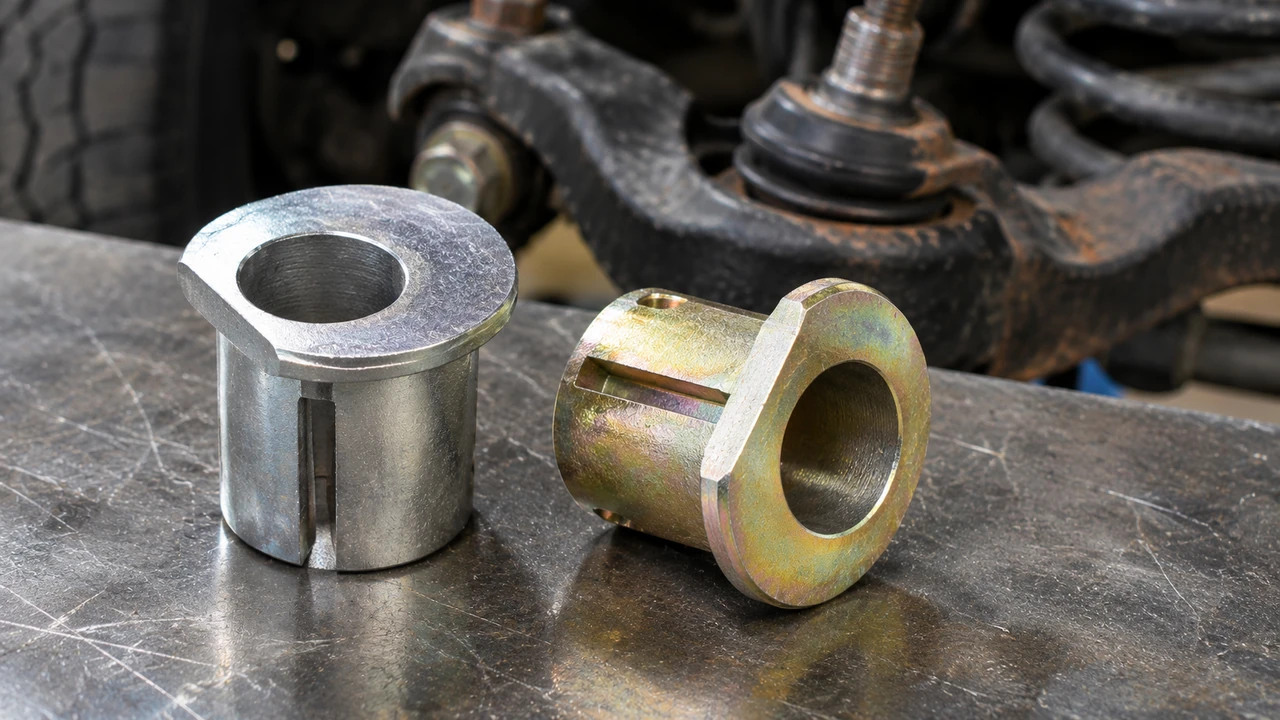
A caster camber bushing is usually an offset alignment sleeve fitted around the upper ball-joint stud on certain Ford trucks, vans, and related vehicles. It changes the position of the steering knuckle so an alignment shop can correct caster, camber, or a combination of the two. Despite the name, this is generally not a soft rubber suspension bushing. It is a precisely shaped adjustment part.
Buying one? Match the exact front suspension and axle first, then use measured alignment readings to select the correct degree range. An adjustable MOOG K80109, a fixed-degree sleeve for a Ford Super Duty, and an eccentric control-arm bolt are three different purchases. The largest advertised number is rarely the best way to choose.
Which Caster Camber Bushing Do You Need?
A parts catalog can show a dozen gold or silver sleeves for the same model name. Before looking at price, identify where the adjustment actually sits on your vehicle. This quick comparison narrows the job down without pretending every Ford uses the same design.
| Vehicle or situation | Start with | Do not assume |
|---|---|---|
| Older Ford or Mazda with an upper-ball-joint alignment sleeve | A sleeve approved for that knuckle, axle and mounting style | Every Ranger, F-150 or Mazda truck has the same sleeve or degree range |
| Ford Super Duty with a serviceable front knuckle sleeve | A model-year- and axle-specific fixed or adjustable sleeve | A 2WD part fits an otherwise similar 4WD truck |
| Part listing says MOOG K80109 | Confirm its application and the adjustment available on your configuration | “4 degrees” means four degrees of caster and camber together |
| Control-arm eccentric bolt or cam plate visible instead | Hardware designed for that control arm | An upper-ball-joint sleeve replaces an eccentric cam bolt |
| Alignment cannot be brought into specification | Inspect for damage and get measured before-and-after readings | A large-offset sleeve can repair a bent axle or worn ball joint |
If the shop has already named a part number, ask for the actual printout and the reason that particular sleeve was selected. If it has only said “you need caster bushings,” the question is still open. The suspension layout, not the wording on the invoice, decides what fits.
What Does a Caster/Camber Alignment Sleeve Actually Do?
An Eccentric Sleeve Moves the Upper Ball-Joint Position
In the applications covered here, a metal sleeve sits in the upper steering-knuckle or axle-yoke bore around the upper ball-joint stud. Its bore is offset from its outside diameter. Turning the sleeve changes where the stud is held relative to the surrounding housing, which changes wheel alignment geometry.
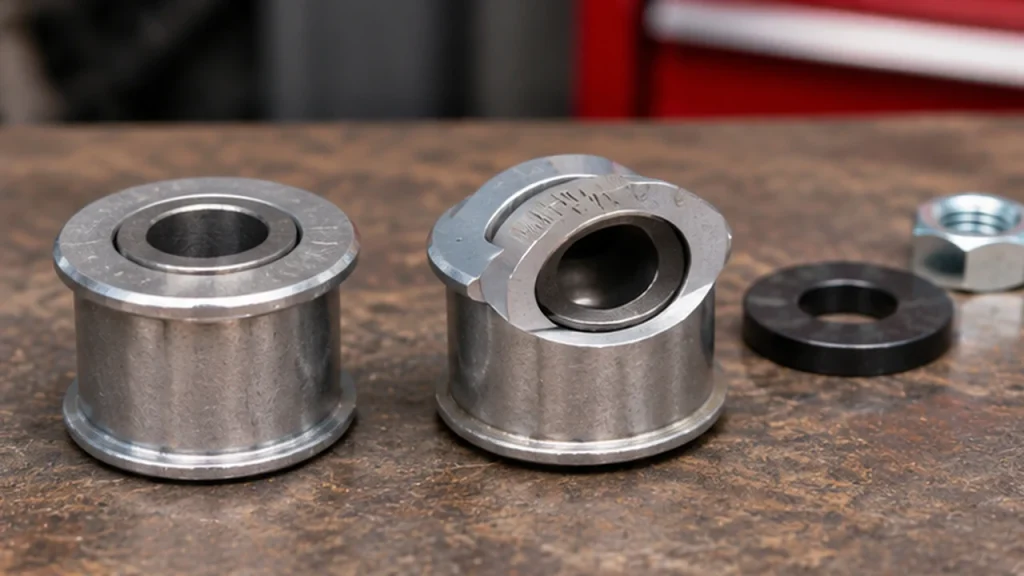
That is why sellers describe the same part as an alignment caster/camber bushing, camber sleeve, caster bushing, or upper ball-joint adjuster. Names vary; the mounting arrangement cannot. You should be able to locate the sleeve in a parts diagram before choosing a replacement.
The Stamped Degree Is an Adjustment Capability, Not a Target
A sleeve marked 1° is not an instruction to give the vehicle one degree of caster. It describes a possible offset in that product family. The actual caster and camber changes depend on the sleeve orientation, its starting position and the axle geometry. Changing one angle may use up some of the available correction in the other.
For context, caster angle concerns the steering axis viewed from the side, while camber angle concerns wheel tilt viewed from the front. This guide is about choosing the hardware, not re-explaining alignment theory.
Fixed-Degree vs. Adjustable Caster Camber Bushings
Fixed Sleeves: Simple Once You Know the Correction
A fixed-degree sleeve has a specified offset. A technician chooses its degree and orientation based on measurements. For a truck that needs a known, modest correction, that can be a straightforward solution. It is also easy to buy the wrong one if the purchase happens before the alignment rack has supplied the numbers.
For example, SPC sells individual Ford heavy-duty sleeves in 0.25°, 0.50°, 0.75°, 1°, 1.25°, 1.50°, 1.75° and 2° versions. Those are different part numbers, not settings on the same fixed sleeve. A shop that stocks several can choose after checking the vehicle rather than guessing in advance.
Adjustable Sleeves: More Combinations, Not Universal Fitment
An adjustable design offers a range of caster/camber combinations and can take the place of several fixed offsets where the vehicle is listed for it. That flexibility is useful when the final requirement is not known until the wheels are measured. It does not make the hardware universal, and it does not guarantee that the maximum advertised caster and camber corrections are both available at once.
SPC 24180, for instance, is sold as an adjustable truck sleeve for compatible knuckle-sleeve applications. Its product description gives a 0.50–2.25° adjustment range. It belongs to a different family from SPC’s later heavy-duty fixed-degree 23220 series; the catalog links and vehicle notes should be checked separately.
When a Zero-Degree Sleeve Is Useful
A true-zero or 0° sleeve can establish a neutral reference before deciding what offset to use. SPC identifies 23229 as the zero-degree member of its heavy-duty series. It is not intended to magically “fix” a truck; its value is that the shop can separate the baseline alignment reading from the correction provided by an offset sleeve.
MOOG and SPC Caster Camber Bushing Part Numbers Compared
One reason this search is frustrating is that shoppers find a part number first and an explanation second. Here are examples with documented differences. They are reference points, not a cross-reference table: none should be ordered for a vehicle simply because its name appears in the right-hand column.
| Part number / family | What distinguishes it | Check before buying |
|---|---|---|
| MOOG K80109 | Adjustable front alignment sleeve; catalog listings describe up to 4° of adjustment | Exact vehicle/drive configuration, sleeve mounting style and effective caster/camber range |
| MOOG K80108 | Different adjustable sleeve family, commonly listed for specific older 4WD truck/axle applications | Do not substitute for K80109 based on similar appearance |
| SPC 24180 | Adjustable sleeve for supported Ford/Mazda knuckle-sleeve applications | Vehicle-specific fitment and adjustment limits |
| SPC 23221–23228 | Fixed-offset sleeves from 0.25° through 2° in the Ford heavy-duty series | Correct degree, specific Ford axle and installation orientation |
| SPC 23229 | 0° reference sleeve for that heavy-duty family | A baseline measurement tool, not a correction by itself |
| SPC 23268 / 23269 | Side-specific fixed caster/camber sleeves aimed at certain lifted Ford trucks | Driver versus passenger position and the prescribed lift/geometry needs |
MOOG K80109: Why the 4-Degree Claim Needs Context
MOOG K80109 is a popular search because it is marketed as an adjustable sleeve with up to four degrees of adjustment and appears across several older Ford and Mazda applications. Retailer fitment notes distinguish axle, 2WD/4WD, and mounting style. A 1990 Bronco II with a specified Dana 35 front axle is not automatically the same application as every other Bronco II or Ranger from that period.
Some listings describe different usable caster and camber ranges for the same general family. Take the vehicle-specific note seriously. The number on the product page is not a promise of plus-four caster and plus-four camber simultaneously. If the shop needs a combination of both, use the manufacturer’s orientation chart for that axle.
MOOG K80108 and Other Familiar Numbers
Searches for K80109 often bring up K80108, K8978 and assorted fixed-degree MOOG sleeves. They may all be described with the same generic product name. K80108, for example, is offered in catalogs for selected older Ford four-wheel-drive and Dodge applications, whereas a K8978 listing refers to a particular smaller offset. Similar catalog thumbnails do not prove identical bore, retention method or compatible steering knuckle.
Do not use a cross-reference from a forum discussion as a substitute for the current maker’s application catalog. Even a model-year match can fail when the front axle has been swapped or when the original adjuster uses a different retaining arrangement.
SPC 23220 Series: A Real Degree-by-Degree Choice
SPC’s 23220 assortment contains nine sleeves: eight fixed offsets from 0.25° to 2°, plus its 0° reference sleeve. Individual part numbers are 23221 through 23229. This is useful if a Ford heavy-duty alignment shop needs to select the final offset after measurement instead of ordering one sleeve on speculation.
For the exact degrees and currently listed Ford applications, see the official SPC 23220 sleeve assortment. The manufacturer lists the assortment as shop inventory, not as a one-kit-per-truck purchase: its individual sleeves are used according to the wheel and measured correction.
SPC 23268 and 23269: An Unusual Driver/Passenger Pair
A useful distinction from the manufacturer’s heavy-duty catalog is that 23268 and 23269 are not simply two identical sleeves. SPC calls out 23268 for the driver side with a fixed +0.50° camber / +2.3° caster change, and 23269 for the passenger side with +0.30° camber / +2.6° caster. It describes the pair as a way to address certain lifted-truck requirements and road crown.
Those figures are part-specific, not recommended alignment targets for your Ford. A road-crown correction chosen for one application can be completely inappropriate for another. Never assume you should order an asymmetric pair merely because a truck pulls right on a crowned road.
Ford and Mazda Fitment: The Suspension Matters More Than the Badge
Ford Ranger, Older F-150, Explorer, and Mazda B-Series
Older Ford light trucks and related Mazda models appear heavily in alignment-sleeve catalogs. Some use 2WD Twin I-Beam-style geometry; some have four-wheel-drive front suspensions with different axle or knuckle hardware. Catalogs also distinguish early Bronco II Dana-axle configurations. A sleeve that fits one 1990s Ford front end may not fit another truck carrying the same grille badge.
This is especially easy to miss if you search “Ford Ranger camber bushing” and filter only by year. Add the front axle type, drive configuration, and whether the original sleeve is held by a pinch bolt or another style of retainer. An existing lifted suspension or replacement axle makes those details even more important.
F-250/F-350 Super Duty: Do Not Mix 2WD and 4WD Lists
The Ford F-250 and F-350 names span different front suspension layouts across generations. Later four-wheel-drive Super Duty applications can use upper-ball-joint correction sleeves such as SPC’s 23220 family. Older 2WD vehicles may be listed for another sleeve series entirely. “Fits F-350” without the year, drive type and axle information is not useful enough to select an alignment part.
Watch for shops and sellers that combine classic F-Series, early Super Duty and later solid-front-axle trucks into one broad results page. That is fine for browsing; it is not a fitment guarantee. Also verify whether a listed part comes as one sleeve or a pair—SPC specifies one per wheel for several of its truck sleeve products.
Ford E-Series Vans and Modified Vehicles
Ford E-Series vans appear in MOOG K80109 and SPC adjustable-sleeve catalogs too. But an E-350 cutaway carrying an RV body can have different actual axle loads, ride height and alignment readings from a lightly loaded van. Use the correct chassis application and check the measurements at the vehicle’s normal running load.
A suspension lift, conversion, rebuilt front axle or replacement knuckle may change what should be installed even though the VIN still points to the original chassis. A parts selector can narrow the catalog; it cannot inspect the vehicle.
How to Read a Caster Camber Bushing Chart
“MOOG caster camber bushing chart” is a real search need. The chart is not simply a list of the biggest available offsets. It tells the technician how a particular sleeve’s orientation changes caster and camber in the intended application. There are three things worth checking before you use it to choose a part.
Start With Measured Caster and Camber, Not Tire Wear Alone
A shop needs before-adjustment caster and camber readings for each front wheel, compared with the vehicle’s approved specifications. A tire that wears on an edge can point toward an alignment problem, but it does not tell you whether that corner requires positive camber correction, caster correction, or a mechanical repair first. Buying from a symptom alone is guesswork.
The alignment printout is the starting point. If it shows one side far outside the range while the other is normal, ask whether a bent part, looseness or previous repair explains the difference before using an extreme offset.
One Offset Cannot Deliver Its Maximum in Two Directions
For many eccentric sleeves, rotating the offset toward one direction emphasizes camber; another orientation emphasizes caster. Intermediate positions share the available correction between both. That is why the manufacturer’s position chart includes orientation marks and separate readings, rather than just “install 2° bushing.” The exact results differ by product and vehicle.
For example, SPC’s fixed-sleeve catalog notes that certain Ford/Mazda four-wheel-drive light-truck applications obtain a smaller effective change than corresponding rear-wheel-drive applications with the same nominal sleeve. You should not transfer a 2WD chart value to a 4WD front end and expect the alignment machine to agree.
True Zero, Left/Right, and Tool Compatibility
A 0° reference sleeve can help establish the current geometry before choosing an offset. Some correction products also have left-versus-right instructions, and some older knuckles use a pinch bolt or snap ring that is not shared with a newer truck. The correct chart identifies which end of the vehicle, which side, and which hardware the number describes.
If you want the mechanical adjustment procedure rather than the product-selection logic, our guide to adjusting caster explains the broader alignment checks. The detailed sleeve orientation and tightening sequence must come from the exact manufacturer instructions.
A Caster Camber Bushing Is Not Every Kind of Alignment Correction
Upper-Ball-Joint Sleeve vs. Control-Arm Eccentric Bolt
Some vehicles correct camber with an eccentric bolt at a lower control arm or strut-to-knuckle joint. Those parts are also marketed as camber adjustment kits, but they are not the upper-ball-joint sleeve discussed here. If the service drawing points to an eccentric washer and bolt on an arm, buying a gold-colored sleeve from a Ford alignment page will not help.
Different designs may use shims, slot adjustments, replacement arms or other engineered components. When the existing hardware is unsuitable, the correct solution is the one specified for that suspension, not a universal bushing chosen solely for its degree rating.
Lifted-Truck Caster Changes May Need a Different Solution
A suspension lift can alter caster, but a sleeve has a finite correction range. On some solid-axle setups, the lift design calls for radius arms, corrected mounting brackets or other geometry changes. Our radius arm drop bracket guide covers one of those separate approaches. A small offset at an upper ball joint cannot fix every change caused by lifting an axle.
It is also worth asking whether the truck is being aligned with the tire size, load, suspension height and steering components it will actually use. An alignment performed before a lift modification does not validate the parts chosen afterward.
Worn Ball Joints or Bent Components Must Be Fixed First
An eccentric sleeve changes geometry; it does not tighten a worn ball joint, straighten a bent yoke or restore an oval mounting hole. If the steering knuckle, stud or surrounding bore is damaged, the installer must repair the underlying problem before expecting an accurate alignment. The same applies to loose wheel bearings or other worn suspension and steering components.
A large-degree sleeve can sometimes make a printout look less alarming while leaving the underlying fault untouched. That is an expensive way to avoid solving the problem—and a poor basis for safe steering.
What to Check Before You Order or Install One
Have these details on hand when you contact an alignment shop or parts counter. They matter much more than whether a product photo looks like the sleeve already in the truck.
- Vehicle and chassis: year, model, 2WD/4WD, exact front axle/knuckle and any prior axle swap
- Location: confirm the adjustment uses an upper-ball-joint sleeve, rather than an eccentric arm bolt or shim
- Measurement: recent front caster/camber readings and factory specifications at normal ride height
- Degree range: fixed versus adjustable, the usable caster/camber combination and vehicle-specific reduction factors
- Hardware style: pinch bolt, snap ring, sleeve head, bore size and required retainer/fasteners
- Quantity: single sleeve or pair, plus any left/right distinction or special correction parts
- Instructions: orientation chart, dedicated puller if specified, safe installation method and final alignment check
Do not attempt to hammer or improvise a tight steering-knuckle sleeve out of place while its joint is loaded. Depending on the design, removal may involve loosening an upper ball-joint connection and using a specified puller. Steering and suspension parts need mechanical support, correct fasteners and torque, and professional measurement afterward.
After any change affecting steering geometry, have the final alignment checked and the hardware inspected as instructed. For the broader reasons to recheck angles after suspension work, see when suspension repairs require an alignment.
Caster Camber Bushing Questions Before Buying
The details that cause most returns are surprisingly small: the wrong axle, the wrong degree range, or a part name that sounds interchangeable when it is not.
Is a caster camber bushing made of rubber?
Usually not in the Ford upper-ball-joint applications discussed here. The “bushing” is typically a rigid eccentric alignment sleeve. It is different from a rubber or polyurethane suspension bushing used to isolate vibration.
Can I use MOOG K80109 on any Ford F-250 or F-350?
No. A catalog may list K80109 for some Ford truck applications, but generation, axle type, drive configuration and mounting design determine fitment. Later 4WD Super Duty trucks may require a different sleeve family. Check the current maker’s fitment for your exact vehicle.
Does a 2-degree caster camber sleeve change both angles by 2 degrees?
Not necessarily. The named degree is an adjustment capability, and the available change depends on orientation and the vehicle. Maximum caster and maximum camber corrections often cannot be used simultaneously. Follow the relevant position chart.
What is the difference between a fixed sleeve and an adjustable sleeve?
A fixed sleeve supplies a defined eccentric offset; an adjustable design permits multiple correction combinations within its stated range. Neither type bypasses fitment restrictions, and the correct degree still depends on actual alignment readings.
What is the purpose of the MOOG caster camber bushing chart?
It helps match sleeve orientation and degree of offset to a particular vehicle’s caster and camber requirements. Check the current instructions for your exact MOOG part, not a chart copied from a different axle family.
Do I need one bushing or two?
Many systems use one sleeve per front wheel, but parts are often sold individually. If both sides need correction, the shop may specify two of the same part or two different settings. Do not infer quantity or symmetry from a listing that says “front.”
Will caster camber bushings fix pulling or uneven tire wear?
Only when an appropriate alignment correction is actually needed. Pulling and wear may also involve tires, brakes, toe, damaged parts or other causes. A sleeve is not a substitute for diagnosing the vehicle and confirming the final alignment.