Wheel Hub Assembly Replacement Cost: Parts & Labor
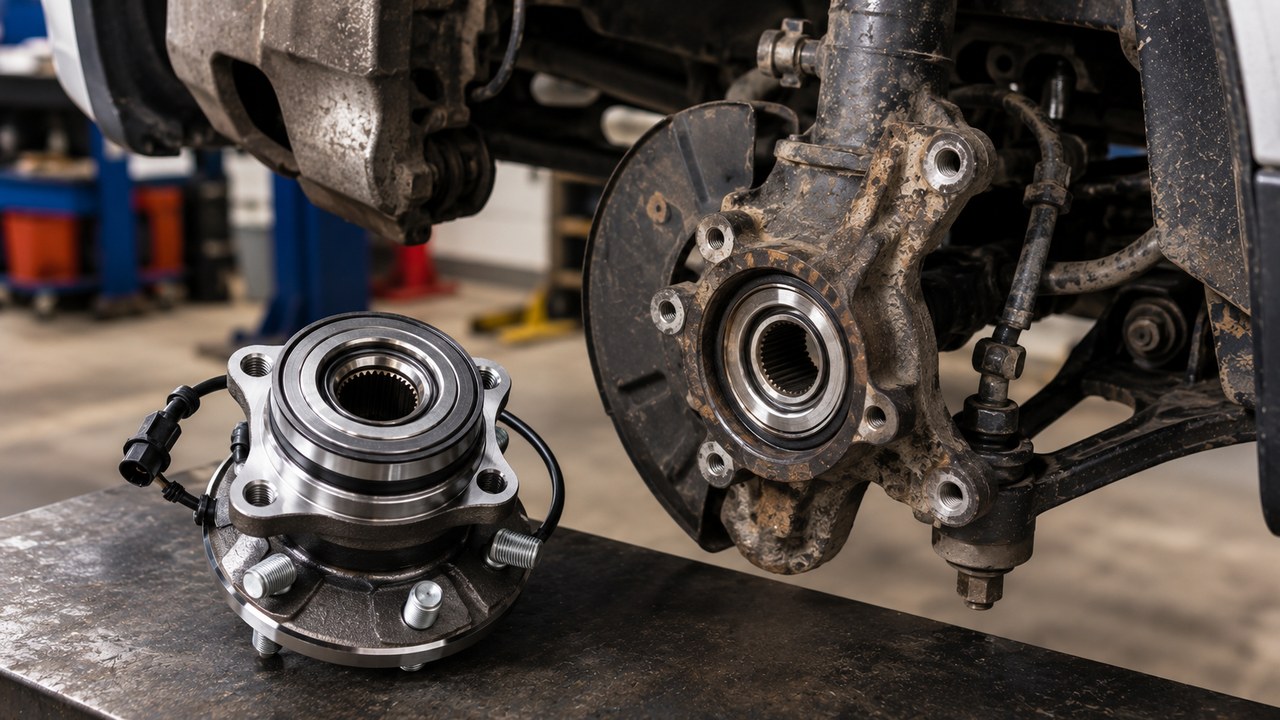
Wheel hub assembly replacement typically costs about $400 to $700 per wheel on many vehicles in the United States. The part itself accounts for a large share of that bill because a complete hub assembly commonly combines the wheel hub, bearing and wheel studs into one serviceable unit.
That higher parts price is not necessarily a disadvantage. In most modern bolt-on applications, searches for wheel hub replacement cost refer to this same complete hub-and-bearing assembly repair. The technician can often replace the complete unit without pressing a bearing in and out of the steering knuckle, so you pay more for the assembly but potentially less for labor.
What Are You Paying for in a Wheel Hub Assembly?
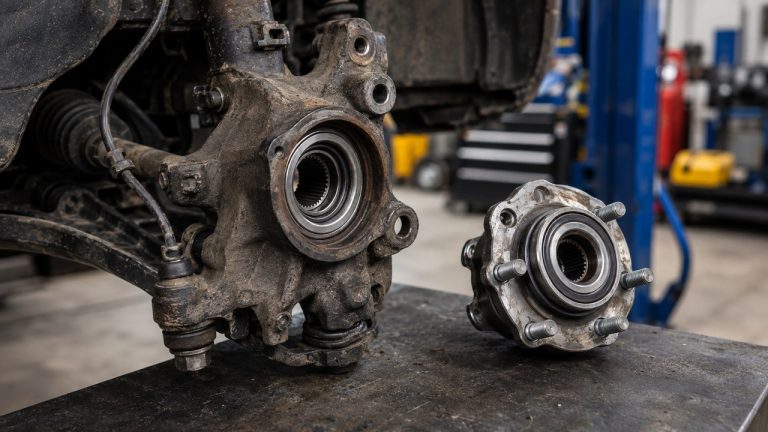
A wheel hub assembly is more than the metal flange that the wheel bolts to.
Depending on the vehicle and replacement part, the assembly may include:
- the wheel hub
- a sealed wheel bearing
- wheel studs
- a mounting flange
- an ABS encoder or tone ring
- sensor-related hardware on some designs
That is why a $250 or $400 hub assembly should not be compared directly with the price of a $75 standalone wheel bearing. They may represent different service designs and very different amounts of labor.
| Wheel Hub Assembly Job | Useful U.S. Planning Range |
|---|---|
| Typical replacement, one wheel | About $400–$700 |
| Lower-cost vehicle / easy access | About $300–$500 |
| Premium or expensive assembly | About $700–$1,000+ |
| Two hubs on the same axle | About $700–$1,300+ |
| Complete hub assembly, part only | Often $150–$450+, depending on vehicle |
These are planning ranges rather than fixed quotes. Some mainstream vehicles fall comfortably below the national average, while others use surprisingly expensive assemblies even when the labor procedure is straightforward.
Wheel Hub Assembly vs. Wheel Bearing
This distinction is the most important part of understanding the quote.
A wheel bearing is the bearing that allows the hub and wheel to rotate. A wheel hub assembly is a larger service unit that usually contains the hub and bearing together.
Some vehicles use a bearing pressed directly into the steering knuckle. Others use a sealed hub-and-bearing unit that bolts to the knuckle with several fasteners.
If the repair is specifically for a standalone or pressed bearing rather than a complete bolt-on assembly, use our wheel bearing replacement cost guide. That repair can involve very different labor.
Why a More Expensive Hub Assembly Can Be Cheaper to Install
A complete hub assembly can look expensive at the parts counter. But it may eliminate several steps required for a conventional pressed bearing.
With a bolt-on assembly, the technician typically removes the brake components, axle hardware when applicable, and the bolts securing the hub to the steering knuckle. The old unit comes out and the replacement bolts back in.
A pressed-bearing design may require removing the entire steering knuckle, pressing out the hub, removing a snap ring, pressing out the old bearing and then carefully pressing the new components together.
So the bolt-on assembly can have a higher parts bill and still require fewer labor hours.
Why Hub Assembly Prices Vary So Much Between Cars
The labor involved in many bolt-on hub jobs is relatively predictable. The price of the assembly itself is often what creates the biggest variation.
Several things can raise the parts cost:
- large truck or SUV bearings designed for higher loads
- premium OEM assemblies
- limited aftermarket availability
- integrated ABS encoder hardware
- more complex seals and bearing construction
- heavy-duty, AWD or performance applications
That means two jobs with similar labor time can still differ by several hundred dollars simply because one vehicle uses a much more expensive assembly.
Front Wheel Hub Assembly Replacement Cost
For a mainstream vehicle, roughly $400 to $700 per front wheel is a useful starting range.
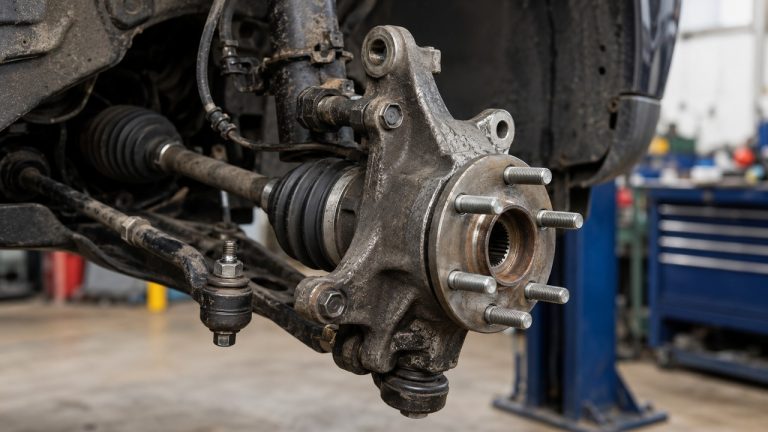
On a front-driven wheel, the CV axle passes through the hub. The technician generally removes the axle nut and frees the axle from the hub before the assembly can be replaced.
The brake caliper and rotor also have to come off or move out of the way, and ABS wiring or sensors near the hub must be handled carefully.
A seized axle spline or a hub corroded tightly into the steering knuckle can turn an otherwise straightforward job into a much longer repair.
Rear Wheel Hub Assembly Replacement Cost
Rear hub assembly pricing can fall in a similar $350 to $700+ per wheel range, but drivetrain design matters.
A non-driven rear hub can be quite simple because there is no CV axle through its center. An AWD or driven rear wheel may require additional axle work.
Electronic parking-brake components, rear suspension packaging and corrosion can also affect accessibility.
Does AWD Make Wheel Hub Replacement More Expensive?
It can, but AWD by itself does not guarantee a high repair bill.
On a driven wheel, the axle passes through the center of the hub. Removing and reinstalling axle hardware adds steps compared with a simple non-driven hub.
What matters more is the specific design, how accessible the mounting bolts are and whether corrosion has seized the axle or hub into place.
Corrosion Can Turn a One-Hour Job Into a Fight
Wheel hubs live in one of the harshest environments on the vehicle. They see water, salt, brake dust, heat and years of road grime.
The hub assembly may bolt to the steering knuckle, but that does not mean it will simply fall out when the bolts are removed.
Corrosion can effectively bond the two metal surfaces together. Technicians may need penetrating oil, pullers, slide hammers, heat or other removal techniques to separate a seized hub.
Axle splines can seize too. If a shop adds labor because the old assembly is heavily corroded, ask what was encountered rather than judging the job solely by the normal book time.
ABS Lights and Wheel Hub Assemblies
Many modern hub assemblies work directly with the ABS wheel-speed system.
The bearing or hub may contain a magnetic encoder ring that the wheel-speed sensor reads as the wheel rotates. Other designs place a separate sensor next to a tone ring or encoder in the assembly.
A failing bearing, damaged encoder or excessive hub movement can therefore be associated with ABS, traction-control or stability-control warnings.
But an ABS light alone does not prove the entire hub assembly is defective. Wiring, connectors and wheel-speed sensors can fail independently. Fault codes and live wheel-speed data should be checked before replacing an expensive mechanical assembly.
Do You Replace Both Wheel Hub Assemblies at the Same Time?
No. A wheel hub assembly normally does not have to be replaced in pairs.
If one bearing inside one hub has failed and the opposite side remains quiet, tight and within specification, replacing only the defective side is normal.
The other side should still be inspected, especially on a high-mileage vehicle, because both assemblies have experienced similar mileage and road conditions.
But similar age is not the same as confirmed failure.
What Does a Bad Wheel Hub Assembly Sound Like?
Because the bearing is normally part of the assembly, the most common symptom is the familiar wheel-bearing humming, growling or rumbling noise that increases with road speed.
The sound can change during a gentle turn as weight transfers from one side of the vehicle to the other.
Advanced wear can also produce roughness, grinding or measurable looseness at the wheel.
Hub Noise Can Still Be Tire Noise
Do not authorize a hub assembly solely because the car makes a roaring sound on the highway.
Cupped or irregularly worn tires can produce remarkably similar noise. The sound may change with pavement type or move after tire rotation.
If your tires show abnormal wear, our guide to suspension-related tire wear covers other causes that should be ruled out.
Can a Bad Hub Make the Car Feel Wobbly?
A badly worn hub bearing can develop enough play to affect how the wheel feels, but wobbling is not specific to the hub assembly.
Wheel damage, tires, ball joints, control-arm bushings, tie rods and other suspension components can produce similar symptoms.
If instability is the main complaint rather than a confirmed bearing diagnosis, see our car feels wobbly when driving guide before assuming the hub is responsible.
Can the Steering Knuckle Be Damaged During a Hub Failure?
Usually the hub assembly can be replaced without replacing the steering knuckle.
However, severe bearing looseness, collision damage, corrosion or difficult previous repairs can damage the mounting surfaces where the hub attaches.
If the knuckle is cracked, bent or too damaged to secure the new assembly correctly, it becomes a separate repair. Our steering knuckle replacement cost guide covers that situation.
Do You Need an Alignment After Wheel Hub Assembly Replacement?
A straightforward bolt-on wheel hub assembly replacement does not normally require a wheel alignment.
The hub can often be changed without altering tie rod length, control-arm position, camber adjustment or other alignment settings.
An alignment may still be appropriate if the repair involved removing the steering knuckle, loosening alignment-sensitive suspension components, repairing collision damage or correcting an existing tire-wear or handling problem.
If alignment appears on the estimate, our alignment after suspension repair guide explains how to judge whether the actual work performed justifies it.
How Long Does Wheel Hub Assembly Replacement Take?
An accessible bolt-on assembly can often be replaced in roughly one to two labor hours per wheel.
The procedure becomes longer when corrosion has seized the hub to the knuckle, the axle will not release from the splines, sensor hardware breaks or surrounding components restrict access.
That is why the same basic repair can take twice as long on two otherwise similar vehicles.
Can You Drive With a Bad Wheel Hub Assembly?
A confirmed failing hub bearing should not be ignored indefinitely.
A faint newly diagnosed hum is different from severe grinding, obvious wheel movement, excessive heat or a hub that no longer rotates smoothly.
As wear progresses, internal bearing clearance can increase and nearby ABS, hub and knuckle components can also be affected.
If there is significant looseness or grinding, treating the issue as a routine noise to deal with months later is not a good approach.
Can You Replace a Wheel Hub Assembly Yourself?
A bolt-on hub assembly is generally more DIY-friendly than a pressed wheel bearing because a hydraulic press may not be required.
That does not make the job trivial.
You still need to lift and support the vehicle safely, remove brake components, deal with high-torque axle hardware on driven wheels and clean the hub mounting surface properly.
The axle nut and hub fasteners must be tightened to the correct manufacturer specifications. Incorrect axle-nut torque can shorten bearing life or damage a new assembly.
Never work beneath a vehicle supported only by a jack.
Why a Wheel Hub Assembly Quote May Be Higher Than Expected
A high quote is easier to evaluate when you know what is driving it. Common reasons include:
- an expensive OEM or premium hub assembly
- a heavy-duty truck or SUV application
- AWD or driven-wheel axle work
- a hub seized into the steering knuckle by corrosion
- seized axle splines or damaged axle threads
- broken ABS sensor or wiring hardware
- additional brake or suspension damage
- previous repairs that damaged the hub mounting surface
If several other suspension repairs appear on the same estimate, our car suspension repair cost guide can help you evaluate the overall bill rather than treating every line as part of the hub replacement.
Four Things to Check Before Approving the Quote
- Confirm that the quote is for a complete hub assembly. Do not compare it directly with a bare wheel bearing.
- Ask what comes with the assembly. Check whether the bearing, wheel studs and ABS-related components are included.
- Ask what caused the labor time. Corrosion or seized axle splines can be legitimate reasons for additional work.
- Check the part brand and warranty. The assembly itself often represents most of the repair cost.
Once those details match, comparing two wheel hub assembly quotes becomes much more useful than simply comparing the final totals.
Frequently Asked Questions
How much does wheel hub assembly replacement cost?
About $400 to $700 per wheel is a useful planning range for many U.S. vehicles. Current national estimates are around $500 to $650, while inexpensive applications can cost less and premium assemblies can exceed $900.
How much does a front wheel hub assembly cost to replace?
Roughly $400 to $700 per front wheel is common. Driven front wheels may require additional axle work, while corrosion or an expensive assembly can push the total higher.
How much does a rear wheel hub assembly cost to replace?
A broad range is about $350 to $700 or more per rear wheel. A simple non-driven rear hub can cost less than a driven or AWD application.
Is a wheel hub assembly the same as a wheel bearing?
Not exactly. The wheel bearing allows the hub to rotate. A wheel hub assembly normally combines the bearing and hub into one replaceable unit, often along with wheel studs and ABS-related features.
Do wheel hub assemblies need to be replaced in pairs?
No. The opposite side should be inspected, but a healthy hub does not normally need replacement simply because the assembly on the other side failed.
Does wheel hub replacement require an alignment?
Usually not for a straightforward bolt-on hub assembly. Alignment becomes more relevant if the steering knuckle or other alignment-sensitive suspension components were disturbed.
Can a bad wheel hub cause an ABS light?
Yes, it can. Many modern hub assemblies work with an integrated encoder or nearby wheel-speed sensor. However, wiring and sensor faults can produce the same warning, so the hub should be diagnosed before replacement.
How long does wheel hub assembly replacement take?
An accessible bolt-on assembly commonly takes around one to two labor hours per wheel. Heavy corrosion, seized axle splines or broken sensor hardware can add significant time.
Do Not Compare the Hub Assembly With the Price of a Bare Bearing
A complete wheel hub assembly costs more than a standalone bearing because you are buying more of the wheel-support system as one preassembled service unit. On the right vehicle, that can actually reduce the amount of shop labor required.
Before judging the quote, confirm that your vehicle really uses a replaceable hub assembly, check exactly what comes with the part and ask whether corrosion or axle removal is adding labor. Once you know those details, the price makes much more sense than comparing it with an inexpensive bearing sold by itself.