Adaptive Damping Suspension: How It Works and Is It Worth It?
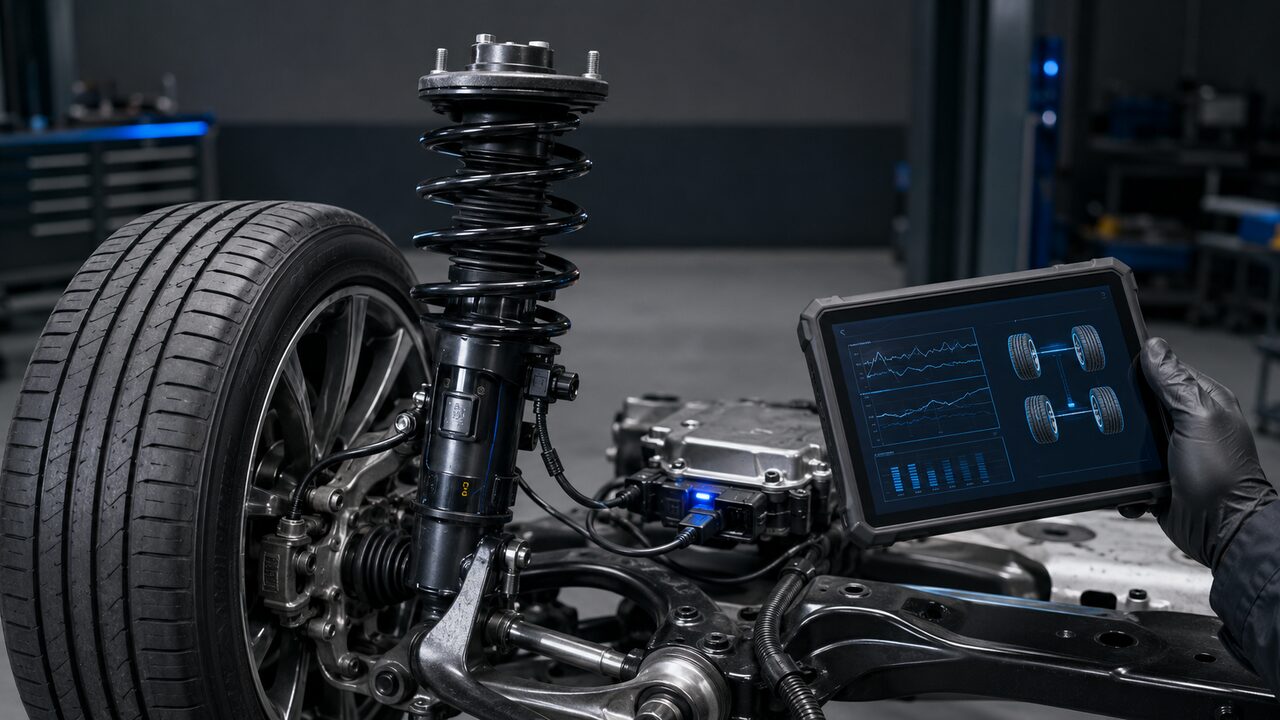
Adaptive damping suspension uses electronically controlled shocks or struts to vary damping force while the vehicle is moving. Sensors monitor wheel and body motion, and a chassis controller changes how freely fluid can move inside each damper. The result can be a more comfortable ride on rough pavement and firmer body control during braking, cornering or rapid steering inputs.
It does not automatically change the spring rate or ride height, and it is not the same as air suspension. For drivers who regularly switch between commuting and spirited driving, adaptive damping can be worth the extra cost. For owners who prioritize simple, inexpensive repairs, a well-tuned passive suspension may be the better choice.
Adaptive Damping Suspension at a Glance
| What changes? | The resistance created by the shock absorbers or struts |
| What controls it? | Electronic valves or another variable-damping mechanism, commanded by a control module |
| What usually does not change? | Spring rate and ride height, unless the vehicle has separate air-spring or active-suspension hardware |
| Main advantage | A wider usable range between ride comfort and body control |
| Main drawback | More expensive, fitment-sensitive parts and additional electronic diagnosis |
| Best suited to | Drivers who want one vehicle to feel comfortable in daily use and more controlled when driven quickly |
What Is Adaptive Damping Suspension?
A conventional passive damper has fixed internal valving. Its resistance still changes naturally with piston speed, but the vehicle cannot command a different damping map while driving. An adaptive damper adds an electronically controlled way to alter that resistance.
The underlying job remains the same: control spring and wheel movement. Our guide to how suspension damping controls ride and grip explains compression, rebound and the difference between damping and spring stiffness. Adaptive suspension builds on those fundamentals by changing the damper’s response in real time.
Depending on the manufacturer, the system may be called adaptive damping, variable damping, electronic damper control, continuously controlled damping, adaptive suspension or semi-active suspension. Marketing names are not perfectly standardized, so the vehicle’s build sheet and technical documentation matter more than the badge on a drive-mode button.
In practical terms, the adaptive damping system is the combination of controlled dampers, sensors, wiring, controller and software. “Adaptive damping suspension” is the broader name commonly used for the vehicle option that contains that system.
How Does Adaptive Damping Work?
Most systems follow the same basic control loop:
- Sensors measure vehicle movement. Inputs can include wheel travel, vertical body acceleration, steering angle, brake application, throttle position, vehicle speed and lateral acceleration.
- A chassis controller interprets the inputs. Software estimates how much damping force each corner needs for the current road and driving situation.
- Each damper receives a command. An electromagnetic valve can restrict or increase hydraulic-fluid flow, changing damping force within milliseconds.
- The process repeats continuously. The commanded force can change again as the wheel reaches the next bump, the driver brakes or the car enters a corner.
Audi’s official suspension technology overview describes wheel-movement and acceleration sensors, a central controller and electromagnetic damper valves that regulate fluid flow for each wheel. BMW’s Adaptive M Suspension explanation likewise describes individually controlled shocks whose valves vary oil flow between softer and firmer responses.
Some systems use magnetorheological fluid instead of a conventional adjustable valve. An electromagnetic field changes how particles in the fluid align, altering resistance very quickly. The operating method differs, but the purpose is similar: vary damper force without physically changing the coil spring.
Passive, Adjustable, Adaptive and Active Suspension
| System | How Damping Changes | What the Driver Gets |
|---|---|---|
| Passive | Factory-selected internal valving; no electronic command | Simple, predictable operation with one basic calibration |
| Manually adjustable | The owner turns an adjuster or changes a setting while stopped | Tuning flexibility, but no automatic corner-by-corner response |
| Adaptive or semi-active | Electronics vary damping force automatically, often at each wheel | Real-time response plus selectable comfort or sport calibrations |
| Fully active | Powered actuators can apply force to control body or wheel movement | Greater control authority, with more cost, energy use and complexity |
Adaptive dampers are commonly described as semi-active because they vary resistance but do not normally lift or push the body with their own actuator force. A fully active suspension can add energy to the system and directly counter body movement. The two terms are sometimes blurred in advertising, so do not assume that every “active” drive mode represents a fully active suspension.
Adaptive Damping Is Not the Same as Air Suspension
Adaptive damping changes how quickly suspension movement is controlled. Air suspension changes the spring medium by using pressurized air bellows instead of conventional coil springs. A vehicle can have either system by itself or both systems together.
| Feature | Adaptive Damping | Air Suspension |
|---|---|---|
| Primary change | Damper resistance | Spring support and air pressure |
| Can use coil springs? | Yes | No; air springs provide the springing function |
| Changes ride height by itself? | Usually no | Often, if height-control hardware and programming are provided |
| Load leveling? | Not by damping alone | Common on factory systems |
| Can include controlled dampers? | It is the controlled-damper function | Yes; many premium air systems combine both technologies |
If you are deciding between complete suspension types rather than damper control alone, see our comparison of coilovers and air suspension. Adaptive damping should not be treated as a synonym for either one.
What Do Comfort, Normal and Sport Modes Change?
A drive mode usually changes the system’s target range or control strategy rather than locking every damper at one constant force. Even in Comfort mode, the controller may add damping during a rapid steering or braking event. In Sport mode, it may still reduce force when a wheel needs to move over a sharp road imperfection.
| Typical Mode | Likely Priority | What to Expect |
|---|---|---|
| Comfort | Compliance and isolation | More willingness to absorb uneven pavement, while retaining automatic control |
| Normal or Auto | Balanced response | A broad everyday calibration that changes with driver and road inputs |
| Sport or Dynamic | Faster body control | Reduced pitch and roll rate, with a firmer response over some surfaces |
| Individual | Driver-selected combination | Suspension may be configured separately from steering, throttle or transmission settings |
The exact result depends on the vehicle. Tire sidewall, pressure, spring rate, seat design, bushings and available suspension travel still affect comfort. Adaptive dampers cannot make an extremely stiff, low-profile setup feel like a softly sprung luxury car.
A sport adaptive damping suspension package may also include firmer springs, different bushings, a lower ride height or larger wheels. When comparing option packages, check the complete hardware list instead of attributing every change in ride quality to the electronic dampers.
Our guide to factory comfort versus performance suspension covers those broader hardware and daily-driving tradeoffs.
Benefits of Adaptive Damping
- A wider operating range: one calibration can favor comfort during routine driving while another favors quicker control.
- Automatic response: the system can react without requiring the driver to stop and turn mechanical adjusters.
- Individual-wheel control: many systems command each corner separately instead of applying one identical setting to all four dampers.
- Better body-motion management: added resistance can reduce the rate of pitch, roll or squat when the driving situation calls for it.
- Fewer compromises: a manufacturer can offer a more controlled performance mode without making the everyday calibration permanently firm.
These are potential benefits, not guarantees that every adaptive setup is superior to every passive one. A carefully tuned passive suspension can ride and handle extremely well. Adaptive hardware expands the engineer’s options, but the final calibration still determines whether the car feels natural and controlled.
Drawbacks and Ownership Costs
- Higher replacement cost: an electronic damper normally costs more than a conventional equivalent, and cheap universal substitutes are rarely appropriate.
- More diagnostic steps: faults can involve the damper, connector, wiring, sensor, control module, power supply or communication network.
- Exact fitment matters: visually similar struts may use different connectors, calibrations, spring seats, mounting dimensions or axle-load ratings.
- Possible calibration or coding: some vehicles require a scan-tool procedure after component replacement, while others do not.
- More expensive used-car risk: a warning light or an apparently inactive mode can turn a desirable option into a significant repair decision.
There is no truthful universal replacement price. Costs vary greatly by vehicle, axle, damper design, parts availability and required programming. Price the exact VIN-specific components before buying a used vehicle or approving a conversion.
Is Adaptive Damping Suspension Worth It?
Adaptive damping is most worthwhile when you can use both ends of its range. A driver who wants relaxed highway comfort during the week and tighter body control on winding roads is more likely to notice its value than someone who drives gently on consistent, smooth roads.
| Your Priority | Likely Decision | Why |
|---|---|---|
| Comfort and handling in the same daily driver | Usually worth considering | The wider damping range directly serves both goals |
| Frequent changes in road quality or driving style | Often worthwhile | Automatic control can adapt more quickly than a fixed setup |
| Lowest long-term repair cost | Passive may be better | Fewer electronic parts and simpler replacement choices |
| Dedicated track build with known setup targets | Depends on the system | Purpose-built adjustable dampers may offer more direct tuning |
| Used luxury or performance car with no service history | Inspect before paying extra | Condition and replacement availability matter more than the option name |
| You cannot feel a useful difference during a test drive | Do not pay solely for the badge | The benefit must be meaningful on your roads and tires |
When comparing a standard and adaptive version of the same car, drive both over the same patched pavement, highway expansion joints and familiar corners. Keep tire model, wheel size and pressure as similar as possible; otherwise, the tires can create a larger difference than the dampers.
Used-Car Adaptive Suspension Checklist
- Confirm the option through the VIN, factory build sheet or original equipment list. Drive-mode buttons alone may control several unrelated systems.
- Check the instrument cluster for suspension or chassis warnings at startup and after the test drive.
- Compare the modes on the same road. A subtle difference can be normal, but no change at all deserves investigation.
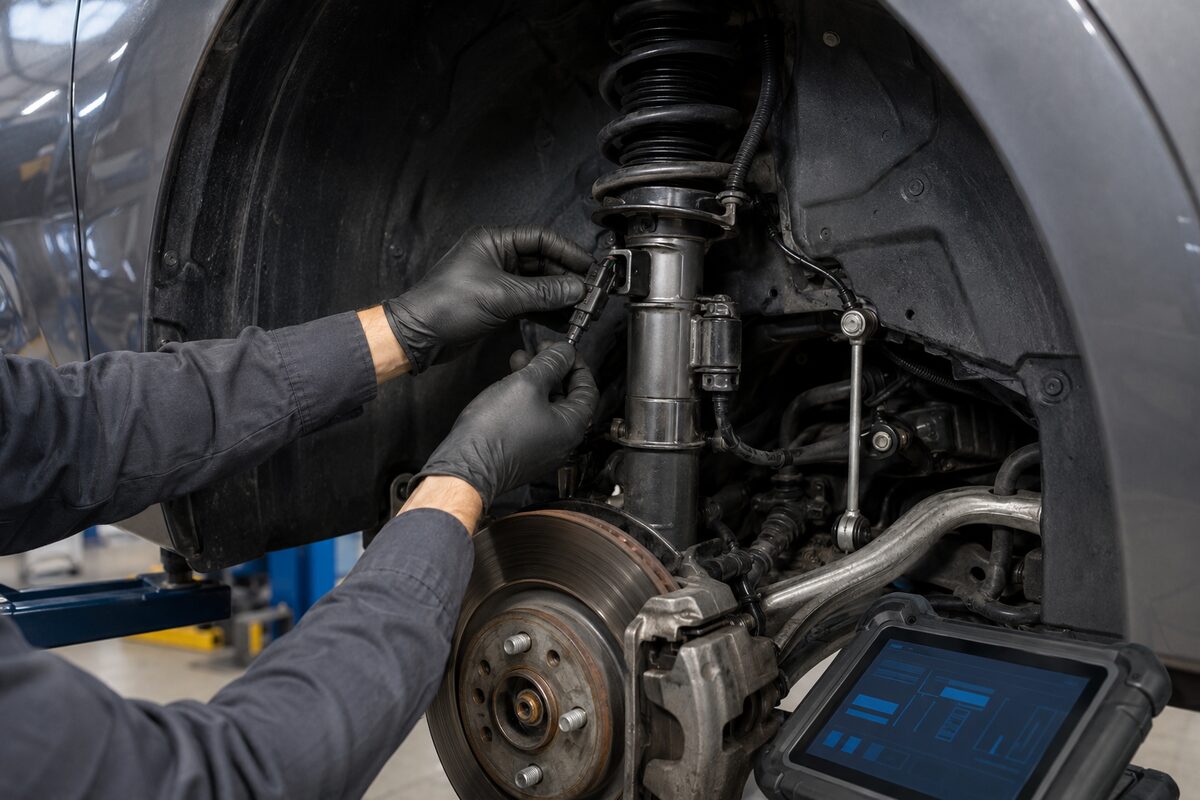
- Inspect each damper for oil leakage, impact damage, damaged connectors, stretched wiring and previous nonmatching replacements.
- Use a scan tool that can access the chassis or suspension control module. A basic emissions-code reader may not communicate with it.
- Obtain prices for the exact replacement parts before purchase, including any calibration, coding or alignment that the service information requires.
For the broader mechanical inspection, follow our seven-step suspension condition check. Adaptive electronics do not replace the need to inspect tires, bushings, joints, springs and mounting hardware.
What Happens When an Adaptive Damper Fails?
Possible symptoms include a suspension warning, a ride that remains unusually firm or poorly controlled, no noticeable response to mode changes, fluid leakage or uneven behavior from one corner. These symptoms do not identify the failed part by themselves.
The safe first step is to record the exact warning and retrieve suspension-module fault codes with capable diagnostic equipment. Then inspect the relevant connector, wiring and damper for visible damage. Do not assume that disconnecting the battery or pulling a fuse repairs the underlying fault; at most, it may temporarily clear a message while the cause remains.
Follow model-specific service information because fail-safe behavior varies. One vehicle may command a firm default setting, another may disable mode selection, and another may have a different symptom entirely. This generic guide intentionally does not provide a universal reset for a brand-specific warning.
Can Adaptive Dampers Be Replaced With Regular Shocks?
Sometimes—but only when a properly engineered conversion exists for the exact vehicle. Installing ordinary shocks can create warning messages, disable drive modes or produce poorly matched damping. Electronic cancellation modules may prevent a warning on some applications, but they do not make an arbitrary shock mechanically correct.
Before converting, confirm spring compatibility, mounting dimensions, axle-load rating, bump-stop travel, electronic integration and whether the vehicle needs coding. Replace dampers in axle pairs unless the vehicle manufacturer’s service information explicitly permits otherwise. If the work disturbs alignment-sensitive components, use our guide to determine whether an alignment is required after suspension replacement.
Frequently Asked Questions
Does adaptive damping change ride height?
Not by itself. Adaptive dampers change resistance to movement. Ride-height adjustment requires separate air springs, hydraulic hardware or powered active-suspension actuators. Some vehicles combine those features, which is why the terms are often confused.
Does Sport mode make the springs stiffer?
Normally, no. Sport mode can increase commanded damping force, making body movement feel tighter, but a conventional coil spring’s actual rate does not change. A vehicle with air springs or fully active hardware may also change other parameters.
How can I tell if my car has adaptive suspension?
Check the VIN-specific build sheet, option codes, owner’s manual and damper part numbers. A Comfort or Sport button is not enough proof because the same control can alter throttle, steering, transmission or exhaust settings without changing the suspension.
Is adaptive suspension reliable?
It can provide years of normal service, but the dampers remain wear components and the system adds connectors, wiring, sensors and control electronics. Reliability and replacement cost vary too much by model and generation for one universal lifespan claim.
Is adaptive damping useful for daily driving?
Yes, especially when road quality and driving conditions vary. Its most practical advantage is not maximum cornering performance; it is the ability to retain everyday compliance while adding body control when needed.
Who Should Choose Adaptive Damping?
Choose adaptive damping when you genuinely value both comfortable daily use and a more controlled dynamic mode, and when you accept the higher cost of fitment-specific replacement parts. Test the actual vehicle rather than buying the option name.
If simplicity and predictable repair costs matter most, a well-engineered passive suspension remains an excellent choice. Adaptive technology expands the available damping range, but tires, springs, travel, geometry and calibration still determine whether the complete car rides and handles well.