Coilover Top Hats: Types, Fitment & Replacement
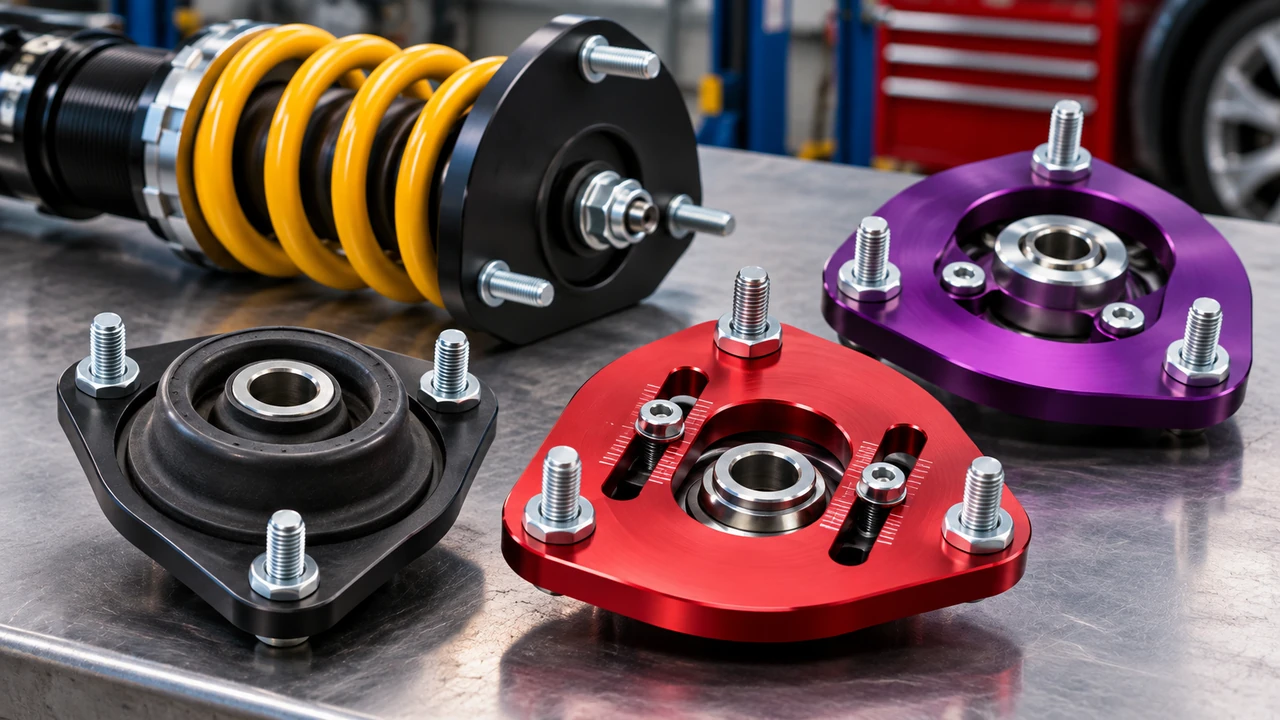
Coilover top hats are the parts at the upper end of a coilover assembly, but that name can describe two different things: the top mount that attaches the damper to the car, or the upper spring hat that supports the coil spring. Before buying a replacement, identify which piece you actually need. A new camber plate will not replace a missing spring seat, and a correctly sized spring hat will not repair a worn upper-mount bearing.
For most street and track builds, start with the exact coilover brand, kit generation, chassis and axle position. Then match the shock shaft, spring seat, bearing and hardware as one assembly. A listing that fits an E36, WRX or Miata bolt pattern can still be wrong for the coilover already fitted to that car. If the top hat is making noise, check what moves before ordering a complete set.
Which Coilover Top Hat Do You Actually Need?
Shopping results tend to put top plates, camber adjusters, spring hats and replacement bearings in the same category. That makes the search look simpler than the repair. This quick guide separates the parts by their job rather than by what the seller calls them.
| What you need to replace | Part to investigate | Common ordering mistake |
|---|---|---|
| Upper assembly bolts to the strut tower | Complete upper mount or top plate | Buying only the circular spring hat |
| Spring no longer sits correctly at the top | Upper spring perch / spring hat | Ordering a complete camber plate without checking the seat |
| Metal bearing in the upper mount is worn | Pillowball bearing or matched mount assembly | Replacing a steering thrust bearing instead |
| Spring winds up or pops when turning | Thrust bearing, spring seat and mount stack | Assuming every spherical top mount rotates like an OE bearing |
| You want adjustable front strut camber | Vehicle- and coilover-specific camber plate | Assuming any three-bolt plate is universal |
| One upper stud, spacer or nut is damaged | Approved replacement hardware for that exact kit | Substituting an ordinary bolt or nut of similar diameter |
A good first step is to photograph the existing assembly from above and below before it is taken apart. Those two views often settle whether the order needs a mount, a perch, or merely a missing collar. Product photos can hide the difference, especially when the manufacturer uses one generic picture for several chassis.
A Top Mount and an Upper Spring Hat Are Not Always the Same Part
The upper mount locates the damper shaft at the chassis. It may contain rubber, a spherical bearing, a radial bearing arrangement or a camber-adjustment plate. The upper spring hat, sometimes called the top spring perch, is the shaped seat contacting the end of the coil spring. On certain kits, the perch nests directly beneath the mount; on others, spacers and a separate thrust bearing sit between them.
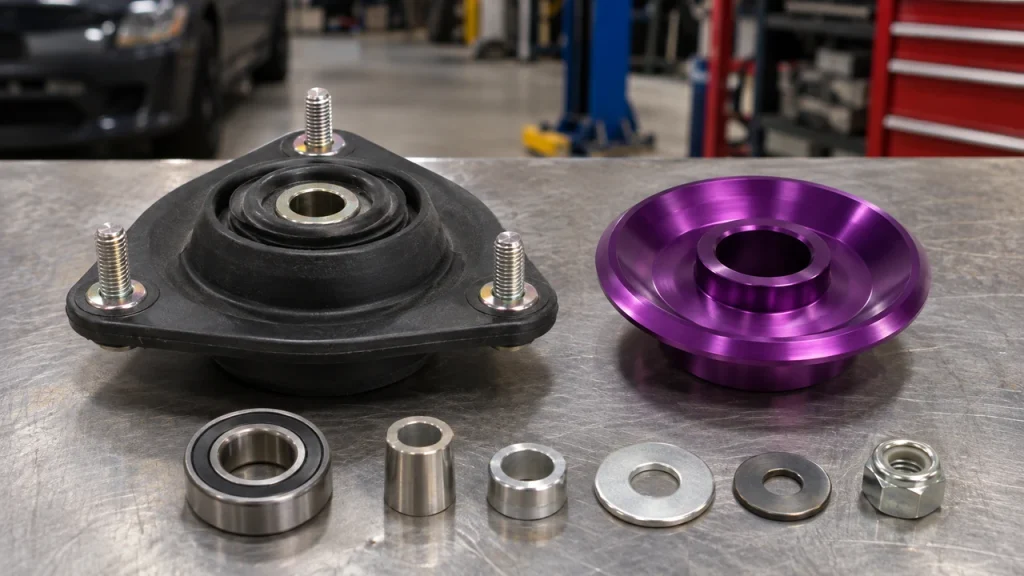
KSport, for example, sells an upper spring hat as its own service component and separately sells complete upper mounts. That is a real parts distinction, not interchangeable wording. If a spring seat cracks or is lost, identify its shape, spring diameter and shaft opening before replacing a perfectly good pillowball top plate.
Some Coilover Kits Reuse the Factory Upper Mount
Not every aftermarket coilover arrives with a new top hat. Certain street-oriented kits are designed to reuse the OE upper mount and bearing, while other packages supply a complete rubber or spherical assembly. Removing the original strut therefore does not automatically mean its upper hardware can be discarded. A kit that requires original parts may need specific washers and an original thrust bearing to retain safe spring rotation.
Check the manufacturer’s parts drawing, not only the photo of the assembled coilover. If a listing says “reuse factory top mounts,” budget for their condition and any separate bearing. Our bad strut mount symptoms guide helps distinguish a worn OE-style mount from other steering and suspension noises; this article deals with choosing the right coilover upper hardware.
Front and Rear Top Hats Can Be Completely Different
A MacPherson-strut front suspension usually has to steer as well as compress, which places specific demands on its bearings. The rear on the same car might use a fixed mount, a separate spring and shock, or an upper assembly with no steering function. A pair of front camber plates does not imply that the matching rear needs adjustable plates too.
Read the listing’s front/rear and left/right fields carefully. Some replacements are identical side to side, while slotted plates, offset mounts and particular stud patterns are handed. A rear “coilover top hat” might also be only a spring perch, not a body-side shock mount.
Rubber, Pillowball, and Camber Plates: Which Style Fits Your Build?
There is no single best material for every driver. The main differences are isolation, bearing articulation and alignment adjustment. A quiet commuter with standard street tires has different priorities from a car that runs aggressive front camber on track weekends.
Rubber Upper Mounts for Daily Driving
Rubber-isolated top mounts allow controlled movement while reducing vibration passing into the strut tower. On a street-driven car, that matters more than the anodized finish on the plate. A correctly matched rubber mount can be a better choice for wet roads, uneven pavement and long maintenance intervals than an exposed motorsport spherical bearing.
Rubber is not maintenance-free. It can separate from a bonded sleeve, crack with age or deform after repeated hard impacts. Replacement mounts from BC Racing, for instance, include rubber versions for selected kits; that does not mean a factory strut mount will necessarily fit a BC Racing damper shaft. Fitment still starts with the complete coilover model.
Pillowball or Spherical Top Mounts for More Direct Response
A pillowball mount uses a spherical bearing in place of a conventional compliant isolator. It limits rubber deflection and can keep a strut more precisely located under load. The trade-off is often more noise, vibration and harshness in the cabin, particularly on broken pavement. A new metallic tick is not automatically a fault, but a loose or rough bearing is not something to ignore.
Also distinguish articulation from rotation. A spherical bearing can allow angular movement of the shaft; that does not by itself prove the spring seat has the correct low-friction path for steering. A MacPherson arrangement may require a separate radial or thrust bearing. If the kit is missing it, spring wind-up can produce an alarming bang at parking speed.
Camber Plates Are an Adjustable Type of Top Mount
A camber plate changes the lateral position of the upper strut attachment within a designed slot or adjustment range. On an appropriate MacPherson setup this can provide additional camber control, and certain plates also offer caster adjustment. A fixed pillowball plate may have a spherical bearing without any camber adjustment at all. Likewise, a plate with adjustment slots is not proof that it can move through the amount your car needs.
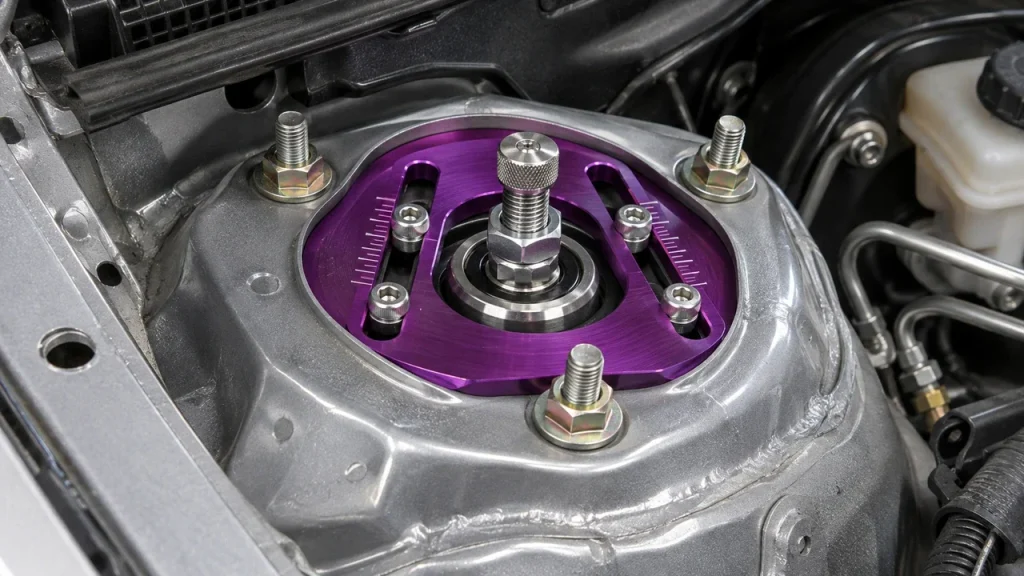
A camber plate must match its chassis bolt pattern and the coilover’s shaft hardware. The manufacturer’s adjustment direction, locking mechanism and clearance under the strut tower matter. This is not a substitute for an actual alignment: our camber adjustment guide covers geometry and alignment methods, while this page focuses on the upper mount you can safely fit.
Thrust Bearings, Radial Bearings, and Spring Rotation
A recurring complaint after a top-hat change is a spring that twists as the steering wheel moves, then releases with a pop. The cause may be a missing or misassembled thrust bearing rather than a bad damper. On some coilovers the bearing belongs immediately below the upper mount; on others it is incorporated in a separate spring seat assembly. The parts stack is kit-specific.
Watch the spring and top seat as a technician turns the steering through its range with the vehicle correctly supported. They should move as designed, without scraping adjacent metal or loading a rubber seal sideways. Do not improvise a spacer to create clearance: the bearing, top perch and shaft shoulder have to transfer the intended loads to the right surfaces.
Five Fitment Checks Before Ordering a Coilover Top Hat
Year, make and model are necessary, but not sufficient. Many replacement listings need the original coilover order number, and there is a reason for that: several kits for one chassis use different shaft lengths, spring diameters or upper hardware. Work through these measurements before choosing a replacement.
1. Find the Exact Coilover Kit, Series, and Revision
Look for a manufacturer label or stamped model number on the coilover body, then record the axle position and which side you are repairing. A secondhand car may wear BC Racing dampers at the front, an OEM rear shock and a mix of replacement hardware. Ordering based on the registration plate alone misses that history.
Ask the manufacturer or supplier to confirm whether the replacement fits your kit series and approximate production generation. If a bearing or spring hat was revised, an older exploded view can show a different spacer stack. Photograph the existing washers and collars before disconnecting the shaft so the support team can identify what is actually present.
2. Confirm Bolt Pattern, Stud Count, and Plate Orientation
Compare the strut tower’s mounting-hole pattern, number of studs, bolt circle or center-to-center spacing, and the direction of any offset bearing. A three-stud plate is not universal just because your car also has three holes. Two chassis can have similar hole spacing and different center-bore clearance, caster offset or access to the locking screws.
Check whether the plate is designed to sit above or below a reinforcement piece and whether a strut tower brace shares the studs. Some camber plates must point a particular way for their slots to adjust camber rather than move in an unintended direction. Do not elongate tower holes or reverse an offset plate unless the approved installation explicitly calls for it.
3. Match Shaft Diameter, Thread Pitch, and Shoulder Geometry
The damper shaft is where a seemingly compatible mount can fail. Compare the upper threaded diameter and pitch, the unthreaded shoulder below it, any tapered or stepped section, and the length available for the approved nut. A supplier may offer 12 mm and 14 mm mount versions, but those numbers alone do not tell you the thread pitch or bearing spacer geometry.
The center nut must clamp the correct inner sleeve or spacer stack, not crush the bearing housing. Too little shaft engagement is dangerous; too many washers can keep the nut from seating properly or make the joint bind. Do not replace a proprietary shouldered nut with an ordinary hardware-store nut simply because it screws on. Confirm the parts drawing and torque method for your exact damper.
4. Match the Spring Inner Diameter and Upper Seat Profile
A spring hat must locate the upper end of the coil spring, not simply cover it. Common aftermarket spring families use nominal 2.25-, 2.5- or 2.75-inch inner diameters, but not every coilover uses those sizes. Check the actual spring ID and the seat profile supplied for the kit. A spring that perches on the edge of the wrong hat can shift or bow under load.
Also inspect the rubber isolator, thrust bearing and any tapered centering washer that belongs between the spring and its upper seat. Flat upper spring hats are sold with multiple center-hole choices; a listing for a 2.5-inch spring can still be wrong if the shaft opening, bearing arrangement or upper perch shape differs.
5. Check Stack Height, Shaft Articulation, and Clearance
Changing a top mount can change the upper assembly’s stack height. Even a small change may affect installed spring compression, damper extension at ride height, or the distance available before the bump stop is engaged. On a tight front strut tower, the camber plate, center nut or damping adjuster may also contact the tower or brace when the suspension moves.
For a lowered vehicle, clearance needs checking at full steering lock and through the approved suspension travel, not only while it is parked. On a custom kit, measure the exact stack rather than assuming an “OEM replacement” label means no geometry change. A car with little bump travel is especially unforgiving of a careless spacer swap.
BC Racing, KSport, Flatout, and Other Replacement Top Hats
The U.S. search results are full of replacement-part pages rather than one universal how-to guide. That reflects the real buying problem: these parts are usually matched to a suspension product as well as a vehicle. A few examples show what sellers need to know before they will confirm an order.
BC Racing: Upper Mounts Depend on the Original Kit
BC Racing sells front and rear replacements in configurations that can include rubber mounts and camber/pillowball designs. Its product information warns that replacement components are engineered for BC Racing coilover kits and specified OEM applications, not guaranteed to work with another aftermarket brand. That matters more than whether two plates use the same stud count.
For an example of the distinction, the official BC Racing front upper-mount listing explains the camber-plate noise trade-off and stresses matching the original kit. Treat the illustrated part as a manufacturer-specific reference, not proof that the same SKU fits your chassis or a different damper.
KSport: The Upper Spring Hat May Be Sold Separately
KSport lists a standalone upper spring hat alongside separate top mounts, lower washers, pillowball assemblies and other service pieces. Its upper spring hat is described for selected pillowball and rubber-mount systems; the manufacturer requests details of the original setup when matching replacement hardware. Buying a complete mount because a small spring seat is missing can be an unnecessarily expensive detour.
Conversely, a round spring hat is not a substitute for a worn bearing in the top mount. Before checkout, ask whether the order includes a thrust bearing or only the metal perch. Some catalog photographs are representative rather than exact, so the real part number and confirmed compatibility carry more weight than the image.
Flatout: Even One Product Page Has Several Mount Choices
Flatout offers a replacement top-mount assembly with choices such as an OEM-hybrid mount, fixed spherical mount or camber plate. The selection also calls for front versus rear, vehicle details and a shaft-size option. That is a useful reminder that the same seller can offer very different top hats under one product name.
A replacement should match the suspension’s intended noise and articulation characteristics, not just its visual style. If the original order number is available, use it. A fixed spherical top hat may be suitable for a particular performance build even when an adjustable camber plate is available as another option; neither is automatically an upgrade for every driver.
TEIN, Cusco, KW, and Mixed-Brand Setups
Other performance brands also use different combinations of rubber, pillowball, fixed and adjustable upper mounts. TEIN’s terminology distinguishes reinforced rubber mounts from pillowball and camber-adjustable types. Cusco applications may require matching collars, spring perches and shaft nuts. A plate from one brand is not proven compatible with another solely because its chassis pattern matches.
This is particularly important when a previous owner has mixed an aftermarket shock cartridge, third-party spring and separate camber plate. Get a component list and confirm the assembly with the companies involved. An adapter can be legitimate if specifically engineered, but improvised washers or a drilled-out bearing center are not a fitment solution.
Vehicle-Specific Fitment Traps in Popular Coilover Builds
People search by chassis because that is how suspension catalogs are organized. The trouble is that chassis fitment confirms only one part of the upper assembly. These common U.S. build families illustrate where it is easy to order the wrong “top hat.”
BMW E36 and E46: Offset Plates and Shaft Hardware
E36 and E46 buyers often encounter upper mounts that offer fixed offset, adjustable camber or camber-and-caster movement. Two plates may bolt to a related BMW strut tower while using different center sleeves or shaft nuts. The coilover series also matters: a plate intended for a small-diameter spring and pillowball stack is not necessarily right for a spring-and-damper arrangement that reuses an OE bearing.
If you are replacing a single failed plate, compare the installed left and right hardware before assuming both are identical. A previous alignment may have moved the bearing position, so record its setting before removal rather than using the other side as a blind template.
Subaru WRX/STI and Honda Civic/RSX: Check Generation First
WRX and STI generations have different suspension layouts, mounting patterns and compatibility notes. The same is true across Civic and RSX applications. A camber plate listed for one generation should not be assumed to fit the next, and a strut-type front assembly may have a different steering-bearing requirement from a rear mount.
Do not buy solely from a search thumbnail that shows three studs and an anodized plate. Read the part number, front/rear designation and the original coilover’s shaft and spring configuration. A correctly matched replacement is more useful than a generic “fits Subaru” claim.
Miata, BRZ/GR86, 240SX S13, and Lexus IS300
Miata NA/NB/NC/ND, Toyota 86/BRZ generations, Nissan 240SX S13 and IS300 show up in top-hat and camber-plate searches. They do not all use the same type of upper control geometry. On an independent double-wishbone arrangement, a strut-tower-like top plate does not necessarily provide the camber adjustment that a MacPherson plate does.
This is where a simple question helps: Does the upper coilover attachment actually locate the steering knuckle? If it does not, a slotted top plate may serve a different purpose or not be applicable at all. Use the vehicle’s suspension design and the manufacturer’s exact mount description, not a generic “camber top hat” label.
Tacoma and Off-Road Coilovers: Do Not Assume a Camber Plate
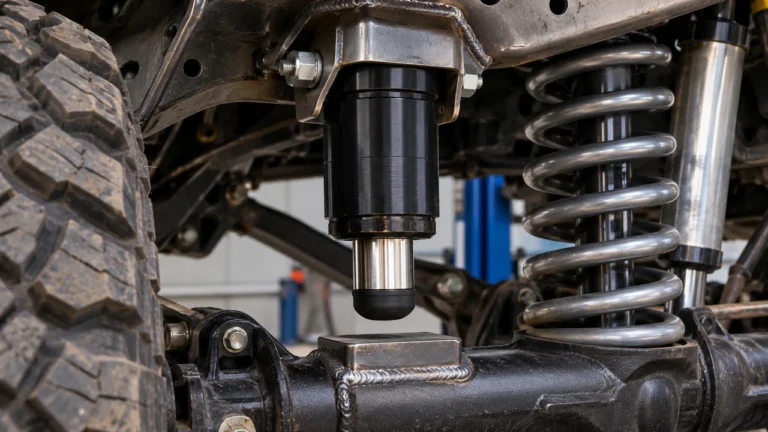
Off-road “coilover top hats” can mean upper mounting caps, mounting plates or vehicle-specific brackets rather than track-style camber adjusters. A Tacoma IFS kit can rely on control-arm adjustments for alignment while the coilover’s upper mount serves as a structural attachment point. The kit’s load path and hardware differ from a sedan’s MacPherson top plate.
Verify the supplied mounting bolts, shaft design and whether the spring assembly is preassembled. A top hat marketed for a third-generation Tacoma is not necessarily compatible with a different upper control arm, lift kit or coilover brand.
When a Coilover Top Hat Needs Replacement
Replacement can make sense when a mount, bearing or spring seat is actually damaged, or when a new suspension configuration calls for different hardware. Noise alone is a weak reason to order a complete top plate. The location, direction and timing of the movement tell you more.
Clunking, Loose Studs, and Visible Mount Movement
A dull clunk as a wheel rises into a driveway can come from an upper mount, but also from sway bar links, a loose lower bracket or suspension bushings. Look for cracked rubber, a bearing moving inside its housing, shifted mounting studs or fresh metal-contact marks. Do not drive on a plate with a visibly loose chassis attachment or cracked load-bearing metal.
If a coilover uses exposed spherical bearings, some extra sound may be expected compared with a rubber mount. That does not excuse a bearing that rattles in its bore or a shaft nut that has lost clamping force. Have the mounting hardware inspected before choosing between a replacement bearing and an entire assembly.
Popping While Steering May Be Spring Wind-Up
A metallic ping heard when backing out of a parking space sometimes points to a spring rotating in jumps rather than smoothly. Inspect the thrust-bearing location, upper spring seat and whether the spring end is properly indexed. A missing washer or a bearing installed upside down can be more relevant than the condition of the pillowball itself.
Steering-related noises also come from other components, so avoid calling every pop a top-hat failure. The useful test is to observe the spring and mount movement while steering is cycled safely. If the spring binds against its seat, stop and identify the incorrect stack before loosening the center nut.
Corrosion, Damaged Spring Seats, and Failed Bearings
Check for pitted or rough bearings, deformed aluminum seats, bent studs and corrosion around threaded hardware. A tiny surface mark is not the same as a cracked spring seat or severely fretted mount. If the upper perch no longer supports the spring squarely, replacing only its rubber pad may not restore a safe load path.
Where service parts exist, replace only what the manufacturer approves: a spherical bearing, a spring perch, an isolator, or a complete upper mount. If the base plate is cracked or its stud press-fit is loose, ask whether the part is serviceable; do not attempt a home repair by enlarging holes or substituting random fasteners.
Replacing Coilover Top Hats: Setup Checks That Prevent Problems
This is a planning guide, not a universal disassembly procedure. Many coilover assemblies retain spring energy even when removed from the vehicle, and some have special shaft-nut or bearing-stack instructions. Follow the manufacturer’s exact sequence or use a qualified suspension workshop.
Confirm Spring Load Before Loosening the Center Nut
The upper shaft nut may retain a spring-loaded assembly. Raising the car, removing the coilover or turning an adjuster collar does not automatically make that nut safe to remove. Consult the kit instructions to determine whether spring load must be removed with an approved compressor or another specified process. Never use an impact gun as a shortcut to disassemble an unknown loaded spring assembly.
A technician should support the vehicle appropriately and record the current settings before disassembly. Damaged threads or mismatched adapters are reasons to stop. The risk is not only losing a washer; an incorrectly restrained spring or upper mount can release force suddenly.
Keep the Original Order of Spacers, Bearings, and Washers
Lay the pieces out in their removal order and compare them against the exploded view for the actual coilover. A thin spacer may establish bearing clearance; a dished washer can have a directional purpose. If a replacement mount arrives without those parts, confirm which original items can be reused rather than assuming they were omitted by accident.
The spring hat should sit squarely against the spring and intended bearing surface. There must be appropriate clearance for shaft articulation and steering movement where applicable. If the hardware stack leaves the bearing pinched, the top nut may appear tight while the assembly still operates incorrectly.
Tighten the Shaft Nut With the Approved Method
Use the specific torque and shaft-holding method provided by the damper or mount manufacturer. Holding the polished piston rod with pliers can damage its surface and cause a seal leak; over-tightening the center nut can harm bearing or spacer hardware. Some shafts have an internal hex or other designated holding feature, and nut designs differ between kits.
Do not invent a torque number based on the nut’s apparent size. Also verify the correct nut thread, bearing sleeve engagement and any locking mechanism. If the original shaft threads are damaged, replacing only the upper plate will not correct the problem.
Verify Steering Rotation, Spring Seating, and Travel
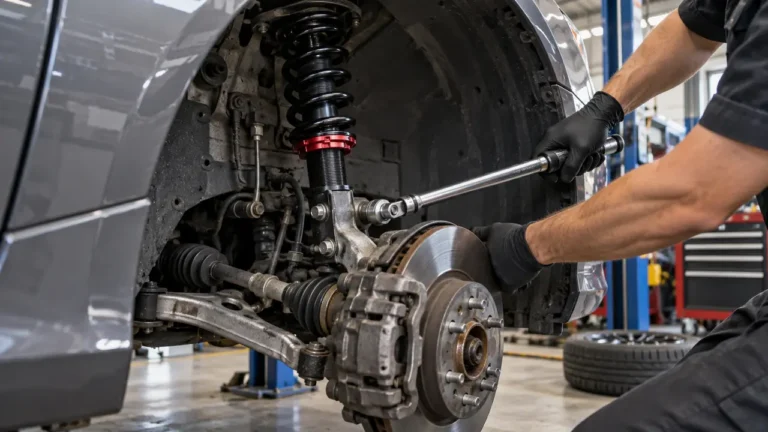
After assembly, the technician should check steering movement where relevant, spring seating, mount clearance and the full approved suspension travel. Watch for the top of the damper or its adjuster touching the body, spring bind at full lock, or the camber plate fouling the strut tower. An installation that looks centered at rest can still contact metal when loaded.
If a spring has been disturbed, restore its specified seating and spring-preload setting, then verify ride height. Our coilover preload setup guide deals with that separate adjustment; changing a top hat does not give permission to guess the spring perch position. Alignment should be checked after replacing or moving an adjustable upper strut mount.
What to Check Before Buying a Replacement Top Hat
Make a short parts record before placing the order. It is especially useful when the car has secondhand coilovers, a previous camber-plate conversion or a replacement shock from a different generation. These are the details most likely to prevent an incorrect shipment.
- Part identity: complete upper mount, upper spring hat, thrust bearing, spherical bearing or hardware only
- Existing kit: coilover brand, series, generation, part number and approximate purchase year
- Vehicle: exact chassis, model year, front/rear position and left/right orientation
- Chassis mounting: stud count, hole spacing, center-bore clearance and plate offset
- Damper shaft: thread diameter/pitch, stepped shoulder, spacer stack and approved nut
- Spring interface: inside diameter, upper perch profile, isolator and bearing arrangement
- Service parts: whether the order includes studs, collars, washers, bearings and approved fasteners
- Installation outcome: stack height, steering rotation, travel clearance and post-installation alignment
A reputable supplier should be willing to confirm these details or ask for photographs. If the seller cannot identify which coilover series a “universal” top hat belongs to, that uncertainty is part of the purchase price. It is better to keep a working assembly in service than to install an incompatible mount because its bolt pattern happens to line up.
Is Upgrading to Pillowball or Camber Top Hats Worth It?
A replacement is often about restoring a damaged component, not turning every daily driver into a track car. A better top hat is the one that supports the suspension’s intended geometry and your tolerance for maintenance and cabin noise. The answer changes with the road, the tire and the rest of the setup.
For a Street Car, a Matched Rubber Mount Often Wins
If the current coilovers work well apart from a worn rubber mount, replacing it with the correct rubber assembly preserves the intended isolation. A spherical conversion might make steering feel more direct, but that change can arrive with sharp road noise and more frequent inspection needs. There is no reason to accept extra harshness merely because a pillowball top plate looks more substantial.
On a car that reuses OEM upper hardware, compare the condition and price of the factory-style mount first. Our strut mount replacement cost guide discusses that ordinary repair market; a coilover-specific upper assembly may have a different price and parts requirement.
For a Track Car, Fitment and Alignment Range Come First
When the car genuinely needs more front camber than its existing adjustments permit, a matched camber plate can be useful. The relevant questions are available adjustment range, bearing quality, clamping design and clearance beneath the strut tower. A generic plate offering “more camber” is no upgrade if its shaft spacers do not fit or it contacts the chassis at full travel.
Also plan the installation and alignment as part of the cost. A plate swap without a measured alignment can leave the steering wheel off-center or the tire contact patch in a worse position than before. The suspension geometry—not the plate’s finish—decides whether the modification helps.
Sometimes the Spring Hat Is the Only Part You Need
If the upper spring seat is bent or missing but the mount and bearings are sound, the repair can be quite narrow. Order the correct seat and its companion isolator or bearing parts, if required. There is little value in replacing an entire adjustable top-mount assembly for a damaged perch unless the manufacturer sells the system only as a complete unit.
Be careful when a new spring is part of the job. A different spring diameter or helper-spring stack may need different seating hardware; our coilover helper springs guide covers the separate issue of keeping the spring stack seated through droop. It does not establish top-hat compatibility, which still comes from the upper assembly specification.
Coilover Top Hat FAQs
These answers address the questions that remain after you have identified the original coilover and its upper assembly. Use them as buying checks, not as a substitute for the exact manufacturer’s parts drawing.
What are coilover top hats?
The term usually refers to the upper mounting assembly that connects a coilover to the chassis, but it may also mean the separate upper spring seat. Confirm which one a product listing is selling. Mounts, camber plates, spring hats and thrust bearings can be separate replacement parts.
Do coilovers come with top hats?
Some do; others require you to transfer the factory upper mounts and bearings. A kit may supply front adjustable plates but reuse original-style hardware at the rear. Check the contents and assembly instructions for the exact model rather than assuming four new mounts are included.
Are coilover top hats universal?
No. Vehicle bolt pattern is only one requirement. The shock shaft, thread pitch, spring seat, bearing stack, stud orientation and kit generation also matter. A plate that bolts to your strut tower can still be unsafe on your damper.
What is the difference between a coilover top hat and a camber plate?
A camber plate is a top-mount design that offers alignment adjustment on appropriate suspensions. A fixed rubber or spherical top mount may have no adjustment. An upper spring hat is generally the seat supporting the coil spring and is not itself a camber-adjustment device.
Can I reuse my OEM top mounts with aftermarket coilovers?
Only when the coilover manufacturer specifies OEM-mount compatibility and the original hardware is serviceable. Some kits require OE bearings and washers, while others use a proprietary mount and spacer arrangement. Matching chassis studs alone is not enough.
Why do coilover top hats clunk or pop when turning?
Possible causes include a loose mount, worn bearing, incorrect shaft-nut stack or a spring that binds and releases during steering. Other suspension joints can sound similar. Identify which part actually moves before replacing a complete top mount.
Can I replace just a coilover top hat stud or bearing?
Sometimes, if the manufacturer offers an approved service part and procedure. A loose press-fit stud or a cracked plate may require complete replacement. Do not install random studs or drive a new bearing into an incompatible housing without instructions.
Do coilover top hats affect ride height or spring preload?
A different top-mount stack height can alter installed geometry and the spring’s position relative to the chassis. It does not create extra damper stroke by itself. After a hardware change, restore the manufacturer’s preload setting and check ride height and clearance.
Do I need an alignment after changing coilover top hats?
If the upper strut location or camber-plate setting changed, yes, an alignment check is appropriate. Even a like-for-like replacement should follow the vehicle and coilover maker’s inspection requirements, especially if the strut was removed or other geometry was disturbed.
Can an upper spring hat be swapped without replacing the whole mount?
Often it can, if the correct spring seat is offered separately and the original bearing and mount are undamaged. Confirm its spring diameter, center-hole design and included hardware. Disassembly still requires the manufacturer’s safe spring-load procedure.