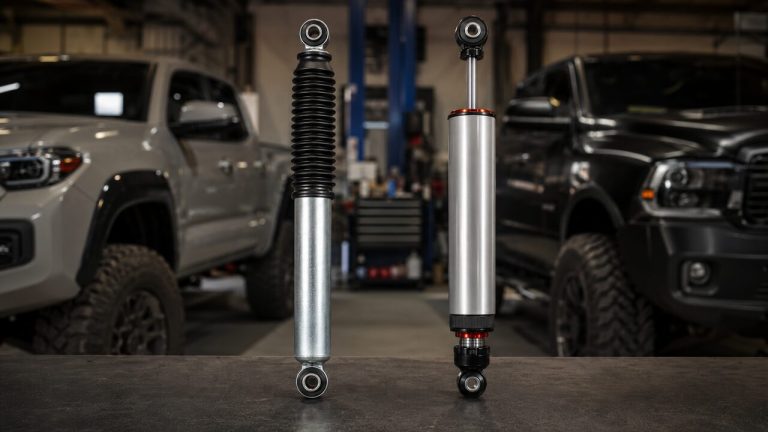
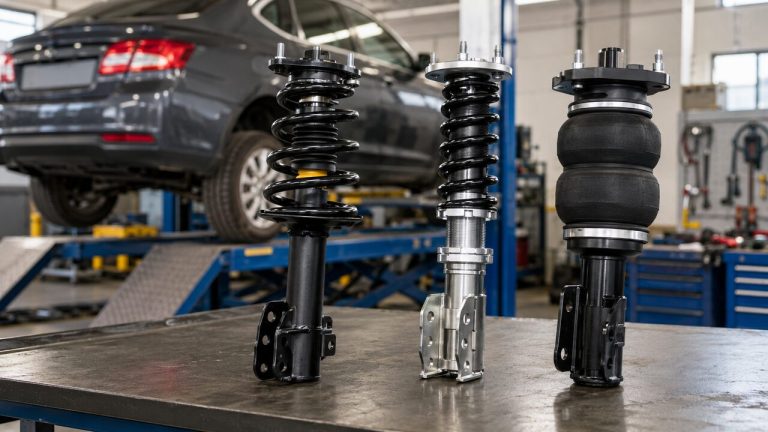
Airbags vs Helper Springs: Which Is Better for Towing & Hauling?
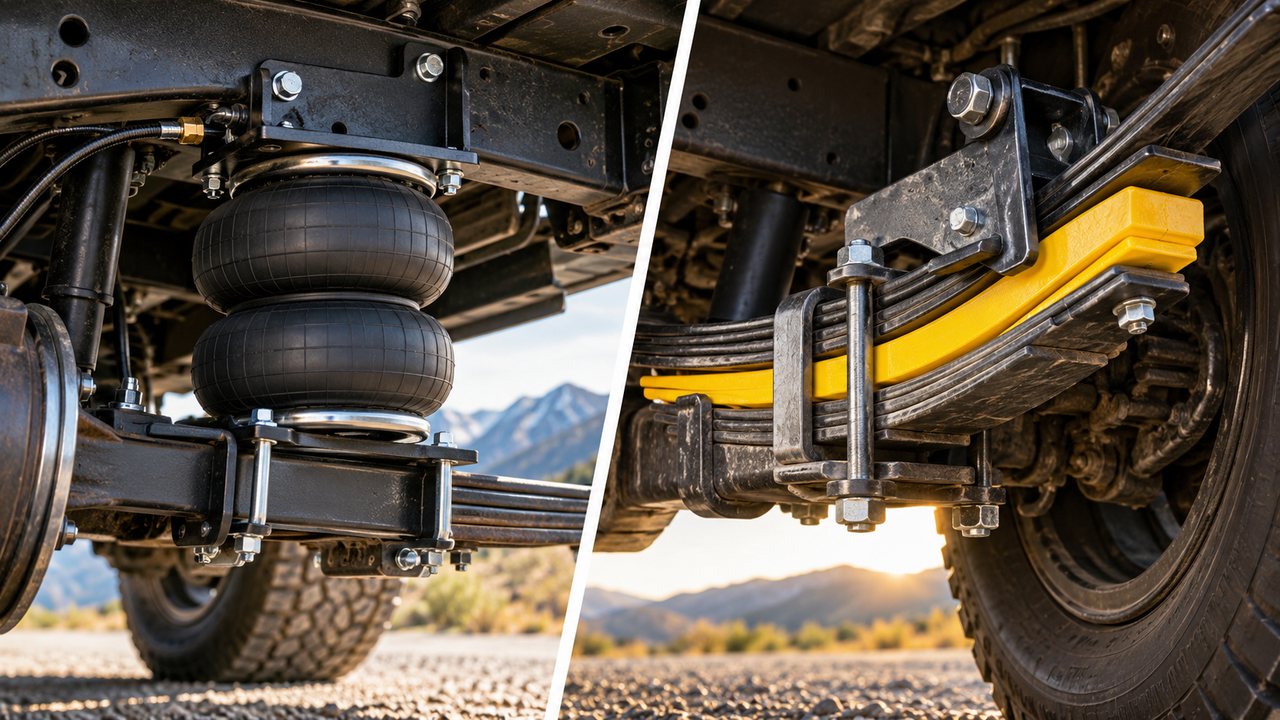
Airbags are usually the better choice when your truck’s load changes often, while helper springs make more sense when you carry a similar heavy load most of the time and want a simpler, low-maintenance setup. If you tow different trailers, alternate between an empty bed and heavy cargo, or need to correct left-to-right lean, adjustable air bags have the advantage. If your truck carries tools, a service body, a camper or other fairly constant weight, a well-matched mechanical helper spring can be easier to live with.
Neither system increases your truck’s payload, GVWR, GAWR, tire capacity or manufacturer towing rating. They help the suspension support a legal, properly loaded truck; they do not make an overloaded truck safe.
There is one more complication: “helper springs” can mean several different products. Steel helper leaves, add-a-leaf systems, progressive coil helpers and rubber load-support springs do not behave the same way. That distinction matters, because the common claim that every helper spring ruins the unloaded ride simply is not true.
Airbags vs Helper Springs: Quick Verdict
| If This Sounds Like Your Truck | Better Starting Point | Why |
|---|---|---|
| Daily driver that tows on weekends | Airbags | Adjust support for the trailer, then reduce it when unloaded |
| Several trailers with different tongue weights | Airbags | Pressure can be tuned for changing loads |
| Slide-in camper with uneven side-to-side weight | Airbags | Some systems allow independent left/right adjustment |
| Work truck carrying similar weight every day | Helper springs | Simple mechanical support with little routine attention |
| Permanent service body or heavy equipment | Helper or replacement springs | A fixed spring solution can better match a constant load |
| You want no air lines, valves or compressor | Helper springs | Fewer pneumatic components to inspect |
| You want maximum adjustability | Airbags | Support changes with air pressure |
| Modified off-road truck | Depends | Suspension travel and bracket geometry may matter more than either system |
For many pickup owners, that table is enough to narrow the choice. The rest of the comparison explains where those differences come from—and the situations where choosing either system can be the wrong fix.
What Are We Actually Comparing?
In this guide, airbags means rear air helper springs: reinforced air springs added to the truck’s existing suspension to provide extra support under load. They are not the same thing as a complete four-corner air-ride conversion that replaces the vehicle’s normal springs for adjustable ride height.
Helper springs means mechanical or elastomeric components that supplement the factory springs without using compressed air. Depending on the product, they may add spring rate all the time or engage progressively as the rear suspension compresses.
Both approaches are primarily aimed at problems such as rear sag, reduced bump travel and excessive suspension movement when a truck is carrying cargo or trailer tongue weight.
How Airbags Support a Loaded Truck
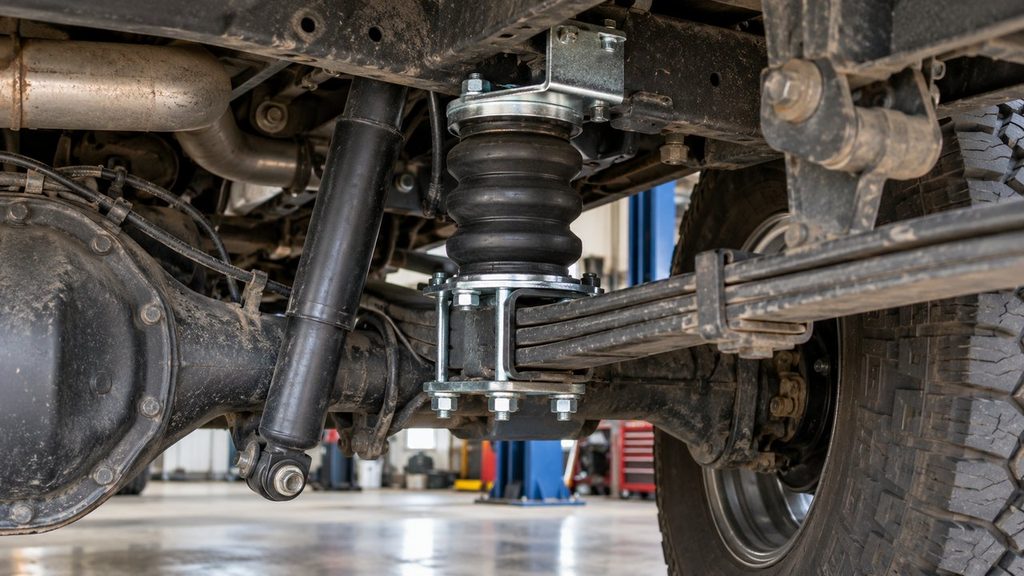
Truck air bags normally mount between the frame and the rear suspension. Adding air pressure increases the support they provide. Reduce the load, and pressure can be reduced within the operating range specified for that kit.
That adjustability is their biggest advantage. A pickup can be nearly empty during the week, tow a travel trailer on Saturday and haul a different load on Sunday without needing a different spring package for each job.
Basic systems use external inflation valves. An onboard compressor can make frequent adjustments much easier, while more advanced controls may provide pressure displays, wireless adjustment or separate control of the left and right air springs.
Do not assume “less pressure is always better” when unloaded. Many kits specify a minimum operating pressure that must be maintained to keep the air springs in the correct shape. Maximum pressure is also a limit, not a target. Follow the instructions for the exact air-spring kit rather than copying someone else’s PSI setting.
What Counts as a Helper Spring?
This is where comparisons often become misleading. A heavy add-a-leaf and a progressive rubber helper may both be sold as “helper springs,” yet they can affect an empty truck very differently.
Steel Helper Leaf Springs
A steel helper leaf supplements a leaf-spring suspension. Some designs engage mainly as the truck settles under load, while others increase effective spring support through a larger part of the suspension’s movement.
They are durable, mechanically simple and well suited to trucks that spend much of their life carrying weight. The trade-off is that a high-rate or early-engaging design can make the rear feel firmer when the bed is empty.
Add-a-Leaf Springs
An add-a-leaf is installed into the existing leaf pack. Instead of providing pressure-adjustable assistance, it changes the mechanical spring package itself.
This can be useful for a truck that regularly operates at a higher working weight, but it is less adaptable when the truck alternates between very light and very heavy loads.
If you want a broader explanation of how leaf springs differ from other spring layouts, see our leaf spring vs coil spring comparison.
Progressive Rubber or Elastomer Helpers
Progressive rubber or elastomer helpers usually provide little or no additional support until the suspension compresses far enough for them to engage. As load increases, the material compresses and its resistance rises.
That can preserve more of the factory-like unloaded ride than a continuously engaged steel helper. It also means they should not simply be grouped with add-a-leaf kits when comparing ride quality.
Some products occupy space normally used by a jounce bumper or bump stop, but a load-support helper is designed to contribute meaningful spring force rather than merely protect the suspension at the end of compression. Our bump stop guide explains that distinction in more detail.
Which Is Better for Towing?
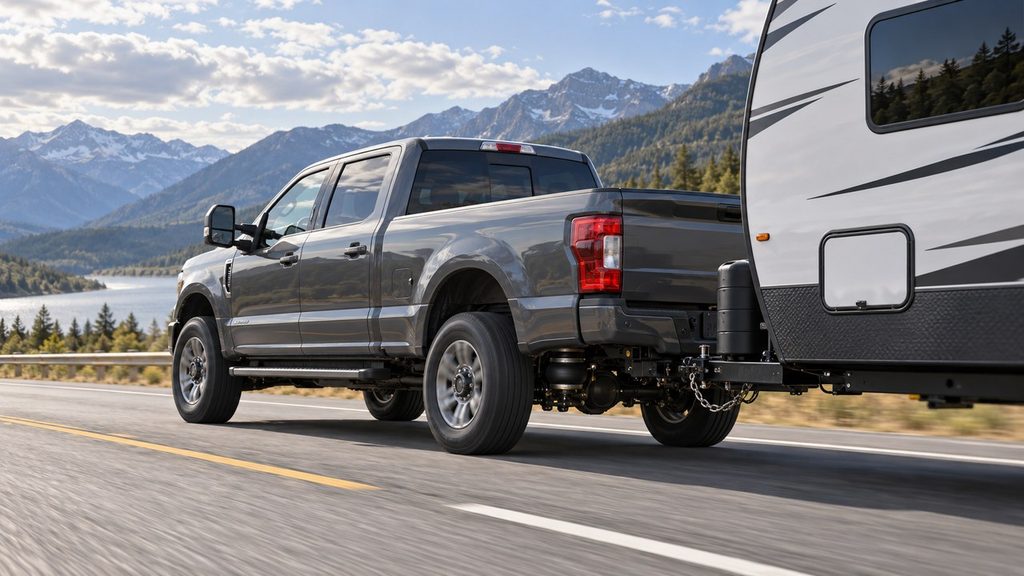
Airbags usually win for towing when trailer tongue weight changes significantly from one trip to another.
That could mean switching between a utility trailer, boat and travel trailer, or using the same trailer with substantially different cargo. Adjustable air pressure lets you match the supplemental support to the load instead of committing to one fixed helper-spring rate.
Mechanical helper springs become more attractive when the towing load is predictable. A truck that pulls the same equipment trailer several days per week may benefit more from a passive system that requires no pressure adjustment before each trip.
Do not use either system to hide excessive trailer tongue weight, a rear axle that is already above its rating or poor trailer loading. Solve the weight problem first.
Airbags Do Not Replace a Weight-Distribution Hitch
This distinction matters because both devices can change how a tow vehicle sits, but they do different jobs.
Air helper springs support the truck’s rear suspension. A properly selected weight-distribution hitch uses spring bars and hitch geometry to redistribute part of the trailer-induced load through the tow vehicle and trailer axles.
Inflating the rear air bags until the truck looks level does not prove that axle loads or front-axle loading are correct. Follow the towing instructions from the truck, trailer and hitch manufacturers, and verify actual weights when the combination is close to its limits.
Variable Loads Favor Airbags
The strongest case for air bags is a truck whose job changes constantly.
- a half-ton pickup driven empty most weekdays and used for towing on weekends
- a truck that pulls trailers with very different tongue weights
- a pickup that alternates between an empty bed and heavy building materials
- a camper setup whose water, fuel and gear load changes during a trip
- a vehicle that occasionally carries substantial rear cargo but is otherwise a daily driver
Instead of choosing a spring stiff enough for the heaviest day and accepting that setup every other day, air springs allow the supplemental support to change with the truck’s actual load.
Constant Loads Favor Mechanical Springs
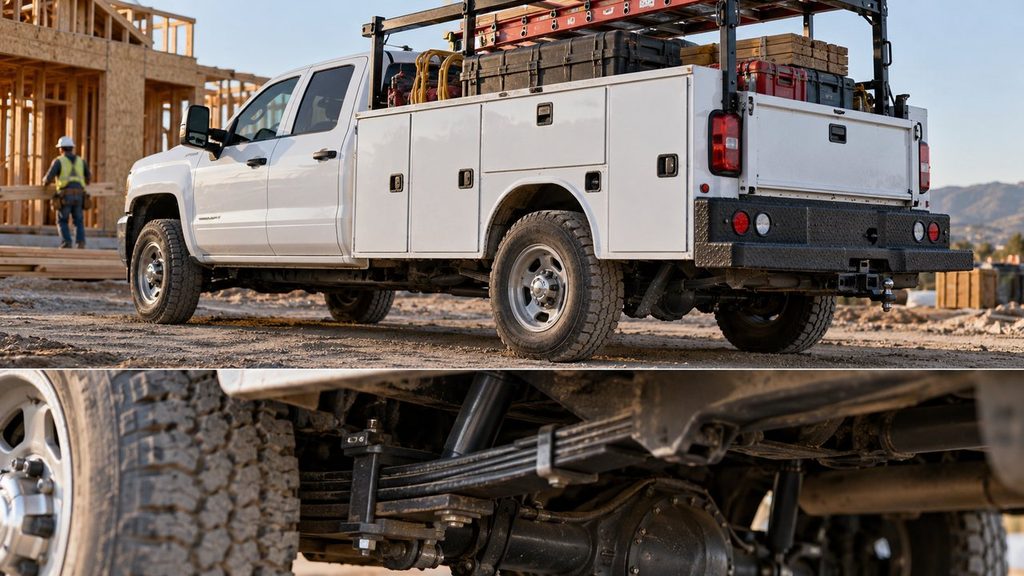
A truck that is rarely empty presents a different problem.
Service bodies, toolboxes, welding equipment, permanently mounted tanks, commercial racks and some slide-in campers can add substantial weight every mile the truck travels. In that situation, continually adjusting air pressure may provide little benefit because the truck’s normal operating weight hardly changes.
A properly selected helper spring—or, for a large permanent load, a replacement spring pack designed around the actual weight—can provide the support without air lines, valves or compressor hardware.
That last point is important. If the truck is permanently hundreds of pounds heavier than stock, the right answer may be springs matched to the new normal weight, not an increasingly aggressive helper added to an unsuitable or worn-out factory spring pack.
Which Gives the Better Unloaded Ride?
There is no honest universal winner here.
Airbags can preserve a near-stock unloaded ride when they are operated at the correct low-load pressure, but excessive pressure can make the rear feel unnecessarily firm.
Traditional steel helpers may add noticeable stiffness when unloaded, especially if they are always engaged. Progressive helper designs can behave very differently because they may not contribute much force until the vehicle is loaded.
So the useful question is not simply “air bags or helper springs?” It is which exact helper design, how soon does it engage, and what weight does the truck normally carry?
Which Controls Rear Sag Better?
Both can control sag when correctly matched to the vehicle and load.
Airbags provide a broader adjustment range because increasing pressure adds support. That makes it easier to compensate for loads that vary significantly.
A fixed helper spring provides the support built into its spring rate and engagement geometry. It may be ideal for the load it was selected for, but you cannot turn that support up or down for a different trailer.
If the truck sags badly under a load that is comfortably within all of its ratings, supplemental spring support may be appropriate. If it sags because the rear springs are broken, fatigued or badly worn, repair the suspension first.
Side-to-Side Leveling: Airbags Have a Real Advantage
Uneven loads are one of the clearest situations where air bags can offer something a conventional helper spring cannot.
With a system designed for independent left and right control, additional pressure can be used on the heavier side of the truck. That can be useful with asymmetric camper interiors, permanently mounted equipment or cargo that cannot be centered perfectly.
Not every air system allows independent adjustment. Some connect both bags through a common circuit, so verify the plumbing and controller design before assuming side-to-side leveling is available.
Maintenance and Reliability
Mechanical helper springs win on simplicity. There is no pressure to maintain and no pneumatic circuit to leak.
Airbag systems add more potential service points:
- air lines
- push-to-connect fittings
- inflation valves
- air-spring bellows
- optional compressor
- pressure sensors and electronic controls on more advanced systems
That does not make air bags unreliable, but installation quality matters. A line routed against an exhaust pipe, sharp edge or moving suspension component can create problems that the air spring itself never caused.
If an air-supported setup begins losing height or requires frequent reinflation, our guide to finding and repairing air suspension leaks covers the basic diagnostic process.
Installation: Which Is Easier?
It depends on the design more than the category.
A bolt-on progressive helper can be extremely straightforward. A steel add-a-leaf may require unloading and disassembling the leaf pack. Air bags require brackets plus careful air-line routing, and an onboard compressor adds wiring, controls and another installation location.
Before buying either system, check for interference with:
- fifth-wheel or gooseneck hitch brackets
- aftermarket exhaust systems
- rear sway bars
- lift blocks and suspension spacers
- factory adaptive suspension hardware
- fuel tanks or other chassis-mounted accessories
Fitment should be confirmed using the exact year, model, drivetrain, rear suspension and installed accessories—not simply the truck badge.
Airbags vs Helper Springs on a Lifted Truck
A lift changes the installation question because the distance between the axle and frame may no longer match the geometry for which the load-support kit was designed.
Some air bag systems use approved spacers for lifted applications. Others are incompatible with certain lift blocks, long-travel suspensions or modified control-arm geometry.
Check the suspension through full compression and full droop. The air spring, helper spring or its bracket must not become an unintended bump stop or droop limiter.
This matters especially on trucks built for significant articulation. Our long-travel suspension guide explains why usable travel depends on the entire system rather than one component.
Which Is Better Off Road?
Neither category automatically wins.
A trail truck needs clearance and freedom of movement throughout articulation. An air bag mounted between the axle and frame may have compression and extension limits that must remain compatible with the suspension’s travel. Air lines also need protection from rocks, branches, heat and abrasion.
A mechanical helper avoids air plumbing but can change effective spring rate or engagement as the suspension articulates.
For a mostly road-going tow vehicle that sees mild dirt roads, those differences may be minor. For a rock crawler or long-travel build, full-cycle suspension geometry should be checked before adding either system.
Truck Camper: Airbags or Helper Springs?
A slide-in truck camper can favor either system depending on whether the camper stays installed.
Choose airbags when: the camper is removed regularly, its loaded weight changes substantially, or one side of the camper is consistently heavier and the system permits independent pressure adjustment.
Choose mechanical springs when: the camper or other heavy equipment remains on the truck for most of the year and you want a passive setup with minimal adjustment.
If the camper is effectively permanent, a correctly rated replacement spring pack deserves consideration as well. Supplemental helpers should not be used to compensate indefinitely for springs that are fundamentally undersized for the truck’s normal operating weight.
Do Airbags Increase Payload Capacity?
No. This is one of the most important points in the entire comparison.
An air bag kit may advertise thousands of pounds of load-leveling capability. That number describes the product’s support capability under specified conditions; it does not add that amount to the truck’s payload rating.
The truck still has to remain within every applicable limit, including:
- GVWR
- front and rear GAWR
- payload rating
- tire and wheel capacities
- receiver or fifth-wheel hitch limits
- manufacturer towing limits
The same is true for steel, rubber and other helper springs. Better ride height does not change the numbers on the certification label.
Can Airbags or Helper Springs Fix a Worn Suspension?
They should not be used as a shortcut around worn-out parts.
If the rear sits low when the truck is empty, one side is permanently lower, a leaf is cracked, bushings are damaged or the factory springs have lost their normal arch, diagnose that condition before installing load-support hardware.
A helper can hide some of the visible sag while leaving the underlying failure untouched.
When Stronger Replacement Springs Are Better Than Either
Sometimes the airbags-vs-helper-springs debate starts with the wrong question.
If a commercial truck has gained substantial permanent weight, the original spring package may simply no longer match how the vehicle is used. In that case, a replacement spring pack engineered for the actual working load can be more appropriate than stacking additional helpers onto a spring system that is always operating near the same heavily compressed position.
Airbags remain useful when adjustability is genuinely needed, but they should not automatically become the answer to every rear-sag problem.
Cost: Look Beyond the Basic Kit
Mechanical helper springs often have the simpler total-cost picture because the installed system usually ends with the spring hardware itself.
An air bag kit can also be relatively straightforward if you are happy to inflate it manually. The cost rises when you add an onboard compressor, tank, pressure sensors, dual-path controls, wireless management or professional wiring and installation.
That extra expense buys convenience and adjustability, not additional legal payload capacity.
Airbags vs Helper Springs: Pros and Cons
| Airbags | Helper Springs | |
|---|---|---|
| Load adjustability | Excellent | Fixed or automatically progressive |
| Changing trailers | Excellent | Good if loads stay within the spring’s intended range |
| Constant heavy load | Good | Excellent when properly matched |
| Side-to-side correction | Possible with independent control | Generally limited |
| Unloaded ride | Often close to stock at correct pressure | Depends heavily on design and engagement |
| Routine maintenance | More | Less |
| Air lines/compressor | Required lines; compressor optional | None |
| Installation complexity | Moderate; greater with compressor | Varies from simple bolt-on to leaf-pack work |
| Failure points | More pneumatic components | Fewer components |
| Best match | Variable loads | Predictable loads |
How to Choose in Five Questions
- Does your load change substantially? If yes, adjustable air bags move to the front of the list.
- Is the truck heavily loaded almost all the time? A mechanical helper or properly rated replacement spring may make more sense.
- Do you need left-to-right leveling? Look at an air system specifically designed for independent control.
- Do you want a completely passive setup? Mechanical helper springs avoid pressure checks, air lines and compressors.
- Is the suspension modified? Check lift height, full bump, full droop, brackets, hitches and other accessories before choosing either system.
If you own a Silverado 1500 and have already decided on air support, our Silverado 1500 air bag kit guide covers generation-specific fitment and product choices rather than repeating that vehicle-specific material here.
Frequently Asked Questions
Are air bags better than helper springs for a daily driver?
Air bags are often a good match when a daily-driven truck spends most of its time lightly loaded but occasionally tows or hauls significant weight. You can reduce supplemental support when the load is removed. A progressive helper spring can also work well if you prefer a maintenance-free system that engages mainly under load.
Will helper springs make my truck ride rough?
Some can, but not all helper springs behave the same way. A heavy steel spring that is always engaged may noticeably firm the unloaded ride. A progressive helper with an engagement gap can have much less effect until the truck is loaded.
Can you use airbags and helper springs together?
Some combinations may be mechanically possible, but more support is not automatically better. Stacking systems can reduce suspension travel, increase stiffness and create bracket or clearance conflicts. Use only combinations approved for the vehicle and load-support products involved.
Do airbags stop trailer sway?
They can improve the behavior of a properly loaded truck that was sagging excessively, but they are not a cure for trailer sway. Incorrect tongue weight, poor cargo placement, tire problems, excessive speed, unsuitable hitch setup and other causes still need to be addressed directly.
Do helper springs increase towing capacity?
No. Helper springs can improve suspension support and loaded ride height, but they do not increase the manufacturer’s towing limit, GVWR, axle ratings, payload sticker or tire capacities.
Do I need an onboard compressor with airbags?
No. Many air bag kits can be filled through manual valves. A compressor becomes more attractive when the load changes frequently, you want to adjust pressure without an external air source or you need convenient left-to-right control.
Are airbags worth it if I tow only a few times per year?
They can be if rear sag is significant with a properly rated trailer and you value preserving the truck’s unloaded behavior the rest of the year. A progressive mechanical helper may be a simpler alternative when you do not want to maintain an air system.
Which is better for a work truck?
For a truck carrying similar tools or equipment every day, mechanical helper springs or a heavier replacement spring package are often the cleaner solution. Airbags become more useful when the work load changes substantially or adjustable side-to-side support is needed.
The Better Choice Depends on How Often the Load Changes
The airbags vs helper springs decision becomes much easier once you stop asking which system is universally “better.” They solve the same rear-support problem with different priorities.
Choose airbags when adjustability is the priority. They are especially useful for changing trailer weights, occasional heavy hauling, removable campers and uneven loads.
Choose helper springs when simplicity and consistent support matter more. They suit trucks with predictable working weight and owners who prefer a mechanical system without air pressure, hoses or compressor hardware.
And if the truck is permanently heavy, overloaded or sitting on worn-out springs, neither answer should be automatic. Start with actual axle weights, the truck’s ratings and the condition of the factory suspension. The best load-support upgrade is the one that matches the way the truck is really used—not the one with the largest number printed on the box.