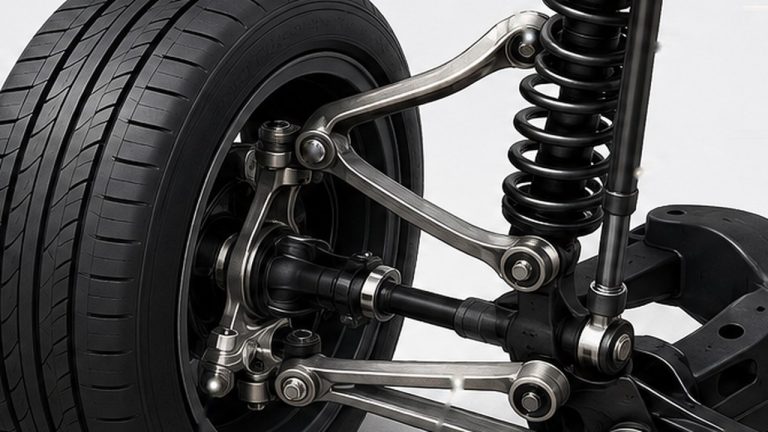
What Is Torsion Bar Suspension? How It Works, Pros and Cons
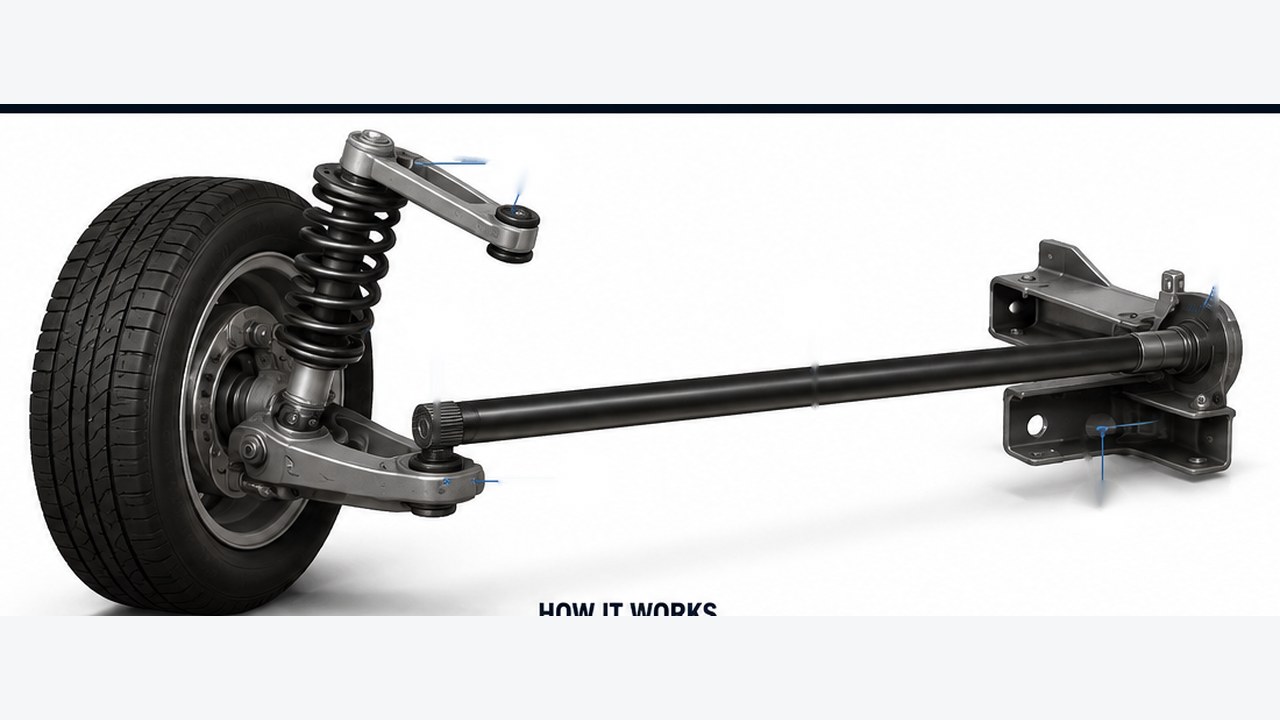
Torsion bar suspension uses a straight steel bar as a spring. Instead of compressing a coil spring, suspension movement twists the torsion bar along its length. The bar resists that twisting force and returns toward its original position, supporting the vehicle and allowing the wheel to move over bumps.
Torsion bars have been used in passenger cars, trucks, SUVs, military vehicles, and other applications because they can provide a durable spring in a compact package. They are particularly familiar in the front suspension of some trucks and 4x4s, where a longitudinal torsion bar works with independent control arms.
The most important point is that a torsion bar is a spring, not an axle or wheel-location architecture. A vehicle can combine torsion bars with independent suspension, control arms, trailing arms, or other suspension layouts.
What Is a Torsion Bar Suspension?
A torsion bar is a long metal bar designed to twist elastically. One end is connected to the suspension, while the other is anchored to the vehicle structure through a fixed mount or adjustable anchor.
When the wheel moves upward, the suspension arm rotates one end of the torsion bar. Because the opposite end is restrained, the bar twists along its length.
The bar resists that rotation just as a coil spring resists compression. When the load decreases, stored elastic energy in the bar helps return the suspension toward its normal position.
The shock absorber or damper still has a separate job. The torsion bar supports load and provides spring force, while the damper controls how quickly the suspension moves and prevents uncontrolled bouncing.
How Torsion Bar Suspension Works
The operating principle is simple even though the complete suspension around the bar can be complex.
- The tire encounters a bump and the wheel moves upward.
- A control arm or other suspension member rotates around its pivot.
- That movement rotates one end of the torsion bar.
- The opposite end of the bar is restrained by an anchor.
- The bar twists and creates resistance to further suspension movement.
- As the wheel moves back down, the bar releases stored energy and returns toward its original position.
The amount of force required to twist the bar depends on its dimensions, material, effective length, mounting geometry, and the amount of rotation.
A thicker or shorter torsion bar can generally provide a higher spring rate than a thinner or longer bar made from comparable material, but vehicle-specific geometry also determines the effective stiffness experienced at the wheel.
What a Torsion Bar Suspension Diagram Shows
A typical front torsion bar suspension diagram shows several components working together rather than the torsion bar acting directly on the wheel.
- Torsion bar: the long spring element that twists.
- Control arm: transfers wheel movement into rotation of the torsion bar.
- Front or suspension-end connection: usually splined or otherwise mechanically connected to the control arm or an attached lever.
- Rear anchor or torsion key: holds the opposite end of the bar and may provide ride-height adjustment.
- Shock absorber: controls the rate of suspension movement.
- Upper and lower suspension joints: allow the wheel and control arms to move through their intended geometry.
Many truck systems use torsion bars mounted roughly longitudinally, running from the front suspension toward a crossmember farther rearward under the vehicle. Other designs can position the bars differently.
A Torsion Bar Is a Spring, Not a Torsion Beam
The similar names cause frequent confusion, but torsion bar suspension and torsion beam suspension are not the same thing.
A torsion bar is a spring element. It twists to support vehicle weight in place of a coil spring or another spring type.
A torsion beam is a rear-suspension architecture that uses trailing arms connected by a transverse beam. The beam twists when the left and right wheels move differently, which is why that layout is normally classified as semi-independent.
Our torsion beam vs. multi-link suspension comparison covers that rear-suspension architecture separately. The torsion bar discussed here performs the spring’s job rather than defining whether the wheels move independently.
Where Are Torsion Bars Used?
Torsion bars can be used in several suspension arrangements, but they are especially recognizable in independent front suspensions on some pickups and SUVs.
In those systems, the torsion bar typically works through a lower control arm. The control arm establishes much of the wheel path, while the torsion bar provides spring resistance as that arm rotates.
Torsion bars have also been used in passenger cars and specialized vehicles. Depending on the design, they may be mounted longitudinally or transversely and can act through different suspension members.
Therefore, seeing “torsion bar suspension” does not tell you whether the vehicle uses MacPherson struts, double wishbones, trailing arms, or another wheel-locating system. The torsion bar describes the spring mechanism.
Front Torsion Bar Suspension
Front torsion bar suspension is particularly well suited to layouts where engineers want a spring element that does not occupy the vertical space required by a large coil spring.
On many independent front suspensions, the torsion bar connects to a lower control arm. As the arm moves upward, it twists the bar.
This arrangement can leave useful space around the wheel, steering system, engine, driveline, and frame. It can also allow spring preload and static ride height to be adjusted through the torsion-bar anchor on designs equipped for that purpose.
The control arms, ball joints, steering geometry, shocks, bump stops, alignment, and CV joints on driven front axles still determine how the complete suspension behaves.
What Determines Torsion Bar Spring Rate?
The resistance of a torsion bar is determined primarily by the properties and dimensions of the bar itself.
- Bar diameter: a relatively small increase in diameter can significantly increase torsional stiffness.
- Effective length: a shorter effective bar generally twists less easily than a longer comparable bar.
- Material: the material’s elastic properties affect how it resists torsion.
- Suspension leverage: the control-arm geometry determines how bar rotation translates into wheel movement.
- Installation geometry: lever lengths and mounting positions influence the effective wheel rate.
The spring rate at the torsion bar and the effective stiffness felt at the tire are therefore not necessarily the same thing. Suspension leverage matters just as it does with coil springs mounted on control arms.
Does Adjusting a Torsion Bar Make It Stiffer?
Adjusting the normal ride-height setting of a torsion bar does not usually change the intrinsic spring rate of the bar itself.
Turning an adjustment bolt or changing the position of a torsion key changes the bar’s installed preload and the suspension’s static position. The same torsion bar still has essentially the same torsional stiffness.
The vehicle may nevertheless feel different after adjustment because its suspension is now operating at a different ride height. Available bump and droop travel, alignment, control-arm angles, bump-stop engagement, shock position, and CV-joint angles may all change.
For this reason, raising a torsion-bar vehicle is not equivalent to installing a physically stiffer torsion bar.
Adjustment procedures and safe limits vary significantly by vehicle, so this article does not provide a universal turn-count or ride-height procedure. Manufacturer specifications should be used for the exact model.
What Happens When You Raise Torsion Bar Suspension?
On an adjustable torsion-bar system, increasing the preload can raise the vehicle’s static ride height within the adjustment range designed into the suspension.
However, the suspension does not gain unlimited extra travel simply because the body sits higher.
Raising the static position can reduce available droop because the wheel begins closer to the lower end of its travel. On independent driven suspensions, CV-joint and control-arm angles may also increase.
Alignment can change as well. Camber and toe should therefore be checked after significant ride-height changes when required by the vehicle’s service procedure.
Excessive adjustment can also change shock operating position and bump-stop or droop-stop clearance. More ride height is not automatically more usable suspension travel.
Torsion Bar vs. Coil Spring: The Basic Difference
A torsion bar and a coil spring perform the same fundamental suspension job using different forms of elastic deformation.
A torsion bar twists along its length. A coil spring compresses as its coils move closer together.
Either can be designed with different spring rates, lengths, materials, and load capacities. Neither is automatically softer, stiffer, stronger, or better simply because of its shape.
The two designs also create different packaging and adjustment opportunities. That comparison has enough distinct trade-offs to deserve its own detailed treatment rather than turning this general torsion-bar guide into a second search intent.
Torsion Bar Suspension Advantages
Compact Spring Packaging
A long torsion bar can be positioned along or across the vehicle instead of requiring the vertical space occupied by a large coil spring.
This gives engineers flexibility when packaging the engine, drivetrain, control arms, frame, steering components, and body.
Ride Height Can Be Adjustable
Many torsion-bar systems include an anchor arrangement that allows the installed preload and static suspension position to be adjusted within a specified range.
This can be useful for factory ride-height setting and service correction, although it should not be treated as unlimited lift adjustment.
Durable Basic Spring Element
A torsion bar is mechanically simple: it has no coils that rub against one another and no air chamber, compressor, or hydraulic circuit.
Properly designed torsion bars can provide long service lives, although corrosion, fatigue, damaged splines, anchors, and surrounding suspension components can still cause problems.
Easy Spring-Rate Changes in Some Applications
On designs where the torsion bar is separately removable, replacing it with a different vehicle-compatible bar can alter the spring rate without redesigning the entire suspension.
Any replacement still needs to match the vehicle’s dimensions, splines, orientation, load requirements, shocks, suspension travel, and intended use.
Torsion Bar Suspension Disadvantages
The Bar Requires Lengthwise Packaging Space
Although torsion bars can save vertical space, they still need room along their length and require strong attachment points at both ends.
On some vehicles, the bars and their crossmember occupy substantial underbody space.
Ride-Height Adjustment Has Limits
The availability of an adjustment bolt can make torsion-bar systems appear more adjustable than they really are.
Moving the static ride position too far can compromise alignment, droop, shock travel, control-arm geometry, CV angles, and ride quality even though the adjustment hardware physically allows further movement.
Corrosion and Age Can Matter
Torsion bars operate under repeated twisting loads. Serious corrosion, physical damage, or fatigue can reduce their ability to operate safely.
Anchors, splines, adjusters, crossmembers, and control-arm connections also need to remain structurally sound.
Different Rates Usually Require Different Bars
Changing preload does not turn the existing bar into a different spring rate. If a substantially different rate is required, the bar itself or another part of the suspension normally needs to change.
Does Torsion Bar Suspension Ride Better?
Not inherently.
Ride quality depends on the torsion-bar rate, effective wheel rate, shocks, control-arm geometry, bushings, tires, unsprung mass, available travel, bump stops, vehicle weight, and many other factors.
A torsion-bar suspension can be tuned for comfort or for much firmer load and handling requirements. The same is true of coil-spring suspension.
Damper calibration is particularly important because the torsion bar provides spring force but does not control suspension velocity. Our guide to what damping does in suspension explains that separate function.
Does Torsion Bar Suspension Handle Well?
Torsion bars can be part of very capable suspension systems because the spring type does not determine the wheel geometry.
Handling is influenced by control-arm geometry, camber gain, caster, toe, roll centers, anti-roll bars, springs, damping, tires, chassis stiffness, alignment, and weight distribution.
A torsion bar can provide the required spring rate while a double-wishbone or other independent suspension controls the wheel path.
It is therefore incorrect to assume that replacing a coil spring with a torsion bar automatically improves or worsens handling.
Can Torsion Bars Be Progressive?
A conventional straight torsion bar is usually designed around a predictable relationship between torque and angular deflection within its working range.
However, the effective stiffness experienced at the wheel can still change because suspension leverage, bump stops, bushings, anti-roll bars, and other elastic elements may behave differently as the suspension moves.
This is similar to the distinction between a spring’s own rate and the complete suspension’s wheel-rate behavior. Our guide to linear vs. progressive springs explains why the spring characteristic and the complete suspension response are not always the same thing.
Do Torsion Bars Sag?
A torsion-bar vehicle can sit lower than specified, but ride-height loss should not automatically be blamed on the bar itself.
Possible causes include changes in torsion-bar condition, incorrect adjustment, worn suspension bushings, damaged anchors or crossmembers, excessive vehicle load, collision damage, or other suspension problems.
Ride height should be measured using the vehicle manufacturer’s specified procedure before adjusting or replacing components.
Simply tightening an adjuster to compensate for an underlying mechanical problem can hide the symptom while leaving damaged parts in service.
What Happens When a Torsion Bar Fails?
A torsion bar is a load-bearing spring component, so a complete failure can cause a substantial change in ride height at the affected corner.
Possible signs of a torsion-bar or related mounting problem include:
- One side of the vehicle sitting unusually low
- A sudden change in ride height
- Clunking or metallic noises from the suspension or anchor area
- Visible corrosion or physical damage to the bar
- Damaged torsion keys, anchors, adjusters, or crossmembers
- Alignment or handling that has changed noticeably
These symptoms are not unique to a failed torsion bar. Control arms, ball joints, bushings, shocks, tires, wheel bearings, frame components, and other parts can cause similar problems.
A vehicle with suspected spring or mounting failure should be inspected before continued normal driving.
Do Torsion Bars Wear Out?
Torsion bars are designed to undergo repeated elastic twisting, but they are not immune to age, corrosion, overload, impact damage, or fatigue.
The surrounding hardware often deserves equal attention. Splined connections, adjustment bolts, anchors, bushings, control arms, and crossmembers may deteriorate even when the bar itself remains serviceable.
Inspection is particularly important on vehicles exposed to road salt, deep corrosion, heavy loads, or off-road impacts.
Can You Replace Torsion Bars Yourself?
Torsion bars can store substantial spring energy even when the vehicle is stationary.
Replacement procedures vary considerably by vehicle and may require unloading the suspension in a specific sequence, measuring ride height, indexing splines correctly, handling loaded adjustment hardware, and performing an alignment afterward.
For that reason, a universal removal or installation procedure would be unsafe. Use the factory service information for the exact vehicle and appropriate lifting and spring-unloading equipment.
Torsion Bar Suspension Pros and Cons
| Advantages | Disadvantages |
|---|---|
| Compact vertical packaging | Requires space along the bar’s length |
| Simple spring element | Adjustment range is limited by suspension geometry |
| Ride height can be adjustable on many designs | Too much adjustment can reduce droop and worsen joint angles |
| Can provide long service life | Corrosion and fatigue can still cause problems |
| Works with several suspension architectures | Different spring rates generally require different bars |
| Can be durable in trucks and heavy-duty applications | Anchors, keys, and crossmembers add vehicle-specific service points |
Is Torsion Bar Suspension Good for Off-Roading?
Torsion-bar independent suspension can work very well off-road when the complete system is designed for the loads, wheel travel, tire size, and terrain involved.
Its adjustable static ride position can be useful, but raising the suspension does not remove the limits created by control arms, CV joints, steering, shocks, bump stops, brake hoses, and tire clearance.
For off-road performance, the complete axle and suspension architecture matters more than the fact that the spring happens to be a torsion bar.
Is Torsion Bar Suspension Good?
Yes. Torsion bars are a proven way to provide suspension spring force, especially when compact vertical packaging, durability, or adjustable static ride height are useful.
Their main limitation is not that they twist instead of compress. It is that every torsion-bar system must still work within the geometry, travel, damping, joint angles, and packaging limits of the suspension around it.
A well-engineered torsion-bar suspension can ride comfortably, handle well, carry substantial loads, and provide long service life. A poorly matched or incorrectly adjusted one can perform badly even when the torsion bar itself is in perfect condition.
Frequently Asked Questions
What is torsion bar suspension?
Torsion bar suspension uses a long metal bar as the spring. Suspension movement twists the bar along its length, and the bar’s resistance to that twisting supports the vehicle and provides spring force.
How does a torsion bar suspension work?
One end of the torsion bar is connected to a moving suspension component such as a control arm, while the other end is anchored to the vehicle. As the wheel moves, the suspension twists the bar. The bar resists that rotation and stores elastic energy.
Is a torsion bar the same as a torsion beam?
No. A torsion bar is a spring that twists along its length. A torsion beam is a semi-independent rear-suspension layout in which left and right trailing arms are connected by a beam that twists when the wheels move differently.
Can torsion bar suspension be adjusted?
Many torsion-bar systems include a ride-height adjustment mechanism. Changing that setting alters the installed preload and static suspension position, but it does not normally change the torsion bar’s intrinsic spring rate.
Does tightening torsion bars make the suspension stiffer?
Not in the sense of changing the torsion bar’s actual spring rate. The vehicle may feel different because ride height, available travel, alignment, bump-stop clearance, or suspension angles have changed.
Do torsion bars replace shock absorbers?
No. The torsion bar provides spring force. The shock absorber or damper controls the speed of suspension movement. A normal torsion-bar suspension needs both functions.
Are torsion bars better than coil springs?
Neither spring type is universally better. Torsion bars provide useful packaging and adjustment possibilities, while coil springs offer their own packaging, rate, and replacement advantages. The complete suspension design matters more than the spring shape alone.
The Key Is Understanding What the Bar Actually Does
Torsion bar suspension is easier to understand once the bar is treated simply as another type of spring. The wheel and control arms determine the suspension movement, the torsion bar resists that movement by twisting, and the damper controls how quickly everything moves.
That separation also explains why adjusting a torsion bar is not the same as installing a stiffer spring, why torsion bar and torsion beam are different concepts, and why ride and handling depend on much more than the spring element alone.