Sway Bar Replacement Cost: Parts & Labor
Sway bar replacement typically costs about $300 to $650 on a mainstream vehicle in the United States, including the complete bar, parts and labor. An easy-to-access rear bar can cost less, while a front sway bar hidden above the subframe, a heavy-duty truck bar, or an active anti-roll system can push the repair above $1,000.
The biggest mistake when comparing sway bar replacement prices is confusing the complete sway bar with its links or bushings. Those are separate components and can have very different repair costs.
Sway Bar Replacement Cost at a Glance
| Repair | Useful U.S. Planning Range |
|---|---|
| Complete sway bar replacement | About $300–$650+ |
| Easy-access sway bar | About $200–$500 |
| Front sway bar with difficult access | About $500–$1,000+ |
| Rear sway bar | Often about $250–$600+ |
| Active or hydraulic anti-roll system | $1,000+ possible |
| Sway bar links only | Different repair |
| Sway bar bushings only | Different repair |
These are planning ranges rather than fixed quotes. The exact vehicle, sway bar design, part price, labor rate, corrosion and access requirements can change the final cost substantially.
What Is a Sway Bar?
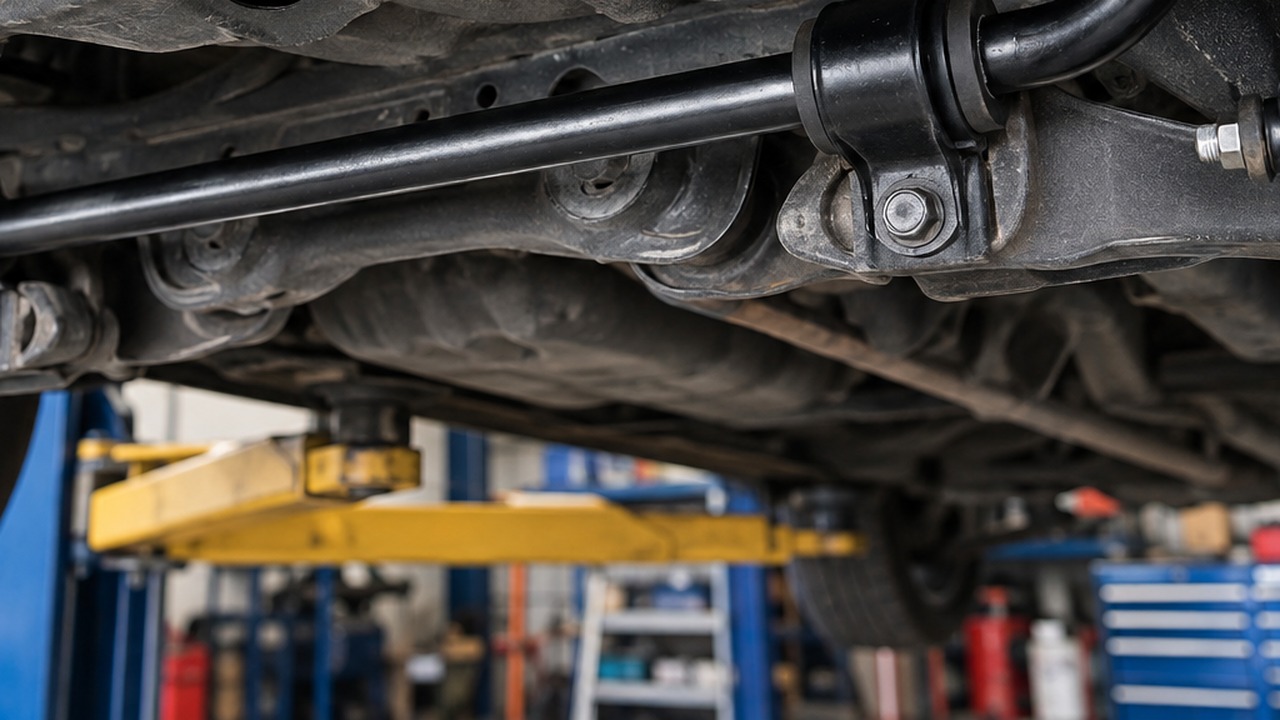
A sway bar is a steel torsion bar that connects the left and right sides of an axle’s suspension. It is also called an anti-roll bar, stabilizer bar or anti-sway bar.
When the vehicle corners and the body begins to lean, the sway bar twists and transfers force from one side of the suspension to the other. This helps reduce body roll and keeps the vehicle more stable during changes of direction.
The bar is normally mounted to the chassis or subframe with bushings and connected to the suspension through sway bar links.
Complete Sway Bar vs. Links and Bushings
The complete sway bar usually does not wear out as often as its links or bushings. Before approving an expensive replacement, make sure the shop has actually diagnosed the bar itself.
There are three different repairs that are commonly grouped together under “sway bar repair”:
- Sway bar replacement: the complete steel bar is removed and replaced.
- Sway bar link replacement: the smaller links connecting the bar to the suspension are replaced.
- Sway bar bushing replacement: the rubber or polyurethane mounting bushings are replaced while the main bar remains in place.
If the diagnosis is actually for the links rather than the complete bar, use our sway bar link replacement cost guide instead.
Why Would the Complete Sway Bar Need Replacement?
The bar itself is a relatively simple and durable component, so complete replacement is less common than replacing links or bushings.
A complete sway bar may need replacement because of:
- a bar bent by an accident or major impact
- severe corrosion or structural rust
- a cracked or fractured bar
- damaged mounting surfaces
- failure of an integrated active anti-roll component
- physical damage from off-road use or road debris
If the bar is structurally sound and the only problem is a loose link or worn mounting bushing, replacing the complete bar may not be necessary.
Sway Bar Parts Cost
A conventional replacement sway bar can cost roughly $100 to $400 or more for the part alone. Large truck and SUV bars, performance components and OEM bars for premium vehicles can cost considerably more.
The price may also depend on whether brackets, bushings or other mounting hardware are included with the new bar.
When comparing quotes, ask for the exact part number. A bare aftermarket bar and a complete OEM assembly with mounting components are not equivalent parts.
Sway Bar Replacement Labor Cost
Labor is where sway bar replacement prices vary most dramatically.
On a vehicle where the bar is mounted underneath the chassis with clear access, removal can be relatively straightforward. The technician disconnects the links, removes the mounting brackets and bushings, withdraws the old bar and installs the replacement.
On other vehicles, however, the sway bar passes above or through the front subframe or engine cradle. Removing it can require supporting the engine or drivetrain, lowering part of the subframe and disconnecting additional components.
That difference can turn a relatively inexpensive repair into a multi-hour job.
Why Subframe Access Can Make the Repair Expensive
Subframe access is one of the most important details to check when a sway bar replacement quote looks unusually high.
The bar has to be physically removed from the vehicle. If suspension arms, steering components, exhaust parts or the engine cradle block its path, the technician may have to loosen or partially lower those components simply to create enough space.
The new sway bar itself may therefore be inexpensive while the labor bill is several times the cost of the part.
Ask the shop whether the quoted labor includes lowering the subframe or supporting the engine. That information often explains the difference between a $400 quote and one approaching or exceeding $1,000.
Front Sway Bar Replacement Cost
Front sway bar replacement commonly costs around $300 to $700 when access is reasonably straightforward.
However, front sway bars are frequently routed around the engine, transmission, steering rack and subframe. On difficult designs, the total can climb to $700 to $1,000 or more because of the additional labor needed to remove the bar.
Front-wheel-drive and all-wheel-drive vehicles can be especially tightly packaged, but the exact procedure depends on the model rather than drivetrain type alone.
Rear Sway Bar Replacement Cost
A rear sway bar is often easier to access than the front bar, making roughly $250 to $600 a useful planning range for many conventional vehicles.
This is not a universal rule. Exhaust systems, rear subframes, differentials and complex independent suspension layouts can make some rear sway bars difficult to remove.
Some vehicles also have no rear sway bar at all.
Active Sway Bar Replacement Can Cost Much More
Not every sway bar is a simple solid or hollow steel torsion bar.
Some luxury SUVs, performance vehicles and advanced suspension systems use electronically, hydraulically or mechanically controlled anti-roll systems that can vary roll stiffness.
Those systems may incorporate actuators, hydraulic components, sensors or special control hardware into the anti-roll system. Repair prices can therefore move well beyond the cost of replacing a conventional passive sway bar.
If the quote involves an active anti-roll system, compare it with the exact manufacturer procedure and part number rather than applying a generic sway bar replacement price.
Should the Bushings Be Replaced With the Sway Bar?
If the complete bar is already being removed, the mounting bushings should be inspected carefully. If the bar itself is still serviceable and the problem is limited to the mounts, see our sway bar bushing replacement cost guide.
Installing badly worn old bushings onto a new sway bar can leave the vehicle with the same knocking or movement that led to the original inspection.
However, bushings should not automatically be replaced solely because a new bar is being installed. The correct decision depends on their condition, whether they are included with the replacement assembly and the manufacturer’s service procedure.
Should the Sway Bar Links Be Replaced Too?
The links have to be disconnected during most complete sway bar replacement jobs, but that does not automatically mean they need replacement.
If the link joints are tight, the boots are intact and the hardware can be reused according to the repair procedure, healthy links may remain in service.
Replacement makes more sense when the links already have measurable play, torn boots, damaged threads or severe corrosion.
Do You Need an Alignment After Sway Bar Replacement?
Replacing only a conventional sway bar does not normally change the vehicle’s adjustable toe, camber or caster settings. For that reason, the bar itself does not automatically require a wheel alignment in the way a tie rod repair does.
The situation changes if the repair requires lowering or repositioning a subframe, disconnecting control arms, disturbing alignment-related components, or completing other suspension repairs at the same time.
If significant suspension or subframe work was required for access, ask whether the manufacturer recommends an alignment or whether alignment measurements should be checked afterward.
Our guide to alignment after replacing suspension parts explains which repairs are most likely to affect wheel geometry.
Symptoms of a Bent or Broken Sway Bar
Complete sway bar failure is less common than worn links or bushings, and the symptoms can overlap significantly.
- increased body roll during cornering
- clunking or knocking from the suspension
- visible bending or deformation of the bar
- cracks or severe corrosion
- one side of the sway bar contacting nearby components
- handling that changed after an impact or collision
A clunk by itself is not enough reason to replace the complete bar. Worn links and bushings are much more common noise sources.
If noise is the main symptom, use our guide to suspension clunks and rattles before assuming the steel bar itself has failed.
Can a Bad Sway Bar Cause Uneven Tire Wear?
A conventional sway bar does not directly set wheel alignment angles, so a damaged bar by itself is not usually the primary cause of uneven tire wear.
If the vehicle has abnormal tire wear as well as sway bar problems, inspect alignment, control arm bushings, ball joints, steering components and other suspension parts rather than assuming the anti-roll bar is responsible.
Our guide to suspension-related tire wear covers the components more likely to change tire wear patterns.
Can You Drive With a Broken Sway Bar?
A conventional sway bar is not a steering link and does not directly hold the wheel onto the vehicle, so its failure is different from a separated ball joint or tie rod.
However, a broken or disconnected bar can allow substantially more body roll and change the way the vehicle responds during cornering, emergency maneuvers and quick lane changes.
A damaged bar can also move out of position and contact other suspension or drivetrain components.
If the bar is visibly broken, badly bent or loose, the vehicle should be inspected and repaired rather than continuing to drive normally.
How Long Does Sway Bar Replacement Take?
A complete sway bar with unobstructed access may be replaced in roughly one to two labor hours.
On vehicles where the bar is trapped above a subframe or surrounded by drivetrain components, the job can take several hours. Some difficult designs can require a substantial portion of a workday because the technician must support and partially lower other assemblies before the bar can be removed.
Rust and seized link or bracket hardware can add further time.
OEM vs. Aftermarket Sway Bars
A replacement bar may be available as an OEM part, a direct-replacement aftermarket component or a performance upgrade.
OEM parts are designed to reproduce the original bar diameter, shape and suspension balance. Direct-replacement aftermarket bars may provide a lower-cost alternative when a reputable manufacturer offers the correct fitment.
Performance sway bars can be stiffer than stock and may intentionally change the vehicle’s handling balance. They should not automatically be treated as equivalent replacements for a damaged original bar.
If the goal is simply to restore factory behavior, compare quotes using parts with equivalent specifications rather than choosing a substantially stiffer bar solely because it fits.
Can You Replace a Sway Bar Yourself?
Whether sway bar replacement is a realistic DIY repair depends almost entirely on access.
An exposed rear bar that can be removed after disconnecting a few brackets and links may be manageable for an experienced DIYer with proper lifting equipment.
A front bar requiring engine support, subframe lowering, steering-component removal or careful repositioning of suspension hardware is a much more advanced repair.
Never work beneath a vehicle supported only by a jack. Subframe work in particular requires correct support points, torque procedures and an understanding of how the drivetrain and suspension are being supported.
Why a Sway Bar Replacement Quote May Be Higher Than Expected
- The front subframe must be lowered for access.
- The engine or transmission needs additional support.
- The vehicle uses an expensive OEM bar.
- The anti-roll system is active, hydraulic or electronically controlled.
- Mounting hardware is badly corroded.
- Sway bar links or bushings are also being replaced.
- Other suspension components must be removed and reinstalled.
- An alignment or additional calibration is required after related work.
If the estimate includes several suspension components rather than only the sway bar, compare the overall scope with our car suspension repair cost guide.
How to Compare Sway Bar Replacement Quotes
- Confirm that the complete bar is being replaced. Links and bushings are different repairs.
- Ask why the bar needs replacement. Get the diagnosis for bending, cracking, corrosion or another structural defect.
- Check the part number and brand. Compare OEM and aftermarket parts on an equivalent basis.
- Ask whether bushings and links are included. Those parts can change both the material and labor cost.
- Ask about subframe labor. This is often the biggest reason one vehicle costs far more than another.
- Check whether an alignment is included and why. The bar alone normally does not change alignment, but related subframe or suspension work may justify it.
- Separate additional repairs. Compare unrelated suspension items individually instead of judging only the final total.
Frequently Asked Questions
How much does sway bar replacement cost?
About $300 to $650 is a useful planning range for complete sway bar replacement on many mainstream vehicles. Easy-access jobs can cost less, while difficult front bars, expensive parts and active anti-roll systems can exceed $1,000.
How much does a front sway bar cost to replace?
Front sway bar replacement commonly costs around $300 to $700 when access is reasonable. Vehicles that require subframe lowering or significant disassembly can cost $700 to $1,000 or more.
How much does a rear sway bar cost to replace?
Roughly $250 to $600 is a useful planning range for many conventional rear sway bars, although difficult access and premium parts can increase the total.
Is a sway bar expensive to replace?
The bar itself is often moderately priced. The repair becomes expensive when vehicle design makes the bar difficult to remove, particularly when the subframe or other major components have to be lowered.
Is replacing a sway bar the same as replacing sway bar links?
No. The sway bar is the long torsion bar spanning the vehicle. Sway bar links are smaller components that connect the bar to the suspension and are usually much cheaper and easier to replace.
Does a sway bar need to be replaced when the bushings wear out?
Usually not. If the bar itself is structurally sound, worn mounting bushings can normally be replaced separately. The bar may need replacement if it is bent, cracked, severely corroded or damaged at its mounting surfaces.
Do you need an alignment after sway bar replacement?
Not automatically for the bar alone. An alignment may be appropriate if the repair required lowering the subframe, disturbing alignment-related suspension components or performing other suspension work.
How long does it take to replace a sway bar?
An accessible sway bar may take around one to two labor hours. A bar positioned above the subframe or surrounded by drivetrain components can require several hours of additional work.
The Bar Is Often Cheaper Than the Labor
For a conventional vehicle, approximately $300 to $650 is a reasonable starting budget for complete sway bar replacement, but the physical location of the bar matters more than the size of the part.
Before approving a high estimate, confirm that the complete sway bar is actually damaged, distinguish it from the links and bushings, identify the replacement part being used, and ask whether the subframe or other major components must be lowered for access. Once those details match, two sway bar replacement quotes become much easier to compare fairly.