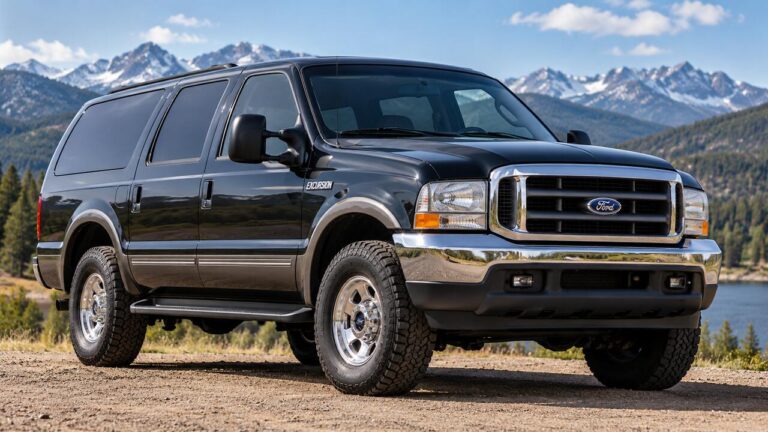
Ford Excursion Lift Kits: 2–10 Inch Suspension Guide
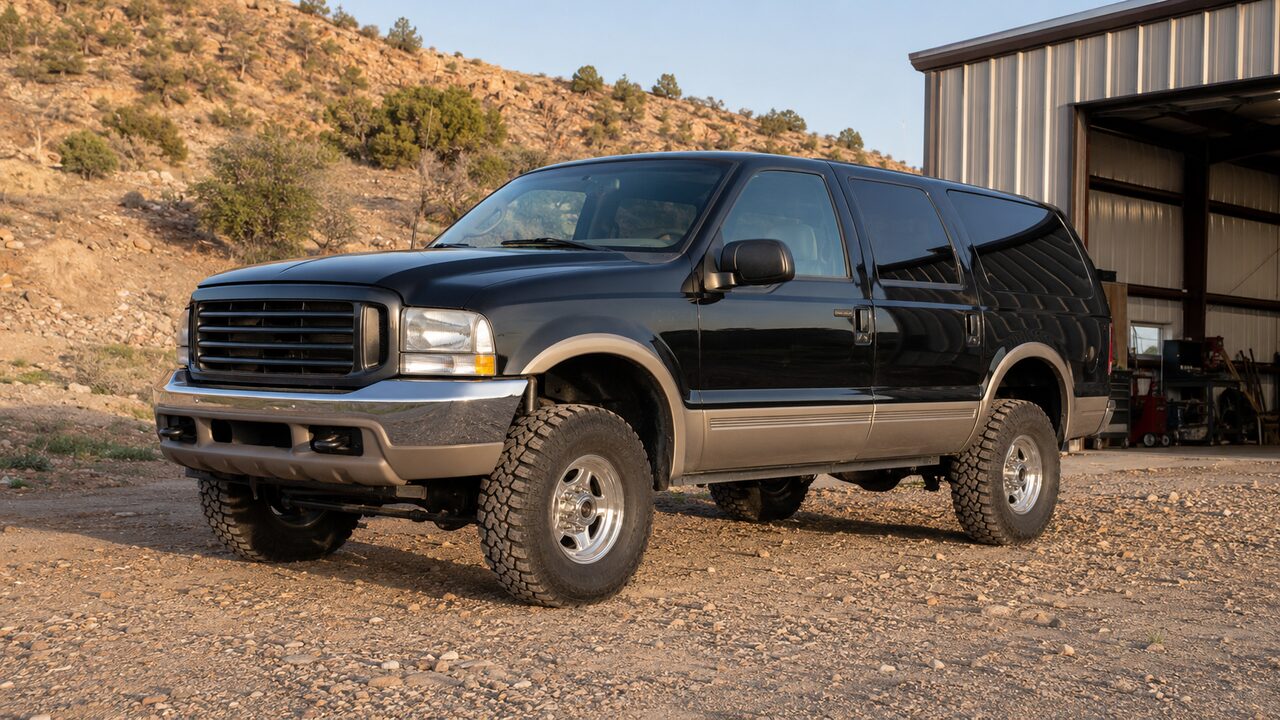
The best Ford Excursion lift kit depends on how the SUV will be used. A 2- or 3-inch system is the most practical choice for daily driving and moderate tire clearance, a 4- to 4.5-inch lift offers a useful balance for off-road use, and 6- to 10-inch systems require increasingly extensive steering, driveline, wheel and tire planning.
This guide covers complete suspension lift systems for the 2000–2005 Ford Excursion. It does not rank replacement shocks by themselves. If you only need new dampers for a stock or already-lifted SUV, use our separate guide to the best shocks for a Ford Excursion.
Fitment warning: many current Excursion lift kits are designed specifically for 4WD models with a solid front axle and leaf springs. A same-year F-250 or F-350 kit is not automatically an Excursion kit, and a 4WD system should not be assumed to fit a 2WD Excursion. Verify the year, drivetrain, axle, existing ride height and every manufacturer fitment note before ordering.
Ford Excursion Lift Height Comparison
| Lift height | Best suited to | Main considerations |
|---|---|---|
| 2–3 inches | Daily driving, mild trails and a level stance | Usually the least disruptive option, but shocks, caster and exact tire clearance still require verification |
| 4–4.5 inches | Mixed road and off-road use | Often requires more complete steering and axle-location corrections than a leveling system |
| 6 inches | Larger tires and more serious trail clearance | Driveshaft angles, brake hoses, steering geometry and step-in height become more significant |
| 8–10 inches | Specialized off-road or appearance-focused builds | High cost, major geometry changes, difficult entry and reduced practicality for everyday use |
Tire size is not determined by lift height alone. Wheel width and offset, backspacing, tire dimensions, axle position, body tolerances and intended suspension travel all affect clearance. Use the tire guidance published for the exact kit rather than assuming every lift of the same height accepts the same tire.
Measure the Excursion Before Choosing a Kit
An Excursion may already have replacement leaf springs, add-a-leaves, blocks or an older lift system. Measure its current stance before ordering parts instead of assuming it remains at factory height.
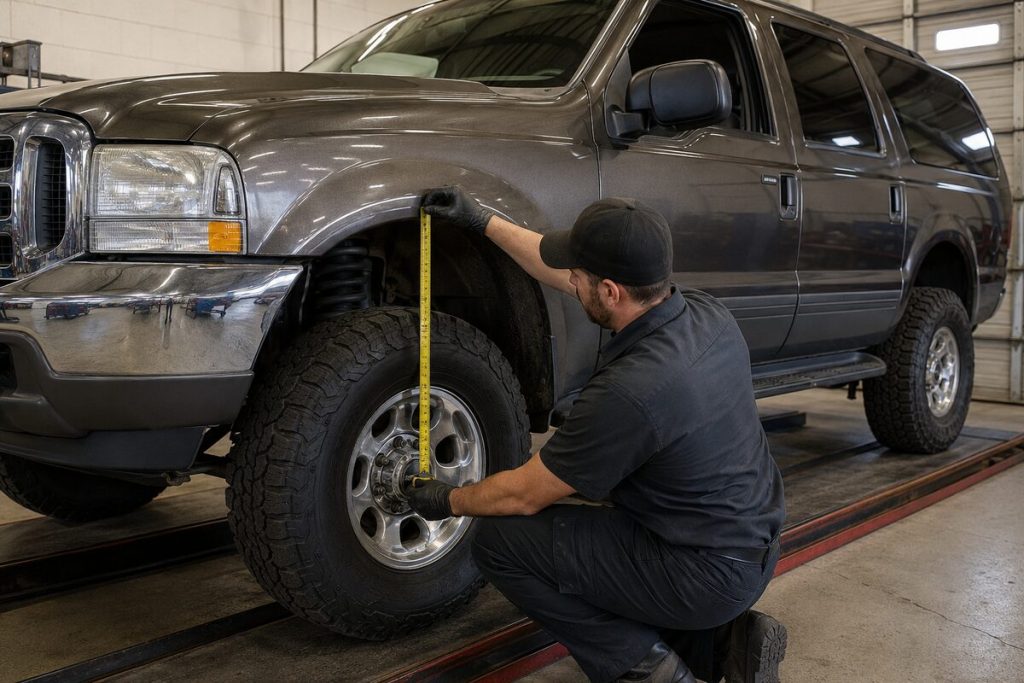
Park on level ground, set the tires to appropriate pressures and measure vertically from the center of each wheel hub to the lower edge of the fender opening. Hub-to-fender measurements avoid most of the variation caused by tire diameter. Record all four corners and compare left to right as well as front to rear.
Also inspect the following before deciding that additional height is the solution:
- Cracked, flattened or uneven leaf springs
- Worn spring-eye and shackle bushings
- Loose steering linkage, ball joints or wheel bearings
- Track-bar movement or damaged mounting hardware
- Leaking or incorrectly sized shocks
- Existing blocks, add-a-leaves or nonfactory brackets
- Uneven tire wear or an alignment problem
Ford’s 2005 maintenance guidance calls for inspection of the steering linkage, ball joints, suspension, driveshaft and U-joints. That is a sensible baseline for every Excursion before changing its suspension geometry.
2-Inch Ford Excursion Lift: Best for Daily Driving
A 2-inch system is usually the most practical option for owners who want a more level stance, modest tire clearance and less disruption to road manners. It can improve approach clearance without making entry, towing setup and garage access as difficult as a tall lift.
However, not every 2-inch product is a complete lift kit. Some systems raise mainly the front to reduce the factory nose-down stance, while others include components intended to alter both ends of the vehicle. Check the stated front and rear height rather than relying on the number in the product name.
ICON’s 2-inch Excursion system specifications, for example, describe a 2000–2005 application intended to level the vehicle and provide room for the manufacturer’s stated tire size. That fitment information applies to that particular system, not to every 2-inch kit.
Choose a 2-inch lift when:
- The Excursion is still used primarily on the road.
- You want a level stance rather than an extreme height increase.
- Passenger access and towing practicality remain important.
- You are willing to verify shock length, caster and alignment after installation.
3-Inch Lift: A Mild Step Up in Clearance
A 3-inch system sits between a basic leveling setup and a more involved 4-inch lift. It can work well for an Excursion that sees forest roads, camping access and occasional trail use while still spending substantial time on pavement.
The exact hardware matters more than the extra inch. A complete system may address spring position, shocks and axle control, while a low-cost package may provide height without correcting every related angle. ICON’s 3-inch system documentation describes its own bolt-on method and intended tire clearance; use those specifications only for that exact product and configuration.
After installation, check brake-hose and ABS-wire slack through the full steering range and suspension travel. Confirm that shocks are not acting as bump stops or travel limiters.
4- to 4.5-Inch Lift: Best All-Around Off-Road Range
For many mixed-use builds, approximately 4 to 4.5 inches is the point where an Excursion gains meaningful clearance without entering the compromises of an 8- or 10-inch system. It can provide space for larger tires and improve trail clearance, but it should be approached as a complete suspension project.
A well-planned system may need to address:
- Front and rear spring height
- Shock length and travel
- Track-bar or axle-location geometry
- Steering correction and pitman-arm requirements
- Brake-hose and ABS-wire length
- Bump-stop position
- Driveshaft slip and operating angles
- Wheel backspacing and tire clearance
The current BDS 4-inch Excursion kit documentation identifies a 2000–2005 4WD application and a leaf-spring front lift method. ICON also offers a 4.5-inch Excursion suspension system. Their included parts and design approaches are not interchangeable, so compare complete contents rather than height alone.
6-Inch Lift: For Larger Tires and More Clearance
A 6-inch lift is a substantial modification on a long, heavy SUV. It may suit an off-road build that needs more tire and underbody clearance, but it also raises the center of gravity, increases step-in height and places more importance on steering and driveline geometry.
At this height, do not budget only for the advertised kit. Depending on the selected system and existing vehicle condition, the project may also require wheels, tires, longer shocks, brake hoses, steering components, driveshaft work, alignment and replacement of worn factory parts discovered during installation.
BDS lists its 6-inch Excursion kit as a 2000–2005 4WD application and identifies drilling and pitman-arm tools among the installation considerations. Review the current instructions before purchasing so labor and specialist-tool requirements are included in the budget.
8- and 10-Inch Lifts: Specialized Builds
An 8- or 10-inch Excursion lift is not simply a taller version of a daily-driver leveling kit. It creates a specialized vehicle with much greater entry height, a higher center of gravity and more demanding steering, braking and driveline requirements.
These heights may be appropriate for a carefully engineered trail, show or large-tire build, but they are rarely the best choice when towing stability, family access, parking-garage clearance and highway behavior are priorities.
The manufacturer pages for the current 8-inch and 10-inch Excursion systems show that these are complete, application-specific projects with longer estimated installation times and additional tool requirements. Do not reproduce their height using stacked blocks or unrelated parts.
Ford Excursion 2WD vs 4WD Lift Kits
The drivetrain distinction is mandatory. Most of the prominent 4-, 6-, 8- and 10-inch systems currently shown in Excursion lift-kit results are listed for 4WD vehicles. A 2WD Excursion uses a different front suspension arrangement, so the springs, brackets, steering corrections and shocks may not match.
If a product page does not explicitly list your drivetrain, do not assume compatibility based only on the model year. Confirm fitment directly with the manufacturer using the VIN and the vehicle’s current suspension configuration.
What a Complete Excursion Lift Kit Should Address
The contents vary by height and design, but a complete system should explain how it handles each component affected by the lift. Before purchasing, check for clear answers to the following:
- Front lift method: replacement springs, spring relocation, mini packs or another documented design
- Rear lift method: springs, blocks or a coordinated combination appropriate for the vehicle
- Shock fitment: correct compressed and extended lengths for the final ride height
- Axle location: the track bar and related brackets must keep the axle correctly positioned
- Steering geometry: the kit should specify any pitman arm or steering corrections it requires
- Travel limits: bump stops and shocks must protect components through compression and extension
- Brake and ABS clearance: hoses and wiring need safe slack at full droop and steering lock
- Driveline operation: driveshaft length, slip travel and joint angles must remain suitable
How Much Does a Ford Excursion Lift Cost?
The advertised kit price is only part of the project. A realistic budget should include the system, compatible shocks, installation, alignment and any wheels, tires or worn steering and suspension parts that must be replaced. For a broader breakdown of labor and supporting expenses by lift height, see our lift kit installation cost guide.
| Lift project | Broad planning range | Common additional costs |
|---|---|---|
| 2–3 inches | $1,000–$4,000 installed | Shocks, alignment and possibly tires or caster correction |
| 4–4.5 inches | $3,000–$10,000+ installed | Wheels, tires, steering components, brake hoses and supporting hardware |
| 6 inches | $4,500–$12,000+ installed | Larger tires, driveline corrections and more extensive labor |
| 8–10 inches | $7,000–$18,000+ installed | Major wheels and tires, steering, driveline work, fabrication and access modifications |
These are planning ranges rather than quotes. Premium suspension systems alone can cost several thousand dollars, and corrosion or previous modifications can add substantial labor. Obtain a written estimate based on the exact Excursion before dismantling it.
Will a Lift Kit Improve Ride Quality?
Not automatically. A complete, well-matched system can improve control over worn factory components, but adding height by itself does not guarantee a smoother ride. Spring rate, shock valving, tire construction, tire pressure, bushing condition and suspension travel all affect comfort.
An inexpensive lift that relies on excessively stiff springs or poorly matched shocks may ride worse than a healthy stock suspension. If comfort is the main goal, read our guide to making a stiff truck suspension ride more smoothly before choosing extra height.
Installation and Alignment Checklist
- Confirm the kit matches the year, 2WD or 4WD drivetrain and current suspension.
- Inspect the frame, steering, wheel bearings, ball joints, springs and bushings before installation.
- Read the manufacturer’s complete instructions and tool list before ordering.
- Measure brake-hose, ABS-wire, driveshaft and shock travel through the full range of movement.
- Verify wheel backspacing and tire clearance at full steering lock and suspension compression.
- Have the Excursion professionally aligned after changing ride height or front geometry.
- Retorque the suspension hardware at the interval specified by the kit manufacturer.
Our guide to alignment after suspension replacement or modification explains why ride-height changes require another geometry check.
Frequently Asked Questions
What is the best lift height for a Ford Excursion?
For a mostly road-driven Excursion, 2 to 3 inches is generally the most practical range. A 4- to 4.5-inch system is better suited to mixed road and off-road use. Six inches or more should be reserved for owners who accept the added cost, entry height and geometry changes required by a specialized build.
Can a Ford Excursion fit 35-inch tires with a lift?
Some manufacturers specify 35-inch tire clearance for particular Excursion systems, but lift height alone does not guarantee fitment. Wheel offset, backspacing, tire width, axle position, body tolerances and suspension travel must match the kit manufacturer’s requirements.
Will an F-250 lift kit fit a Ford Excursion?
Do not assume so. Although the vehicles share some components, the Excursion has different weight, rear suspension requirements and application listings. Use a system that explicitly includes the Ford Excursion’s model year and drivetrain.
Does a lifted Excursion need longer shocks?
Usually, but the required length depends on the lift design and actual suspension travel. Use the shock lengths or part numbers specified by the lift manufacturer. A shock that is too short can limit droop, while one that is too long may bottom internally before the suspension reaches its bump stop.
Does a Ford Excursion need an alignment after a lift?
Yes. Any lift that changes front ride height or steering geometry should be followed by an alignment and inspection of axle position, steering-wheel centering and component clearance.
Final Recommendation
Choose the smallest complete lift that meets the Excursion’s real use. A 2- or 3-inch system is the sensible choice for most daily-driven SUVs, while approximately 4 to 4.5 inches provides a stronger off-road compromise. Taller systems demand a much larger budget and more extensive supporting modifications.
Fitment and engineering matter more than advertised height. Verify the drivetrain and existing suspension, inspect all worn components, follow the exact manufacturer instructions and treat shocks, steering, brakes, tires and driveshaft geometry as parts of one system.