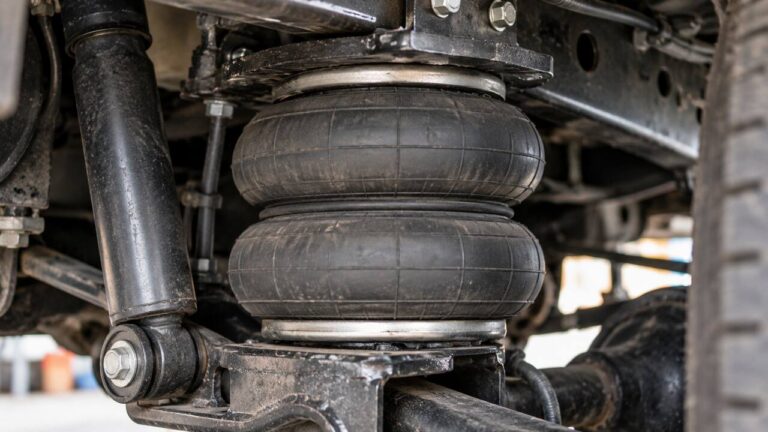
Air Suspension Leak Repair: How to Find and Fix a Leak
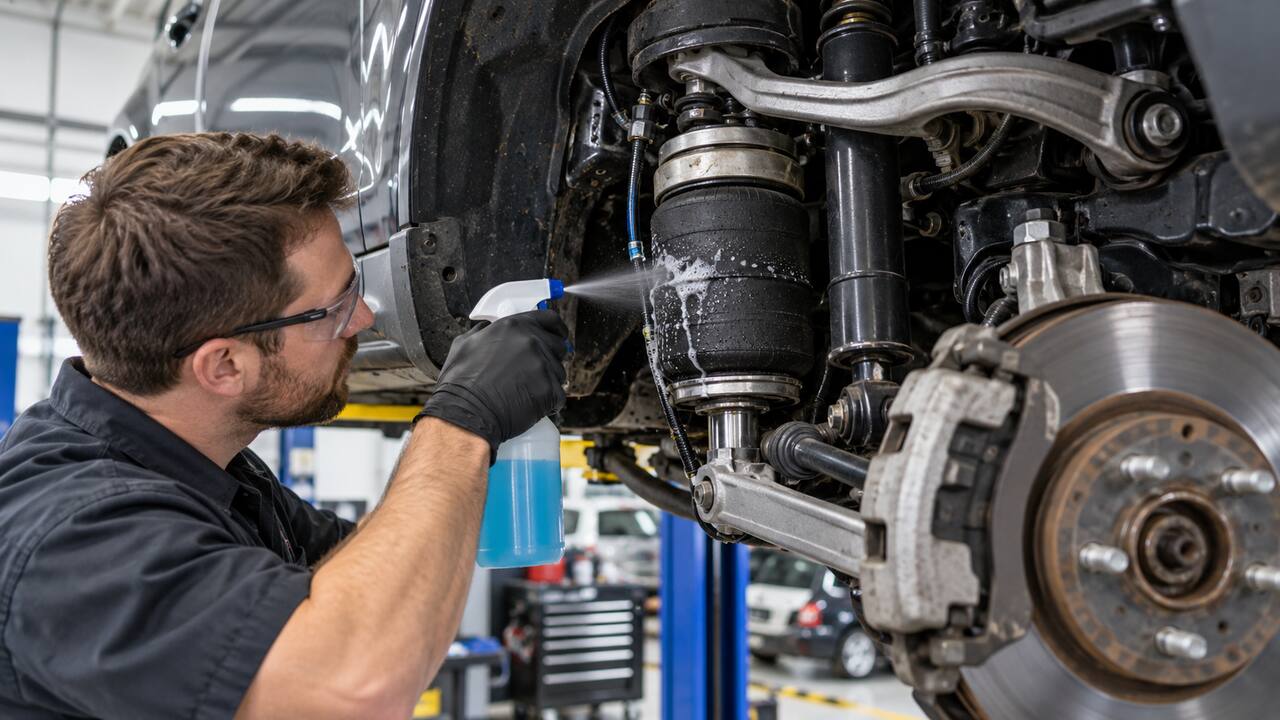
An air suspension leak usually reveals itself when one corner or one axle drops after parking, the compressor runs more often than normal, or the vehicle takes too long to reach ride height. The leak may be in an air spring, strut, line, fitting, reservoir, valve block, or compressor check valve.
You can inspect accessible components with an approved leak-detection solution, but repairing high-pressure suspension components requires the correct depressurization, lifting, refilling, and calibration procedure. Never remove a fitting or air spring while the system is pressurized.
Air Suspension Leak Symptoms
Air suspension leaks can produce different symptoms depending on which circuit is losing pressure. Use these observations to narrow down the likely cause before ordering replacement parts:
| Symptom | Possible Cause | Useful First Check |
|---|---|---|
| One corner drops overnight | Air spring, strut, line, or fitting leak | Measure all four corners before and after parking |
| Both corners on one axle drop | Shared circuit, valve block, or two aging springs | Check whether both sides fall by a similar amount |
| Whole vehicle drops | Valve block, reservoir, check valve, or multiple leaks | Scan the suspension module and isolate circuits |
| Compressor runs frequently | Leak causing repeated pressure loss | Find the leak before replacing the compressor |
| Vehicle rises slowly | Large leak, weak compressor, restriction, or low voltage | Check fault codes, voltage, pressure, and compressor time |
| Hissing near one wheel | Air spring, line, solenoid, or fitting leak | Use approved leak-detection fluid on accessible areas |
| Height changes with no visible external leak | Internal valve-block or check-valve leak | Professional circuit isolation may be required |
| Suspension warning message | Pressure, compressor, sensor, valve, or electrical fault | Read suspension-module codes before clearing them |
How Air Suspension Holds the Vehicle Up
An air suspension system uses pressurized air springs instead of—or in combination with—conventional metal springs. A compressor supplies air, a reservoir may store it, a valve block directs it, and height sensors tell the control module how the vehicle is sitting.
When the control module detects that the vehicle is below its target height, it may operate the compressor and open the appropriate valves. If air escapes, the system must repeat that process. A small leak can therefore damage a compressor over time even when the vehicle still raises normally after starting.
Common Causes of Air Suspension Leaks
Air can escape from several points in the suspension system, and the location of the leak determines the correct repair. These are the components most worth checking:
Cracked or Worn Air Spring
Air springs flex whenever the suspension moves. Age, dirt, road salt, heat, cold, abrasion, and repeated folding can eventually crack the rubber bellows. Leaks often appear where the rubber rolls over itself, so the damaged area may be hidden at normal ride height.
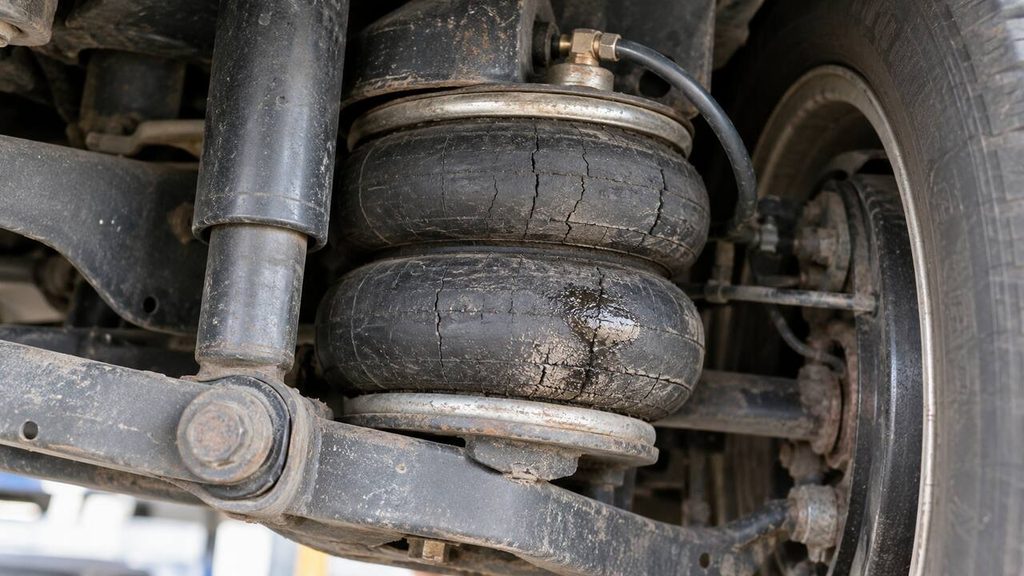
A leaking air spring or integrated air strut is normally replaced, not patched. Sealants and tire-repair products can contaminate the pneumatic system and are not a safe structural repair for a suspension component supporting vehicle weight.
Damaged Air Line
Pneumatic lines can leak where they rub against the body, contact heat, bend too sharply, suffer impact damage, or enter a connector. A line may also be damaged during unrelated suspension or body work.
Wrapping the line with tape or applying external glue is not a suitable repair. Depending on the vehicle, the correct solution may be a complete original line or an approved section repair using the specified tubing, connector, cutting tool, and routing.
Leaking Fitting, Seal, or O-Ring
A connection may leak because the line is not inserted fully, its end is scratched or cut at an angle, the retaining collet is damaged, or an internal seal has deteriorated. Repeatedly tightening a push-to-connect fitting does not necessarily fix it and may damage the component.
Air Strut Solenoid Leak
Many original air struts contain a solenoid valve controlling airflow into and out of the spring. The solenoid body, connector, or sealing rings can leak. Replacement and sealing procedures vary by vehicle and may require the system to be depressurized electronically with a diagnostic tool.
Valve Block Internal Leak
The valve block distributes air between the compressor, reservoir, and individual suspension circuits. An internal leak may transfer air from one circuit to another or allow pressure to escape without producing visible bubbles outside the block.
Because valve-block symptoms can imitate a leaking spring, it should be tested rather than replaced based only on the vehicle’s stance.
Reservoir or Compressor Check-Valve Leak
Corrosion or physical damage can cause a reservoir to leak. A check valve or dryer connection near the compressor may also allow stored pressure to bleed away. The compressor itself may still run, but the system cannot retain the air it produces.
Leak or Compressor Failure?
A vehicle that will not rise does not automatically need a compressor. It may have a leak so large that pressure cannot build, a stuck valve, a sensor fault, low system voltage, a blown fuse, a faulty relay, or a compressor that has already been damaged by excessive operation.
| Observation | More Consistent With a Leak | More Consistent With Compressor or Electrical Trouble |
|---|---|---|
| Vehicle drops while parked | Yes | Not usually by itself |
| Compressor runs repeatedly | Often | Possible if compressor is inefficient |
| No compressor sound | Leak may still be present | Fuse, relay, wiring, module, or compressor fault possible |
| Vehicle rises but later drops | Strong leak indicator | Compressor may be functional |
| Vehicle never rises | Possible large leak | Compressor, power, valve, or pressure fault possible |
See our separate guide on how to tell if an air suspension compressor is bad. That article focuses on compressor diagnosis, while this page concentrates on locating and repairing lost air pressure.
How to Find an Air Suspension Leak
The following checks help locate a leak without opening the pressurized system. Stop if the manufacturer’s procedure requires a scan tool or if any inspection would place you beneath an unsupported vehicle.
1. Record the Vehicle’s Ride Height
Park on level ground with normal tire pressures and remove unusual cargo. Measure from the center of each wheel vertically to a consistent point on the wheel arch. Record all four measurements and repeat them after several hours or the next morning.
Measuring from the wheel center avoids tire-pressure changes affecting the result as much as a ground-to-body measurement. Remember that some vehicles perform normal leveling corrections after shutdown, so consult the owner’s manual before interpreting a small change.
2. Listen for Escaping Air
In a quiet location, listen around each wheel and accessible pneumatic component. A larger leak may hiss, but many slow leaks are silent. Keep hands, clothing, and tools away from moving suspension parts because the vehicle may change height automatically.
3. Inspect Accessible Components
Look for cracked rubber, abrasion, pinched lines, corrosion, damaged connectors, loose routing clips, or evidence that a line has contacted a tire, exhaust, or moving suspension part.
Do not crawl beneath a vehicle supported only by its air suspension or a jack. If lifting is required, use the manufacturer’s jack or service mode, specified lift points, and properly rated support equipment.
4. Apply Approved Leak-Detection Solution
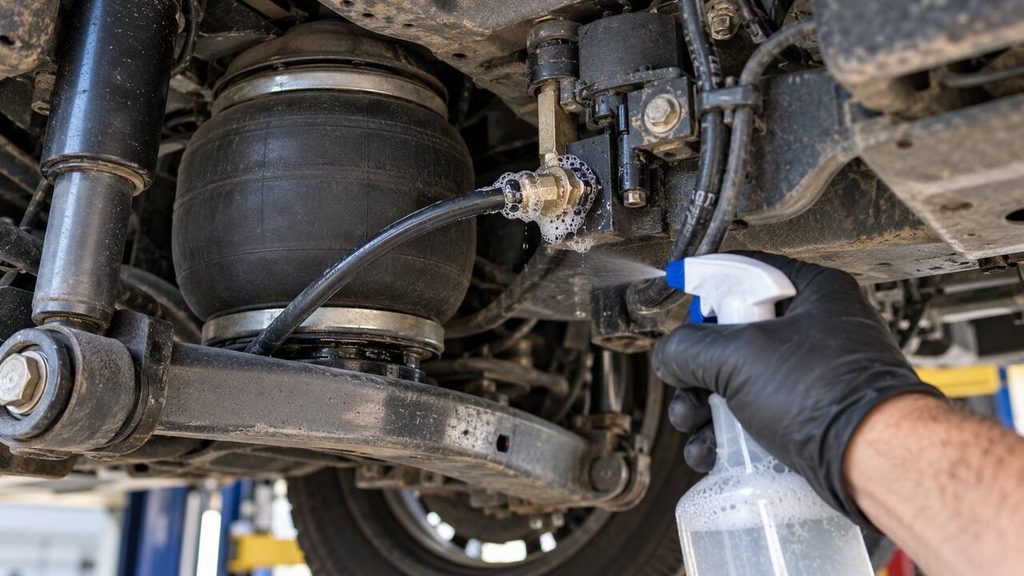
With the system pressurized, apply a manufacturer-approved leak detector—or a suitable soap-and-water solution when permitted—to accessible air spring folds, line connections, valve fittings, and reservoir connections. Do not flood electrical connectors or spray hot components.
Watch for bubbles that continue to form or grow. Foam created while applying the solution is not proof of a leak. Mark the confirmed location and clean the area afterward as instructed by the product manufacturer.
5. Scan the Suspension Control Module
A capable scan tool can show stored faults, requested and actual ride heights, sensor values, pressure data, compressor run time, and valve commands. A basic engine-code reader may not communicate with the suspension module.
Record the codes before clearing them. Erasing a warning or disconnecting the battery does not repair a leak and may remove useful diagnostic evidence.
6. Isolate the Pneumatic Circuits
If no external leak is visible, a technician may isolate the air springs, valve block, reservoir, and compressor circuit while monitoring pressure loss. This helps distinguish a leaking spring from an internal valve or check-valve fault.
Do not disconnect lines merely to perform this test. Opening a pressurized line can cause injury and may introduce dirt or moisture into the system.
How an Air Suspension Leak Is Repaired
The correct repair depends on the confirmed leak location. Replacing parts based only on where the vehicle sits can become expensive and may leave the original problem unresolved.
| Leak Location | Normal Repair | Important Follow-Up |
|---|---|---|
| Air spring or air strut | Replace the leaking assembly or approved service component | Inspect the matching side and compressor duty cycle |
| Damaged pneumatic line | Replace the line or use an approved model-specific repair | Correct routing and abrasion cause |
| Fitting or seal | Replace damaged seal, connector, or correctly prepared line end | Pressure-test the connection |
| Valve block | Replace or service only when internal leakage is confirmed | Test all circuits and calibrate if required |
| Reservoir | Replace a corroded or damaged reservoir | Inspect mounts and connected lines |
| Compressor check valve or dryer connection | Repair according to the manufacturer’s procedure | Verify pressure retention and compressor run time |
Can an Air Suspension Bag Be Patched?
A vehicle air spring should normally be replaced rather than patched. It is a structural, constantly flexing, pressurized component carrying vehicle weight. A patch, external adhesive, tire plug, or liquid sealant may fail without warning and can contaminate other parts of the system.
If bubbles appear at the line connection rather than through the rubber bellows, the problem may be the fitting, O-ring, solenoid seal, or line end. Diagnose the exact source before condemning the complete spring.
Can You Repair an Air Line Yourself?
Some aftermarket systems permit line replacement or approved push-to-connect repairs using the specified pneumatic tubing and fittings. The line must be cut squarely with the correct tool, inserted to the required depth, routed away from heat and movement, and pressure-tested.
Factory systems may use model-specific line sizes, connectors, sealing methods, and electronic depressurization procedures. Follow the service manual rather than applying a universal air-line repair method.
Do not use:
- Electrical tape or duct tape over a pneumatic leak
- Unrated household air tubing
- A kinked or angled line end inside a push fitting
- Sealant that can travel into valves or the compressor
- A splice positioned beside exhaust heat or moving suspension parts
DIY Repair or Professional Mechanic?
Some leak checks are suitable for careful owners, while others involve pressurized components, vehicle lifting or specialized diagnostic equipment. The table below shows when professional assistance is recommended:
| Task | Suitable for Careful DIY Inspection? | Professional Service Recommended? |
|---|---|---|
| Record overnight ride height | Yes | Not normally required |
| Listen and inspect accessible components | Yes | If lifting or disassembly is needed |
| Apply approved leak detector externally | Sometimes | If access is unsafe or the vehicle self-levels |
| Read manufacturer-level suspension data | Only with suitable equipment and knowledge | Usually |
| Depressurize the suspension | No for inexperienced owners | Yes |
| Remove an air strut or spring | Advanced model-specific repair | Yes for most owners |
| Diagnose an internal valve-block leak | Not reliably without equipment | Yes |
| Calibrate ride height after repair | Only with correct scan tool and specifications | Usually |
Air Suspension Leak Repair Cost
Cost depends on whether the leak comes from an inexpensive accessible fitting or a complete electronically controlled air strut. Labor access, OEM versus aftermarket parts, calibration, wheel alignment, taxes, and damage to the compressor can change the final price substantially.
Ask for an itemized estimate identifying:
- The confirmed leak location
- The diagnostic method used
- Whether one component or an axle pair is being replaced
- OEM, aftermarket, or remanufactured part quality
- Required calibration or alignment
- Parts and labor warranty
- Whether the compressor and relay were tested for secondary damage
For current planning ranges by component, see our dedicated air suspension replacement cost guide.
Can You Drive With an Air Suspension Leak?
Do not drive if the body is close to a tire, one corner is severely collapsed, a tire rubs, steering or braking feels unstable, the suspension is resting on its bump stops, or the dashboard tells you to stop. Arrange towing or professional assistance.
A small leak may initially allow the vehicle to rise, but continued driving can force the compressor to run repeatedly and cause an additional failure. Repairing the leak early is normally less expensive than replacing both the leak source and an overheated compressor.
How to Verify the Repair
After the leaking component has been repaired using the manufacturer’s procedure, verify that the system holds pressure and operates normally. These final checks help identify any remaining leaks or related faults:
- Pressure-test the repaired connection or replacement component.
- Confirm that the vehicle reaches its specified ride height.
- Run any required filling, bleeding, or calibration procedure.
- Check that the compressor operates for a normal period rather than cycling repeatedly.
- Scan the suspension module and address remaining faults.
- Repeat the parked ride-height measurements after several hours or overnight.
- Obtain a wheel alignment when required by the repair procedure.
Frequently Asked Questions
Why does my air suspension drop overnight?
A leaking air spring, line, fitting, valve block, reservoir, or check valve may allow pressure to escape while parked. The corner or axle that drops helps narrow the search but does not prove which component failed.
Can a valve block make one side sag?
Yes. An internal valve-block leak can imitate an air spring leak by allowing pressure to move between circuits or escape. Circuit isolation is often required when no external bubbles are found.
Will disconnecting the battery fix an air suspension leak?
No. It may temporarily clear a message or reset module behavior, but it cannot seal a pneumatic leak. It may also erase useful diagnostic information.
Will a leaking air spring damage the compressor?
Yes. The compressor may run too frequently or for too long while trying to replace escaping air. This can overheat the compressor, damage its relay or connectors, and increase the final repair cost.
Should both air springs be replaced together?
Not in every case, but replacing both on the same axle may be sensible when they are the same age and one has failed from rubber deterioration. Follow the vehicle and component manufacturer’s recommendation and compare the condition of the opposite side.
How long do air suspension bags last?
There is no universal mileage or age. Climate, contamination, suspension movement, load, storage, rubber quality, and system maintenance all affect lifespan. See our guide on air suspension bag lifespan and failure signs.
Find the Leak Before Replacing Parts
A sagging vehicle does not automatically need an air spring, and a vehicle that will not rise does not automatically need a compressor. Record how the vehicle loses height, inspect accessible components, use leak-detection solution correctly, and read suspension-module data. Once the leaking circuit is confirmed, repair it using the vehicle manufacturer’s depressurization, replacement, refilling, and calibration procedure.