Chevy Colorado Lift Kit: Heights, Tires & Fitment by Year
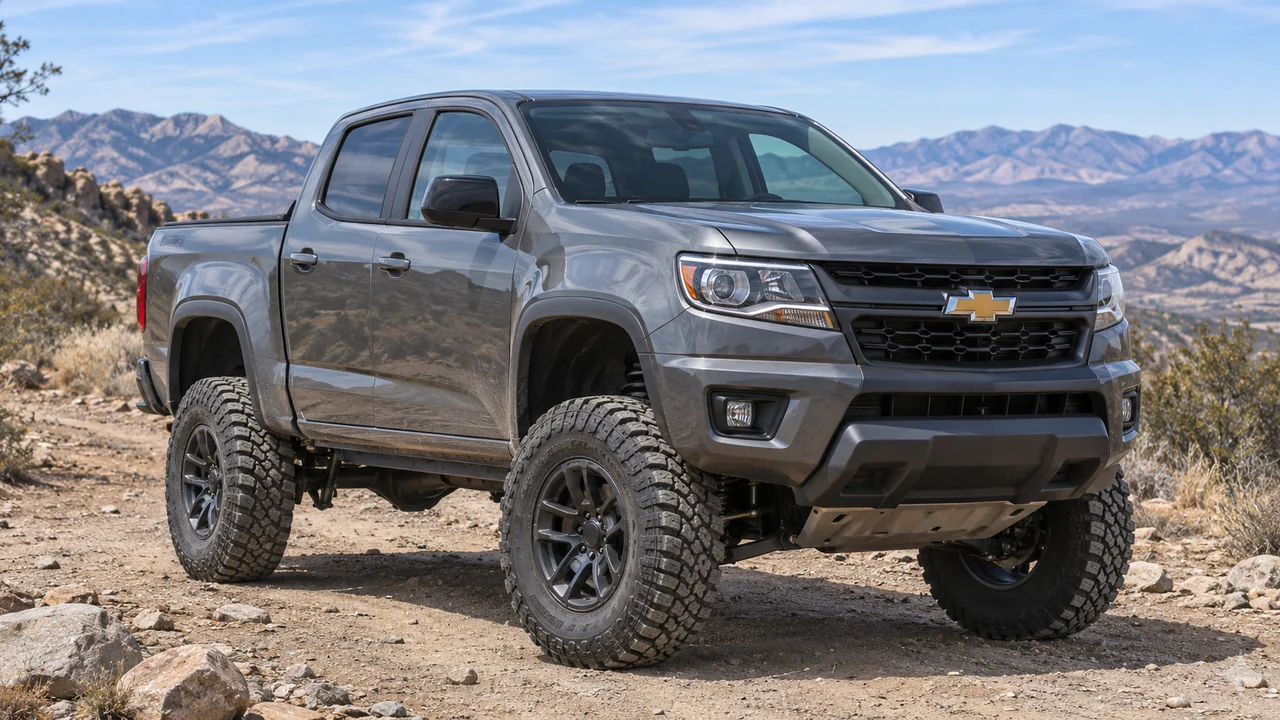
The best Chevy Colorado lift kit for a daily driver is often a 1–2-inch level or a matched suspension upgrade in the 2–3-inch range. A four-inch lift is worth considering if your particular truck needs more clearance for its intended wheels and tires. Six inches is a much bigger commitment. And if you own a Trail Boss, ZR2 or Bison, start with parts designed for that factory suspension rather than a kit made for a standard Colorado.
The model year matters just as much as the height. A 2005 Colorado may have torsion bars or front coil springs. A 2018 uses a different chassis, and a 2023 uses another wheel bolt pattern. Even two trucks from the same year can need completely different lift parts. Use the following comparison to narrow down the choices before spending money on a kit.
Which Lift Makes Sense for Your Colorado?
These are shopping starting points for U.S.-market trucks, not universal clearance guarantees. The heights refer to aftermarket changes from the applicable factory suspension unless otherwise specified. A kit sold for a factory-lifted model must be interpreted using that manufacturer’s own height reference.
| Colorado configuration | Where to start | Typical tire goal or reason |
|---|---|---|
| 2004–2012, torsion-bar front end | 1–2.5-inch key/level package, or a chassis-specific full lift | Around 30–31 inches on a mild build |
| 2004–2012, standard coil-spring 2WD | Coil-spring chassis-specific lift | Modest height increase; do not order torsion keys |
| 2015–2022, standard suspension | 1–2-inch level or matched strut package | About 31–32 inches; larger sizes need a closer fitment check |
| 2015–2022, taller street build | 4- or 6-inch suspension system | Wheel clearance and roughly 33-inch tire territory, depending on the kit |
| 2023–2026, WT/LT/Z71 | 1–2-inch level or matched strut upgrade | Approximately 32–33 inches with suitable wheels |
| 2023–2026, standard 4WD with larger tire goal | 4- or 6-inch geometry-corrected system | 33–35-inch territory where explicitly supported |
| 2023–2026, Trail Boss or ZR2 | Retain factory setup or buy a trim-specific system | 33–35 inches depending on trim, wheel and body clearance |
| ZR2 Bison with factory 35s | Keep factory configuration unless there is a specific reason to change it | Maintain clearance, travel and factory off-road equipment |
If you are choosing between two heights, ask the seller for the actual wheel-and-tire combination used to establish clearance. A four-inch kit that requires new wheels may cost much more to finish than a two-inch package that works with the wheels you already own. That is particularly relevant on the Colorado because wheel fitment changes across generations.
2004–2012 Colorado: Look Under the Front End First
Shopping for a 2005 Chevy Colorado lift kit is not simply a matter of entering 2005 into a parts selector. The first-generation truck was available with more than one front spring arrangement. Standard-height rear-wheel-drive versions used coil springs, while 4WD and certain high-stance 2WD versions used torsion bars. A Z71 badge or the absence of a front driveshaft is not enough to identify every part.
Torsion-bar trucks
Look for a long spring bar extending rearward from each lower control arm. On this layout, a mild lift is commonly achieved through a revised key or key-spacer arrangement, with rear shackles or another matched rear component when needed. The truck’s existing ride height, suspension travel and condition determine whether that approach is sensible. It is not a way to restore a front end with worn-out joints or damaged springs.
One example is Rough Country’s 920 package for 2004–2012 4WD Colorados. Its wheel chart includes 265/75R16 on factory 16-inch wheels and 31×10.50R16 on 16×8 wheels with +30 mm offset. Those are concrete starting combinations for that particular kit, not approval for every first-generation truck. A different wheel position or aggressive tread shoulder can change clearance considerably.
If you are evaluating a key-based kit, our torsion bar key fitment guide explains what the key actually changes. On a Colorado that is two decades old, check the current ride height and inspect the steering and control-arm joints before ordering lift hardware.
Coil-spring 2WD and high-stance 2WD are not interchangeable
A standard coil-spring 2WD truck needs a kit specifically engineered for its front suspension. Do not order a torsion-key set because a marketplace title says it fits every 2004–2012 Colorado. Likewise, a lift spindle or coil-spring spacer designed for one front-end layout should not be assumed to work on a high-stance truck with torsion bars. Confirm the chassis from the vehicle identification and a visual inspection, then match the part number.
When a first-generation four-inch lift is worth the trouble
Complete lifts for selected early 4WD trucks exist, including systems using revised suspension geometry rather than simply turning up the torsion adjustment. Before buying one, check whether its replacement hardware is still available separately. An incomplete used kit may be cheap because its brackets, steering pieces or installation instructions are missing. On an older truck, rusted fasteners and overdue front-end repairs can also change the installation budget substantially.
2015–2022 Colorado: A Different Starting Point
The second-generation U.S. Colorado arrived for the 2015 model year with a coil-spring front strut arrangement and a leaf-sprung solid rear axle. Its front suspension parts are not carried over from the 2004–2012 truck. There is no U.S. Colorado model year for 2013 or 2014, so be cautious about international-market listings that span those dates.
WT, LT and Z71: leveling and mild suspension lifts
A one-inch front spacer can be enough when the main complaint is factory rake. A two-inch leveling kit is a more visible change and may help accommodate a slightly taller tire. Rough Country’s 922 kit, for example, identifies 265/70R17 on factory wheels as a fitment target for the applicable 2015–2022 configuration. That tire is approximately 31.6 inches in nominal diameter, considerably smaller than a true 33-inch flotation-size tire.
If the original dampers are worn, consider a matched set of replacement lift struts rather than paying to install spacers over tired parts and then repeating the work. A loaded strut is not the same thing as a basic spacer: the spring and damping assembly are part of the purchase. Compare the approved engine, drive type, trim and intended height before choosing either route.
The 2.8L Duramax and 3.6L V6
A diesel Colorado carries a different front-end load than a gasoline truck. Some full kits cover both engines, while certain strut packages, body lifts or preload-based systems have narrower application lists. A front spring calibrated for one engine may not produce the expected height or ride behavior on another. Check the 2.5L four-cylinder where applicable as well. The vehicle year alone is not a complete fitment specification.
2017–2022 ZR2 and the late second-generation Trail Boss
The second-generation ZR2 has wider suspension geometry and a factory lift of approximately two inches compared with a conventional Z71, along with Multimatic DSSV dampers. It is not the same as a standard Colorado with aftermarket wheels. Some common four- and six-inch systems specifically exclude it. Owners of the late second-generation Trail Boss package should also pay attention to separate exclusions for its factory-raised suspension; do not confuse that package with the third-generation Trail Boss chassis.
A ZR2 owner who wants to retain its factory dampers should begin with a system expressly designed around them. A standard replacement strut advertised for the same model year does not necessarily preserve the factory travel, mounting arrangement or valving. If replacing the DSSV hardware is part of a deliberate suspension conversion, evaluate the complete system rather than treating the dampers as interchangeable accessories.
2023 and Newer: The Trim Changes the Lift You Need
Chevrolet introduced three chassis configurations for the third generation, as detailed in its 2023 Colorado engineering announcement. WT, LT and Z71 share the standard-height chassis family, while Trail Boss and ZR2 have factory suspension changes. The 2023–2026 aftermarket examples below are year-specific; 2027 owners should confirm the exact new-model-year listing rather than assume every earlier part number has been carried forward.
| Third-generation trim | Factory starting point | What to check when buying |
|---|---|---|
| WT / LT | Standard chassis family | 2WD or 4WD, spring/strut fitment, wheel clearance |
| Z71 | Standard chassis family with off-road equipment | Exact kit approval; do not confuse Z71 with ZR2 |
| Trail Boss | 2-inch factory lift and wider stance | Additional height referenced to Trail Boss; unique exclusions |
| ZR2 | 3-inch factory lift, wider chassis, DSSV dampers, 33-inch tires | Damper retention, control arms, travel and tire clearance |
| ZR2 Bison | ZR2-based AEV package with factory 35-inch tires on third-generation Bison | Bison-specific body, bump stops, armor and damper compatibility |
WT, LT and Z71: start with the tire you actually want
For a commuter or a truck that sees forest roads and occasional camping, an inch or two of additional height may do everything needed. The 2023–2026 Rough Country 13100 kit lists several wheel-and-tire combinations, including 285/65R18 on an 18×9 wheel with zero offset. It also lists a 33×11.50R20 combination with trimming. Its exclusions include the ZR2. That illustrates why a general claim that a two-inch lift fits 33s needs a much more specific explanation.
Colorado Trail Boss: already lifted from the factory
On a third-generation Trail Boss, the factory front track is wider and the suspension is raised by two inches compared with the standard chassis reference. Adding a kit advertised as three inches for a conventional Colorado is not necessarily equivalent to adding three inches to a Trail Boss. Some standard-height kits are expressly excluded; other systems are designed specifically for the taller factory truck. The relevant number is the additional change produced on your actual trim.
For an example of a dedicated system, the Zone Offroad Trail Boss 3-inch kit for 2023–2026 pairs revised upper control arms with a spacer arrangement and a rear shock choice. Its published recommendation includes 35×11.50 tires on 17×8.5 or 17×9 wheels with 5.5 inches of backspacing. Trimming may be necessary. That is quite different from promising that any 35×12.50 tire will fit after installing a generic spacer.
ZR2 and Bison: protect what you paid for
On the third-generation ZR2, the factory 33-inch tires, DSSV dampers and suspension layout already provide substantial off-road capability. The Bison version of this generation is supplied with 35-inch tires and additional AEV equipment. A new lift is not automatically an improvement, especially if it reduces usable droop or forces you to replace expensive factory components that are already working well.
ReadyLIFT’s 2023–2026 SST application announcement is a useful example of how differently these trucks are treated: its 69-33200 system is intended for ZR2 applications, while 69-33250 is intended for Trail Boss applications. The two part numbers are not interchangeable. If you have a Bison, confirm that it is expressly supported; a generic ZR2 listing is not sufficient proof.
Chevy Colorado 4-Inch vs 6-Inch Lift Kit
The decision is not just about whether you like the look of a tall truck. A four-inch and a six-inch kit can have very similar tire recommendations, yet require different amounts of rear lift, changes to the front crossmembers and different shock lengths. Compare the parts in each box and the wheel requirements before deciding that the taller system is better value.
What a four-inch suspension lift changes
On a standard second-generation Colorado, a full four-inch system can move the steering and suspension geometry away from the limits of a simple strut spacer. Depending on the design, it uses replacement knuckles, crossmembers, differential brackets on 4WD models, and rear lift hardware. Some systems retain the original front strut assembly with an extension; others offer complete replacement assemblies.
The advantage is that the truck can be built around the desired wheel position with a more comprehensive set of corrections than a tall spacer alone. The downside is a more involved installation. A kit may require drilling or trimming even when the product description calls it bolt-on. Check the instructions before paying for labor or assuming the truck can easily be returned to stock.
When six inches actually earns its place
A six-inch lift makes sense for a deliberately tall build, when the selected kit supports the planned tire and wheel package and you are comfortable with the additional height. It is not a prerequisite for every 33-inch tire. For 2015–2022 trucks, Rough Country’s four- and six-inch systems both list combinations such as 285/65R18 with aftermarket 18-inch wheels. Both have factory-wheel restrictions. The extra two inches therefore do not automatically buy a larger approved tire.
On the next generation, the same manufacturer’s 2023–2026 six-inch 4WD system has a different wheel requirement: aftermarket 20-inch wheels are specified because the corrected steering geometry makes the original wheels incompatible. The listing also rules out ZR2. If you already own a good set of 17-inch trail wheels, a system with that restriction may send your build in a completely different direction.
There are also practical costs that do not show up in a kit photo. Garage clearance, a roof rack, a bed-mounted tent, trailer hitch height and getting children or equipment into the truck can all become more awkward. A tall Colorado is still a midsize pickup, but it may no longer fit the spaces that made a midsize truck appealing in the first place.
Will 31s, 33s or 35s Fit? Read the Whole Tire Size
A tire described as a 33 may actually measure closer to 32.5 inches, and a narrow 35 can be considerably easier to package than a wide one. These common sizes explain why two Colorado owners can report completely different clearance results while describing their tires with the same rounded number. Dimensions below are nominal calculations, not measurements of a mounted tire.
| Tire size | Approx. diameter | Approx. nominal width |
|---|---|---|
| 265/75R16 | 31.6 in | 10.4 in |
| 265/70R17 | 31.6 in | 10.4 in |
| 275/70R17 | 32.2 in | 10.8 in |
| 285/65R18 | 32.6 in | 11.2 in |
| 285/70R17 | 32.7 in | 11.2 in |
| 285/75R17 | 33.8 in | 11.2 in |
| 35×11.50R17 | 35 in (labeled) | 11.5 in |
| 35×12.50R17 | 35 in (labeled) | 12.5 in |
A sensible 33-inch Colorado build
On an early Colorado or a standard second-generation truck, a true 33-inch tire can be more demanding than a nominal 32-inch metric alternative. Decide whether your goal is the look of a larger tire, extra clearance underneath the axle or a particular off-road tread pattern. A 265/70R17 may be a more useful daily-driver choice than buying a taller kit solely to accommodate a wider tire. For a third-generation truck, check its original tire size first; a ZR2 already has a factory 33-inch class tire.
Running 35s on a Colorado
Do not assume a six-inch lift is the only way to fit 35s on the newest generation. Trim-specific packages for the Trail Boss and ZR2 are available around that tire goal, and the third-generation Bison comes equipped with 35s from the factory. But that does not make those combinations interchangeable. The Bison has its own body and suspension equipment, and aftermarket recommendations can be limited by both tire width and wheel position.
A 35×11.50 and a 35×12.50 tire differ by a full inch in nominal section width. On the same wheel, the wider tire may extend roughly half an inch farther on each side, before differences in actual construction are considered. That extra width can be significant near a Colorado’s control arm, steering components and rear edge of the front wheel opening. A narrower tire may allow you to avoid a larger change to the truck.
Check wheel fitment before buying the kit
Six lug nuts do not guarantee that a wheel fits all three Colorado generations. U.S. trucks from 2004–2012 commonly use a 6×139.7 mm (6×5.5-inch) bolt pattern; 2015–2022 models use 6×120 mm; 2023–2026 models return to 6×139.7 mm. The first and third generations still have different hub dimensions, and wheel load rating, brake clearance, lug-seat design and offset matter. Verify your exact model, including newer model-year applications, before trying to reuse wheels from another Colorado.
When a kit specifies backspacing rather than offset, use our wheel offset and backspacing comparison to interpret the requirement for the actual wheel width. A wheel positioned farther outward might clear a control arm, yet swing into the fender liner when turning. It is not necessarily the solution to a rubbing problem.
Where the Colorado tends to run out of clearance
Inspect the front wheel opening near the bumper, the rear of the liner and any mud flap, as well as the upper control arm and steering knuckle. The tire must have space while steering and moving through suspension travel, not just when the truck is parked on flat ground. A photo with the steering straight cannot establish whether the same wheel will rub at full lock or when the suspension compresses.
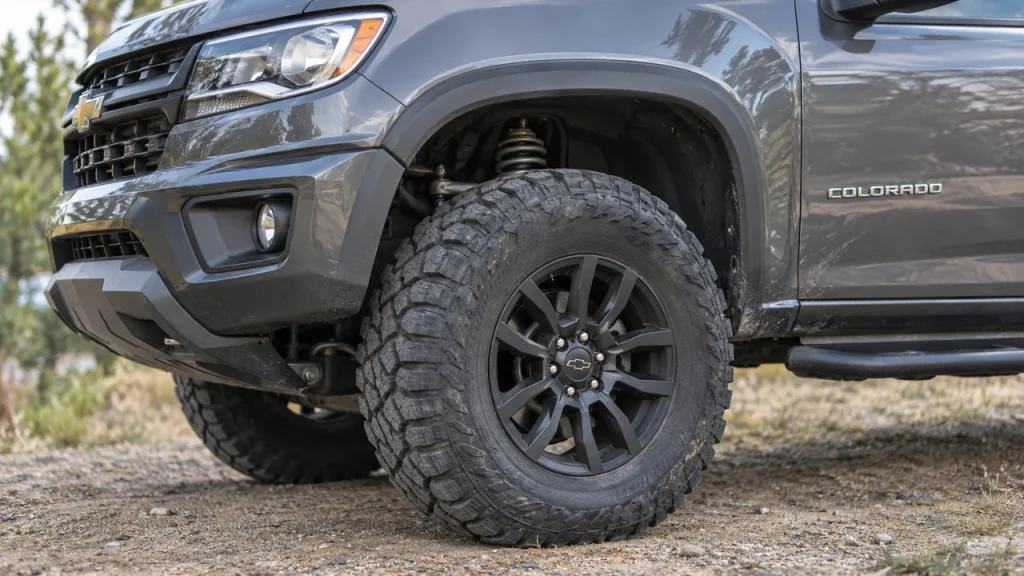
Also check that the spare can be carried securely and accessed when needed. A full-size replacement may be too large for the original under-bed position, particularly with a 35-inch conversion. For a remote trail truck, solving that problem belongs in the build budget, not on the list of things to think about after the first puncture.
Spacers, Replacement Struts or a Full Suspension System?
The cheapest lift is not always the cheapest way to achieve a particular result on a Colorado. These approaches solve different problems. Choose according to the condition of the original parts, the intended terrain and the height your exact chassis can accommodate.
A leveling kit for a truck that mostly stays on the road
A small front level is a reasonable purchase if you simply want less rake and your existing suspension is healthy. On a first-generation torsion-bar truck that means one kind of hardware; on a newer coil-spring truck it means another. A front-only change can also leave the truck nose-high when carrying a heavy load in the bed. For the broader distinction between these modifications, see our leveling kit versus suspension lift comparison.
A matched spring and damper package for rough-road driving
If your Colorado spends weekends on corrugated dirt roads, consider the spring rate, damping and remaining travel before focusing on the maximum advertised height. A quality vehicle-specific spring and damper package can improve control without requiring an extreme stance. For a camping build, tell the supplier about permanent front bumper or winch weight and rear cargo weight, rather than choosing a spring solely by how the unloaded truck looks.
Some kits include revised upper control arms; others do not. The need depends on the exact suspension position, ball-joint articulation, alignment capability and clearance to the spring or strut. An aftermarket arm is not a universal requirement for every two-inch lift, nor does its presence make every taller setup safe. Use the arm specified for the selected system and inspect travel after installation.
Body lifts and combination kits
A body lift raises the cab and bed relative to the frame. It can provide additional body-to-tire clearance but does not raise the suspension pivots or rear differential. Certain second-generation Colorado kits combine a body lift and suspension spacers to achieve a larger advertised height. Read the product description carefully so that a combination kit is not mistaken for a complete geometry-corrected suspension system. Verify engine exclusions, bumper mounts, steering connections and other affected components.
The front differential on 4WD models
An independent front suspension lift can increase the working angle of the front CV axles. Complete systems often reposition the differential to help manage that change, while a mild kit may not require separate hardware. Do not add a generic differential spacer to a system that already relocates the housing. Our front differential drop guide explains why the mounting design and the resulting axle angles matter more than the nominal spacer thickness.
At the rear, the Colorado uses leaf springs and a solid axle. Blocks or revised leaf springs can lift the frame above the axle, but the lowest point of the rear differential only gains clearance from the increase in tire radius. Moving from a nominal 33-inch tire to a 35-inch tire gives approximately one inch of additional theoretical axle clearance, not two. The actual difference depends on the mounted and loaded tire dimensions.
Shopping by Brand and Total Installed Cost
Rough Country is useful for comparing a wide range of Colorado-specific heights, including older torsion-bar applications and large crossmember systems. ReadyLIFT and Zone Offroad offer model-specific packages for newer trucks, including some factory-lifted trims. Eibach and other spring-and-damper specialists are worth comparing when the priority is a balanced suspension rather than a very tall stance. None of these names is a substitute for the manufacturer’s fitment and installation sheet.
As a rough U.S. parts-only budget, simple leveling hardware can cost less than $150, while replacement strut packages can run several hundred dollars or more. A dedicated trim-specific system or large crossmember kit can approach or exceed $1,000 before upgraded dampers, wheels, tires, tax and labor. Those are shopping ranges, not quotes for a particular truck. The final price depends heavily on what you can retain from the original configuration.
For general labor and alignment estimates, use our lift kit installation cost guide. For your Colorado quote, ask the installer to price the exact kit, including any mandatory wheels or supporting hardware, rather than requesting a generic price for a four-inch lift.
What to send a parts seller or installer
You can settle most fitment questions in a single message if you include the information below. A useful quote should be based on the whole vehicle, not only a year and the advertised lift height.
- Model year, trim and whether the truck is 2WD or 4WD; include engine and factory suspension package.
- For 2004–2012 trucks, whether the front end uses coil springs or torsion bars.
- Any existing lift, spacers, aftermarket control arms or non-original springs.
- Current tire size and wheel width, bolt pattern and offset or backspacing.
- Target tire size, acceptable amount of trimming and whether the original wheels must be retained.
- Normal cargo, trailer use and permanent accessory weight; whether factory DSSV dampers must be kept.
- Whether the quoted kit includes rear lift hardware, all required geometry corrections and the final alignment.
What to Check After the Colorado Is Lifted
Do not consider the job finished just because the truck is standing on its new tires. The installer should verify that the suspension and steering operate through their intended range, and that all kit-specified fastener checks and alignment procedures have been completed. Follow the vehicle and kit manufacturer’s instructions rather than applying generic torque figures from another Colorado generation.
Ask for the alignment results and confirmation that the tires clear at both steering limits and through the relevant suspension movement. Check CV boots on 4WD models, brake hose and ABS-wire routing, damper travel, headlight aim and any required driver-assistance system calibration. Larger tires may also require speedometer correction, where supported. Follow the specified inspection and retorque schedule, especially for rear U-bolts where the kit uses them.
Finally, pay attention to how the truck behaves on ordinary roads. New vibration, pulling, steering-wheel misalignment, repeated topping out or tire contact are not things to accept as normal consequences of a lift. Have the installation inspected and corrected before taking the vehicle off-road or towing with it. A lift does not increase the manufacturer’s rated payload or towing capacity.
Chevy Colorado Lift Kit FAQs
These are the questions that come up when narrowing the shopping list to a specific height or trim. The answers assume U.S.-market trucks and should be checked against the application notes for the exact part number.
What lift kit fits a 2005 Chevy Colorado?
Identify the front suspension first. A 4WD or high-stance 2WD truck with torsion bars requires a different lift from a standard coil-spring 2WD truck. A key-based package may be suitable for modest height on an approved torsion-bar model, but a coil-spring truck needs hardware designed for its own chassis. Verify the year, drivetrain and suspension before ordering.
Can I run 33-inch tires with a 2-inch Colorado leveling kit?
Sometimes, especially on a newer standard-height Colorado with a compatible wheel combination. It is not a universal second-generation or first-generation fitment. A 285/65R18 measures about 32.6 inches nominally, whereas a flotation-size 33 can be wider or taller. Follow the manufacturer’s tested wheel specifications and check whether trimming is required.
Is a four-inch lift better than six inches?
Four inches may be the better choice for a street-driven truck when both systems support your planned tires. Six inches is more appropriate when additional chassis height is a deliberate goal and the wheel, installation and handling tradeoffs are acceptable. Compare the actual approved tire sizes rather than assuming the two extra inches are necessary.
Can I lift a Chevy Colorado Trail Boss more?
Yes, with a compatible system. Third-generation Trail Boss trucks already have a two-inch factory lift, so shop for a kit explicitly approved for that starting height. Some dedicated packages provide more height and room for larger tires. Check the stated additional front and rear lift and the exact tire width, wheel position and trimming notes.
Can I keep my Multimatic DSSV shocks on a lifted ZR2?
Yes, if the kit is engineered to retain the factory DSSV assemblies for your generation and trim. Some systems are specifically designed around them. Others exclude ZR2 entirely or replace its suspension as part of a complete conversion. Do not buy a standard Colorado lift strut simply because it is advertised for the same model year.
Will a Colorado lift kit also fit a GMC Canyon?
Many manufacturers sell shared Colorado and Canyon applications, but not all trims share the same starting geometry. Check both vehicles and model years in the actual listing. In particular, Canyon AT4 and AT4X should not be treated as identical to each other or to every Colorado. A shared platform does not establish compatibility by itself.
Can I install a Colorado lift and keep my factory wheels?
Some mild levels permit factory wheels, but certain larger kits require aftermarket wheels to clear their replacement knuckles and steering hardware. Some second-generation four- and six-inch systems specify aftermarket 18-inch wheels, while a third-generation six-inch example specifies aftermarket 20-inch wheels. Use the exact manufacturer requirements before buying tires for your current rims.