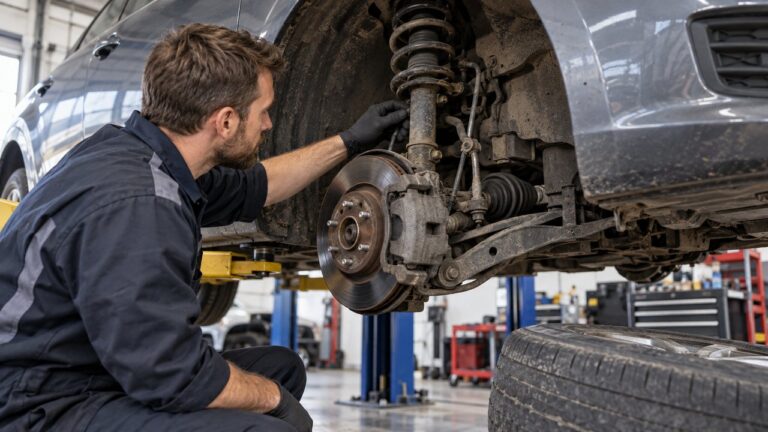
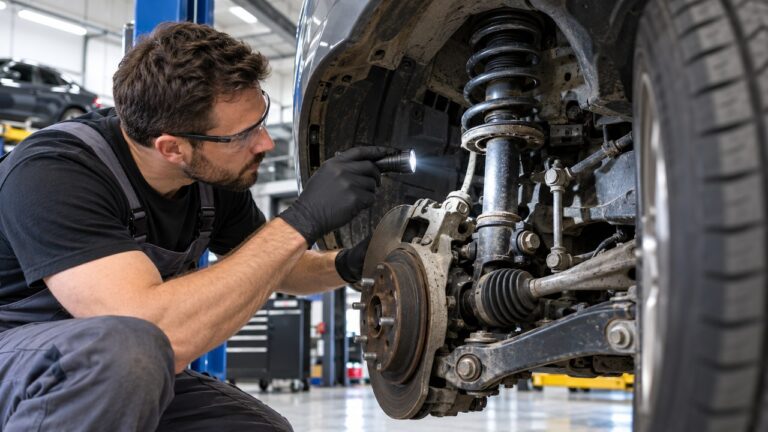
Torsion Bar Bushings: Symptoms, Types & Replacement
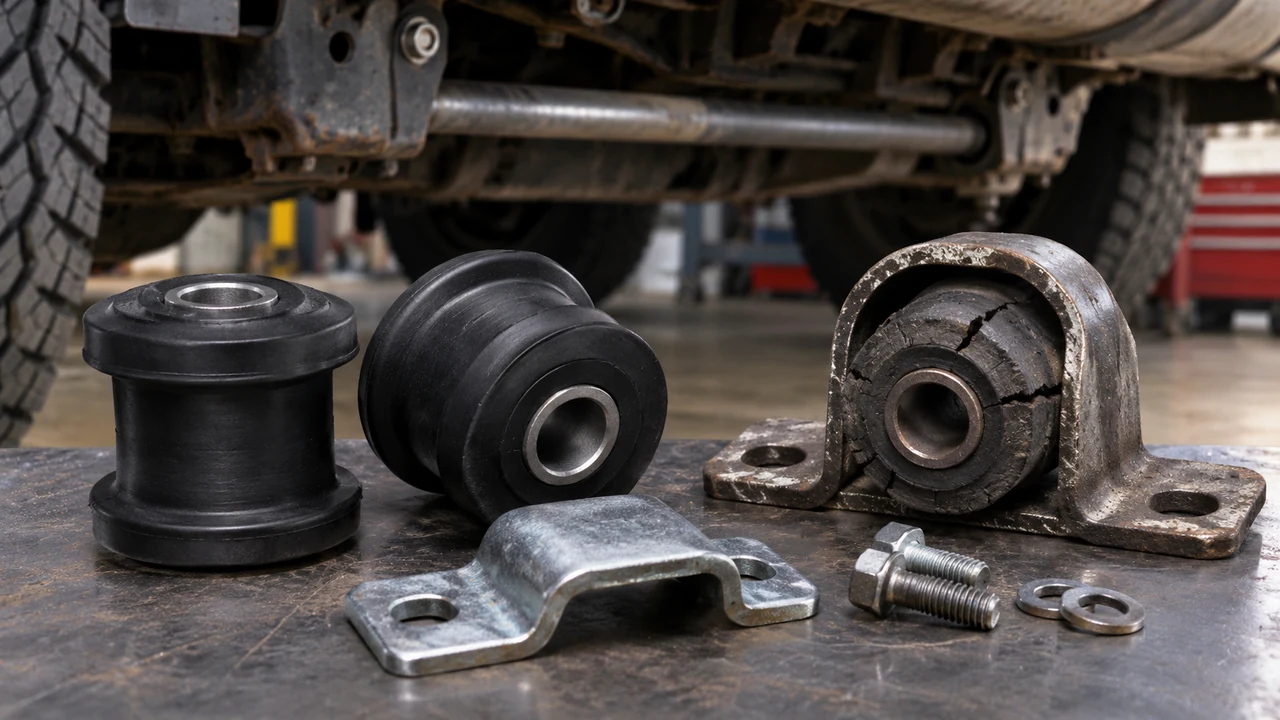
Torsion bar bushings are not one interchangeable suspension part. On many GM trucks, the name refers to rubber or polyurethane isolators supporting the torsion-bar crossmember. On older Chrysler cars, a catalog may show a crossmember mount or a dust seal at the bar anchor. In racing applications, it can mean a low-friction plastic bearing inside a torsion tube. Identify the mounting location before ordering a replacement kit. A bushing for one of those jobs will not substitute for another.
If you have a clunk near the middle or rear of a torsion-bar front suspension, inspect the crossmember hangers, their bolts and the surrounding frame first. But do not buy bushings on noise alone: worn control-arm pivots, stabilizer bar mounts and a loose torsion key can sound similar. The useful order is confirm the part, establish the fault, match the hardware, then plan safe removal—because a loaded torsion-bar system is not a casual bushing swap.
Which Torsion Bar Bushing Do You Actually Need?
This distinction is missing from many retail filters. It matters more than whether the replacement is advertised as rubber, polyurethane or heavy-duty. The term “torsion bar” can describe both a spring and, in some commercial-vehicle catalogs, a completely different suspension link.
| Part named in a listing | Where it works | What to verify before buying |
|---|---|---|
| Torsion-bar crossmember / hanger bushing | Between the anchor crossmember and frame or its hanger on applicable trucks | Exact vehicle and crossmember, sleeve, bolt and bushing shape |
| Torsion-bar mount insulator | A specific isolating mount in the bar-anchor structure | OEM diagram and whether the bushing comes with the bracket |
| Torsion-bar dust boot or seal | At or near a splined end, protecting the bar or anchor from debris | Bar diameter, seal style and generation; not a structural mount |
| Racing torsion-tube bushing | Within a sprint-car or similar torsion-bar tube | Tube bore, bar/spline dimensions, wall thickness and material |
| Sway-bar D-bushing or heavy-truck torque-rod bushing | A different anti-roll or locating component | Do not substitute on the basis of a search-result category |
Crossmember Bushings Support the Anchor Structure
In a typical torsion-bar front suspension, one end of the steel spring bar connects to a control arm; the other works against an anchored key or support farther back in the chassis. On applications with an isolated rear crossmember, bushings sit in the frame-hanger area and help control unwanted metal-to-metal movement. They are not rubber collars that slide over the entire torsion bar.
The exact arrangement varies with model and generation. Some vehicles have a directly mounted anchor and no replaceable crossmember bushing of the type shown in a popular GM truck catalog. For an overview of the load path, see our torsion bar suspension guide rather than assuming a parts illustration describes every vehicle.
Dust Boots and Seals Are Not Load-Bearing Bushings
On classic Mopar suspensions, a rubber boot at the end of the bar often serves as a dirt and moisture barrier around an anchor. It may be sold next to polyurethane torsion-bar bushings, and an older shop may refer to both as “torsion-bar rubber.” Their duties are not the same: a dust seal protects the assembly, while an isolator supports a mounting structure. A torn boot can allow contaminants in without being the source of a loose crossmember.
If an older Chrysler, Dodge or Plymouth has a missing boot, compare its original shape and the bar-end hardware before ordering. Do not buy a large crossmember bushing kit to replace a thin end seal. Conversely, a fresh seal will not restore a crossmember mount whose rubber has separated from its metal sleeve.
Racing Torsion-Tube Bushings Are a Different Size System
Micro Sprint and sprint-car catalogs may list short nylon or bearing-grade plastic sleeves under exactly the same keyword. They are meant to provide controlled, low-friction movement in a torsion-bar tube. Dimensions are often specified by a bar or spline size, outside diameter and wall thickness, not the year and trim of a road-going pickup.
For example, JOES Racing Products’ 25900 is listed as a set of small plastic racing bushings, not a GM crossmember repair. If your result page mixes 7/8-inch racing parts with Chevrolet suspension mounts, that is a catalog collision—not an indication that either piece has universal fitment.
Do Not Confuse These With Sway Bar Bushings
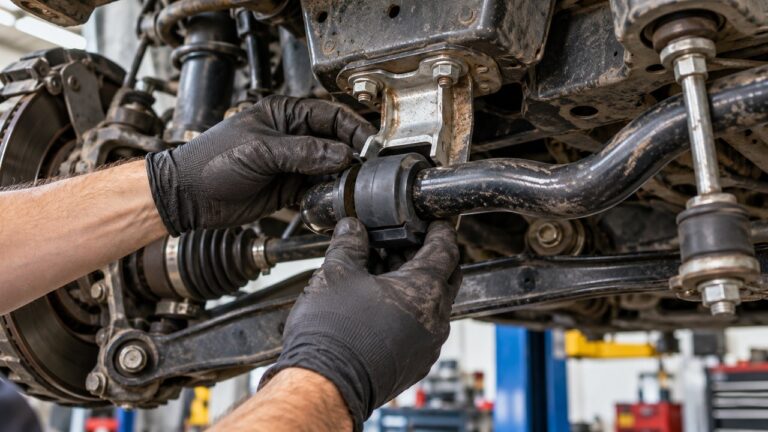
A sway bar connects the suspension sides to resist roll; a torsion spring bar supports the vehicle’s weight by twisting. Both can have nearby-looking bushings and both can make knocking noises, but their mounting points and repair methods differ. A split D-bushing clamped around a stabilizer bar is not how you replace a truck’s torsion-bar crossmember isolator.
If the part is actually attached to the anti-roll bar, our sway bar bushing replacement guide covers that separate job. Keep those part numbers out of your torsion-bar order.
Where Torsion Bar Crossmember Bushings Are Found on GM Trucks
GM pickup and SUV results dominate many U.S. parts searches, but even within GM the part name and frame-hanger layout can change. A truck owner searching for a “torsion bar bushing kit” should start at the vehicle identification and service diagram, not a universal exploded view.
Silverado and Sierra HD: Check the Frame-Hanger Kit
Energy Suspension lists part 3.1143G as a torsion-bar mount bushing kit for selected Chevrolet Silverado and GMC Sierra 2500HD/3500HD applications, including specific 2001–2010 model years. That example is useful because the manufacturer identifies the part as a mount bushing, not a torsion bar, leveling key or generic control-arm bushing. A vehicle-year filter still needs to be checked against model, drivetrain and kit instructions.
The kit information also calls out separate hanger bushings and metal sleeves. If the old steel sleeve is badly corroded or its dimensions differ, ordering two rubber-looking pieces without checking the supplied sleeve can lead to a stalled repair. See Energy Suspension’s official 3.1143G product listing for a manufacturer-specific fitment example; it is not a fitment chart for every GM truck.
Older GM 1500 Applications May Use a Different Insulator
A separate GM service bulletin covering certain late-1990s through mid-2000s 1500 trucks and SUVs refers to the torsion-bar crossmember bushing as an insulator, commonly part number 15001006 for the covered applications. The bulletin specifically tells parts departments to verify the number for the individual vehicle. The bushing is not necessarily sold with its metal bracket.
There is also an orientation trap: that bulletin identifies an elongated center hole and calls for it to be installed horizontally. This is a good example of why copying a photo from another truck—or guessing the hole orientation—can cause a bad repair. It does not mean every crossmember bushing uses an oval hole or follows the same installation direction.
Model Year, Frame, and Suspension Package Beat the Badge
Do not assume a Chevrolet 1500, 2500HD and 3500HD share a mount simply because they all have front torsion bars. Two vehicles with the same body styling may use different anchor brackets, bolts and suspension options. Likewise, an older Silverado may have a replacement crossmember or aftermarket lift components that invalidate an otherwise plausible fitment listing.
Look for the original-equipment part number, location in the parts diagram and the instructions for that exact kit. A label such as “front position” on the box may refer to the front suspension assembly, not necessarily the forward end of the torsion bar or the front face of the crossmember.
Bad Torsion Bar Bushing Symptoms: Look for Movement, Not Just Noise
A worn crossmember bushing can transmit noises through the frame, but a clunk by itself proves very little. A useful diagnosis links the sound to a visible or measurable problem at the correct mount. Establish whether you are looking at a degraded isolator, loose attachment hardware or an unrelated suspension joint before ordering parts.
A Clunk or Pop When the Chassis Loads and Unloads
One possible complaint is a pop as the truck crosses a driveway lip, brakes, accelerates or twists over an uneven surface. When the torsion-bar crossmember shifts against a degraded mount or its bracket, the sound can travel into the cab. The location of the noise is a clue, not a diagnosis: sway-bar mounts, control-arm bushings and body mounts can make similar sounds.
Ask a shop to reproduce the complaint safely and look for fresh metal contact marks, an off-center sleeve, split rubber or visible relative movement where the hanger attaches. The repair target should be the mount that actually moves, not whichever bushing happens to be cheapest online.
Cracked Rubber, Separation, and a Displaced Sleeve
Surface checking on old rubber does not always mean a mount has lost its function. More convincing evidence includes rubber torn completely through, a sleeve separating from its bonded material, a bushing that has walked out of place, or a crossmember contacting its bracket. Polyurethane can also crack or deform, and a new-looking bushing can fail if the hardware was assembled incorrectly.
Rust around the hanger is not automatically a bushing failure, but it deserves attention. A compromised frame bracket or elongated mounting hole cannot be repaired merely by sliding in stiffer material. If the attachment itself is damaged, the structural repair takes priority.
Ride-Height Problems Do Not Automatically Point to Bushings
A front corner that sits low can result from torsion-bar adjustment, spring fatigue, a damaged anchor, incorrect parts, or other suspension problems. A soft frame-hanger isolator may let a mount move, but it is not the first part to blame for every sagging truck. Record ride height using the factory reference points before disturbing the adjuster.
Similarly, an alignment that drifts or tires wearing unevenly warrants a check of ball joints, control-arm pivots, steering parts and ride height. If the complaint leads to replacement of a control-arm pivot rather than a torsion mount, the labor and parts are a different job. Do not let the word “bushing” on a quote obscure which mounting point the mechanic actually found defective.
A Simple Diagnostic Order Before You Spend Money
A technician can narrow the problem down without guessing from the sound. Start with the original fitment diagram, confirm the visible mount and inspect the complete surrounding assembly before unloading anything. These observations matter more than the mileage on the odometer.
- Identify the component: crossmember insulator, dust boot, control-arm bushing or sway-bar mount
- Confirm the complaint: note whether the clunk occurs on bump, brake, steering or chassis twist
- Inspect the hanger: look for torn material, sleeve displacement, witness marks and loose or damaged hardware
- Rule out neighbors: check the adjuster, control-arm pivots, ball joints and body mounts as applicable
- Check the service diagram: match the repair part and its orientation before any disassembly
- Plan the load release: determine whether the crossmember or anchor requires a vehicle-specific unloading procedure
Rubber vs. Polyurethane vs. Plastic Torsion Bar Bushings
Material choice comes after correct identification. A street truck’s frame-hanger mount should control noise and motion, while a racing torsion tube may intentionally use a bearing-like plastic sleeve. Picking the hardest material available does not guarantee a better repair.
| Material | Typical application or benefit | Trade-off or buying check |
|---|---|---|
| OE-style rubber | Isolation and factory-like compliance on compatible road vehicles | Age, oil exposure, and bonding condition; verify whether a metal sleeve is included |
| Polyurethane | A firmer replacement for listed crossmember and hanger mounts | May transmit more noise or vibration; installation and lubrication depend on kit design |
| Bearing-grade nylon/plastic | Low-friction torsion-tube support in dedicated racing hardware | Not a substitute for an automotive frame-hanger isolator; dimensions are critical |
| Metal sleeve or bracket | A separate load-carrying or locating part used with some bushing designs | Not itself a rubber bushing; reuse versus replace depends on the specific kit |
OE-Style Rubber for a Quiet Daily Driver
A properly matched rubber insulator generally suits a truck whose owner wants the original level of isolation and has not changed the suspension layout. Look closely at whether the rubber is bonded to a sleeve, how the assembly indexes in its hanger and whether the supplier sells the complete mounting unit. An OEM number can be more reliable than a vague description such as “torsion bar support rubber.”
Do not coat a bonded rubber mounting surface in general-purpose grease unless the service procedure calls for it. Some designs depend on controlled friction or bonding to work correctly; applying lubricant because another suspension bushing uses it may create slip and noise.
Polyurethane Can Reduce Mount Movement, but Fit Matters More
Polyurethane replacement sets are common in the aftermarket for older GM and Chrysler applications. A firmer mount may limit unwanted deformation, but it can also pass more vibration into the chassis than a compliant original part. Installation details differ: certain kits include new metal sleeves; other kits require the factory sleeves, brackets or washers to be reused.
If a polyurethane kit calls for its own lubricant, use the type and application points specified for that kit. Energy Suspension’s general FAQ discusses its Formula 5 lubricant for products that require grease; that is not permission to lubricate every torsion mount, rubber isolator or anchor spline. When instructions differ, the instructions for the exact part number take precedence.
Color Is Not a Hardness Specification
Red and black bushing sets are often displayed as two choices, but color alone does not tell you the durometer, mount design, compatible frame or noise level. Two colors in one manufacturer’s product family can share a material formula, while a different company may use another compound altogether. Compare actual part number and published application data before choosing by appearance.
For a custom race car, a bearing-grade sleeve also should not be treated as a “polyurethane upgrade” to a road-vehicle crossmember. Its purpose is free rotation in a torsion tube, not isolation between a heavy crossmember and the chassis.
How to Check Fitment Before Ordering a Replacement Kit
A catalog result is a lead, not proof. Keep the existing bushing intact until you know what the replacement contains and how the service procedure releases the loads around it. These are the measurements and details that separate a correct kit from a box of close-looking parts.
Get the Original Part Number and a Location Diagram
Start with the VIN or exact model identification, drivetrain, model year and the manufacturer’s illustrated parts catalog. Identify the frame-hanger or crossmember position, then compare the old part and replacement photograph only as a second check. An aftermarket fitment list may group multiple variations under one model name, particularly where the body style changed midyear.
Be especially cautious with “front torsion bar bushing” search results. One retailer may mean a front-suspension hanger, another a dust seal at the front of a bar, and another a part attached to a completely different torsion component. The drawing should resolve the ambiguity before the order is placed.
Inspect Sleeves, Bolt Size, Offset Holes, and Kit Quantity
Measure or verify the outer diameter of the bushing, sleeve bore, mounting-bolt diameter, bracket width and whether the opening is concentric or offset. Do not assume an oval hole is a manufacturing error: on some genuine replacement applications its orientation is intentional. A centered round sleeve is not automatically interchangeable with an elongated factory insulator.
Count the actual components. Does “set” mean two bushings, two half-bushings for one hanger, or a full pair with sleeves and washers? For a used truck, check that the original bolt and hanger are not worn or modified. A new bushing cannot make an undersized fastener or stretched bracket safe.
The Same Search Term Can Cover Different Classic Chrysler Hardware
Energy Suspension’s 5.4110 family, for example, is cataloged as a torsion-bar crossmember mount set for certain 1970s Chrysler, Dodge and Plymouth cars. That is not the same application as a later Silverado HD hanger kit, despite the shared “torsion bar bushing” label. Mopar dust-boot sets for older A-, B- or E-body cars are another distinct product line.
On a restoration, inspect how the particular suspension generation uses its front and rear anchors. Do not apply a Chevrolet unloading sequence or a modern pickup bushing orientation to a classic Chrysler just because both systems use longitudinal torsion springs.
Replacing Torsion Bar Crossmember Bushings: The Safe Repair Sequence
The exact procedure varies too much to describe as a universal bolt-by-bolt repair. On some vehicles, access to the hanger is simple after the bar load has been dealt with; on others, the crossmember, key and anchor hardware require more extensive work. The key safety issue is the stored spring energy in the torsion bar.
Before Removal, Confirm How the Torsion Bar Is Loaded
A torsion bar can carry substantial torque even with the vehicle raised. Supporting the frame or letting a wheel hang does not necessarily unload its anchor. Never remove an adjuster retainer or crossmember hardware on the assumption that the load has disappeared. Check the factory service manual for the exact bar/key design and support points.
Many truck procedures call for a model-specific unloading tool and controlled removal of the adjuster load. Our torsion bar unloading tool and fitment guide deals with selecting that equipment; an ordinary clamp or improvised puller is not an acceptable substitute. If the proper procedure or tool is unavailable, this repair belongs with a qualified workshop.
Removing the Old Insulator Is Only Part of the Work
Once the vehicle and spring load have been made safe according to the service procedure, the technician can inspect the hanger, sleeve and bolt holes. Rust, trapped dirt, elongated holes or a bent crossmember may be the reason the old bushing failed. Cleaning and checking the supporting structure matters as much as pressing or extracting the rubber itself.
Some replacement products are designed around the original metal carrier; others include a new sleeve. Do not burn out rubber beside fuel, brake or underbody components, and do not cut into a loaded bracket. Use the approved shop method and replace damaged fasteners with the specified grade and size, not arbitrary substitutes.
Install the Correct Orientation and Tighten as Specified
Fit the bushing with the maker’s indicated orientation and make sure the sleeve, washer faces and frame bracket seat correctly. Where the service bulletin calls for a horizontal elongated opening, that detail is part of the repair. Where no such instruction exists, do not copy it. A reversed bushing or missing sleeve may allow immediate contact and reproduce the original clunk.
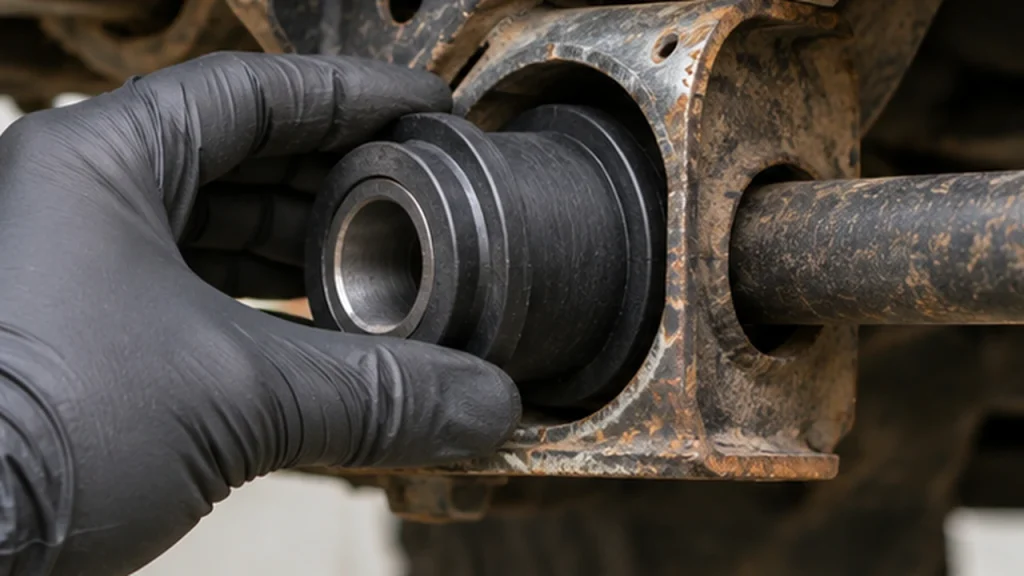
Torque must come from the service manual or manufacturer’s instruction sheet. Avoid “tight enough” estimates and do not assume all suspension bushings should be tightened at exactly the same ride position; bonded pivot bushings and isolated crossmember hangers can have different procedures.
What to Check After the Bushings Are Replaced
A new mount should stop the unwanted movement that the original inspection identified. That is a testable result, not a guarantee that every suspension noise will disappear. Before road use, the shop should establish that the torsion bar, crossmember, adjuster and nearby lines are secure and correctly positioned.
Recheck Mount Position, Height, and Contact Marks
Compare the hanger’s installed position with the service diagram, look for metal-to-metal marks and verify fastener seating. If the adjustment setting was disturbed, return ride height to the manufacturer’s specification rather than simply matching exposed adjuster-bolt threads. Two bolts with equal thread showing do not necessarily establish equal vehicle height.
The safe process for restoring and checking suspension height is covered separately in our torsion bar suspension adjustment guide. This article concerns failed isolators and replacement fit, not how to raise or lower the truck.
Do You Need an Alignment After Bushing Replacement?
Replacing a crossmember isolator does not automatically change wheel alignment in the way moving a control-arm adjustment point does. However, if ride height was reset, suspension geometry was disturbed, or other joints were loosened, a professional alignment check may be necessary. The vehicle-specific service procedure decides what checks are required; do not use a blanket “no alignment needed” promise.
If the repair shop finds that an adjuster key or its seating surface is damaged, that is another replacement decision. Our torsion bar keys and fitment guide explains the difference between the spring anchor and aftermarket re-indexed lift keys without treating those parts as bushings.
A New Creak Does Not Automatically Mean the New Bushing Is Bad
If noise appears immediately after installation, verify orientation, sleeves, contact clearances and hardware first. A bracket that shifts because a fastener was not seated will not be cured by switching from red polyurethane to black. Likewise, a torn boot or rusted spline may create a separate problem that was hidden by the original noise.
Follow the parts maker’s reinspection guidance and return to the workshop if a hard clunk, steering change or new metal-on-metal contact appears. Continuing to drive a vehicle with a loose anchor or damaged crossmember is different from tolerating a minor trim squeak.
What Does Torsion Bar Bushing Replacement Cost?
Parts and labor are best priced separately. A small bushing kit can be relatively inexpensive, but releasing a torsion-bar anchor and repairing seized or damaged hanger hardware can make labor the larger expense. The phrase “torsion bar bushing replacement cost” is too broad for a trustworthy one-price quote across a GM HD truck, a classic Chrysler and a sprint car.
The Price of a Kit Does Not Tell You the Total Repair Bill
A basic aftermarket hanger-bushing kit can sell for tens of dollars, while a service quote may also include sleeve or bracket hardware, rust removal, specialized tooling, alignment checks and replacement of other failed components. Racing tube sleeves may be sold as a different quantity and require a different preparation method. Prices change, so compare quotes by included work rather than a universal labor estimate.
If the crossmember is cracked or the mounting hole has elongated, a bushing-only repair may not be enough. Ask whether the estimate includes structural repairs, hardware replacement and the final ride-height verification. Those details explain why two shops can quote different totals for what sounds like the same job.
Replace the Bushing, the Mount, or Another Part?
Replace only the isolator when the surrounding carrier is sound, the correct replacement exists and the manufacturer supports the procedure. Replace or professionally repair the mount when its bracket, bolt hole or sleeve is damaged beyond specification. If inspection reveals a control-arm joint, key or sway-bar mount problem instead, repair that component; a firmer torsion-bar bushing will not fix it.
The best buying decision is the one supported by the fault you can actually see. A complete mount is not automatically needed for a torn rubber insert, just as a new insert cannot rescue a failed crossmember. Correct part identification saves more money than chasing the hardest or cheapest material.
Torsion Bar Bushing FAQs
These are the practical questions that arise while comparing replacement mounts, crossmember insulators and similarly named parts in U.S. catalogs.
Do all torsion bar suspensions have bushings?
No. Many use bushings somewhere in the suspension, but not all have a separately replaceable torsion-bar crossmember isolator. The bar may engage a splined control arm and a rigid anchor; other applications use an isolated hanger or dedicated boot. Check the parts diagram for the actual vehicle.
Where are torsion bar bushings located?
On many GM truck applications the relevant mount bushings sit at the torsion-bar crossmember/frame hangers, farther back from the lower control arms. On a classic car, the same term might refer to anchor mounts or end seals. On a race car, it can describe sleeves within the torsion tube.
What does a bad torsion bar crossmember bushing sound like?
A worn or loose mount can produce a knock, clunk or pop when the chassis loads and moves. That sound is not unique to the bushing; inspect the hanger, key, control-arm joints and other nearby mounts before buying anything.
Can worn torsion bar bushings cause uneven tire wear?
Not usually as a direct, isolated cause. Severe mount movement or related suspension damage can affect geometry, while changes in torsion-bar ride height can alter alignment. Uneven wear warrants a complete suspension and alignment inspection rather than a bushing guess.
Are polyurethane torsion bar bushings better than rubber?
They may limit deformation and resist certain contaminants, but they can also transmit more road vibration. For a quiet, factory-like daily driver, correctly matched rubber can be preferable. Choose by the actual mount and approved kit, not a general claim that polyurethane is always superior.
Do torsion bar bushings need grease?
Only where the specific design and manufacturer instruct it. Some polyurethane components have designated lubrication surfaces; bonded rubber bushings and anchor seals may not. Never apply random grease to a torsion-bar mount based on advice intended for sway-bar D-bushings.
Do I need a torsion bar unloading tool to replace them?
It depends on the suspension and the repair access required. If the procedure involves removing or unloading the spring anchor or adjuster, a model-specific unloading tool may be required. Follow the service manual and do not assume lifting the truck removes stored torsion-bar energy.
Can I replace torsion bar crossmember bushings myself?
Only if you can safely support the vehicle, identify the exact component and follow the manufacturer’s unloading and installation procedure with the correct tools. If a spring-loaded anchor must be removed, this is not a suitable improvised driveway job.