Torsion Bar Keys: OEM vs. Lift Keys & Fitment
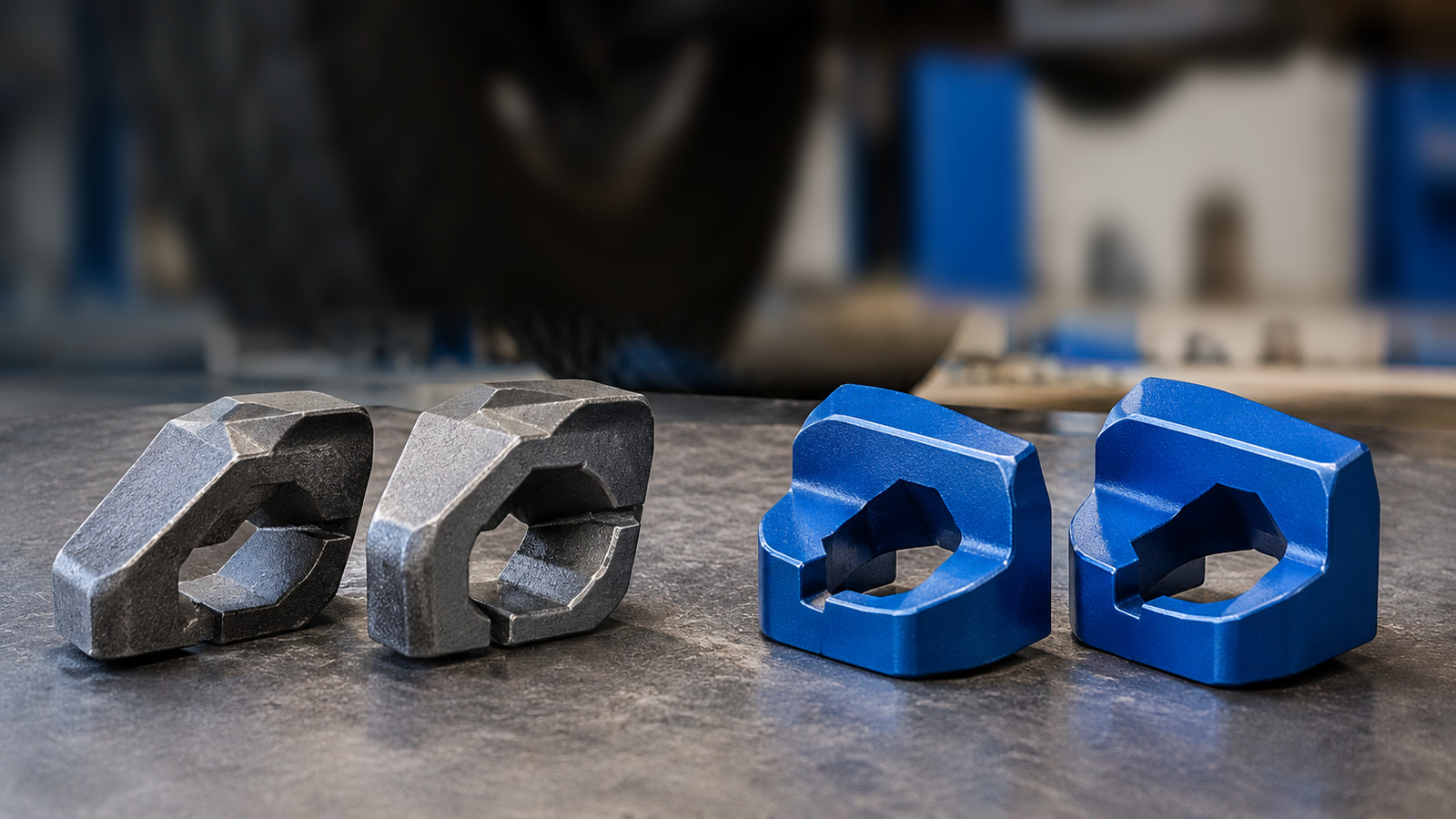
Torsion bar keys are the small but heavily loaded levers that anchor the torsion bars on many older pickups and certain heavy-duty trucks. If you are replacing a damaged factory key, buy an exact-fit OEM-style replacement. If you want the front end a little higher, look at a vehicle-specific re-indexed lift key kit—but only after checking that the truck has enough usable suspension travel and alignment range for the proposed height.
A different key changes how the bar is indexed at its anchor. It does not turn an old torsion bar into a stronger spring, increase payload, or create extra wheel travel. That distinction can save you from buying a shiny 3-inch kit for a truck that already sits near its extension limit.
Which Torsion Bar Keys Should You Buy?
Pick the part by the job first, then match the truck. A listing with the right model name but the wrong production year, bar end, or front suspension layout is still the wrong part. The practical choices look like this:
| What you need | Best starting point | Check before ordering |
|---|---|---|
| Restore a damaged or missing original key | Exact-fit OEM or OE-equivalent torsion bar key | OE part number, bar interface, side and crossmember design |
| Level a front end that is still within its factory adjustment range | Diagnose and assess the existing keys first | Measured ride height and remaining safe adjustment range |
| Gain modest front height beyond the stock key’s useful adjustment | Approved re-indexed torsion key leveling kit | Actual application, ride-height ceiling, droop and alignment |
| Repair a seized or rounded adjuster bolt | Correct service hardware, not necessarily new lift keys | Thread, nut block, contact area and corrosion damage |
| Replace a broken or badly corroded torsion bar | Correct torsion bar and anchor components | Spring rate, side marking, vehicle load and damaged mating parts |
| Work on a coil-spring or strut-equipped front suspension | A suspension-specific solution, not torsion keys | Identify the front spring design before shopping |
For most buyers, the decision is simple: replacement keys return a suitable vehicle to its intended setup; lift keys provide different adjustment geometry. Neither can compensate for a worn ball joint, a bar with the wrong spring specification, or a setup that is already out of safe suspension travel.
What a Torsion Bar Key Does Under the Truck
On a typical longitudinal torsion-bar front suspension, one end of the spring-steel bar connects to the control-arm assembly and the opposite end engages an anchor lever near a frame crossmember. The anchor lever is commonly called the torsion key. An adjustment screw bears against it to establish the installed position and static front ride height. The exact layout is vehicle-specific, but that is the hardware you are comparing in parts catalogs.
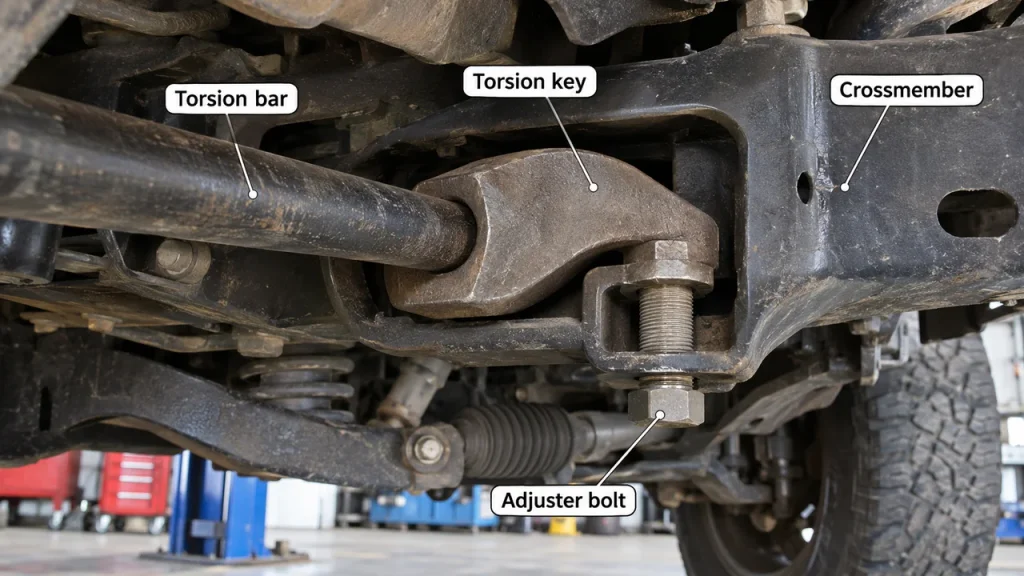
A key may look like a chunky forged or cast bracket with a hexagonal opening and a tail for the adjuster bolt. That is not a cosmetic shape. The bar end must fit the opening precisely; the key must seat properly in the crossmember, and the bolt must load the designed contact area.
The Hex Opening and the Key’s Clocking
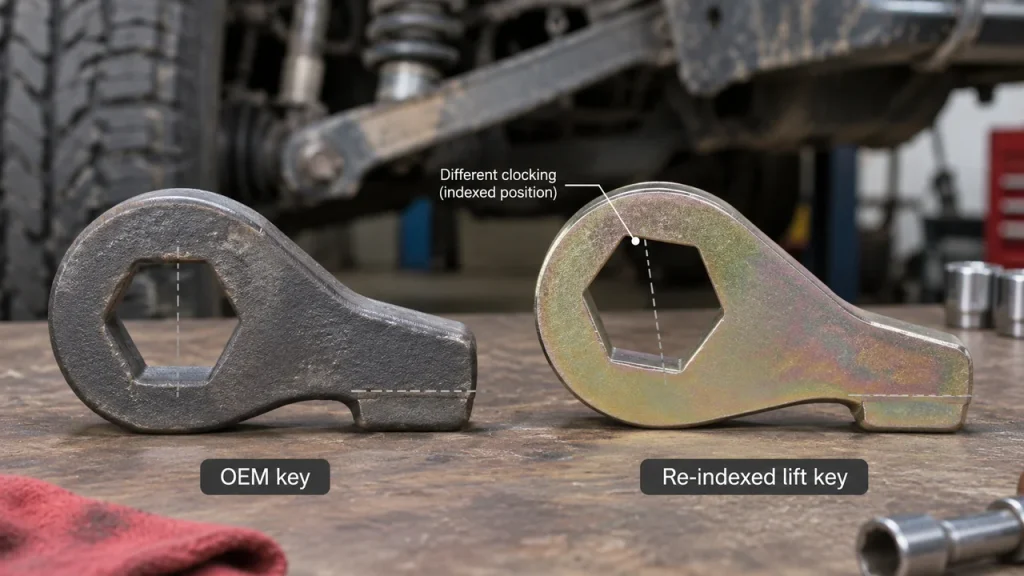
Many truck bars have a hexagonal end that fits into a matching opening in the key. When a manufacturer calls a lift key re-indexed or re-clocked, it means the relationship between that opening and the key’s lever has been altered. With the correct assembly, the adjuster can position the bar differently than it would with the original key.
That does not make all keys interchangeable. Even a tiny mismatch at the bar end, the crossmember contact, or the keeper arrangement can make an otherwise convincing-looking replacement unsuitable. This is where an exact manufacturer part number earns its keep.
A Key Is Not the Torsion Spring
The bar supplies spring resistance by twisting. The key anchors and positions it. Changing the key can change where the front suspension rests, but it does not change the bar’s diameter, effective length or inherent spring rate. If the front feels harsh after a lift-key installation, reduced droop, altered shock position or steeper control-arm angles are more plausible explanations than a magical increase in spring stiffness.
For the underlying spring design—not parts selection—see our torsion bar suspension explanation.
OEM Torsion Keys vs. Re-Indexed Lift Keys
The letters OEM on a listing do not necessarily mean the part came from the vehicle manufacturer; OE-equivalent usually means an aftermarket part intended to match the original configuration. Lift keys are different by design. The problem is that both may be sold under the vague heading ‘adjustable torsion bar key.’ Read the specification, not just the category label.
When an OEM-Style Replacement Is the Right Purchase
If a key is cracked, the bar-end opening is damaged, or corrosion has compromised the anchor, restore the correct factory-style hardware before thinking about a lift. Dorman’s OE-replacement catalog, for example, includes application-specific adjustable torsion keys, sometimes sold as a single piece rather than a complete pair. ‘Adjustable’ on that description does not promise additional lift beyond the design’s original purpose.
A vehicle that has unexpectedly dropped on one front corner needs diagnosis first. A rusty adjuster bolt, failed bar, damaged crossmember seat, control-arm problem or incorrect earlier installation can all put the blame in the wrong place. A fresh key alone is not a cure for every low front end.
Why Lift Keys Are Re-Clocked
A lift-key maker changes the relative location of the bar opening and lever so the adjuster works over a different range. ReadyLIFT describes this specifically as changing the clocking of the hexagonal bore on its forged keys. That design detail is more meaningful than a seller’s promise that its ‘heavy-duty key’ raises every truck by two inches. See the manufacturer’s explanation of re-indexed torsion keys for the distinction.
The altered clocking can be helpful when the original adjuster geometry is the limiting factor. It cannot move a ball joint farther than its articulation limit, create more shock extension, or turn an incompatible suspension into a suitable one. Think of it as a different way to set the front height, not a new front suspension system.
Forged, Cast and Powder-Coated Keys
Forged steel keys are common in premium lift kits; other OE-style and aftermarket products use engineered cast metal. The manufacturing method is relevant, but a forged part from the wrong application is not safer than a properly specified OE-equivalent. More useful evidence is the listed vehicle fitment, dimensional accuracy, published instructions, required hardware and whether the manufacturer supports the final ride height.
A black e-coat or powder coat helps with corrosion resistance. It does not tell you whether the key is indexed correctly for your truck. Do not let a finish, color or vague ‘military-grade’ label replace that check.
Do You Need New Keys or Just More Factory Adjustment?
Not every owner chasing a level stance needs to buy keys. Some torsion-bar trucks have a modest amount of legitimate adjustment left in the original setup; others are already at the useful end of their range. The answer comes from the vehicle’s trim-height specification, the present adjuster position and what the front suspension does at full permissible movement.
When Stock Adjustment May Be Enough
Imagine a pickup that sits a little nose-low, has healthy suspension parts and measures within the manufacturer’s specified setup range. Before ordering aftermarket keys, determine whether the original system can achieve the intended height while keeping adequate droop and an alignable front end. If it can, new lift keys add cost and disassembly without necessarily adding any benefit.
Our separate torsion bar adjustment guide covers how to measure, adjust and recheck the existing system. This article stays with the purchase decision rather than repeating that procedure.
When Re-Indexed Keys Make Sense—and When They Do Not
A kit-specific re-indexed key may be appropriate when the manufacturer has validated the truck, the stock key geometry is limiting the intended modest lift, and the rest of the front suspension retains acceptable travel and alignment. Some aftermarket makers explicitly warn that particular trucks can already reach their permitted height with the original keys. Buying a second set merely because it is advertised as a lift kit would be redundant.
If the current ride height is already near the droop stop, a different key cannot solve the underlying problem. Raising it farther is not a clever workaround; it is asking the same control arms, CV joints, shocks and steering parts to work from a worse starting position.
Torsion Key Fitment: The Details Vehicle Filters Miss
Part-selector pages are convenient until two truck generations share nearly the same name. The listing must fit the actual torsion-bar configuration installed on your vehicle, not just the badge on the tailgate. Check each of these before buying a replacement key or leveling kit:
- Year and generation: distinguish redesigns, carryover ‘Classic’ body styles and mid-year suspension changes.
- Actual front spring design: verify torsion bars, not coil springs or coilover struts that look similar through the wheel opening.
- Drivetrain, trim and axle package: confirm 2WD/4WD, load rating, suspension option codes and manufacturer exclusions.
- Bar-to-key interface: check the correct hex/spline dimensions, clocking and seating surface against the OE or kit specification.
- Left/right requirements: identify side-specific keys, bar markings or paired kits rather than assuming two loose pieces are identical.
- Crossmember and adjuster: confirm the lever, keeper/cross pin, bolt, threaded block and contact surfaces match the application.
- Existing modifications: a previous lift, lowering kit or torsion-key change can invalidate a stock-vehicle listing.
- Approved finished ride height: find the kit’s actual limit and any required shock, control-arm or alignment provisions.
Do not order by photographs of similar six-sided holes. A dimensional mismatch in the anchor is more consequential than the wrong finish on an ordinary trim part, and the stored energy in the torsion bar makes improvisation especially unwise.
Chevrolet/GMC 1500 vs. 2500HD and 3500HD
This is a classic fitment trap. Different Silverado and Sierra years and weight classes use different front-suspension architectures. A kit advertised for a torsion-bar-equipped 2500HD or 3500HD is not automatically a solution for a 1500 with front coilover struts. Even among the HD trucks, key design, OE reference and allowed height can change by production year.
For a concrete example, ReadyLIFT’s 2020-and-later GM HD torsion-key documentation lists specific factory key references and vehicle exclusions. The lesson is not that its published height limit applies to every Chevy truck; it is that the correct part-number instructions matter more than a broad ‘Silverado’ search result.
Ford F-150, Ranger, Explorer and Expedition
Some earlier F-150, Ranger, Explorer and Expedition configurations used torsion-bar front suspension and have dedicated aftermarket key listings. That does not mean a current F-150—or every older two-wheel-drive variant—has the same front end. SPC’s torsion-key catalog, for instance, names particular late-1990s and early-2000s Ford applications. Treat that as an illustration of generation-specific fitment, not a universal Ford compatibility rule.
The same caution applies to other brands: vehicle names survive long after their suspension systems change. Inspect the physical front spring arrangement or use the OE parts diagram before you shop.
How Much Front Lift Can Torsion Keys Safely Provide?
Retail listings commonly promise roughly 1–3 inches of front lift, depending on the vehicle and kit. That range is a catalog description, not a blanket safe-height recommendation. Some kits have a lower approved limit. Others work only with a particular shock extension, control arm or larger suspension system.
A Two-Inch Advertisement Is Not a Two-Inch Guarantee
Suppose a kit says ‘up to 2 inches’ and your truck is already sitting an inch above its stock ride-height baseline. You cannot simply add the advertised two inches to what you already have and assume the suspension is approved. The number may describe a maximum total front increase under the manufacturer’s specified starting conditions.
Also measure the vehicle at a consistent load and compare the permitted height at both sides. Tire diameter, fender variations and a full fuel tank can distort a casual driveway comparison. A photo of a leveled truck will not tell you how much rebound travel remains.
Droop Travel, Control Arms and CV Axles Set the Real Limit
As a torsion-bar truck rises at the front, its wheel normally begins closer to the end of permitted downward movement. If the upper control arm is near its droop stop, a pothole can make the suspension top out abruptly. On driven front axles, CV shafts may work at steeper angles; ball joints, steering links and brake/ABS routing also need adequate clearance throughout the intended travel.
This is why a front lift obtained by re-clocking keys is not equivalent to an engineered long-travel conversion. If the build requires major height or tire changes, compare a complete leveling kit vs. lift kit solution that addresses the actual geometry.
Do Lift Keys Require Different Front Shocks?
Some kits include shock extensions or specify compatible shocks; others are designed around the existing dampers. There is no universal rule that adding two inches of static ride height requires a shock that is two inches longer. The shock’s full extension and compression, mounting style and the suspension’s permitted travel all have to work together.
A shock should not become the suspension’s makeshift limiting strap. If the kit calls for replacement dampers, use the relevant manufacturer’s dimensions, not a guessed length. Our shock length calculator explains the measurement comparison separately.
What Should Be Included in a Torsion Key Leveling Kit?
The cheapest listing is not necessarily the cheapest completed installation. Some products contain one OE-equivalent key; others are sold as a pair, and a full leveling package may add bolts, retainers, shock-related hardware or other vehicle-specific parts. Check the ‘package contents’ field rather than treating every photograph as an inventory list.
Before checkout, make sure you can identify the components and information below:
- Correct torsion keys: verify the quantity, side design, key index and manufacturer part number.
- Adjuster bolts and nut blocks: confirm whether the kit includes them or instructs you to reuse serviceable OE pieces.
- Retaining pins and small hardware: use only the specific keepers, cross pins and fasteners called for by that system.
- Shock-related parts: look for included extensions or a required shock specification, without assuming they are universal.
- Installation sheet and height limits: the maker should specify the approved setup, exclusions and checks after installation.
- Tool requirements: confirm whether the service procedure calls for a rated torsion-bar unloading tool supplied separately.
For example, SPC markets some Ford replacement key kits as one assembly per axle, while Dorman catalogs individual OE-style keys. Those descriptions are not contradictory; they are reminders to read the actual package contents. A set with two keys is not automatically complete if the original adjuster hardware is unsafe to reuse.
When the Key Is Not the Part That Needs Replacing
A front-end height problem can start several feet away from the adjuster. Before purchasing a lift-key kit to fix an uneven nose, it helps to separate a damaged anchor from a worn spring, bent control arm or seized adjuster bolt. Re-indexing a faulty system may disguise the issue until it fails again.
Cracks, Sloppy Bar Engagement and Damaged Adjuster Contact
A visibly cracked key or damaged bar-to-key interface warrants stopping and evaluating the complete anchor, crossmember and bar end. The lever should fit as designed, without unintended rocking at the engagement or improvised shims behind the adjuster. Rusted threads and severely worn bolt-contact pockets are also reasons to inspect replacement hardware rather than force more movement.
Not every clunk below the cab means the key has failed. Crossmember mounts, control-arm bushings, steering parts and other underbody components can make similar noises. A qualified inspection should establish the source before an expensive—or unsafe—parts order.
One Side Low Does Not Mean One Key Is Bad
If the left front fender looks lower, verify tire pressures, loading, ride-height measurement points and the suspension on both sides. A torsion bar can be incorrectly indexed or the adjuster can be set differently; a damaged bar or unrelated suspension fault can produce a similar stance. The repair should correct the condition, not merely make the visible fender gaps match.
Likewise, replacing a healthy factory key will not change the spring’s load capacity. If the truck cannot maintain its specified ride height with the correct healthy components, diagnose the complete front suspension rather than using a more aggressive key as a substitute for repair.
Installing Lift Keys Is Not the Same as Turning an Adjuster Bolt
This is the step that surprises first-time buyers. Torsion bars store substantial spring energy. Removing the key or its keeper is a service operation that typically requires a torsion bar unloading tool approved for that vehicle and the exact vehicle/kit procedure. A random C-clamp, ordinary puller or improvised jack arrangement is not an acceptable substitute for a rated tool designed for that system.
The point here is not a step-by-step teardown. Identify who will install the keys, verify they have the correct tool, and include labor, any replacement hardware and post-install measurements in the cost before ordering. Manufacturer instructions may specify particular support points, alignment marks, loading sequences and crossmember access; one online shortcut cannot safely cover every configuration.
After Installation: Height, Clearance and Alignment
Once the correct parts are installed and the vehicle is sitting at its normal load, the result needs to be measured against the kit’s stated limits. The technician should verify suspension compression and rebound clearance, shock operation, steering movement, hoses, CV/joint articulation where applicable, and the tire’s full-lock clearance. An alignment check follows at the final height.
Changing static front height can change camber, caster and toe even when the steering wheel still looks centered. We cover when and why in our alignment after suspension work guide.
Tire Size Claims Need a Second Look
A listing that promises room for a 33- or 35-inch tire usually assumes a particular wheel width, offset, tire shape and truck configuration. Fitment at straight-ahead ride height is not the same as clearance at full steering lock or compression. Fender liners, mudflaps and aftermarket bumper edges can still be in the way. Do not treat the torsion-key lift number as a tire-clearance guarantee.
Some kits are also designed to work only with their own steering, shock or lift-system components. Mixing a separately purchased key with an engineered full-lift system can defeat the height and geometry the kit maker designed around. Read the exclusions before treating the parts as building blocks.
Torsion Bar Key Questions Buyers Keep Asking
The following questions come up when shopping for torsion key lifts, OE replacements and removal hardware. They are short answers about selecting parts—not a substitute for the installation sheet for your truck.
Are lift keys better than cranking the stock torsion keys?
Not inherently. A correctly designed lift key can offer a different adjustment position, which is useful on some vehicles. It does not create droop travel or make a too-high setting safe. If the factory system already reaches the approved target with healthy clearance, changing keys may add no practical benefit.
Do aftermarket torsion keys make the ride rough?
They do not necessarily change the spring rate, but raising the front can reduce rebound travel and change shock and control-arm operating positions. A truck that repeatedly tops out may ride noticeably worse. Judge the completed suspension by its measured travel and behavior, not the claimed comfort of the key material.
Can a torsion key lift damage CV axles or ball joints?
Too much front height can put these components closer to their angular and travel limits. Whether a modest kit is acceptable depends on the vehicle and manufacturer-approved geometry. A key by itself is not a CV or ball-joint upgrade, and a clicking joint or torn boot after lifting needs diagnosis rather than another turn of the bolt.
Do I need both torsion keys, or can I replace one?
Follow the vehicle service procedure and the specific product’s packaging and side requirements. Some OE-style parts are sold individually, while leveling kits commonly cover both sides. A single damaged key may be replaceable with a correct matching component, but do not mix indexed and factory keys or mismatched side hardware contrary to manufacturer instructions.
Is a torsion bar key removal tool the same as a lift key?
No. The key is a suspension part; the torsion bar unloading or removal tool is service equipment used to safely manage stored spring load during certain procedures. A catalog search for ‘torsion key tool’ is a different shopping task from selecting a replacement anchor or leveling kit.
Do I need an alignment after installing torsion keys?
Yes, plan for an alignment check after the final front ride height is established. The adjustment can alter steering and suspension geometry even if no tie-rod length was deliberately changed. A shop should confirm it can achieve the relevant specification and address any remaining mechanical problems before releasing the vehicle.
Will torsion keys lift the rear of my truck?
They normally address the front ride-height adjustment on a torsion-bar-equipped truck. They do not raise the rear axle or change the rear springs. If the plan includes a rear lift, that is a separate compatibility and load-support decision; use a complete application-approved suspension package rather than mixing unrelated components.
Buy the Key That Fits the Truck, Not the Biggest Lift Claim
There is nothing wrong with a modest torsion-key level on a truck that was designed to accept it. The good purchase is the one that matches the actual bar and crossmember, provides a realistic height range, includes or specifies the correct hardware, and leaves room for the front suspension to work. A failed OEM key calls for an OEM-equivalent repair; a healthy truck may need no new key at all.
Before spending money, identify the front suspension, record the current ride height, check the kit’s vehicle exclusions and approved maximum, and confirm the installer has the right unloading equipment. If those answers do not line up, the advertised ‘2-inch lift’ is not the right reason to buy it.