Wheel Offset vs Backspacing: What’s the Difference?
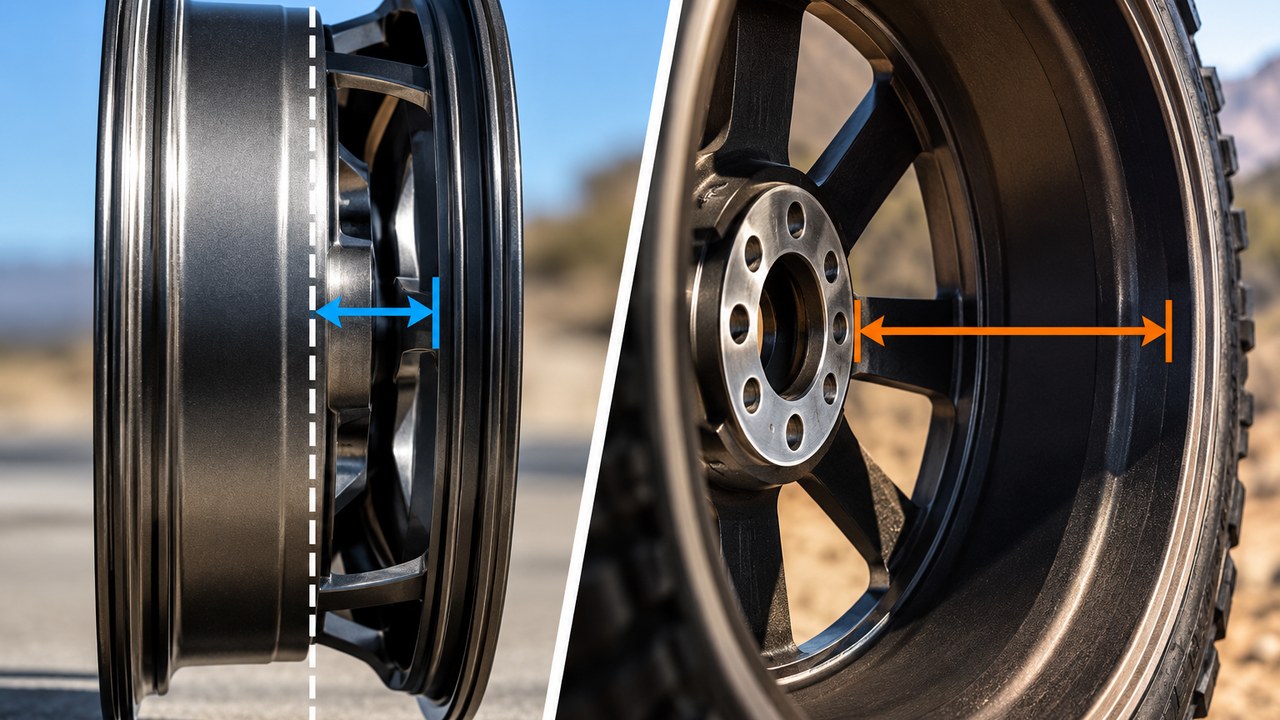
Wheel offset and backspacing both describe where a wheel sits relative to the hub, but they measure that position from different reference points. Offset measures the mounting face relative to the wheel’s centerline and is usually given in millimeters. Backspacing measures from the mounting face to the wheel’s inner lip and is usually given in inches.
For two wheels of the same width, more positive offset means more backspacing and moves the wheel farther inward toward the suspension. Less positive—or more negative—offset means less backspacing and moves the wheel outward toward the fender.
But there is an important catch: you cannot compare offset and backspacing correctly without knowing wheel width. A 9-inch-wide wheel and a 10-inch-wide wheel can have the same offset while placing both their inner and outer edges in different locations.
Wheel Offset vs Backspacing at a Glance
| Measurement | Wheel Offset | Backspacing |
|---|---|---|
| Reference point | Wheel centerline | Inner wheel lip |
| Measured to | Hub mounting face | Hub mounting face |
| Typical unit | Millimeters (mm) | Inches |
| Can be positive or negative? | Yes | No, normally expressed as a positive distance |
| Higher number generally means | Wheel sits farther inward, if width is unchanged | More wheel extends inward, if width is unchanged |
| Common marking | ET35, +18, 0, -12 | 4.5″, 5″, 5.5″, etc. |
| Main fitment concern | Overall inboard/outboard wheel position | Inner suspension and frame clearance |
The easiest way to remember the difference is this: offset starts at the middle of the wheel; backspacing starts at the back of the wheel.
Start With the Mounting Face
Both measurements revolve around the same physical feature: the wheel mounting face, also called the mounting pad or hub mounting surface. This is the flat surface on the back of the wheel that contacts the vehicle’s hub or brake rotor.
Imagine looking down at a wheel from above while it is mounted on the vehicle. Part of the wheel extends inward toward the suspension and part extends outward toward the fender. Moving the mounting face within the wheel changes how much wheel exists on each side of the hub.
Offset describes that mounting face relative to the centerline. Backspacing describes it relative to the inner lip. The geometry is related, but the numbers are not interchangeable unless wheel width is also known.
What Is Wheel Offset?
Wheel offset is the distance between the wheel’s mounting face and its centerline. It is normally measured in millimeters and often appears on the wheel as an ET number.
For example, a wheel marked ET35 has approximately +35 mm of offset: its mounting face is 35 mm toward the outer—or street—side of the wheel from the centerline.
Positive offset
With positive offset, the mounting face is positioned toward the wheel’s outer face. For the same wheel width, increasing positive offset moves the wheel inward toward the suspension and generally reduces outer poke.
Positive offset is common on many factory vehicles, but the correct number is vehicle-specific. A +45 mm wheel is not automatically better or safer than a +20 mm wheel simply because the number is higher.
Zero offset
A zero-offset wheel has its mounting face positioned at the wheel’s centerline. Assuming symmetrical flange geometry, roughly half of the wheel lies inward of the mounting surface and half lies outward.
Negative offset
With negative offset, the mounting face is positioned toward the vehicle side of the wheel’s centerline. At the same wheel width, a more negative offset moves the wheel outward, increasing outer poke and usually increasing clearance from inner suspension components.
That does not mean negative offset automatically fixes fitment. Moving the tire outward can solve an inner control-arm or frame-clearance problem while creating a new rubbing problem at the fender, bumper, mud flap or body mount.
What Is Wheel Backspacing?
Wheel backspacing is the distance from the hub mounting face to the wheel’s inner rear lip. Unlike offset, it is normally expressed in inches.
A wheel with 5 inches of backspacing has approximately 5 inches of physical depth from its mounting pad to its inner edge.
When comparing wheels of the same width:
- More backspacing places more of the wheel inward toward the suspension.
- Less backspacing places less of the wheel inward and more of it outward.
Backspacing is especially useful on trucks and off-road vehicles because suspension manufacturers sometimes specify a maximum or recommended backspacing to keep oversized tires away from control arms, steering components or lift-kit hardware.
Is Backspacing the Same as Offset?
No. They describe the same underlying wheel position, but they are not the same measurement.
Offset uses the wheel’s centerline as its reference point. Backspacing uses the inner wheel lip. That difference is why wheel width is required before one number can be converted accurately into the other.
This also explains a common source of confusion: two wheels can have the same offset but different backspacing, or the same backspacing but different offset, if their widths are different.
The Wheel-Width Trap Most Conversion Charts Hide
This is the detail that causes many incorrect offset-to-backspacing calculations.
A wheel advertised as 17×9 is not necessarily 9 inches wide from its outermost inner lip to its outermost outer lip. The advertised 9-inch dimension is normally measured between the tire bead seats.
The physical wheel also has flanges outside those bead seats. As a rough rule, overall wheel width is often about one inch greater than nominal width—approximately half an inch per side—but the exact flange dimensions vary by wheel.
That matters because backspacing is measured to the inner lip, not to the inner bead seat.
So if you use 9.0 inches as the total physical width of a 17×9 wheel, your calculated backspacing may be about half an inch wrong.
For precise fitment, use the wheel manufacturer’s published backspacing or measure the wheel’s actual overall width. Treat “nominal width + 1 inch” as an approximation, not a manufacturing standard.
How to Convert Wheel Offset to Backspacing
If you know the wheel’s actual overall width, the relationship is straightforward:
Backspacing (inches) = overall wheel width ÷ 2 + offset (mm) ÷ 25.4
To calculate offset from backspacing:
Offset (mm) = [backspacing − overall wheel width ÷ 2] × 25.4
If you only know the wheel’s advertised bead-seat width, a common estimate is:
Estimated overall width ≈ advertised wheel width + 1 inch
Use that approximation for understanding the geometry, not for approving a wheel when clearance is only a few millimeters.
If you would rather skip the manual math—or compare your current wheels with a different width, offset or spacer setup—use our wheel offset and backspacing calculator to convert the measurements and see how the new wheel position changes.
Wheel Offset vs Backspacing Chart: 9-Inch Wheel Example
The table below assumes a nominal 9-inch wheel with an estimated 10-inch overall width. It is an illustration of the relationship, not a universal specification for every 9-inch wheel.
| Offset | Estimated Backspacing | General Direction |
|---|---|---|
| -25 mm | 4.02″ | More outward |
| -12 mm | 4.53″ | Outward |
| 0 mm | 5.00″ | Centered mounting face |
| +12 mm | 5.47″ | Inward |
| +25 mm | 5.98″ | More inward |
Notice that this chart only works because wheel width has been held constant. Change the width and the backspacing changes even if offset stays exactly the same.
Same Offset, Wider Wheel: What Actually Moves?
This is one of the most useful wheel-fitment concepts to understand.
Suppose you move from an 8-inch-wide wheel to a 9-inch-wide wheel while keeping exactly the same offset. Ignoring small differences in flange shape, you have added approximately one inch of wheel width around the same centerline.
That additional width is split approximately in half:
- about 0.5 inch farther inward;
- about 0.5 inch farther outward.
So same offset does not mean same clearance.
The wider wheel may sit 12.7 mm closer to a strut or control arm while simultaneously extending 12.7 mm farther toward the fender—even though the offset number printed on both wheels is identical.
Same Backspacing, Wider Wheel: A Different Result
Now imagine two wheels with the same backspacing but different widths.
Because the distance from the mounting face to the inner lip remains approximately the same, the wider wheel adds most of its extra width to the outboard side.
For example, moving from an 8-inch wheel with 4.5 inches of backspacing to a 10-inch wheel with the same 4.5-inch backspacing does not push the inner wheel edge two inches closer to the suspension. Instead, most of that additional wheel width appears toward the fender.
This is why backspacing by itself cannot describe how far a wheel will poke. You still need the wheel width.
How to Measure Wheel Backspacing
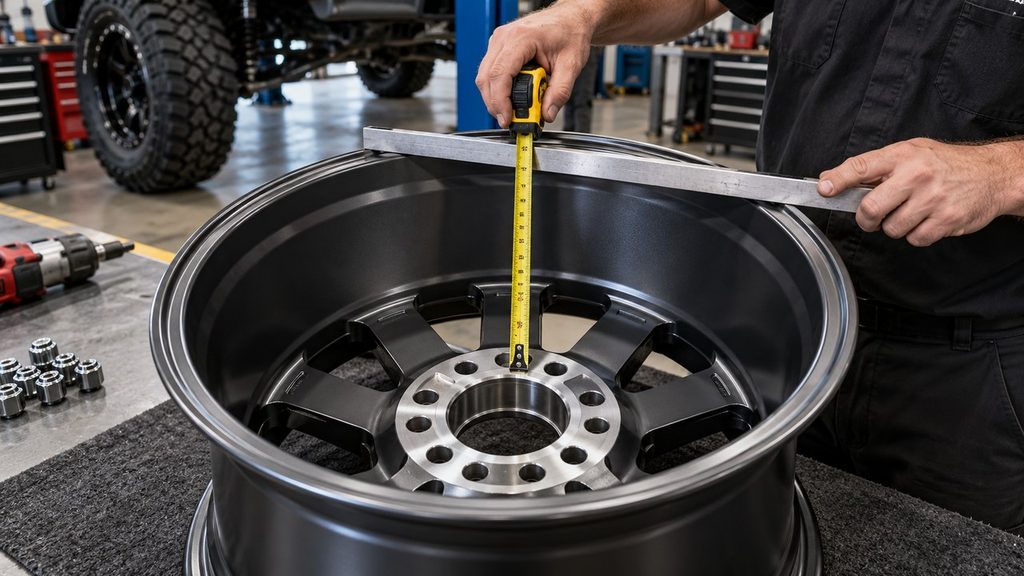
You can measure backspacing directly with a straightedge and tape measure. The wheel should ideally be removed from the vehicle, and measuring is easiest without the tire mounted.
- Place the wheel face down on a protected flat surface.
- Lay a straightedge across the wheel’s inner rear lip.
- Measure vertically from the hub mounting pad up to the underside of the straightedge.
- Record that distance in inches. That is the wheel’s measured backspacing.
Keep the tape perpendicular to the mounting surface. Measuring at an angle can easily introduce enough error to matter when suspension clearance is tight.
How to Measure Wheel Offset If It Is Not Marked
Before measuring anything, inspect the back of the spokes, barrel and mounting pad. Wheel offset is often cast or stamped into the wheel as ET followed by a number, such as ET20 or ET45.
If no usable marking exists, you can derive offset from actual measurements:
- Measure the wheel’s overall physical width from outer lip to outer lip.
- Divide that measurement by two to establish the physical centerline.
- Measure the wheel’s backspacing.
- Subtract half of the overall width from the backspacing.
- Multiply the result in inches by 25.4 to convert it to millimeters.
A positive result means positive offset; a negative result means negative offset.
Again, do not substitute the stamped bead-seat width for actual overall width if you need an accurate measurement.
How Offset Changes Inner and Outer Clearance
At the same wheel width, changing offset moves the entire wheel sideways relative to the hub.
For example, changing from +25 mm to +10 mm offset moves the wheel approximately 15 mm outward.
That means, before considering tire shape:
- the inner wheel edge gains about 15 mm of clearance from the suspension;
- the outer wheel edge extends about 15 mm farther toward the fender.
This trade is central to aftermarket wheel fitment. Moving outward can fix one interference point while creating another.
Too much inward position
A wheel-and-tire assembly positioned too far inward may contact the upper control arm, strut, shock body, spring, sway-bar link, frame, steering component or inner wheel well, depending on suspension design.
Too much outward position
Move the assembly too far outward and clearance may disappear at the fender lip, fender liner, bumper edge, mud flap or body mount.
The location that rubs can also change as the steering moves from straight ahead to full lock.
Wheel Position Is Not the Same as Tire Position
Offset and backspacing describe wheel geometry. Your vehicle ultimately has to clear the complete wheel-and-tire assembly.
A tire’s section width may extend beyond the wheel lips. Its exact width also changes with tire model and the width of the wheel on which the tire is measured.
This means two setups with identical wheel dimensions can still have different clearance if one tire has a wider casing or more aggressive sidewall lugs.
For a real fitment check, consider:
- actual tire section width;
- sidewall and tread-lug shape;
- wheel width;
- offset or backspacing;
- suspension geometry;
- steering angle;
- suspension compression;
- vehicle load.
Full Lock and Suspension Compression Matter More Than a Parked Photo
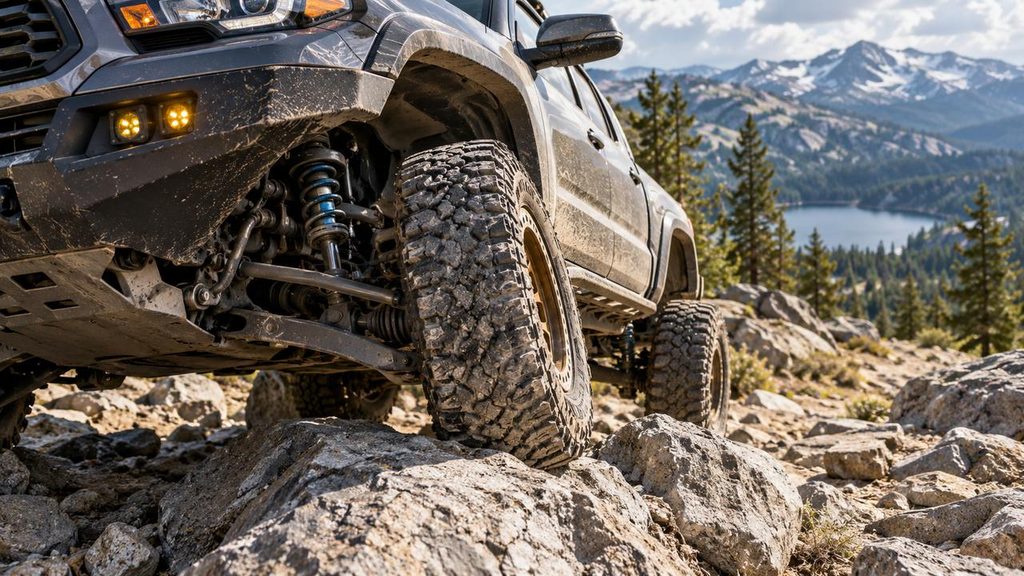
A wheel can look perfectly clear while the vehicle is parked with the steering straight and still rub badly in normal use.
The front tire does not simply rotate around its own center when you steer. Its leading and trailing edges sweep through the wheel well, and that path changes with offset, tire width and suspension geometry.
Suspension compression creates another dimension. A tire that clears the fender at normal ride height may contact the body when the suspension compresses into a bump, driveway or trail obstacle.
That is why “it fits while parked” is not the same as full functional clearance.
Does Wheel Offset Affect Steering and Suspension?
It can. Wheel offset is not only an appearance measurement.
Changing how far the tire’s contact patch sits relative to the steering axis can change scrub radius. Large departures from the original wheel position can therefore affect steering effort, feedback over bumps, kickback and the loads carried by wheel bearings, ball joints and steering components.
The effect is vehicle-specific because steering-axis geometry, tire size, suspension design and original offset all matter. This is why universal claims such as “anything within X millimeters is always safe” should be treated cautiously.
A small offset change on one truck may be routine aftermarket fitment. The same numerical change on another vehicle can create a substantial geometry or clearance change.
Does Lower Offset Always Mean More Poke?
Only when wheel width stays the same.
If you compare two 9-inch wheels, lowering offset from +20 mm to 0 mm moves the entire wheel outward by 20 mm.
But if wheel width changes at the same time, both variables have to be calculated. A narrower wheel with a lower offset can potentially have an outer edge in a similar position to a wider wheel with a higher offset.
This is why shopping by offset alone is unreliable. Always compare width and offset together.
Poke, Flush and Tuck Are Results, Not Offset Numbers
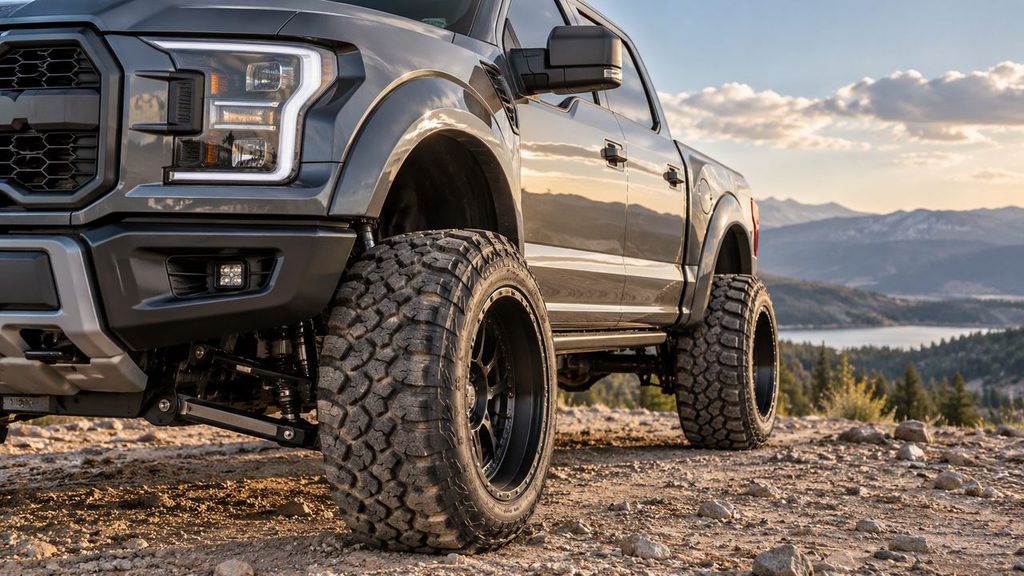
The terms poke, flush and tuck describe how the wheel-and-tire assembly appears relative to the body:
- Tuck: the tire sits noticeably inside the fender line.
- Flush: the outer tire or wheel sits approximately level with the fender.
- Poke: part of the assembly extends outside the fender line.
There is no universal “flush offset.” A -12 mm offset can poke aggressively on one vehicle and sit much closer to flush on another because factory track width, wheel width, body shape and suspension architecture are different.
If appearance matters, use photos of the same generation, trim, suspension height, wheel width, offset and tire size as your vehicle—not just another truck using the same offset number.
What Do Wheel Spacers Do to Offset?
A spacer moves the installed wheel outward from the hub.
For wheel-position calculations, a 10 mm spacer makes the installed setup behave approximately like a wheel with 10 mm less offset. A +30 mm wheel used with a 10 mm spacer therefore sits approximately where a +20 mm wheel of the same width would sit.
The spacer does not physically change the wheel’s manufactured offset or its measured backspacing. It changes the wheel’s position relative to the vehicle.
Spacers also introduce their own fitment, hardware, hub engagement and installation considerations, so they should not be treated as a universal correction for buying the wrong wheel.
Why Backspacing Matters So Much With 35- and 37-Inch Tires
As tire diameter and width increase, the available margin inside the wheel well usually becomes smaller. That makes wheel position increasingly important.
A lower-backspacing wheel can move a large tire away from an upper control arm or frame rail, but the same change can make the tire sweep farther into the fender, bumper or body mount while turning.
Lift height alone therefore does not determine whether an oversized tire fits. Wheel width, offset, backspacing, actual tire dimensions and steering clearance all interact.
If you are planning a 35-inch setup, see our guide to 35-inch tire lift and clearance requirements. For a larger build, our 37-inch tire fitment guide explains why wheel position becomes even more important as tire size increases.
Can Offset Fix Tire Rubbing?
Sometimes—but only if you know exactly where the tire is rubbing.
If the tire contacts an inner suspension component, moving the wheel slightly outward may create additional inner clearance. But if the tire already rubs the outer fender or rear of the wheel opening, moving it farther outward can make the problem worse.
Before changing wheels or adding spacers, identify the interference point at:
- straight-ahead ride height;
- full steering lock in both directions;
- suspension compression;
- normal operating load.
Then decide whether the solution requires wheel position, tire dimensions, trimming, suspension changes or a different combination of those factors.
Which Is More Useful: Offset or Backspacing?
Neither measurement is inherently better.
Offset is usually more convenient when comparing modern wheels because wheel manufacturers commonly publish it and it makes side-to-side movement easy to calculate when width stays constant.
Backspacing can be more intuitive when checking physical inner clearance because it directly describes how far the wheel extends inward from the hub mounting face.
Off-road suspension and lift-kit instructions may also specify backspacing because the manufacturer is trying to keep the wheel or tire away from a particular steering or suspension component.
The best approach is to understand both and use whichever specification is supplied by the wheel, vehicle or suspension manufacturer.
Before Ordering Wheels, Check More Than Offset
A mathematically correct offset does not guarantee that a wheel fits your vehicle.
Confirm all of the following before ordering:
- Bolt pattern. The wheel must match the hub’s lug pattern.
- Hub bore. The center bore must be compatible with the vehicle and any required hub-centric rings.
- Wheel diameter. The inner barrel must clear the brake package and other components.
- Wheel width. It must suit both the tire and available inner/outer space.
- Offset. Compare it with the original wheel and proven vehicle-specific fitments.
- Backspacing. Check available room toward the suspension and frame.
- Brake-caliper clearance. Offset alone does not describe spoke shape or caliper clearance.
- Wheel load rating. It must be appropriate for the vehicle and intended loads.
- Tire dimensions. Verify actual section width and overall diameter, not just nominal size.
- Dynamic clearance. Check steering lock, compression and expected vehicle load.
Common Wheel Offset and Backspacing Mistakes
- Comparing offset without comparing wheel width. The same offset on different widths produces different inner and outer positions.
- Using nominal wheel width as overall width. Advertised width is normally measured between bead seats, while backspacing reaches the inner lip.
- Assuming lower offset always improves fitment. It may improve inner clearance while making outer rubbing worse.
- Ignoring tire width. Wheel lips may clear while the tire sidewall still contacts suspension or bodywork.
- Checking only with the steering straight. Full lock can move the tire into a completely different part of the wheel well.
- Assuming lift height fixes everything. More ride height does not automatically create the inner, steering or body-mount clearance an oversized tire needs.
- Copying another vehicle’s offset. Offset requirements are tied to the exact chassis, brakes, suspension and wheel width.
Frequently Asked Questions
What is the difference between wheel offset and backspacing?
Wheel offset measures the hub mounting face relative to the wheel centerline, usually in millimeters. Backspacing measures from the mounting face to the inner wheel lip, usually in inches. They describe related geometry but use different reference points.
Is wheel backspacing the same as offset?
No. They can be converted when wheel width is known, but the numbers are not interchangeable. Two different-width wheels can have the same offset and different backspacing.
Does more backspacing move the wheel in or out?
For wheels of the same width, more backspacing moves more of the wheel inward toward the suspension. Less backspacing moves the wheel outward.
Does positive offset move the wheel inward?
Yes, when wheel width is unchanged. Increasing positive offset moves the entire wheel inward relative to the hub. Decreasing offset moves it outward.
How do you measure wheel backspacing?
Lay the wheel face down, place a straightedge across the inner rear lip and measure vertically from the hub mounting pad to the straightedge. That distance is the wheel’s backspacing.
Why is a 9-inch wheel wider than 9 inches when measured?
The advertised wheel width is normally measured between the tire bead seats. The physical outer flanges extend beyond those points, so overall lip-to-lip width is greater—often by roughly one inch, although the exact amount varies.
Can two wheels have the same offset but different backspacing?
Yes. A wider wheel at the same offset has more backspacing because additional width extends on both sides of the centerline. This is why width must be included in any offset-versus-backspacing comparison.
Can two wheels have the same backspacing but different offset?
Yes. If wheel widths differ, the same inner-lip-to-mounting-face distance corresponds to different centerlines and therefore different offsets.
Does negative offset cause rubbing?
It can, but not necessarily on the inner suspension. Negative offset moves the assembly outward, which may improve inner clearance while increasing the chance of contact with fenders, liners, bumpers or body mounts at steering lock or suspension compression.
What wheel offset should I use?
There is no universal offset that is correct for every truck or car. Start with the factory wheel width and offset, then compare proven fitments for your exact year, model, trim, suspension and tire size. Verify both inner and outer clearance before ordering.
The Fitment Rule Worth Remembering
Never judge a wheel by offset or backspacing alone. Wheel width is the missing dimension that tells you where both edges actually sit.
Offset measures from the wheel centerline. Backspacing measures from the inner lip. More positive offset generally moves a same-width wheel inward; more negative offset moves it outward. More backspacing means more inward depth—but only when the width being compared is the same.
Then remember that the wheel itself is only part of the fitment. The tire can extend beyond the rim, steering changes its path through the wheel well, and suspension compression can remove clearance that looked generous while parked.
If you compare wheel width + offset/backspacing + actual tire dimensions + dynamic clearance as one system, the numbers stop being confusing—and you are far less likely to discover the wrong fitment after the wheels are already mounted.