Body Lift vs Suspension Lift: Which Is Better for Your Truck?
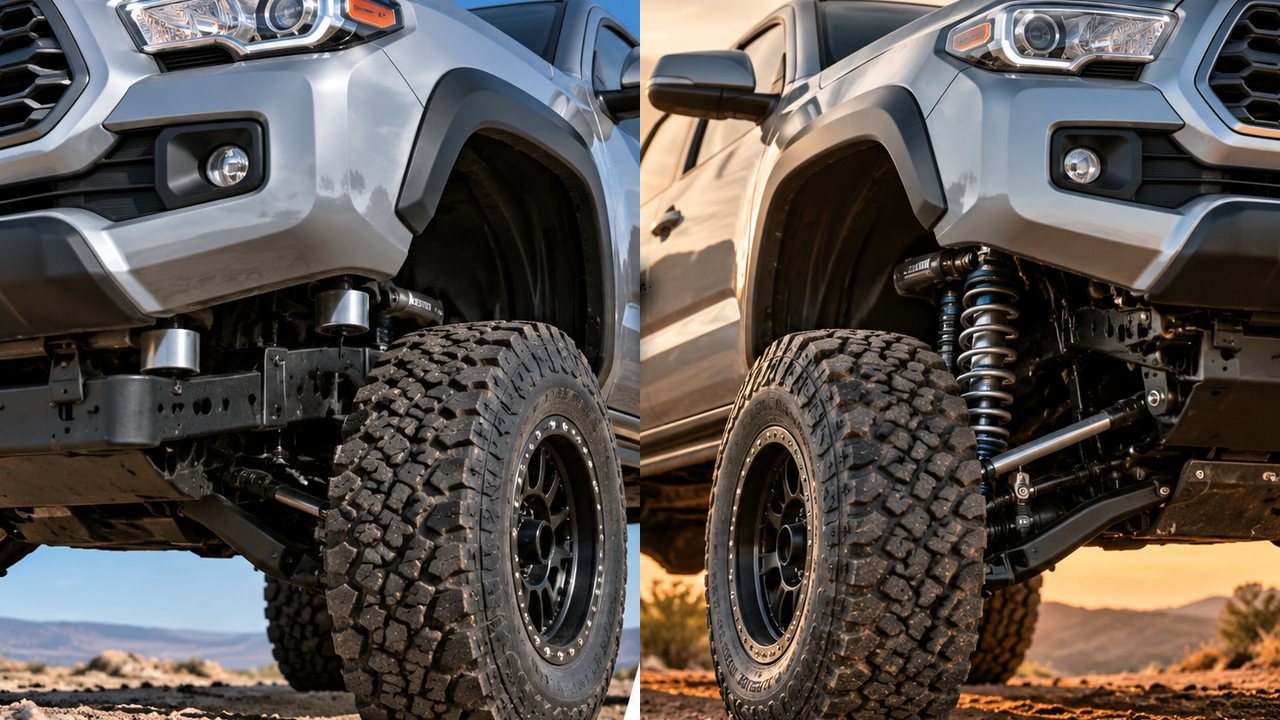
For most body-on-frame trucks that already ride well, a body lift makes more sense when you mainly want a taller stance and extra room around the tires. A suspension lift is the better choice when you need the chassis higher relative to the wheels, want meaningful suspension changes, or regularly drive off-road.
The important difference is not simply how many inches each kit advertises. A body lift separates the cab and body from the frame while leaving the suspension in its original position. A suspension lift changes the relationship between the chassis and the wheels by modifying springs, struts, control arms, brackets or other suspension hardware.
There is also one detail that many comparisons miss: neither type automatically raises every low point under a truck. A body lift leaves the frame, axles and differentials where they were, while a suspension lift can raise the frame but may still leave a solid axle and differential at essentially the same ground clearance. Larger tires are what raise an axle-mounted differential farther from the ground.
| Feature | Body Lift | Suspension Lift |
|---|---|---|
| What moves | Body moves higher above the frame | Suspension position or components change, raising the chassis/body relative to the wheels |
| Typical vehicle | Body-on-frame truck or SUV | Depends on the exact vehicle and suspension design |
| Tire clearance | Improves body and fender clearance | Usually improves tire clearance, depending on the kit |
| Frame clearance | No | Usually increases |
| Solid-axle differential clearance | No, unless larger tires are fitted | Not from suspension height alone; larger tires raise the differential |
| Suspension geometry | Largely unchanged | Can change substantially |
| Wheel travel | Unchanged | May change, but extra lift does not guarantee extra travel |
| Ride quality | Springs and dampers remain unchanged | Can improve or worsen depending on the system |
| Alignment | Normally not changed by the body lift itself | Should be planned after installation |
| Best for | Stance and tire room with minimal suspension change | Off-road clearance and a more complete suspension build |
What Actually Moves With Each Lift?
A Body Lift Raises the Body Above the Frame
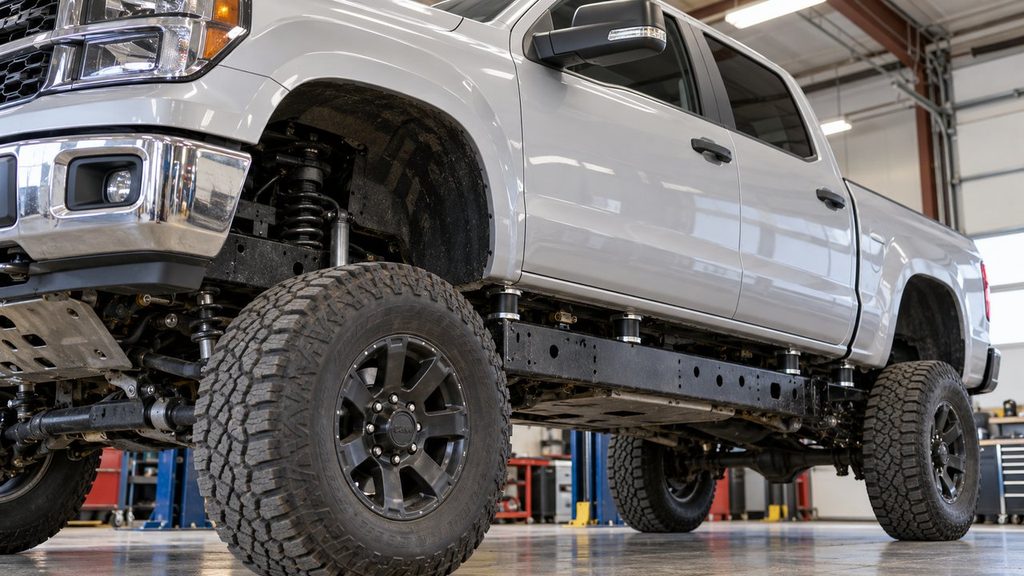
A conventional body lift installs spacers or blocks at the body mounts of a compatible body-on-frame vehicle. The cab, bed and body panels move upward, but the frame, engine, transmission, suspension, axles and differentials remain in their original chassis positions.
This distinction is why a body lift can create additional room around the wheel openings without changing control-arm angles, spring position or normal suspension travel.
It also means a traditional body lift is not a universal option for every SUV or car. A unibody vehicle does not have a separate body sitting on conventional frame-mounted body bushings in the same way. Always verify that a body-lift kit is specifically designed for the exact year, model and configuration.
A Suspension Lift Changes the Chassis-to-Wheel Relationship
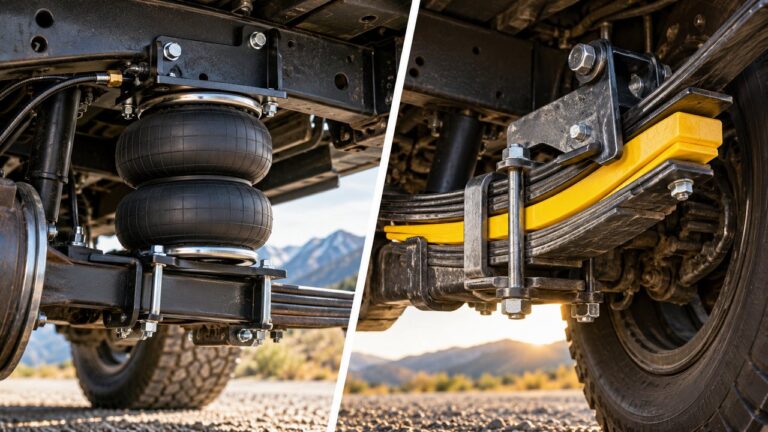
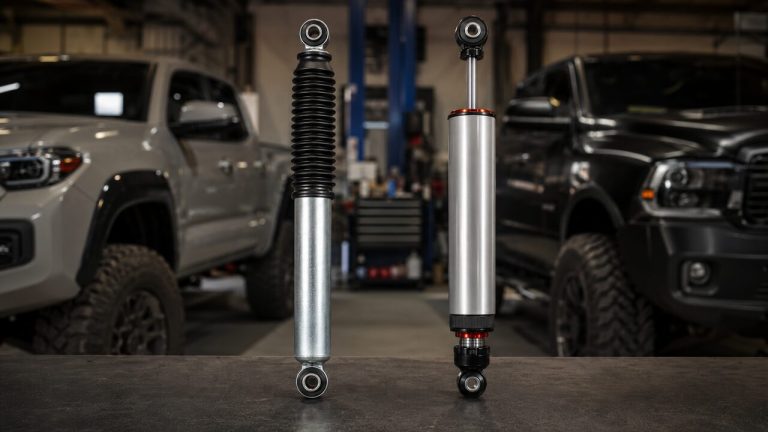
A suspension lift raises the vehicle by changing suspension position, components or mounting points. Depending on the platform and lift height, that may involve springs, struts, coilovers, control arms, steering knuckles, crossmembers, track-bar brackets, shocks, leaf springs or other vehicle-specific hardware.
The result is not merely a taller body. The chassis itself normally sits higher relative to the wheel hubs or axles, which can improve clearance beneath portions of the frame and create more room for larger tires.
However, a suspension lift should not automatically be treated as a long-travel conversion. A taller static ride height can still use stock-like suspension travel, and some poorly matched setups can actually lose usable droop. Lift height and wheel travel are separate measurements.
The Ground Clearance Difference Is More Complicated Than It Looks
This is the biggest reason to look beyond a simple “body lift gets no clearance, suspension lift gets clearance” rule.
A body lift does not raise the frame, suspension crossmembers, axles or differential housings. It mainly increases the distance between the body and the chassis. That can help the body clear tires and obstacles, but the mechanical parts underneath remain at their previous height.
A suspension lift usually raises the frame and body relative to the wheels. That can improve frame clearance and breakover clearance, but the lowest mechanical point depends on the suspension design.
On a solid axle, the differential housing moves with the axle and wheels. Raising the frame does not magically move the bottom of that differential farther from the trail. To increase clearance there, you normally need a tire with a larger actual radius.
Independent suspension is different again. Control arms, differential position, crossmembers and any drop brackets determine the lowest points. Some larger IFS lifts deliberately reposition the differential or add crossmembers, so advertised lift height should never be assumed to equal the same increase beneath every component.
If you want to understand why solid axles and independent suspension respond differently to modifications, our guide to off-road suspension layouts explains those architectures separately.
Which Lift Is Better for Bigger Tires?
A body lift can be very effective when tire-to-body clearance is the main limitation. Raising the fenders and wheel openings farther from the chassis gives the tire more physical room without adding more suspension angle.
A suspension lift can also create tire clearance, often while raising the chassis at the same time. But neither option guarantees that a particular tire size will fit. If you are specifically planning to run 35s, our guide to choosing the right lift height for 35-inch tires covers the clearance, wheel offset and rubbing factors in detail.
Tire width, actual measured diameter, wheel width, offset, backspacing, steering angle, suspension compression and the shape of the inner fender all matter. Two trucks with the same advertised lift height can therefore rub completely differently.
Full compression matters too. A body lift moves the body upward, but the suspension still cycles through its original path. A suspension lift may alter that path or its available travel. The tire must clear the vehicle while turning and while the suspension moves—not just while the truck is parked on level ground.
Body Lift vs Suspension Lift Pictures: What to Look For
The easiest way to identify the difference in side-by-side pictures is to look at the space between the body and the frame rather than only at the distance between the tires and fenders.
- Body lift: the cab and bed sit higher above the frame, while axles and suspension mounting points remain near their original positions.
- Suspension lift: the frame and body sit higher relative to the wheels because suspension components or mounting locations have changed.
- Large tires: can make either truck appear substantially taller and may provide the only increase in clearance beneath a solid axle differential.
Visible frame-to-body gaps can make some body lifts easy to spot, although vehicle-specific bumper relocation and gap guards can make the finished installation look much more integrated.
Body Lift Pros and Cons
A body lift is attractive because it solves a very specific problem without rebuilding the suspension.
Advantages
- Creates additional body and fender clearance for larger tires.
- Retains the existing springs, shocks and basic suspension geometry.
- Does not normally change camber, caster or toe by itself.
- Leaves CV and driveshaft angles largely unchanged because the drivetrain stays with the frame.
- Usually requires fewer suspension components than a complete suspension lift.
- Can make sense for a street-driven body-on-frame truck that already rides the way the owner wants.
Disadvantages
- Does not raise the frame, axles or differentials.
- Does not increase suspension travel or improve damping.
- Can expose an unattractive gap between the body and frame.
- May require bumper, steering, radiator, fan-shroud or other vehicle-specific corrections.
- Raises some vehicle mass and therefore still affects overall center of gravity to some degree.
- Is limited to compatible body-on-frame designs.
A Body Lift Changes More Than the Suspension Diagram Shows
The suspension may remain untouched, but the body is connected to many parts that stay attached to the frame. Those relationships must still be checked during installation.
- Steering shaft: the steering column moves with the body while the steering gear remains attached to the chassis.
- Bumpers: many factory bumpers are frame-mounted and may need relocation hardware to line up with the raised body.
- Radiator and fan relationship: vehicle-specific brackets or shroud changes may be required because body-mounted and chassis-mounted parts no longer sit in the same relative position.
- Fuel filler: hoses or filler-neck routing must have sufficient length and correct positioning.
- Shifter and linkage: mechanical linkages need to operate correctly throughout their full range.
- Wiring and hoses: nothing should become stretched, pinched or incorrectly routed as the body rises.
- Receiver hitch and frame-mounted accessories: these remain with the frame even though the body and bed move upward.
This is why a body lift should not be dismissed as simply installing a few generic blocks. The correct kit needs hardware and instructions designed around the exact vehicle.
Suspension Lift Pros and Cons
A suspension lift gives the installer much more control over ride height and suspension behavior, but that also creates more variables to get right.
Advantages
- Raises the chassis relative to the wheels or axles.
- Can improve clearance beneath the frame and portions of the underbody.
- Can create substantial room for larger tires.
- Can replace worn or limited factory springs and dampers with components better matched to the intended use.
- Offers more potential for a complete off-road-focused suspension setup.
Disadvantages
- Changes suspension and steering geometry.
- Can increase CV, ball-joint, driveshaft or U-joint angles depending on the design.
- May require control arms, crossmembers, track-bar correction, extended brake lines or other supporting parts.
- Requires a proper post-installation alignment in normal lift applications.
- Can change ride quality and steering feel.
- Usually involves more parts, labor and setup than a body lift.
Suspension Geometry Matters More Than the Lift Number
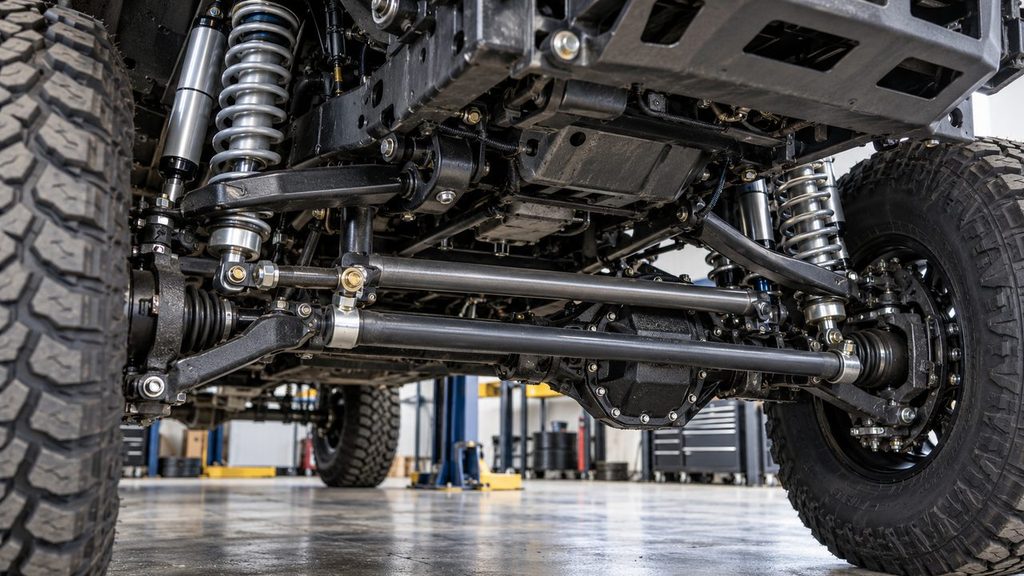
Suspension components are designed to operate within specific ranges. Raising static ride height changes where those components sit at rest and can change their angles throughout compression and droop.
On an independent front suspension truck, upper control-arm and ball-joint angles, CV axles, tie rods, caster and available droop can all become important. On a solid-axle vehicle, axle location, track-bar angle, steering geometry, pinion angle, driveshaft position and brake-line travel may need attention.
The taller the change, the less useful it becomes to judge a kit only by the advertised number on the box. A complete system should address the vehicle-specific geometry affected at that height.
Once suspension ride height changes, plan to have the geometry measured. Our guide to alignment after suspension work explains why camber, caster and toe can change when suspension position or wheel-locating components are altered.
Which One Rides Better?
A body lift leaves the springs and shocks in their existing positions, so the suspension itself should behave much like it did before the lift. That does not mean the entire modified truck will feel identical.
The body is now higher relative to the chassis, and owners frequently combine a body lift with heavier or larger-diameter tires. Those changes can affect steering response, acceleration, braking feel, fuel economy and overall stability even though the dampers and springs were never touched.
A suspension lift can ride better, worse or simply different from stock. Spring rate, preload, damper tuning, available travel, bushings, tire construction and corrected geometry all matter more than the word “lift.”
A well-matched spring-and-damper system can control a truck better than tired factory suspension. A poorly matched kit can be harsh, floaty or difficult to align. There is no rule that a suspension lift must ride badly.
Which Is Better for Daily Driving?
For a mostly street-driven body-on-frame truck that already rides well, a modest body lift is often the lower-impact choice when the goal is appearance or additional tire room.
It keeps suspension geometry close to factory configuration and avoids adding suspension height solely for appearance. The trade-off is that the frame and other chassis components remain at their original clearance.
A moderate, properly engineered suspension lift can still work very well on a daily driver. The important question is whether the additional suspension height provides something the owner actually needs. If the truck spends nearly all of its life on pavement, maximum lift height usually creates more compromises than benefits.
Which Is Better Off-Road?
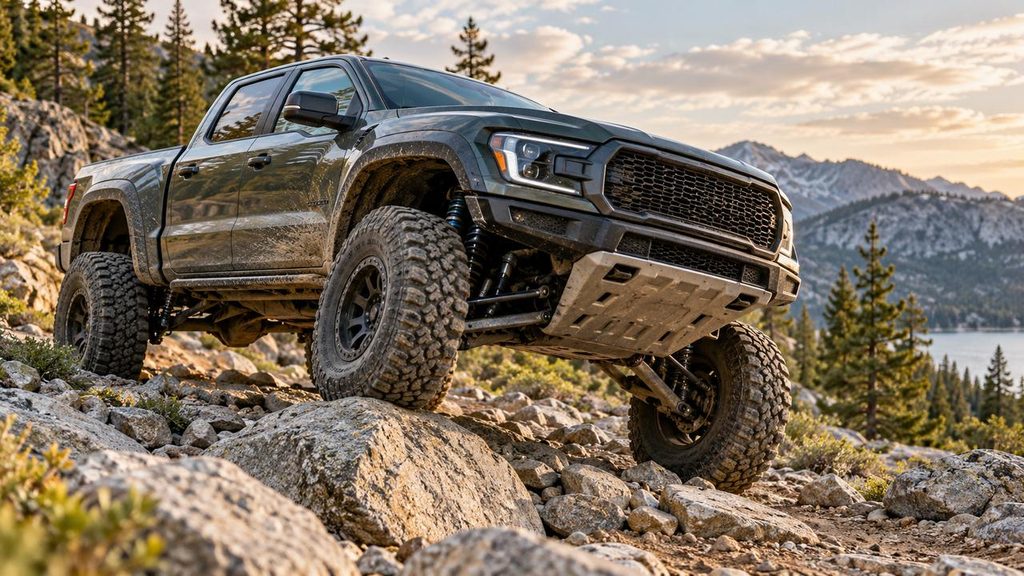
A suspension lift has the greater performance potential for regular off-road use because it can raise the chassis, change spring and damper performance, and accommodate a more complete suspension setup.
But taller is not automatically better. Traction, damping, usable wheel travel, bump-stop control, steering geometry, tire pressure and vehicle weight can matter more than an extra inch of static ride height.
A body lift can still be useful on an off-road build when the suspension already works well and the main goal is additional body clearance for a larger tire. Those larger tires may then create the important increase in axle and differential clearance that the body lift itself cannot provide.
If the goal has progressed beyond choosing lift type and into selecting a complete trail setup, see our guide to off-road suspension kits for trucks and 4x4s.
Body Lift vs Suspension Lift Cost
A body lift is usually the less expensive type of project, but the parts count does not tell the whole story. The suspension may stay intact, yet the installer still has to access body mounts, safely separate the body from the frame and correct any vehicle-specific bumper, steering, cooling-system, linkage or hose relationships.
A suspension lift normally involves more suspension hardware and can also add alignment, control arms, brake-line changes, driveline corrections and other supporting components to the final bill.
Because labor varies dramatically by vehicle and lift design, this article does not assign one universal price to either option. Our separate lift kit installation cost guide covers parts, labor, alignment and hidden expenses in detail.
3-Inch Body Lift vs 3-Inch Suspension Lift
Two kits both advertised as “3-inch lifts” do not produce the same modification.
A nominal 3-inch body lift raises the body approximately three inches farther from the frame while the frame and suspension stay at their original ride height. It can therefore create substantial wheel-well clearance without providing three inches of extra frame or differential clearance.
A nominal 3-inch suspension lift changes the suspension position so the frame and body sit higher relative to the wheels. That can provide additional chassis clearance, but the exact result depends on suspension architecture and kit design. On a solid axle, the differential still does not gain three inches of ground clearance unless tire radius also increases.
The same advertised height can therefore solve completely different problems. Choose based on which part of the truck actually needs to move.
Can You Combine a Body Lift and Suspension Lift?
Yes, compatible body-on-frame vehicles can sometimes use both. A moderate suspension lift can provide chassis clearance and suspension changes, while a separate body lift can create additional room around larger tires without demanding even more suspension height.
That does not make stacking lifts automatically better. The finished vehicle is taller, its center of gravity changes, tire and wheel requirements may become more demanding, and every body, steering, suspension and driveline relationship still needs to remain within a safe operating range.
A combination should therefore be planned as one complete vehicle setup rather than treating two individually compatible kits as automatically compatible with each other.
What If You Only Want to Remove Factory Rake?
If your only goal is raising the front of a pickup so it sits more level with the rear, you may not need either modification discussed here.
A leveling kit targets factory rake rather than lifting the body away from the frame or substantially raising the entire suspension system. Our leveling kit vs lift kit comparison covers that decision separately, including tire clearance, towing, geometry and daily driving.
Body Lift or Suspension Lift? Choose by Goal
| Your Main Goal | Usually the Better Starting Point |
|---|---|
| Taller stance with minimal suspension change | Body lift |
| More room between body and tires | Body lift can be effective |
| Keep current springs and shocks | Body lift |
| Raise frame clearance | Suspension lift |
| Improve or replace suspension components | Suspension lift |
| Regular difficult off-road use | Suspension lift |
| Increase solid-axle differential clearance | Larger-diameter tires are the key change |
| Correct factory nose-down rake | Leveling kit |
| Lowest suspension-geometry impact | Body lift, on a compatible vehicle |
| Maximum overall lift | Suspension or carefully planned combination |
The most useful rule is simple: identify the clearance or performance problem first, then lift only the part of the truck that needs to move. Buying the tallest kit first and deciding what it is supposed to accomplish afterward is how unnecessary compromises begin.
Frequently Asked Questions
What is the main difference between a body lift and suspension lift?
A body lift raises the body above the frame using body-mount spacers while leaving the suspension and chassis at essentially their original height. A suspension lift changes suspension components or mounting relationships so the chassis and body sit higher relative to the wheels.
Does a body lift increase ground clearance?
Not beneath the frame, axles or differential. A body lift increases clearance between the body and chassis and can create room for larger tires. If those tires have a larger actual radius, they can then increase clearance beneath axle-mounted components.
Does a suspension lift increase differential clearance?
Not necessarily. On a conventional solid axle, the differential remains attached to the axle and its distance from the ground is primarily determined by tire radius. A suspension lift raises the frame relative to that axle. Independent-suspension layouts vary by design.
Do you need an alignment after a body lift?
A pure body lift does not normally change wheel-alignment geometry because the suspension remains attached to the frame in its original position. However, any vehicle with existing alignment symptoms or additional suspension modifications should still be checked. A suspension lift should normally be followed by alignment.
Can you install a body lift on a unibody vehicle?
Not in the traditional body-on-frame sense. A conventional body lift requires a separate body and frame with suitable body mounts. Unibody vehicles use different structural designs and require vehicle-specific suspension or subframe solutions rather than generic body-mount spacers.
Which lift is better for larger tires?
Either can help, but in different ways. A body lift raises the body and fenders away from the tires, while a suspension lift changes chassis and suspension position. Exact tire fit depends on the vehicle, wheel width, offset, backspacing, actual tire dimensions, steering angle and full suspension compression.
Is a body lift bad for a truck?
Not when a properly engineered, vehicle-specific kit is installed correctly. Problems are more likely when excessive height, improvised spacers, incorrect hardware or uncorrected steering, bumper, cooling-system, hose or linkage relationships are involved.
Body Lift or Suspension Lift: Final Verdict
Choose a body lift when you have a compatible body-on-frame truck, already like the way its suspension works and mainly want more body clearance for tires or a taller stance without adding unnecessary suspension geometry changes.
Choose a suspension lift when you actually need the chassis higher, want to change springs and damping, or are building the vehicle for more demanding off-road use. Just remember that suspension lift height does not automatically equal extra wheel travel or differential clearance.
Start with the tire size, terrain and clearance point that is limiting the truck. Then verify exact year, model, drivetrain and suspension fitment before ordering anything. The best lift is not the one with the biggest number—it is the one that moves the right part of the vehicle while creating the fewest unnecessary compromises.