Torsion Bar vs. Coil Spring Suspension: Key Differences Explained
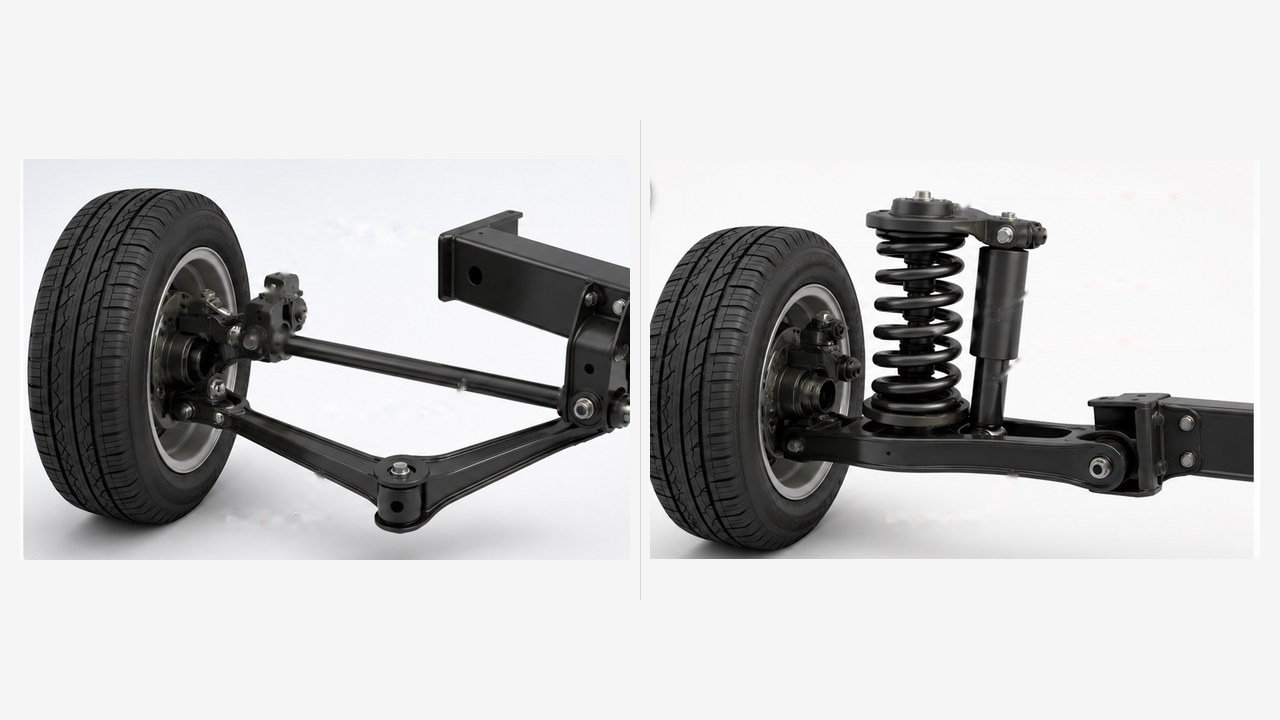
Torsion bars and coil springs perform the same fundamental job in a vehicle suspension: they support the vehicle’s weight and provide spring force as the wheels move. The difference is how they do it. A torsion bar stores energy by twisting a straight steel bar, while a coil spring stores energy as its helical coils deflect under load.
Torsion bars generally offer useful packaging flexibility and, on many designs, straightforward static ride-height adjustment. Coil springs are more common in modern passenger vehicles and give manufacturers enormous flexibility in spring shape, rate, travel, and packaging around different suspension architectures.
Neither is automatically more comfortable, stronger, or better for handling. Those outcomes depend on spring rate, suspension geometry, dampers, tires, travel, vehicle weight, bushings, alignment, and how the complete chassis is engineered.
Torsion Bar vs. Coil Spring at a Glance
| Factor | Torsion Bar | Coil Spring |
|---|---|---|
| How spring force is created | Bar twists | Helical spring deflects |
| Typical shape | Long straight steel bar | Helical coil |
| Ride-height adjustment | Often adjustable through anchor/preload setting | Usually requires different hardware or spring length |
| Vertical packaging | Can require relatively little vertical spring space | Requires space for the spring or spring/strut assembly |
| Lengthwise packaging | Requires room along the bar | More localized around the wheel or suspension arm |
| Spring-rate options | Rate mainly determined by bar dimensions and material | Extremely flexible coil geometry and rate design |
| Progressive-rate designs | Less straightforward | Common and easy to package in many forms |
| Replacement | Vehicle-specific bar, splines, anchors, and orientation | Vehicle-specific spring dimensions and rate |
| Common applications | Some trucks, SUVs, older cars, specialized vehicles | Modern cars, trucks, SUVs, and performance vehicles |
This comparison is about the spring element itself. A torsion-bar vehicle and a coil-spring vehicle can still use very similar control-arm geometry, shocks, steering components, and other suspension hardware.
The Core Difference: Twisting vs. Spring Deflection
A torsion bar is a long spring-steel bar anchored at one end and connected to a moving suspension component at the other. When the wheel moves, the suspension twists the bar along its axis.
The bar resists that rotation and stores elastic energy. As suspension load decreases, it attempts to return toward its original position.
A coil spring forms spring steel into a helix. Wheel movement changes the spring’s length and loads the wire through a combination of stresses within that helical shape.
In both cases, the result is spring force opposing suspension displacement. The two designs achieve that result through different physical shapes and installation arrangements.
If you want the torsion-bar system explained independently of this comparison, see our complete guide to torsion bar suspension.
Does One Suspension Work Differently at the Wheel?
The spring type does not necessarily determine the wheel path.
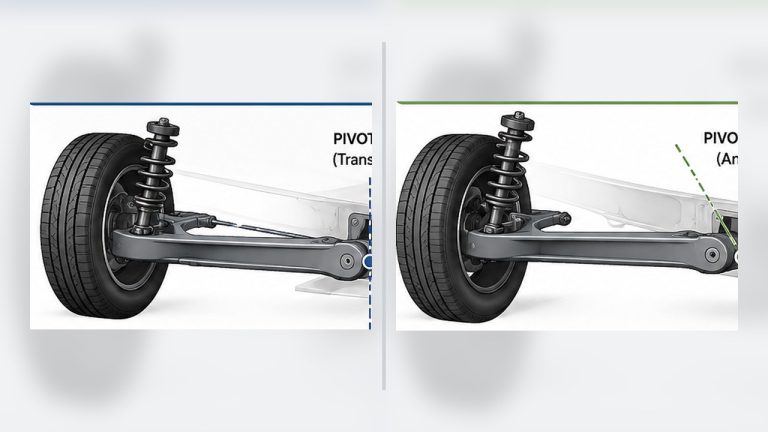
For example, a double-wishbone front suspension can use a coil spring acting on a control arm, or a torsion bar connected to one of those arms. The control-arm geometry still determines much of the wheel’s camber, caster, toe, and movement path.
This is important because comparisons sometimes attribute every difference between two vehicles to the spring. In reality, the vehicles may also have different control arms, shocks, anti-roll bars, tires, alignment, bushings, ride heights, and chassis tuning.
The torsion bar or coil spring provides spring resistance. It does not independently define the complete suspension architecture.
Which Has Better Packaging?
Neither has a universal packaging advantage because they consume space in different places.
A torsion bar can run longitudinally along the chassis, allowing engineers to avoid placing a large spring vertically between a control arm and the body. That can free space around the wheel and upper suspension area.
The trade-off is that the bar needs sufficient length, an anchor, adjustment or indexing hardware, and structural mounting points farther along the chassis.
A coil spring concentrates more of the spring package near the wheel. It may sit between a control arm and body, around a damper in a coilover-type arrangement, or in another dedicated spring pocket.
Modern vehicle platforms are designed around these components from the beginning, so neither solution should be judged without considering the rest of the chassis.
Which Is Easier to Adjust for Ride Height?
Torsion bars often have the advantage in factory static ride-height adjustment.
Many torsion-bar systems use an adjustable anchor or key. Changing that setting alters the installed preload and resting position of the suspension within the range provided by the manufacturer.
A conventional coil-spring suspension normally does not provide the same adjustment simply by turning a factory adjuster. Changing static height may require a different spring, an adjustable spring perch, coilover hardware, spacers, or another vehicle-specific modification.
However, torsion-bar adjustability should not be confused with unlimited lift capability. Raising the static suspension position can reduce droop travel and alter alignment, control-arm angles, shock position, CV-joint angles, bump-stop clearance, and ride quality.
Vehicle-specific adjustment procedures deserve separate treatment; simply counting adjuster turns is not a universal or reliable way to set suspension height.
Does Tightening a Torsion Bar Make It Stiffer Than a Coil Spring?
Not in the way this question is often understood.
Changing the normal ride-height adjustment on an existing torsion bar generally changes its installed position and preload, not the intrinsic spring rate created by the bar’s material and dimensions.
The vehicle can still feel firmer after excessive adjustment because it may now have less droop, different control-arm geometry, altered shock position, or earlier interaction with suspension limits.
A genuinely higher-rate torsion-bar setup generally requires a bar with different physical properties or dimensions, just as changing the rate of a conventional coil-spring setup normally requires a different spring.
Which Offers More Spring-Rate Flexibility?
Both can be engineered in many rates, but coil springs provide manufacturers and suspension tuners with especially broad geometric flexibility.
Coil spring rate can be influenced by wire diameter, coil diameter, active coil count, material, and other design choices. Manufacturers can also create linear, progressive, or multi-rate behavior using different spring geometries.
Torsion-bar rate is heavily influenced by bar diameter, effective length, material, and suspension leverage. Different bars can therefore provide different rates, but achieving a deliberately progressive spring characteristic is generally less straightforward.
For more on how spring behavior changes through compression, see our guide to linear vs. progressive springs.
Which Has Better Ride Quality?
Neither torsion bars nor coil springs inherently provide better ride comfort.
A comfortable suspension needs an appropriate spring or wheel rate, enough usable travel, suitable damping, compliant tires, appropriate bushings, and geometry that works through the vehicle’s normal operating range.
A low-rate torsion bar can be more compliant than a high-rate coil spring. A carefully designed progressive coil spring may provide a different compromise between smaller and larger suspension movements. Neither comparison can be made from shape alone.
The damper is equally important because a spring stores and releases energy but does not adequately control how quickly the wheel and body oscillate. Our guide to what damping does in suspension explains that separate function.
Which Handles Better?
Spring type alone cannot determine handling performance.
A torsion bar can provide a precise spring rate while control arms determine wheel geometry. A coil spring can do exactly the same job in another suspension with similar geometry.
Handling differences are more directly affected by effective wheel rate, damping, camber behavior, toe, caster, anti-roll bars, tires, chassis stiffness, alignment, track width, weight distribution, and available travel.
A torsion-bar performance car can therefore handle better than a poorly tuned coil-spring car, and the reverse can also be true.
The useful question is not which spring shape handles better. It is whether the complete spring rate and suspension geometry match the vehicle’s purpose.
Which Is Better for Off-Road Use?
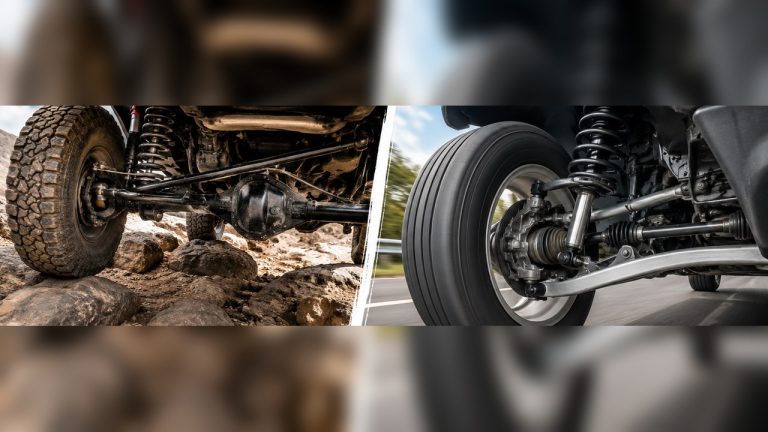
Torsion bars became familiar on several trucks and SUVs partly because they package effectively with independent front suspension and can provide convenient static ride-height adjustment.
That does not make them inherently better off-road than coil springs.
A coil-spring suspension can provide excellent wheel travel, durability, and load control when properly engineered. Likewise, a torsion-bar independent suspension can perform very well within the limits of its control arms, shocks, CV joints, steering system, bump stops, and other components.
For off-road use, usable wheel travel, damping, tire size, joint angles, ground clearance, articulation, spring rate, and durability are more important than choosing a suspension because its spring twists instead of coils.
Which Is Better for Trucks?
Both systems can work extremely well on trucks.
Torsion bars can be attractive for independent front suspension because the long bar can run along the chassis and the static ride position may be adjustable. Some truck platforms have used this design successfully for years.
Coil springs are also widely used on modern trucks because they can be packaged in many suspension arrangements and tailored to a broad range of rates and travel requirements.
The presence of a torsion bar does not automatically indicate a heavy-duty model, and a coil spring does not automatically indicate a lighter-duty suspension. Vehicle ratings are established around the complete axle, frame, tires, wheels, brakes, bearings, springs, and chassis.
Which Is Better for Daily Driving?
For normal road use, there is little reason to choose or reject a vehicle solely because it uses torsion bars or coil springs.
Either design can deliver excellent comfort, predictable handling, and long service life when properly engineered.
For a buyer comparing two vehicles, tires, seats, suspension tuning, wheelbase, damping, road noise, steering feel, and overall chassis calibration are likely to have a much greater effect on everyday experience than the shape of the spring.
Durability: Which Lasts Longer?
Both torsion bars and coil springs can last for many years, but both operate under repeated cyclic loading and can eventually suffer from corrosion, fatigue, physical damage, or other deterioration.
Coil springs can corrode and may eventually crack or break, particularly in environments where road salt and moisture attack the spring coating and steel.
Torsion bars can also suffer from corrosion, fatigue, damaged splines, or problems at their anchors and adjustment hardware.
The spring itself is only part of the system. Bushings, control arms, ball joints, shocks, mounts, crossmembers, keys, spring seats, and other surrounding components can fail before the main spring element does.
Which Is Easier to Replace?
There is no universal winner because service difficulty varies substantially by vehicle.
A coil spring may require the suspension to be safely unloaded and, depending on its location, specialized spring-compression procedures or significant component removal.
A torsion bar may require unloading stored torsional force, removing adjustment hardware, dealing with seized splines or anchors, and indexing replacement components correctly.
Both are load-bearing spring components that can store substantial energy. Replacement procedures should follow the service information for the exact vehicle rather than a generic removal sequence.
Can a Torsion Bar Sag Like a Coil Spring?
A vehicle using either system can eventually sit lower than specified, but the cause should be diagnosed rather than assumed.
On a coil-spring vehicle, ride-height loss can involve spring deterioration, damage, excessive load, worn spring seats, or other suspension problems.
On a torsion-bar vehicle, bar condition, anchor position, adjustment hardware, bushings, structural mounts, vehicle load, and previous adjustments may all affect measured ride height.
Correct ride height should be verified using manufacturer measurement points before parts are replaced or torsion-bar settings are changed.
Which Is More Adjustable?
At the factory suspension level, torsion bars commonly offer easier adjustment of static ride position because many systems provide a dedicated anchor adjustment.
Coil springs usually require additional adjustable hardware if ride height needs to change without replacing the spring.
However, the aftermarket changes that comparison. Coilover assemblies, adjustable spring perches, replacement coils, helper springs, tender springs, and many other systems give coil-spring suspensions enormous tuning flexibility.
So torsion bars often have the simpler factory height adjustment, while coil-based performance systems can offer much broader aftermarket tuning depending on the vehicle.
Do Coil Springs Have an Advantage for Progressive Rates?
Coil springs give designers several practical ways to vary the rate through suspension travel.
Changes in coil spacing, diameter, wire dimensions, active coil count, and other geometry can be used to create different load-versus-deflection characteristics.
A conventional straight torsion bar normally behaves more like a consistent torsional spring within its intended elastic range.
The complete wheel rate can still become progressive even with a torsion bar because control-arm leverage may change through travel and bump stops or other elastic components can add stiffness.
Weight Is Not as Simple as It Looks
It is tempting to declare one system lighter, but spring weight cannot be separated cleanly from the hardware required to install it.
A torsion-bar system needs the bar itself, anchors, mounting structure, and the suspension components that apply torque to it.
A coil-spring system needs suitable spring seats or a strut/coilover assembly and structural support for those loads.
Materials, spring rate, vehicle load, suspension travel, control arms, crossmembers, and chassis design all influence the final system mass. Comparing two spring shapes without the surrounding hardware can therefore be misleading.
Torsion Bar Advantages Over Coil Springs
- Can reduce the vertical space needed for the spring element
- Static ride height is adjustable on many factory systems
- Simple spring element with no helical spring pocket required
- Can package effectively with independent front suspension
- Spring-rate changes may be possible by replacing a removable bar
- Proven durability in many truck, SUV, and specialized applications
Torsion Bar Disadvantages Compared With Coil Springs
- Requires sufficient length and strong anchor points
- Progressive-rate spring design is less straightforward
- Factory adjustment can tempt owners to exceed useful geometry limits
- Bar splines, anchors, keys, and adjusters create vehicle-specific service points
- Large rate changes generally require a different torsion bar
- Far fewer modern applications and aftermarket options on many platforms
Coil Spring Advantages Over Torsion Bars
- Extremely common across modern vehicle platforms
- Broad range of linear, progressive, and specialized spring designs
- Can be packaged with struts, coilovers, control arms, and many other layouts
- Large aftermarket selection on popular performance vehicles
- Spring rates and free lengths can be offered in many combinations
- Spring hardware is concentrated near the suspension rather than extending far along the chassis
Coil Spring Disadvantages Compared With Torsion Bars
- Requires dedicated space for the coil and spring seats
- Conventional factory systems usually lack simple ride-height adjustment
- Coils can crack or break after corrosion or fatigue
- Spring replacement can require significant unloading or disassembly
- Changing ride height often requires different springs or additional adjustable hardware
Can You Convert Torsion Bar Suspension to Coil Springs?
Not as a simple spring swap.
The vehicle structure must provide appropriate load paths and mounting points for whichever spring is installed. A chassis designed around torsion-bar anchors may not have suitable coil-spring seats or towers in the required locations.
A conversion may also require different control arms, shocks, bump stops, crossmembers, brackets, geometry, alignment settings, and surrounding components.
Even when aftermarket conversion kits exist for a specific platform, their engineering and installation requirements should be evaluated as a vehicle-specific modification rather than assuming the two spring types are interchangeable.
How to Tell Whether Your Vehicle Has Torsion Bars or Coil Springs
A visual inspection can often identify the basic spring type, although official specifications or service information are the safest reference for the exact model and trim.
- Torsion bar: look for a long metal bar connected to a suspension arm and extending toward an anchor or crossmember.
- Coil spring: look for a visible helical spring located between the suspension and vehicle structure or surrounding a damper in a coilover or strut-type arrangement.
Some vehicle families use different suspension systems according to drivetrain, year, trim, or load rating, so identifying the exact configuration is important before ordering control arms, shocks, springs, or other suspension parts.
So, Which Is Better: Torsion Bar or Coil Spring?
Torsion bars are particularly useful when compact vertical packaging and straightforward factory ride-height adjustment are valuable. Coil springs generally provide greater design variety, broader modern application, and more options for linear, progressive, and performance-oriented spring setups.
That still does not make either design universally superior.
A torsion-bar truck can be comfortable and highly capable. A coil-spring truck can carry heavy loads and perform extremely well off-road. A performance car can also use either type successfully when the spring and suspension geometry are engineered around the application.
For an existing vehicle, the better spring type is normally the one the suspension was designed to use. Changing the complete architecture solely to obtain the other spring shape rarely makes sense unless the vehicle is undergoing a properly engineered specialized build.
Frequently Asked Questions
What is the difference between torsion bar and coil spring suspension?
A torsion bar provides spring force by twisting a straight steel bar, while a coil spring provides spring force through the deflection of a helical spring. Both support vehicle weight and allow suspension movement, but their shapes create different packaging and adjustment options.
Are torsion bars better than coil springs?
Not universally. Torsion bars can offer compact vertical packaging and convenient static ride-height adjustment. Coil springs provide enormous flexibility in rate, shape, progressive characteristics, and modern suspension applications. The complete vehicle design determines which works better.
Do torsion bars ride rougher than coil springs?
Not inherently. Ride quality depends on effective spring rate, damping, suspension travel, tires, bushings, geometry, vehicle weight, and tuning. Either spring type can be engineered for a soft or firm ride.
Why do trucks use torsion bars?
Torsion bars can package effectively with independent front suspension and allow manufacturers to set or adjust static ride height through the anchor system. Their durability and compact vertical profile have also made them useful in some truck and SUV designs.
Does adjusting a torsion bar change the spring rate?
Normal ride-height adjustment generally changes the bar’s installed preload and suspension position rather than its intrinsic spring rate. The vehicle may still feel different because travel, alignment, shock position, control-arm angles, and other geometry have changed.
Are coil springs more progressive than torsion bars?
Coil springs can be designed with linear or progressive characteristics using several geometric methods, making progressive spring designs common. A conventional straight torsion bar is generally less flexible in this respect, although the complete suspension can still produce progressive wheel-rate behavior through geometry and other components.
Can you replace torsion bars with coil springs?
Not as a direct spring replacement. Coil springs need suitable spring seats and structural load paths, and a conversion may require substantial changes to control arms, shocks, crossmembers, mounting points, bump stops, and suspension geometry.
Different Shape, Same Fundamental Job
The simplest way to understand torsion bar vs. coil spring suspension is that both are solutions to the same engineering problem. One stores spring energy by twisting a bar; the other uses a helical spring.
Their shapes influence packaging, adjustment, available rate designs, and servicing, but neither determines the quality of the entire suspension. Spring rate, damping, geometry, tires, travel, alignment, and overall chassis tuning remain more important than whether the spring is straight or coiled.