What Is Multi-Link Suspension? How It Works, Pros and Cons
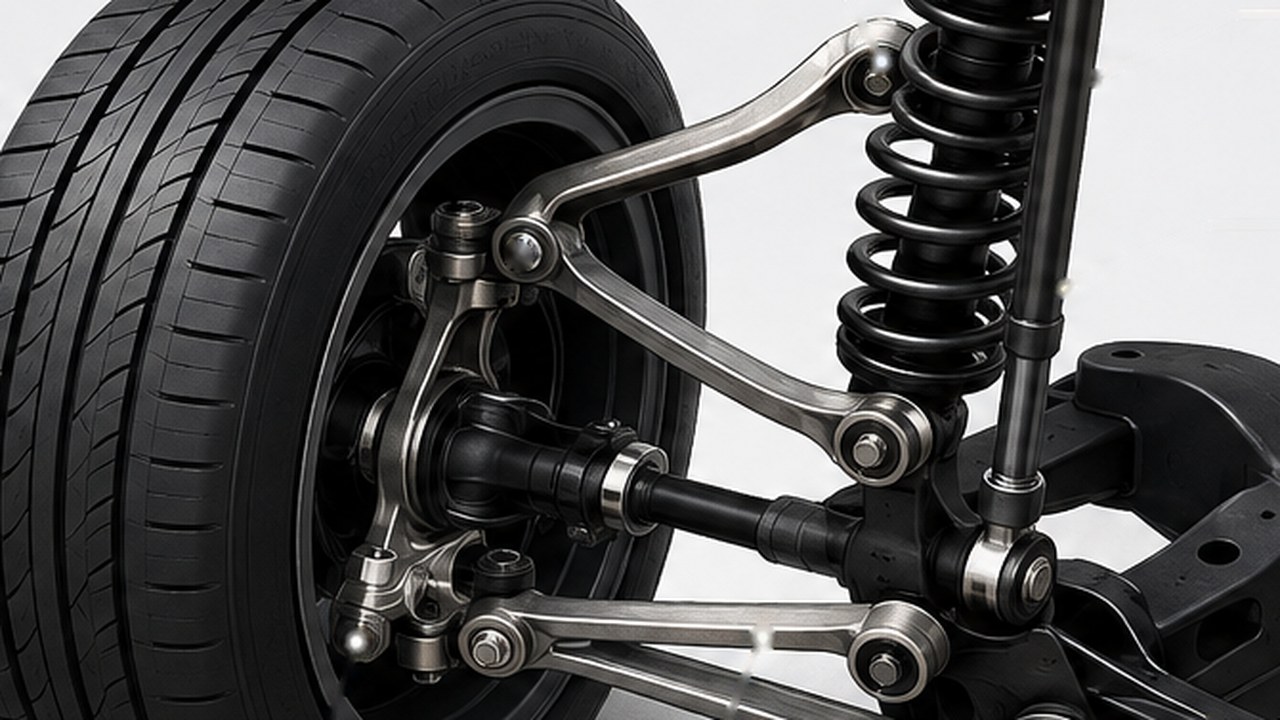
Multi-link suspension is a suspension design that uses several separate arms, or links, to control the position and movement of a wheel. Instead of asking one or two large control arms to manage several forces at once, engineers can assign different jobs to individual links and tune how the wheel moves during cornering, braking, acceleration, and bumps.
That extra freedom is the main reason multi-link suspension is common on modern performance cars, luxury vehicles, and increasingly on mainstream models. A well-designed system can combine precise wheel control with good ride comfort, although it requires more components, more mounting points, and usually more cost than a simpler suspension layout.
There is one important detail: “multi-link” is a family of suspension designs, not one universal arrangement. Two vehicles can both be described as having multi-link suspension while using very different numbers, shapes, and positions of control arms.
What Does Multi-Link Suspension Mean?
A link is simply a suspension member that helps control the position of the wheel or axle relative to the vehicle body or subframe.
In a typical independent multi-link system, several separate links connect the wheel carrier or steering knuckle to the vehicle. Their mounting points determine how the wheel moves as the suspension compresses and rebounds.
Some designs use four or five individual links. Others combine individual links with a wishbone-shaped arm. Because of this variation, counting visible arms is not always enough to decide whether a suspension should technically be called multi-link.
The important feature is that engineers have several separate locating elements available to control different aspects of wheel movement.
How Does Multi-Link Suspension Work?
A wheel does more than move straight up and down. During normal driving it is exposed to forces from several directions.
- Vertical forces occur as the wheel travels over bumps and dips.
- Lateral forces act on the tire while cornering.
- Longitudinal forces act during braking and acceleration.
- Camber changes alter how much the top of the wheel leans relative to the road.
- Toe changes alter the direction the wheel points as the suspension moves.
A multi-link suspension uses the position, length, angle, stiffness, joints, and bushings of its various links to control those movements.
One link may primarily resist fore-and-aft movement under braking. Another may have a large influence on lateral wheel location. Another can help determine how toe changes as the suspension compresses. The actual functions overlap and vary by design, but separating the links gives engineers much more freedom than relying on a single large arm to handle everything.
The spring still supports the vehicle’s weight, and the damper controls the rate at which the suspension moves. Multi-link describes how the wheel is located; it does not replace the springs and dampers.
What a Multi-Link Suspension Diagram Shows
If you look at a multi-link suspension diagram, you will normally see a wheel carrier connected to the chassis or subframe by several arms pointing in different directions.
A five-link independent layout, for example, may use links arranged to control lateral position, longitudinal movement, camber, and toe. Another manufacturer may achieve similar goals with four links or with a combination of separate links and a wishbone.
This is why multi-link diagrams can look surprisingly different from one vehicle to another. The name describes the engineering approach rather than prescribing one exact arrangement.
Why Use Several Links Instead of One Control Arm?
The major advantage is tuning freedom.
When one suspension member performs several jobs, changing its geometry to improve one characteristic can also change another. Separating those jobs across several links gives engineers more opportunities to adjust one behavior without creating as large a compromise somewhere else.
For example, engineers may want a wheel to remain stable laterally during hard cornering while still allowing some controlled fore-and-aft compliance when it hits a sharp bump. Bushings, link angles, and pivot locations can be selected to produce that combination.
Multi-link systems can also be designed to control toe and camber as the suspension moves. Those changes influence tire contact, stability, steering response, and how the vehicle behaves during body roll.
Why Multi-Link Suspension Is So Common at the Rear
Rear multi-link suspension is particularly common because it allows engineers to control rear-wheel geometry without needing the wheel to steer through the large angles required at the front.
The rear wheels still experience cornering, braking, acceleration, and bump forces, and small changes in rear toe and camber can have a noticeable effect on stability.
A multi-link rear suspension can be designed so that wheel geometry changes in a controlled way as the vehicle rolls into a corner or encounters a bump. Engineers can also use bushing compliance to balance lateral stiffness with the ability to absorb longitudinal impacts.
That combination helps explain why multi-link rear layouts appear across very different vehicles, from comfortable sedans and crossovers to high-performance cars.
Can Multi-Link Suspension Be Used at the Front?
Yes. Multi-link suspension can also be used at the front, although packaging becomes more complicated because the wheel must steer as well as move vertically.
A front multi-link design gives engineers substantial freedom to position suspension pivots and influence steering geometry, camber, toe behavior, and compliance. The cost is additional components and a more complicated layout around the engine, transmission, steering system, brakes, and wheel.
MacPherson struts and double wishbones are two other common independent front-suspension architectures. Our MacPherson strut vs. double wishbone comparison explains how those two layouts differ without treating multi-link as simply another name for either one.
Is Multi-Link Suspension Always Independent?
No. This is an important terminology distinction.
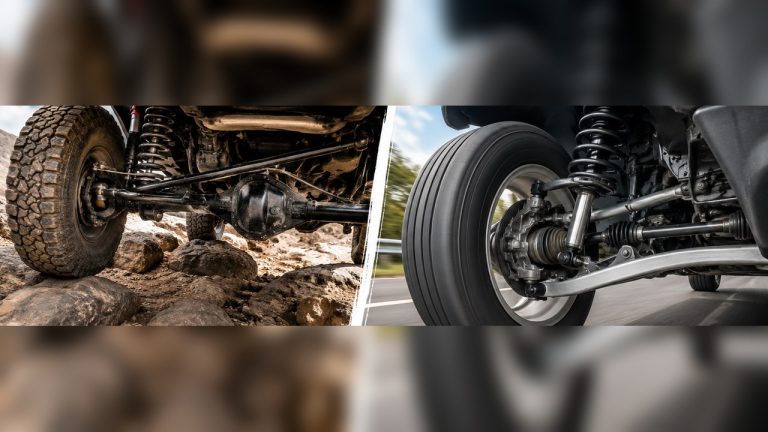
In passenger-car specifications, “multi-link suspension” very often refers to an independent suspension in which each wheel is located by several links. However, multiple links can also be used to locate a solid axle.
A coil-sprung solid rear axle, for example, needs links or control arms to prevent the axle from moving uncontrollably forward, backward, or sideways. Depending on the arrangement, that system may also be described using multi-link terminology even though the left and right wheels remain connected by a rigid axle.
So if a vehicle specification simply says “multi-link,” check whether the manufacturer is describing an independent wheel layout or the links locating a solid axle.
For the broader difference between connected and independently moving wheels, see our guide to solid axle vs. independent suspension.
Multi-Link Suspension Advantages
1. More Control Over Wheel Geometry
Multiple links provide more variables that engineers can use to shape the wheel’s path through suspension travel.
Camber and toe can be managed according to what the vehicle needs under cornering, braking, acceleration, and body roll. That does not mean every multi-link car has ideal geometry, but the architecture gives engineers substantial freedom to pursue it.
2. Ride and Handling Can Be Tuned More Independently
A suspension needs lateral stiffness to control the wheel accurately during cornering, yet complete rigidity in every direction can transmit harsh impacts into the vehicle.
With several links and carefully selected bushings, engineers can create different amounts of compliance depending on the direction of the load. This helps explain how a multi-link vehicle can feel controlled in corners without necessarily requiring an excessively harsh ride.
3. Toe Behavior Can Be Carefully Managed
Rear-wheel toe has a significant effect on vehicle stability. In a multi-link layout, a dedicated link or the interaction of several links can be used to influence how toe changes as the wheel moves or receives lateral and longitudinal loads.
Small controlled changes can be useful. Unwanted changes caused by worn components, however, can make the vehicle feel unstable and increase tire wear.
4. Good Potential for Tire Contact During Cornering
Controlling camber through suspension travel can help keep the tire operating at a favorable angle to the road while the body rolls.
This is one reason multi-link suspension is attractive for vehicles where handling matters, although tires, alignment, spring rates, damping, chassis stiffness, and weight distribution remain just as important to the finished result.
5. Flexible Packaging
Individual links can sometimes be shaped and positioned around a fuel tank, electric drive unit, exhaust, trunk floor, subframe, or other components more easily than one very large control arm.
This does not mean multi-link always takes less space. It means engineers have more freedom to distribute its components around the available space.
Multi-Link Suspension Disadvantages
More Components
The same feature that makes multi-link so adjustable also makes it mechanically more complicated.
Several links mean multiple bushings, joints, fasteners, and mounting points. Depending on the design, there may be considerably more individual parts than in a simpler strut or beam-type rear suspension.
Higher Manufacturing Cost
More components require more material, assembly operations, mounting points, and engineering work. This is one reason simpler suspension architectures remain common where manufacturing cost and packaging simplicity are priorities.
More Wear Points
Every additional bushing or ball joint is another component that can eventually wear.
A multi-link suspension is not automatically unreliable, but an older high-mileage system may require more individual parts to restore than a simpler suspension. One worn link can also alter wheel alignment and place additional load on neighboring components.
Alignment Can Be More Sensitive
The geometry that gives engineers so much control also means damaged, bent, loose, or incorrectly installed parts can change wheel position.
Alignment should therefore be checked after relevant suspension repairs, collision damage, or replacement of components that affect wheel geometry.
Does Multi-Link Suspension Ride Better?
Multi-link suspension can provide excellent ride quality, but the architecture itself does not guarantee a smooth ride.
Its advantage is that engineers can use separate links and compliant bushings to manage different directions of wheel force. A wheel may remain firmly controlled laterally while being allowed a small amount of compliant movement when it strikes a sharp road imperfection.
But comfort still depends on springs, dampers, tires, wheel size, bushings, suspension travel, body stiffness, seats, and overall vehicle tuning.
An aggressively tuned multi-link sports car can ride much more firmly than a comfort-focused vehicle using a simpler suspension. To understand the part the shock absorbers play independently of the suspension architecture, see what damping does in a suspension.
Does Multi-Link Suspension Handle Better?
It has a high handling potential because engineers can control several aspects of wheel geometry and compliance independently.
That can help maintain useful tire contact and predictable toe behavior as the suspension moves under cornering loads. Multi-link also allows designers to pursue lateral stiffness without necessarily making the suspension equally rigid in every direction.
However, suspension type alone cannot tell you which car will handle better.
- Tire grip
- Alignment
- Spring rates
- Damper calibration
- Anti-roll bars
- Bushing stiffness
- Steering geometry
- Chassis stiffness
- Vehicle mass and weight distribution
All of these affect the result. A well-developed simpler suspension can outperform a poorly tuned multi-link setup.
Multi-Link Suspension and Camber
Camber is the inward or outward tilt of the wheel when viewed from the front or rear. As a vehicle corners and the suspension compresses, controlling that angle can help keep the tire working effectively against the road.
Multi-link geometry gives engineers several pivot points they can position to influence the camber curve through suspension travel.
This does not mean multi-link always maintains a perfectly vertical tire or that zero camber is desirable. Suspension geometry is deliberately designed around how the vehicle is expected to move under real loads.
Multi-Link Suspension and Rear-Wheel Steering Effects
A vehicle does not need an active rear-steering system for its rear wheels to experience very small changes in steering angle.
As forces act through the links and bushings, the rear wheel’s toe can change slightly. Engineers can design this compliance behavior to contribute to stability and response.
This is very different from the large steering movement of the front wheels. The changes can be small enough that the driver never notices them directly, yet they still influence how the chassis responds.
How Many Links Does Multi-Link Suspension Have?
There is no universal number that applies to every multi-link suspension.
Five-link designs are common examples because five separate locating links provide substantial control over wheel movement. Other systems use fewer individual links or combine a wishbone with separate links.
The driveshaft or half-shaft can also play a geometric role in some designs, further complicating attempts to classify a suspension simply by counting visible arms.
For owners, the exact number matters less than the geometry and condition of the complete system.
Multi-Link vs. Other Suspension Designs
Multi-link is only one way to locate a wheel.
A MacPherson strut combines structural and damping functions into a compact layout with relatively few components. Double wishbone suspension uses upper and lower arms to give engineers direct control over wheel geometry. Multi-link separates more of those locating functions into individual arms.
None of those descriptions establishes which vehicle will ride or handle best. They describe the engineering tools available to the designers.
At the rear of many lower-cost vehicles, manufacturers may instead use a simpler torsion-beam arrangement. That architecture has a different set of cost, packaging, ride, and handling trade-offs and should be evaluated as its own comparison rather than assuming that more links automatically make a suspension better.
What Happens When Multi-Link Components Wear?
A multi-link suspension depends on several components working together to maintain the intended geometry. Wear in a bushing or joint can allow movement that the engineers did not design into the system.
Possible signs include:
- Clunking or knocking over bumps
- Uneven or accelerated tire wear
- A steering or handling feel that has changed
- The vehicle pulling or wandering
- Rear-end instability during braking or cornering
- Alignment measurements that will not remain within specification
Those symptoms do not prove that a particular link has failed. Tires, wheel bearings, shocks, springs, alignment, steering components, and other suspension parts can produce similar symptoms, so the vehicle should be inspected before replacing parts.
Is Multi-Link Suspension Good?
Yes, multi-link is an excellent suspension architecture when its additional tuning freedom justifies the cost and complexity.
It is particularly useful when engineers want to combine accurate wheel control, carefully managed camber and toe, good cornering behavior, and compliant response to road imperfections.
Its disadvantages are equally straightforward: more parts, more joints and bushings, greater manufacturing complexity, and potentially more components to replace as the vehicle ages.
For a new-car buyer, the presence of multi-link suspension should therefore be treated as one engineering feature rather than proof that a vehicle is automatically superior. The quality of the geometry and tuning matters far more than the number of arms visible underneath the car.
Frequently Asked Questions
What is multi-link suspension?
Multi-link suspension uses several separate links or arms to control the position and movement of a wheel or axle. In independent passenger-car systems, this gives engineers substantial freedom to manage camber, toe, lateral movement, longitudinal movement, ride compliance, and handling.
How does multi-link suspension work?
Several links connect the wheel carrier to the vehicle body or subframe. Their lengths, angles, pivot positions, joints, and bushings determine how the wheel moves and changes geometry as the suspension compresses, rebounds, corners, brakes, and accelerates.
Is multi-link suspension independent?
It often is, particularly when manufacturers describe a modern passenger car as having multi-link rear suspension. However, multiple links can also be used to locate a solid axle, so the term “multi-link” does not by itself guarantee that the left and right wheels move independently.
Is multi-link suspension good for handling?
It has excellent handling potential because engineers have substantial control over wheel geometry, toe behavior, lateral stiffness, and compliance. Actual handling still depends on tires, alignment, springs, dampers, bushings, steering, chassis design, and the overall vehicle setup.
Is multi-link suspension expensive to repair?
It can be more expensive to restore than a simpler suspension because it usually contains more links, bushings, joints, and fasteners. Repair cost depends on which components are worn, whether individual parts are available separately, labor time, alignment requirements, and the specific vehicle.
How many links are in a multi-link suspension?
There is no fixed number for every design. Four- and five-link arrangements are common examples, while other systems combine separate links with wishbone-style arms. “Multi-link” describes a family of designs rather than one standardized layout.
What the Multi-Link Label Really Tells You
Seeing “multi-link suspension” on a specification sheet tells you that the manufacturer has chosen a relatively flexible way of controlling wheel or axle movement. It does not tell you exactly how many arms are fitted, where they are positioned, how stiff the bushings are, or how the vehicle will ultimately ride and handle.
The architecture’s strength is the number of tuning choices it gives engineers. With the right geometry and calibration, those choices can produce excellent wheel control without sacrificing everyday comfort. With poor tuning or worn components, simply having more links offers no guarantee of a better result.