Solid Axle vs. Independent Suspension: Which Is Better?
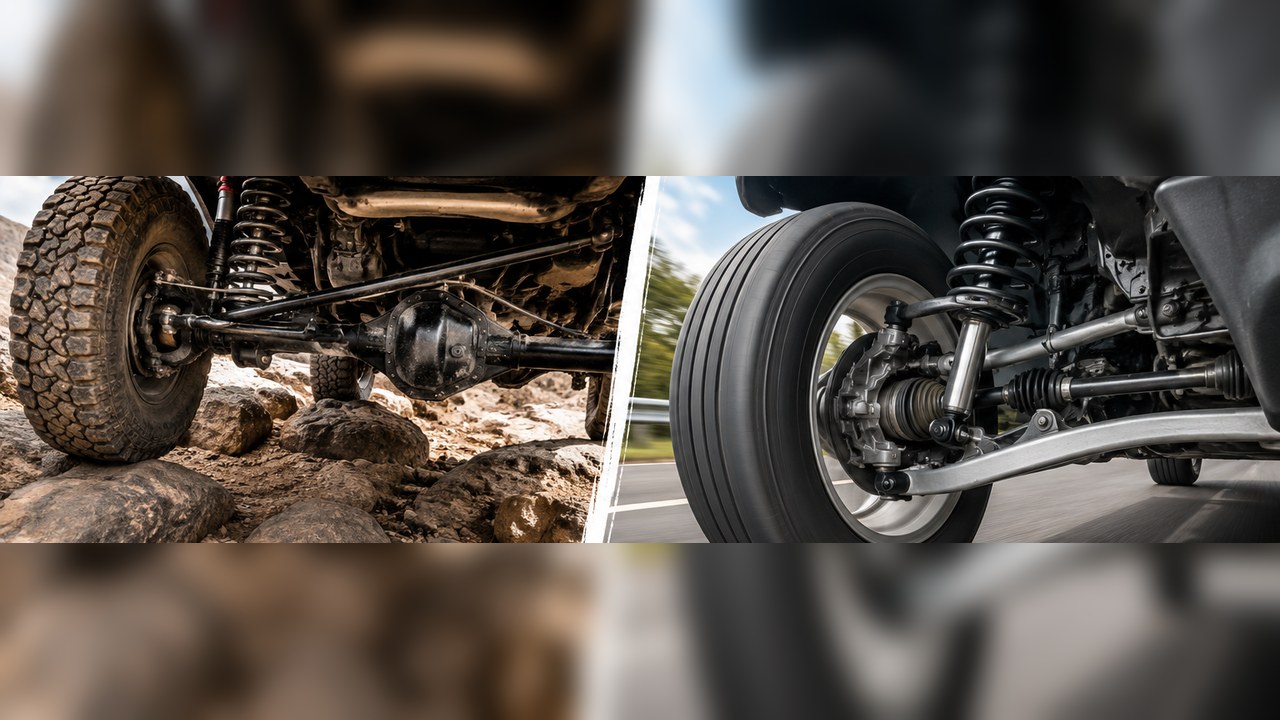
When comparing a solid axle vs. independent suspension, neither design is better at everything. A solid axle is usually the stronger choice when simplicity, durability, articulation potential, heavy-duty use, and easier off-road modification matter most. Independent suspension usually has the advantage when ride comfort, steering precision, wheel isolation, and control over repeated bumps at higher speeds are the priorities.
For slow technical off-roading and heavily modified 4x4s, a solid axle remains an excellent starting point. For daily driving, fast dirt roads, and vehicles that need to combine road manners with off-road ability, independent suspension often makes more sense. The right answer depends on what the vehicle actually needs to do.
Which One Should You Choose?
| If your priority is… | Usually the better starting point |
|---|---|
| Slow rock crawling | Solid axle |
| Maximum articulation with a conventional 4×4 build | Solid axle |
| Large lifts and big tires | Solid axle |
| Simple, rugged construction | Solid axle |
| Heavy-duty rear suspension | Often solid axle |
| Daily ride comfort | Independent suspension |
| Precise road handling | Independent suspension |
| High-speed rough terrain | Independent suspension |
| Reduced disturbance from one wheel to the other | Independent suspension |
| A mixed-use road and trail vehicle | Depends on the complete vehicle |
This table describes typical strengths, not hard rules. Long-travel independent suspension can be extremely capable off-road, and a properly engineered solid-axle vehicle can have excellent road manners.
The Difference Starts With How the Wheels Are Connected
A solid axle mechanically connects the left and right wheels across the vehicle. In a driven solid axle, the axle housing also contains the differential and axle shafts. When one wheel moves over an obstacle, that movement influences the axle and therefore affects what happens on the opposite side.
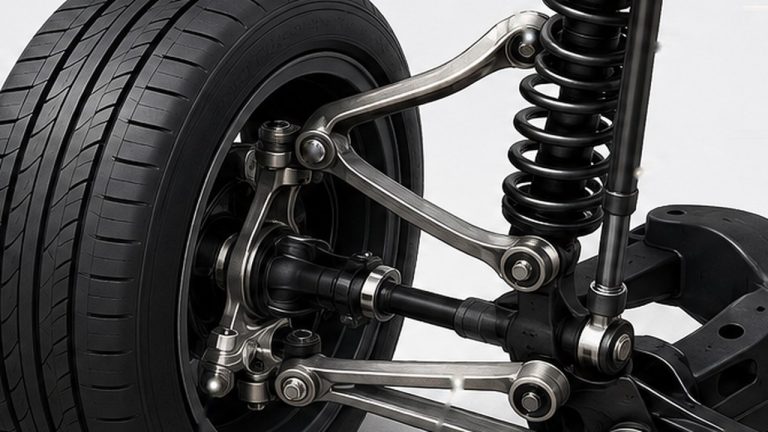
Independent suspension separates the vertical movement of the two wheels. Each wheel uses its own control arms, links, strut, or other locating components, allowing one side to rise or fall with much less direct movement transferred to the wheel opposite it.
That fundamental difference explains most of the advantages and disadvantages that follow.
Why Solid Axles Work So Well Off-Road
Solid axles have remained popular on serious off-road vehicles because the basic design is rugged and relatively straightforward. The axle housing, differential, hubs, and wheels move as a connected assembly, and there are fewer constantly changing CV-joint and half-shaft angles to manage than in a typical driven independent suspension.
For a conventional trail build, that can make it easier to create substantial wheel travel while retaining a strong driveline.
Articulation
Solid axles are especially associated with articulation. As one end of the axle moves upward, the axle can rotate relative to the body while the opposite wheel moves differently within the available suspension travel.
With suitable springs, control arms, joints, shocks, bump stops, and anti-roll-bar behavior, this can keep useful tire contact over large, uneven obstacles.
However, a solid axle does not automatically articulate more simply because it is solid. Shock length, link geometry, driveshaft angles, steering components, tire clearance, brake hoses, and bump stops can all limit usable travel.
Strength and Simplicity
A solid axle can package major driveline components inside one robust housing. That makes the design attractive for trucks, commercial vehicles, rock crawlers, and other applications exposed to high loads or repeated impacts.
This does not mean every solid axle is stronger than every independent suspension. Axle tube diameter, housing design, shafts, joints, bearings, knuckles, differential components, vehicle weight, tire size, and torque all determine actual strength.
Lifts Can Be More Straightforward
Solid-axle vehicles can also be easier to modify for substantial increases in suspension height and travel because the wheels and much of the driveline move with the axle.
That does not make a lift simple or automatically safe. Caster, pinion angle, steering geometry, track-bar position, driveshaft angles, brake hoses, bump stops, anti-roll bars, and control-arm geometry may still need correction.
Where Independent Suspension Has the Advantage
Independent suspension approaches the same problem differently. Because one wheel can react to a bump without forcing the entire axle assembly to move with it, the suspension can isolate road disturbances more effectively.
This becomes particularly useful when the vehicle encounters many bumps in rapid succession.
Less Mass Moving With Each Wheel
A solid driven axle carries a differential housing, axle tubes, shafts, and other components as unsprung mass. Much of that assembly moves whenever the wheels move.
With independent suspension, the differential can be attached to the vehicle structure while half-shafts and individual suspension components move with each wheel. Depending on the design, this can substantially reduce the mass that the springs and dampers must control.
Lower unsprung mass generally makes it easier for the tire to follow rapid changes in the road or trail surface.
Better Wheel Isolation
If the right wheel hits a pothole in an independent system, the left suspension does not have to move with a rigid axle connecting the two sides.
That isolation can improve comfort and reduce how much a single bump disturbs the body. It can also help the vehicle remain composed across washboard surfaces and rough roads where the wheels are moving rapidly and independently.
More Freedom for Road Handling
Independent suspension also gives engineers considerable freedom to control wheel geometry. The exact amount depends on whether the vehicle uses struts, double wishbones, multi-link suspension, or another layout.
Two of the most common independent front designs are covered separately in our MacPherson strut vs. double wishbone comparison. They are both independent systems, but they achieve wheel control in very different ways.
Solid Axle vs. Independent Suspension for Ride Quality
Independent suspension usually has an advantage in ride isolation, but suspension type alone does not determine comfort.
Because the wheels can react separately and there may be less unsprung mass moving with each one, independent suspension can make it easier to prevent a disturbance at one wheel from affecting the rest of the vehicle.
A solid axle moves a larger connected assembly, and an impact on one side can influence the other side. On a rough road, that can create more body disturbance.
But spring rate, damper calibration, tire construction, tire pressure, bushings, anti-roll bars, seat design, vehicle weight, and suspension travel can completely change how either system feels.
A well-damped solid axle can ride better than a poorly tuned independent setup. If you want to understand why shock tuning matters independently of axle design, our guide to what damping does in a suspension explains compression and rebound control in more detail.
Which Handles Better on the Road?
Independent suspension usually provides engineers with more tools for optimizing road handling because each wheel can move and change geometry without being rigidly tied to the wheel on the other side.
This can help maintain tire contact while reducing the amount of unwanted motion transmitted across the vehicle.
That is one reason independent suspension is common on modern passenger cars, crossovers, performance vehicles, and the front of many pickups and SUVs.
Still, “independent” does not automatically mean good handling. Alignment, camber behavior, roll centers, tires, steering geometry, dampers, springs, bushings, anti-roll bars, and chassis stiffness remain critical.
Likewise, a solid rear axle can be located very precisely using properly designed control arms, a Panhard bar, Watts linkage, or other systems. The wheels remain connected, but the complete chassis can still be tuned for predictable and capable road behavior.
Which Is Better for Rock Crawling?
For a conventional low-speed rock-crawling build, solid axles are usually the easier and more practical starting point.
The combination of rugged components, articulation potential, relatively simple driveline geometry, and strong aftermarket support on popular 4×4 platforms makes solid axles particularly attractive when the vehicle repeatedly crosses large obstacles at low speed.
Independent suspension can also perform extremely well in technical terrain. Long control arms, purpose-built joints, sufficient wheel travel, strong CV components, appropriate steering geometry, and careful packaging can produce enormous capability.
The difference is that achieving extreme travel with independent suspension can require more specialized engineering and more components operating through large angles.
Which Is Better for High-Speed Off-Road Driving?
At higher speeds across repeated bumps, independent suspension can have a significant advantage.
Each wheel can react individually, and the lower unsprung mass possible with independent designs can make rapid wheel movement easier to control. The suspension does not need to accelerate the mass of an entire axle housing every time one wheel hits a bump.
This is very different from slow rock crawling. At speed, suspension frequency, damping, heat management, wheel control, and how quickly the tire can recover after an impact become increasingly important.
A solid axle can still be engineered for fast off-road driving, but the connected axle mass creates a different set of challenges.
Solid Axle vs. Independent Suspension Ground Clearance
Ground clearance is another comparison that is easy to oversimplify.
On a conventional solid axle, the differential housing is one of the lowest major points. Its clearance relative to the ground is determined largely by tire radius and the size and shape of the axle housing. Simply lifting the body or chassis does not raise the differential farther from the ground.
Independent suspension does not have a rigid differential housing spanning the vehicle at wheel-center height. The differential can be mounted higher to the body or subframe, but control arms, crossmembers, skid plates, and other components still create low points.
Independent suspension geometry can also cause clearance under some components to change as the wheels move through their travel.
For either design, the useful question is not simply which has more advertised ground clearance. Look at the location and movement of the lowest components across the vehicle.
Solid Axle vs. Independent Suspension Durability
Solid axles have a deserved reputation for durability, but it is more accurate to describe them as structurally simple and easy to build very strong rather than universally stronger.
An independent driven suspension normally adds CV joints, half-shafts, control arms, bushings, and several pivots. When suspension height or travel changes substantially, some of those joints may operate at more demanding angles.
A solid axle avoids many of those independent wheel-drive joints and packages the axle shafts inside a rigid housing. That can be useful when large tires, high torque, impacts, and difficult terrain are part of normal use.
But component quality still matters. A light-duty solid axle can fail where a properly engineered independent system survives, and heavy-duty independent systems are used successfully in demanding applications.
Which Is Easier and Cheaper to Maintain?
A conventional solid axle usually wins on mechanical simplicity.
There can be fewer control arms, CV joints, boots, half-shafts, and wheel-locating components than in a driven independent system. That can make inspection, modification, and some repairs more straightforward.
Independent suspension has more potential wear points, particularly where multiple links, bushings, ball joints, and CV joints are involved.
That does not mean independent suspension is inherently unreliable or expensive to own. Modern factory systems can operate for very high mileages, and actual repair cost depends much more on the specific vehicle and replacement parts than on the architecture alone.
Solid Rear Axle vs. Independent Rear Suspension
The same basic principles apply when the comparison is limited to the rear of the vehicle, but the priorities change because the rear wheels normally do not need to steer.
A solid rear axle remains very common where load capacity, towing, durability, simplicity, or off-road modification are important. Both rear wheels and the differential are packaged into a strong connected assembly.
An independent rear suspension (IRS) allows each rear wheel to react separately and lets the differential remain mounted to the vehicle rather than moving with the wheels. This can reduce unsprung mass and improve ride isolation and wheel control.
| Rear-suspension priority | Solid rear axle | Independent rear suspension |
|---|---|---|
| Mechanical simplicity | Advantage | More complex |
| Ride isolation | More wheel-to-wheel interaction | Advantage |
| Handling potential | Can be very capable | Greater independent wheel control |
| Heavy-duty applications | Common choice | Depends on vehicle design |
| Large off-road modifications | Often easier | More geometry and joint constraints |
| Parts count | Usually lower | Usually higher |
Do not assume a solid rear axle automatically gives a vehicle a higher payload or towing rating. Those ratings depend on the entire chassis, brakes, tires, wheels, cooling system, springs, axle ratings, hitch structure, and manufacturer certification.
What About the Front Axle?
The front creates additional challenges because the wheels must steer as well as move vertically.
A solid front axle connects the steering knuckles through the rigid axle assembly. This creates a strong and relatively straightforward arrangement that remains popular on some serious off-road and heavy-duty vehicles.
Independent front suspension, usually abbreviated IFS, gives each front wheel its own suspension movement. It can improve ride isolation, steering precision, packaging, and wheel control at speed, which explains why it is widely used on modern pickups and SUVs.
The trade-off for a driven IFS system is that CV joints and half-shafts must transmit power while changing angle with both steering and suspension movement. Large lifts or excessive travel can therefore create joint-angle and geometry problems if the complete system was not designed for them.
Does a Solid Axle Carry More Weight?
Not automatically.
Solid axles are widely used in heavy-duty vehicles because they can be made extremely robust and package load-bearing components efficiently. That association sometimes gets turned into the incorrect claim that any solid-axle vehicle can carry more than one with independent suspension.
Payload and axle capacity are engineered for a specific vehicle. Springs, bearings, hubs, brakes, tires, wheels, frame or body structure, and many other components contribute to the final rating.
Never use suspension type or an aftermarket suspension modification to infer a higher payload or towing limit than the manufacturer specifies.
Is Independent Suspension Too Fragile for Off-Roading?
No. That is too broad a conclusion.
An independent system has more joints and may expose CV boots, control arms, tie rods, and other components to damage, but ruggedness depends on how those parts were designed and sized.
Purpose-built independent suspension can survive extremely demanding terrain and high speeds. The potential disadvantage is complexity: achieving very high strength and very large travel may require more specialized parts than a comparable solid-axle build.
That distinction matters because comparing a factory crossover suspension with a heavy-duty solid axle says little about what the architecture itself can ultimately achieve.
Is a Solid Axle Always Better for Articulation?
No. Solid axles make large articulation comparatively straightforward on many conventional 4×4 platforms, but architecture alone does not set the travel limit.
A purpose-built independent suspension with long control arms can achieve substantial wheel travel. Conversely, a solid axle with short shocks, restrictive anti-roll bars, binding joints, or insufficient clearance may articulate poorly.
The more useful comparison is how much controlled and usable travel a particular vehicle has without overstressing joints, steering, driveshafts, brake hoses, shocks, or tires.
Can You Convert Independent Suspension to a Solid Axle?
Solid axle swaps exist for some off-road platforms, but this is a major chassis modification rather than a normal suspension upgrade.
The conversion can require new axle mounting points, steering components, springs or coilovers, links, track bars, driveshaft changes, brake modifications, bump stops, differential compatibility, wheel fitment, and substantial fabrication.
Steering geometry, suspension travel, braking behavior, vehicle electronics, and legal requirements also need to be addressed. A conversion should not be treated as a simple way to make an independent vehicle “better” off-road.
If you are still deciding what architecture fits a particular type of trail or vehicle, our broader guide to off-road suspension types explains where solid, independent, and mixed layouts fit without focusing solely on this comparison.
Solid Axle Pros
- Simple and rugged basic architecture
- Well suited to heavy-duty applications
- Strong foundation for slow technical off-roading
- Large articulation can be relatively straightforward to achieve
- Often easier to modify for substantial lifts and large tires
- Fewer independent driveline joints on driven axles
- Extensive aftermarket support for popular 4×4 platforms
Solid Axle Cons
- High unsprung mass, especially on driven axles
- Wheel movement on one side influences the other side
- Can transmit more disturbance into the body on rough roads
- Less inherent wheel isolation at higher speeds
- Differential clearance is closely tied to tire size
Independent Suspension Pros
- Each wheel reacts largely independently
- Potential for lower unsprung mass
- Usually better ride isolation
- Strong foundation for precise road handling
- Excellent wheel control over repeated high-speed bumps when properly designed
- Greater freedom in packaging and wheel geometry depending on the layout
Independent Suspension Cons
- More joints and suspension components
- Driven systems use CV joints and half-shafts that operate through changing angles
- Large lifts can create difficult geometry and driveline compromises
- Extreme off-road travel can require specialized components
- Usually more complex to modify and diagnose
The Better Choice Depends on Where You Drive
If your vehicle spends most of its time crawling slowly over large rocks, carrying heavy loads, or being modified around big tires and substantial suspension travel, a solid axle has clear practical advantages.
If the vehicle spends substantial time on pavement or crosses rough terrain at higher speeds, independent suspension can offer better wheel isolation, lower unsprung mass, and more refined handling.
For many trucks and SUVs, the compromise is already built in: independent suspension at the front and a solid axle at the rear. That combination allows manufacturers to improve steering and front-wheel isolation while retaining a robust rear layout for load carrying and durability.
The architecture should therefore match the vehicle’s job rather than an assumption that one suspension design is universally superior.
Frequently Asked Questions
Which is better, solid axle or independent suspension?
Solid axles are usually better suited to simple, rugged, heavily modified, low-speed off-road applications. Independent suspension generally provides better wheel isolation, road handling, comfort, and control over repeated bumps at speed. The better design depends on the vehicle and how it is used.
What is the difference between a straight axle and independent suspension?
A straight or solid axle connects the two wheels through a rigid axle assembly, so movement on one side influences the other. Independent suspension allows each wheel to move vertically with much less direct effect on the wheel opposite it.
Why are solid axles good off-road?
They combine rugged construction with relatively simple driveline and suspension geometry, and they can be adapted for substantial articulation and large tires. Those advantages are especially useful during slow technical off-roading, although independent suspension can also be extremely capable when designed for the task.
Why does independent suspension ride better?
One wheel can react to a bump without moving an entire rigid axle or forcing as much disturbance across to the opposite side. Independent designs can also have lower unsprung mass. Springs, dampers, tires, bushings, and the rest of the chassis still have a major effect on actual comfort.
Is a solid rear axle better than independent rear suspension?
A solid rear axle is often the more straightforward choice for heavy-duty use, substantial off-road modification, and mechanical simplicity. Independent rear suspension usually offers better wheel isolation and greater potential for refined ride and handling. Neither automatically determines payload, towing capacity, reliability, or overall vehicle quality.
Is IFS weaker than a solid axle?
Not inherently. Independent front suspension generally contains more joints and moving components, and extreme lifts can place CV joints and other parts at difficult angles. A properly engineered heavy-duty IFS can still be extremely strong. Actual durability depends on component design, loads, tires, driving conditions, and maintenance.