MacPherson Strut vs. Double Wishbone: Which Is Better?
Double wishbone suspension generally has the higher performance potential because it gives engineers more control over camber and wheel movement, while MacPherson struts are simpler, more compact, and less expensive. That does not mean every double wishbone car handles better than every MacPherson-strut car. Suspension geometry, tires, spring and damper tuning, chassis stiffness, alignment, and weight distribution can matter just as much as the basic layout.
For most everyday cars, a well-designed MacPherson strut suspension is more than capable. For applications where maximum tire contact and precise geometry during hard cornering are priorities, double wishbone usually gives engineers more options.
MacPherson Strut vs. Double Wishbone at a Glance
| Factor | MacPherson Strut | Double Wishbone |
|---|---|---|
| Packaging | Compact, especially around transverse engines | Requires more room for upper and lower arms |
| Cost | Usually lower | Usually higher |
| Parts count | Lower | Higher |
| Camber control | More limited through suspension travel | Greater engineering freedom |
| Hard cornering potential | Good when properly designed | Generally higher potential |
| Ride comfort | Depends mainly on tuning | Depends mainly on tuning |
| Maintenance complexity | Usually simpler | More joints and bushings |
| Geometry tuning potential | More limited | Greater |
| Daily driving | Excellent fit | Excellent, but usually more expensive |
| Performance use | Very capable | Usually the stronger starting point |
The important word is potential. Suspension type alone does not tell you how well a vehicle will drive.
What Is the Main Difference?
The biggest difference is how each design locates the wheel as the suspension moves.
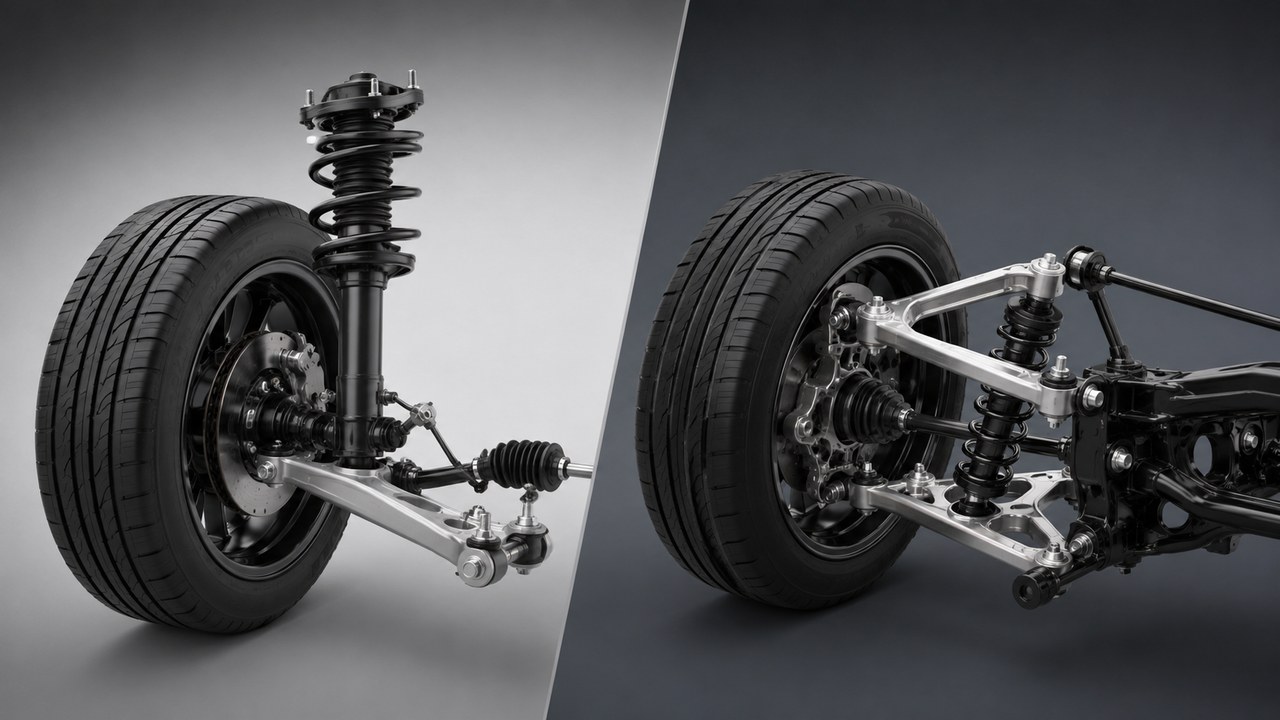
A MacPherson strut normally uses a lower control arm together with a tall strut attached to the steering knuckle. The upper end of that strut mounts to the body, so the strut is not simply a shock absorber. It is also a structural part of the suspension and helps determine the wheel’s position.
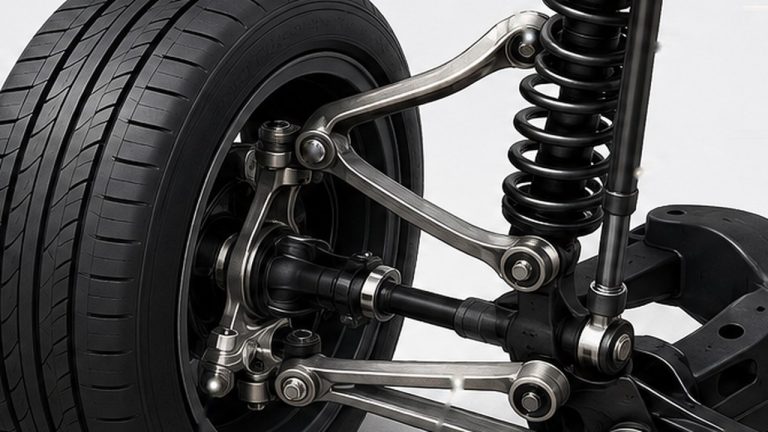
A double wishbone suspension uses separate upper and lower control arms to locate the wheel. These arms are often shaped roughly like an A or wishbone, although the exact shape varies. The spring and damper control suspension movement, but they do not have to perform the same wheel-locating role as a MacPherson strut.
That extra upper control arm gives suspension engineers another set of pivot points to work with. This is the foundation of most of double wishbone’s performance advantages.
Why Double Wishbone Can Control Camber Better
Camber describes how much the top of a wheel leans inward or outward when viewed from the front of the vehicle. Keeping the tire at a useful angle to the road becomes particularly important when the body rolls during cornering.
With a double wishbone setup, engineers can use different upper and lower control-arm lengths and pivot locations to deliberately change camber as the suspension compresses. The outside wheel can gain negative camber as the car rolls into a corner, helping preserve the tire’s contact patch.
MacPherson suspension has fewer geometric variables available because the strut itself acts as the upper locating member. Camber still changes as the wheel moves, but engineers generally have less freedom to shape that camber curve.
This is one reason double wishbone is attractive when cornering performance is a major design priority. It does not create grip on its own, but it gives engineers more control over how the tire is presented to the road.
Does Double Wishbone Actually Handle Better?
All else being equal, double wishbone generally offers greater potential for maintaining favorable wheel geometry during hard cornering. In the real world, however, all else is almost never equal.
A carefully developed MacPherson-strut car can handle exceptionally well, while a poorly tuned double wishbone suspension can feel vague, underdamped, or unpredictable. The suspension architecture is only one part of the chassis.
- Tire construction and compound
- Wheel alignment
- Spring rates
- Damper calibration
- Anti-roll-bar stiffness
- Bushing compliance
- Chassis rigidity
- Track width and wheelbase
- Steering geometry
- Vehicle weight and weight distribution
All of these can change how a vehicle corners. Looking at the words “double wishbone” on a specification sheet therefore does not guarantee that one car will outperform another.
Why Manufacturers Use MacPherson Struts
If double wishbone gives engineers more geometry control, it may seem strange that MacPherson struts are so common. The answer is that vehicle design involves far more than maximizing cornering grip.
MacPherson suspension combines several functions into relatively few components. It does not require a conventional upper control arm, which can free valuable space around the engine, transmission, steering system, and body structure.
That packaging advantage is particularly useful in compact vehicles and front-wheel-drive layouts with a transversely mounted engine.
There are other practical benefits:
- Fewer components: the basic layout can use fewer arms, joints, and bushings.
- Lower manufacturing cost: fewer components and mounting points can simplify production.
- Efficient packaging: engineers can dedicate more lateral space to the powertrain and other systems.
- Straightforward servicing: there are generally fewer suspension links to inspect or replace.
- More than enough performance for most drivers: modern MacPherson systems can deliver excellent steering and grip when the complete chassis is properly developed.
In other words, MacPherson is not simply the “cheap version” of double wishbone. It solves a different set of engineering problems.
Why Manufacturers Choose Double Wishbone
Double wishbone becomes attractive when the design team is willing to accept greater packaging complexity in exchange for more control over suspension geometry.
Because the upper and lower arms can be positioned independently, engineers have more freedom to determine how camber, caster-related geometry, roll-center behavior, and wheel position change through suspension travel.
That can be valuable in sports cars, performance-oriented vehicles, and other applications where keeping the tire working effectively under high cornering loads matters more than minimizing parts count.
The trade-off is that the additional control arms need somewhere to go. They also add pivots, bushings, ball joints, brackets, and other components that may eventually require inspection or replacement.
Which One Has Better Ride Quality?
Neither suspension type automatically provides a smoother ride. This is one of the easiest comparisons to oversimplify.
Ride quality depends heavily on spring rate, damper tuning, suspension travel, bushings, tires, unsprung mass, seat design, body stiffness, and how all of those elements work together.
A softly calibrated MacPherson suspension can be more comfortable than a stiff double wishbone setup. Likewise, a sophisticated double wishbone design can combine excellent wheel control with a very compliant ride.
Choose between the two architectures based on their engineering trade-offs, not on the assumption that one automatically rides better.
MacPherson vs. Double Wishbone for Steering Feel
Double wishbone gives engineers more freedom to position the steering axis and control wheel geometry, which can be useful when tuning steering behavior. But steering feel is another area where the suspension name alone cannot predict the result.
Steering ratio, power assistance, tire sidewalls, compliance in bushings and mounts, scrub radius, caster, alignment, chassis stiffness, and even software calibration on modern electric power steering systems all influence what the driver feels.
A MacPherson-strut car can therefore have sharper and more communicative steering than a double wishbone vehicle if the rest of the system is better optimized.
What About Torque Steer in Front-Wheel-Drive Cars?
MacPherson suspension is sometimes blamed for torque steer in powerful front-wheel-drive cars. The relationship is real, but the explanation is more complicated than saying that MacPherson struts cause torque steer.
The location of the steering axis, scrub radius, driveshaft geometry, tire behavior, differential operation, engine movement, and suspension compliance can all contribute. A conventional MacPherson layout can restrict some of the geometric choices available to engineers, while double wishbone offers more freedom.
Modern variations of the strut layout can also separate or reposition some of these functions, reducing disadvantages that apply to a simpler MacPherson design. The exact suspension matters more than the label alone.
Which Is Cheaper to Maintain?
MacPherson suspension usually has the advantage in simplicity. A basic system has fewer control arms, bushings, and ball joints than a typical double wishbone arrangement.
Double wishbone does not necessarily fail more often, but it provides more potential wear points. If multiple bushings or ball joints eventually need replacement, parts and labor can add up.
Actual ownership cost still depends on the vehicle. An inexpensive double wishbone component may cost less to replace than a specialized MacPherson strut assembly on another model, so architecture should not be used as a repair-cost estimate by itself.
Is Double Wishbone Better for Performance Driving?
For maximum chassis-development flexibility, double wishbone has the advantage. The ability to control wheel geometry more precisely through compression, rebound, and body roll makes it an excellent foundation for performance-focused suspension tuning.
That advantage becomes more relevant as cornering loads increase. Maintaining a useful tire contact patch matters more on a racetrack or during aggressive driving than it does during a normal commute.
However, switching from one suspension architecture to another is not a normal upgrade. These layouts are fundamental parts of the vehicle’s chassis design. Owners looking for more performance usually work with the suspension architecture the vehicle already has rather than attempting to convert it.
If the goal is specifically to lower the vehicle or change ride-height adjustability, that is a different decision. Our guide to lowering springs vs. coilovers covers those upgrade choices without changing the underlying suspension architecture.
Which Is Better for Daily Driving?
For a daily driver, there is usually no reason to reject a car simply because it uses MacPherson struts.
The design is compact, proven, and capable of excellent road behavior. For normal driving speeds, the theoretical geometry advantage of double wishbone may be far less noticeable than differences in tires, damping, alignment, seat comfort, or overall vehicle calibration.
Double wishbone can also make an excellent daily suspension, of course. It simply tends to require more components and packaging space to achieve its advantages.
Which Is Better for Track Use?
If two equally well-developed cars were being designed specifically around sustained high cornering loads, double wishbone would generally provide the more flexible starting point.
Its camber curve and other geometric characteristics can be shaped with greater freedom as the wheel travels. That makes it easier to target tire behavior under braking, cornering, and combined loads.
Still, MacPherson suspension should not be dismissed for track use. A good strut chassis with suitable alignment, dampers, springs, tires, and sufficient suspension travel can be extremely capable. The architecture establishes constraints; it does not establish the lap time.
What About Off-Road Vehicles?
For off-road use, comparing MacPherson and double wishbone alone misses several larger questions. Wheel travel, durability, CV-joint angles, ground clearance, steering geometry, damping, tire size, and whether the vehicle uses independent or solid axles can all become more important.
Many independent front suspensions designed for trucks and SUVs use upper and lower control arms because that architecture provides useful geometry and packaging options for the application. But that does not make double wishbone universally superior on every trail. Our guide to off-road suspension types compares the broader layouts and the terrain each one suits best.
Can a Car Use MacPherson in Front and Double Wishbone in the Rear?
Yes. The front and rear suspension do not have to use the same architecture.
Manufacturers choose each axle layout according to the space available, whether the wheels are driven or steered, cost targets, suspension travel, cargo requirements, and the handling characteristics they want.
A vehicle can therefore use MacPherson struts at the front and double wishbones at the rear, or use another rear design entirely. Seeing one suspension type listed for the front does not tell you what is fitted at the back.
Is MacPherson or Double Wishbone Better for Rear Suspension?
The same basic trade-off applies at the rear: double wishbone gives engineers greater control over wheel geometry, while a strut-based design can reduce component count and packaging complexity.
Rear suspension also has different requirements because the wheels normally do not steer through large angles. Vehicle designers may therefore choose double wishbone, strut, multi-link, trailing-arm, torsion-beam, or other layouts depending on the vehicle.
There is no rule that says the architecture considered best for the front must also be used at the rear.
MacPherson Strut Pros and Cons
Advantages
- Compact layout
- Relatively low parts count
- Generally cheaper to manufacture
- Usually simpler to service
- Works particularly well with space-efficient front-wheel-drive packaging
- Can provide excellent real-world handling when properly engineered
Disadvantages
- Less freedom to control camber through suspension travel
- The strut carries structural loads as well as providing damping
- Tall strut towers are required
- Fewer geometry variables are available to suspension engineers
- Can require compromises when targeting extreme cornering performance
Double Wishbone Pros and Cons
Advantages
- Greater control over camber change
- More freedom to design wheel movement through suspension travel
- Excellent foundation for high-performance chassis tuning
- Upper and lower control-arm geometry can be optimized independently
- Can maintain favorable tire geometry under high cornering loads
Disadvantages
- More components
- Usually higher manufacturing cost
- Requires more packaging space around the control arms
- More bushings, joints, and pivots to inspect
- More complex does not automatically mean better tuned
So, Which Suspension Is Better?
Double wishbone is usually better when maximum control of suspension geometry is the priority. MacPherson is usually better when simplicity, packaging, cost, and efficient use of space matter more.
For a performance-focused vehicle, double wishbone offers engineers more freedom to manage camber and wheel movement during hard driving. For a compact daily driver, MacPherson can provide excellent handling without the cost and space requirements of an additional upper control arm.
The most important takeaway is that suspension architecture describes the tools available to the engineers, not the quality of the finished result. A well-developed MacPherson suspension can be better than a mediocre double wishbone design, and the way the complete vehicle is tuned ultimately matters more than the name of one component.
Frequently Asked Questions
Is double wishbone better than MacPherson strut?
Double wishbone generally gives engineers more control over camber and wheel geometry, which provides a higher performance ceiling. MacPherson is simpler, more compact, and often the more practical choice for mass-production vehicles. The better complete suspension depends on how each system is designed and tuned.
Why do some performance cars still use MacPherson struts?
Because MacPherson suspension can still provide very high levels of grip and steering precision while offering useful packaging and weight-distribution options. Engineers can also optimize geometry, stiffness, alignment, tires, and damping to work around the layout’s limitations.
Is double wishbone more expensive to repair?
It can be because there are generally more arms, bushings, ball joints, and mounting points. Actual repair cost depends on the specific vehicle and which component has failed.
Does double wishbone mean a smoother ride?
No. Suspension architecture alone does not determine ride comfort. Springs, dampers, tires, bushings, available travel, vehicle weight, and chassis tuning have a major influence on how smoothly a car rides.
Can MacPherson struts be used in the rear?
Yes. Strut-type independent suspension can be used at the rear as well as the front. Manufacturers are free to use different suspension architectures at each axle depending on packaging and handling requirements.
What about MacPherson vs. double wishbone vs. multi-link?
Multi-link is another independent suspension architecture that uses several individual links to control wheel movement. Like double wishbone, it can provide engineers with substantial geometry flexibility, but its packaging, cost, and behavior depend heavily on the specific design. It should not be assumed to be better simply because it uses more links.