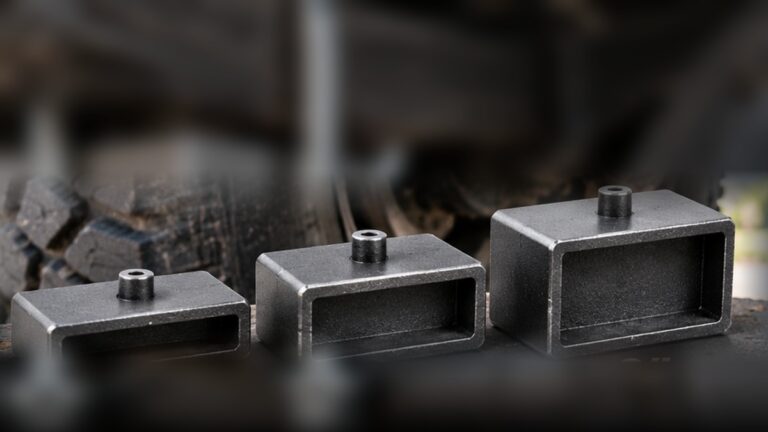
Toyota Sequoia Lift Kit: Best Heights, Tires & Fitment by Year
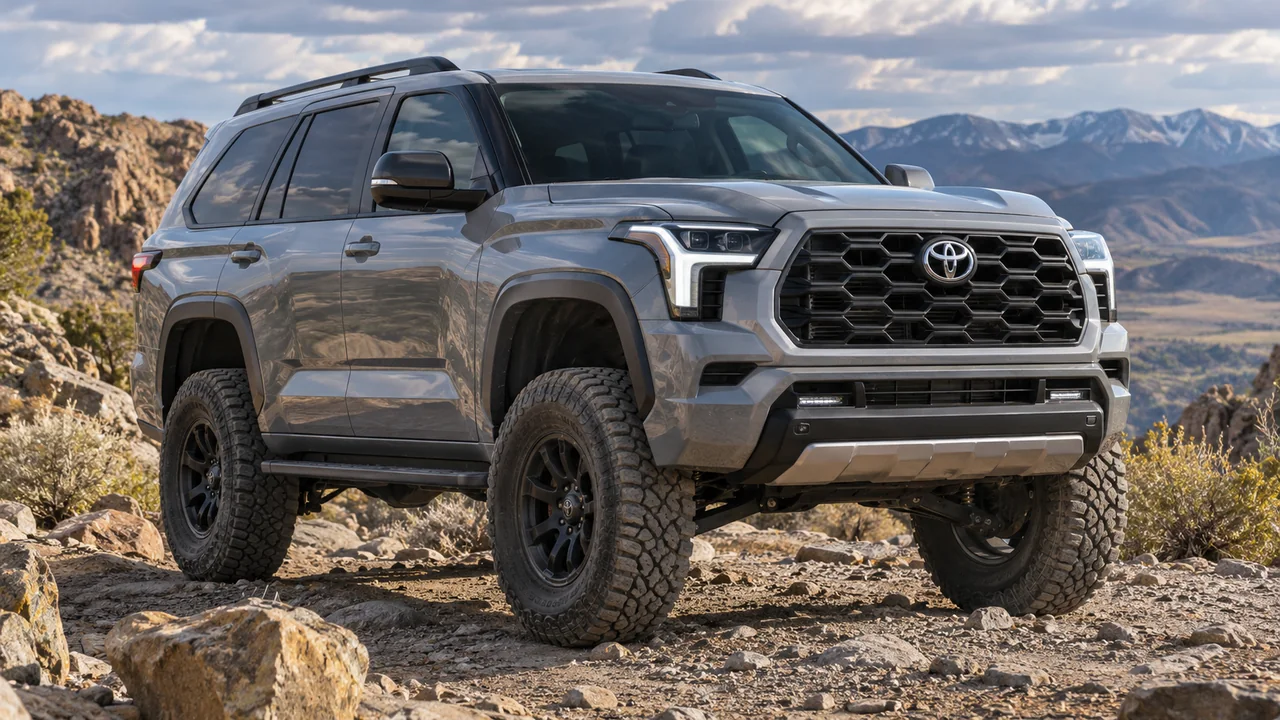
A Toyota Sequoia lift kit makes the most sense when it is matched to the rear suspension as well as the front. For a 2001–2007 Sequoia, a two-inch spring-and-shock system is an excellent starting point, with a 2.5–3-inch setup worth considering for a larger tire. On a 2008–2022 model, look for a roughly two-inch system designed for the independent rear suspension. For a 2023 or newer Sequoia, a modest front-biased lift is usually enough for a road-driven SUV; TRD Pro, rear air suspension and Adaptive Variable Suspension (AVS) need their own fitment checks. A six-inch lift belongs in a different category altogether, and should be chosen as a complete geometry-correction system rather than a collection of tall spacers.
The right kit for an older camping truck bought on a tight budget may be quite different from the right one for a new Capstone that tows a trailer. Both have three rows of seats, but their suspension hardware, original wheel sizes and intended loads tell very different stories.
Which Lift Kit Fits Your Sequoia?
Use this table to narrow the shopping list before comparing prices. Heights are advertised changes over the relevant starting suspension, not guaranteed measurements on every vehicle. The examples are U.S. applications, and the exclusions are as important as the lift figures.
| Generation and use | Kit or route worth comparing | What could rule it out |
|---|---|---|
| 2001–2007, conventional coils, daily driver | Eibach Stage 1, 2 in front / 1.5 in rear for 4WD | Rear air suspension; condition of original mounting points |
| 2001–2007, economical stance change | ReadyLIFT 69-5010, 2.5 in front / 1.5 in rear | Rear frame spacer mounting design; factory rear air |
| 2001–2007, more demanding trails | Load-matched coils and dampers, or TOTAL CHAOS 2–3 in front system with matched rear parts | Lower-arm year split; steering, axle location and travel |
| 2008–2022, conventional suspension | Dobinsons 1.75 in IMS for 5.7L V8 or a matched Eibach system | Engine, electronic damping and self-leveling equipment |
| 2008–2022, taller stance | ReadyLIFT 69-5015, 3 in front / 2 in rear | Rear air, adjustable rear suspension or TRD Pro |
| 2023–2026, conventional 4WD | Eibach Stage 1, 2.4 in front / 1.1 in rear | AVS, rear air and unlisted trims |
| 2023 and newer, factory air/AVS or FOX TRD Pro | Equipment-specific Westcott Designs collar kit | Correct factory damper type and approved model year |
| 2023–2025 TRD Pro, tall custom build | Rough Country 77300 six-inch system | Requires cutting/drilling and at least 20 in wheels |
If you cannot identify the rear suspension, stop here and check the VIN equipment list and the actual hardware. A previous owner may already have converted a first- or second-generation truck from air springs to coils. A Limited or Platinum badge alone will not tell you what is under the vehicle today.
2001–2007 Sequoia: Spend the First Dollars on the Right Hardware
The first generation (XK30/XK40) combines an independent, coil-sprung front suspension with a coil-sprung solid rear axle on conventional-suspension versions. It is closely related to the early Tundra, but the pickup uses rear leaf springs. That is why a front coilover can appear in both catalogs while the rear half of a Tundra kit is of no use on a Sequoia.
A 2001, 2002 or 2003 Sequoia may need repairs before a lift
Many of these trucks have covered enough miles to need more than new springs. Pay particular attention to front lower ball joints, the lower-control-arm bushings and alignment eccentrics, steering rack mounts and CV boots on 4WD vehicles. Examine the frame and rear link brackets for corrosion. If the current suspension cannot be aligned or has significant play, the lift should not be the first repair.
Toyota issued lower-ball-joint safety recalls affecting certain first-generation Sequoias. Check the vehicle through Toyota’s VIN recall lookup and ask a dealer about the campaign history if the online result is incomplete. A previously completed campaign does not establish the present condition of a ball joint. Use correctly specified replacement parts and have the suspension inspected before adding the leverage of larger tires.
ReadyLIFT 69-5010: check the rear frame before ordering
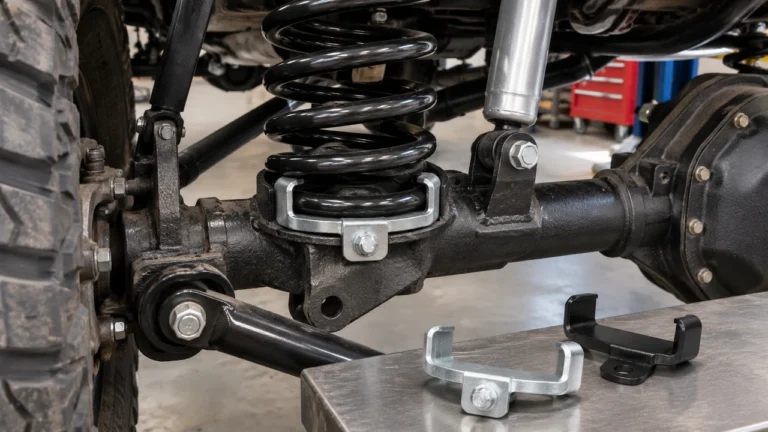
The ReadyLIFT 69-5010 SST kit is marketed for a nominal 2.5-inch front and 1.5-inch rear increase on 2001–2007 2WD and 4WD models. It uses the original spring and damper assemblies with front extensions, rear spring spacers and provisions for the front differential and skid plate. Its catalog puts the upper tire-size target at 33 inches.
The interesting restriction is not the engine or the exterior trim. ReadyLIFT says its rear spacer is intended for only one of three rear suspension designs and requires a suitable bolt provision at the frame. The company also excludes trucks with factory rear air springs. Inspect that mounting point before ordering and ask the supplier about any other configuration; do not drill or improvise a spring seat because the box says 2001–2007.
A front-only leveling kit can cost less if the rear height is already satisfactory. On a Sequoia that regularly carries passengers, however, leaving a small amount of rear rake can make more sense than making the empty truck perfectly level. The distinction between a front correction and a lift at both axles is covered in our leveling kit versus lift kit guide.
Eibach, Bilstein or Dobinsons for an older daily driver?
A spacer is not a particularly good investment if the original shocks are leaking or the coils are badly sagged. The Eibach PRO-TRUCK Stage 1 package E80-82-095-01-22 is a useful alternative: its U.S. 4WD application lists four springs and four dampers, with two inches of front lift and 1.5 inches at the rear. The application excludes air suspension. Eibach specifies its lowest front snap-ring position for the published height and reserves higher positions for additional weight; this is not a system to raise indiscriminately to three inches.
Bilstein 5100 or 6112 front units paired with suitable rear springs and shocks are another common first-generation combination. Dobinsons and Old Man Emu provide spring options for trucks with extra equipment. The important question is whether the front assembly is set for original weight or for a bumper and winch, and whether the rear springs are selected for the cargo that stays aboard. Ask for the full component references rather than buying by a nickname used in an owner group.
Why a 2004 Sequoia lift kit can have different lower arms from a 2003 kit
The facelift-era hardware split is easy to overlook. TOTAL CHAOS lists a common replacement upper arm for the 2001–2007 range, yet its Expedition Series lower arms and some mid-travel packages are separated into 2001–2003 and 2004–2007 applications. The split is visible in the manufacturer’s first-generation Sequoia suspension catalog. A shared upper-arm listing is therefore not proof that an entire lower-arm or mid-travel kit carries over.
The same company offers a front coilover-and-upper-arm combination in the two- to three-inch class. That is useful for a heavier trail build, but it does not supply all the rear components merely because the front application says Sequoia. Work out rear spring selection, axle location and shock travel as a separate part of the purchase. Check the production year and complete kit configuration before buying used parts for a 2004, 2005, 2006 or 2007 truck.
The solid rear axle needs more than a taller coil
Raising the rear with coils changes the resting angle of the Panhard rod, which locates the axle laterally. The axle can shift sideways as the rod moves through its arc. Measure its position relative to the body at the intended ride height rather than assuming that unequal tire clearance means a bent frame. A suitable adjustable rod or correction bracket may be useful where the measured displacement or geometry warrants it.
Check whether the rear spring stays securely seated at full extension and whether the shock still has enough compression travel. A longer rear shock can allow more movement than a brake hose, ABS wire or spring seat can accommodate. Our shock length calculator explains the measurements needed to select a damper rather than simply ordering one advertised for three inches of lift.
What about a 2004 Toyota Sequoia six-inch lift kit?
This is a popular search, but it does not follow that an equivalent new six-inch kit is currently available for every first-generation truck. I would not order a six-inch Tundra system based on the appearance of the front end or reuse its rear leaf hardware. Nor would I treat a three-inch front spacer stacked with another spacer as a six-inch suspension system.
A tall IFS build requires an engineered solution for the front suspension and steering geometry and, on a 4WD, the front driveline. The rear coil-sprung axle needs its own spring and locating-link provisions. Ask for the manufacturer’s complete Sequoia application, instructions, replacement hardware availability and any required modifications before buying a legacy or secondhand system. Without that documentation, a well-matched two- or three-inch setup is a much more defensible purchase. There is no verified current first-generation six-inch package recommended here.
2008–2022 Sequoia: The Independent Rear Suspension Changes the Shopping List
Toyota changed the rear of the second-generation XK60 to independent suspension. Both rear wheels now have their own suspension arms and half-shafts. This makes it a substantially different lift project from the earlier solid-axle SUV, and explains why a rear spring, shock or relocation bracket selected for the first generation will not automatically be suitable.
A 1.75–2.5-inch suspension system for the 5.7 V8
Dobinsons lists IMS (Internal Monotube Shock) suspension packages for the 2008–2022 Sequoia 5.7L V8 in nominal 1.75- and 2.5-inch versions. These are worth comparing when the original damping is tired or the truck regularly carries equipment. The company’s application is expressly tied to the 5.7; owners of an early 4.7 or a later 4.6 V8 need to establish their own approval rather than relying on the generation name.
The front spring load rating, rear spring and damper choices matter more than whether the number in the title is 1.75 or 2.5. Eibach also offers a Stage 2 adjustable front coilover package, E86-82-103-01-22, with rear springs and dampers for the conventional 4WD application. Its U.S. listing rules out load-leveling rear air suspension. Confirm the electronic damper configuration as well, especially on a higher trim.
A Bilstein 6112 front package is not necessarily a four-corner lift. If the supplier combines it with rear 5100 shocks, check the exact rear shock’s approved height range, including any limitations concerning electronic damping. A complete dealer-built package may include a different rear damper or relocation hardware from a simple front-and-rear shock bundle.
ReadyLIFT 69-5015 and the three-inch option
ReadyLIFT’s second-generation SST system, part 69-5015, uses front extensions, rear spring spacers and rear shock extensions to obtain an advertised three-inch front and two-inch rear change. The manufacturer identifies 2008–2022 applications but specifically excludes rear air springs, rear adjustable suspension and TRD Pro. Some older catalog titles end in 2019 or 2021; confirm the current application rather than relying on a reseller’s abbreviated title.
Three inches at the front can be attractive visually, but the rear independent setup is not exempt from geometry changes. Have the installer check rear toe and camber, half-shaft articulation, brake and ABS routing, and the shock’s available travel. Replacing an upper front control arm will not correct an out-of-range rear alignment. Our alignment eccentric and camber bolt guide explains why the mounting design matters when selecting correction hardware. Seized rear adjustment hardware is an additional concern on older vehicles exposed to winter road salt.
The 2020–2022 TRD Pro is not just a different badge
Toyota introduced the second-generation TRD Pro for 2020 with FOX dampers, including rear piggyback-reservoir shocks. It remains an independent-rear-suspension truck. Do not select the newer solid-axle TRD Pro’s collar kit for it or assume the ordinary 69-5015 spacers can be added to its factory FOX package. If those original shocks are still in good condition, preserving their intended working range may be more valuable than gaining another inch of height.
On a used TRD Pro, verify that the original dampers are actually still installed. A truck that has been converted to a different spring and shock combination needs to be assessed as it stands, with the current parts identified and any changed mounting hardware included in the fitment discussion.
Rear Air Suspension: Retain It or Convert It Before Choosing the Lift
Some Sequoias use automatic rear height control instead of ordinary steel rear coils. The equipment differs by generation and trim, and may coexist with electronically controlled damping. It helps to separate the decision about keeping the system from the decision about lift height.
Keeping the original height-control system
If the truck tows frequently, a working self-leveling system has real value. It can compensate for changes in load within its designed range. That does not mean it is safe to alter the sensor linkage to force the rear to sit permanently higher, or to fit a generic spacer under an air spring. The bellows, shock, height sensor range, bump stops and control logic have to work together.
Ask the suspension manufacturer whether its exact kit retains the factory air springs, how it accounts for the rear height-control mechanism and whether it supports the existing electronic dampers. A front-only kit may avoid changing the rear spring, but the manufacturer must still approve the overall application. If the rear already sags overnight, diagnose the leak or height-control fault before modifying it.
Converting a first- or second-generation Sequoia to coils
A conversion can be practical on an older vehicle with expensive failed height-control components, provided it is a complete, vehicle-specific conversion. The first generation has a solid rear axle; the second has independent suspension. Their spring seats, spring sizes and shock arrangements are different. Buy a system that addresses the correct hardware, the original electronic functions where applicable and the desired final ride height.
Do not assume that any standard lift spring can be installed directly in the place of a factory air bellows. The conversion needs the appropriate spring mounting provisions, compatible damping and a defined approach to any electronic warnings or functions. A stock-height conversion is also not automatically a lift. Establish the baseline height after the conversion before deciding whether additional suspension changes are justified.
2023 and Newer Sequoia: Choose by Damper Type, Not Just Trim
The third-generation XK80 moved to the TNGA-F platform with a multi-link solid rear axle and the i-FORCE MAX hybrid powertrain. It shares some front components with the contemporary Tundra, yet its rear hardware, body clearances and equipment combinations are SUV-specific. Our Toyota Tundra lift kit guide is for the pickup; do not transfer its advertised lift figures directly to the Sequoia.
Eibach Stage 1 and Stage 2 for conventional suspension
Eibach’s third-generation Sequoia application guide identifies Stage 1 E80-82-099-01-22 for 2023–2026 SR5, Limited and Platinum 4WD configurations without AVS or rear load-leveling air. Its listed front and rear gains are 2.4 and 1.1 inches. Stage 2 E86-82-099-01-22 uses adjustable front coilovers, with a stated 1.4–3.25-inch front range and 1.2 inches at the rear. The Stage 2R adds rear reservoir shocks.
Those numbers describe different assemblies, not different settings of the same shock. The Stage 2 front coilovers arrive set to match the original rear spring height, so the manufacturer’s preload adjustment is needed when fitting its rear lift springs. A Platinum in the application table is not approval for a Platinum equipped with excluded suspension options. Check the actual equipment before ordering.
A 3.5-inch kit does not automatically mean 35-inch tires
ReadyLIFT’s 69-53300 SST kit combines tubular upper control arms, front spacers, rear coil spacers and shock extensions. It excludes TRD Pro, AVS and factory rear air suspension. Its published wheel-and-tire example is 285/75R17 on a 17×8.5-inch wheel with +25 mm offset, with 295/75R17 requiring minor trimming. Those are nominal 33.8- and 34.4-inch tires, respectively. The kit’s product name refers to suspension height, not a promise of fitting every tire labeled 35.
The manufacturer’s material describes a 3.5-inch front and 2.5-inch rear increase in its main specifications, although a detail paragraph gives a different front figure. Confirm the intended height for the exact current kit revision before ordering if that difference matters to your garage clearance or wheel selection.
Westcott preload collars for standard suspension and AVS/Air Ride
Westcott Designs makes a useful distinction between its collar systems. Its 2023–2027 Sequoia preload collar kit lists a 2.5-inch front and one-inch rear change on static suspension, compared with two inches front and seven-eighths of an inch rear on AVS/Air Ride applications. The ordering choices differentiate black Hitachi dampers, red Bilstein TRD Off-Road dampers and air/AVS combinations with Hitachi or Tokico units.
This is a case where identifying the actual shock matters more than reading the tailgate emblem. The kit retains the original shocks and springs and does not include replacement dampers. A collar changes the spring’s installed condition; it does not turn a worn original shock into a new one. Follow the specific assembly and height-control instructions and have any required calibration completed.
The TRD Pro FOX suspension has its own lift kit
Westcott’s separate FOX-equipped TRD Pro collar system lists an additional three inches at the front and one inch at the rear on the approved 2023–2027 applications. Do not confuse those figures with the standard or AVS version. The 2027 model also brings changes to the factory off-road equipment, including updated FOX shocks on TRD Pro and an available Trailhunter package. Confirm the actual new damper specification and kit revision before transferring fitment from a 2024 or 2025 model; a Trailhunter package should not be treated as a TRD Pro by default.
Many owners want the appearance of a larger tire while retaining the expensive FOX setup. That can be a reasonable goal with an approved mild system, but preserving the original shock does not guarantee the same available droop, compression clearance or alignment. A professionally installed, correctly matched system still needs a physical check through its working range.
A genuine six-inch system for the newer TRD Pro
There is a documented modern option for the six-inch search: Rough Country 77300, listed specifically for 2023–2025 Sequoia TRD Pro. It uses a crossmember-based approach and rear upper-link relocation provisions. The manufacturer advertises 35-inch tire capability, specifies cutting and drilling, and requires wheels of at least 20 inches to clear the supplied knuckles. Toyota Safety Sense recalibration may also be necessary.
That wheel requirement alone can change the economics of the build if the owner intends to keep the original 18-inch TRD Pro wheels. Do not assume that any 20-inch wheel has the correct width, offset or spoke clearance. The kit is not listed as a universal six-inch system for the standard Sequoia or an earlier generation. Obtain an itemized quote covering wheels, tires, geometry, installation and calibration before committing to it.
Can You Fit 33s or 35s on a Lifted Sequoia?
Tire measurements help put kit advertisements in context. The following figures are nominal dimensions calculated from the size designation, not measured dimensions or fitment guarantees. A particular all-terrain tire may be wider or taller in practice, depending on its construction and measuring rim.
| Tire size | Nominal diameter | Nominal width | Comparison |
|---|---|---|---|
| 265/70R16 | 30.6 in | 10.4 in | Older Sequoia size reference |
| 265/65R17 | 30.6 in | 10.4 in | Alternative older wheel size |
| 275/65R18 | 32.1 in | 10.8 in | Moderate tire-size comparison |
| 285/75R16 | 32.8 in | 11.2 in | First-generation 33-inch candidate |
| 285/70R17 | 32.7 in | 11.2 in | Common 33-inch-class candidate |
| 285/75R17 | 33.8 in | 11.2 in | ReadyLIFT XK80 example |
| 295/75R17 | 34.4 in | 11.6 in | Larger XK80 example with trimming |
| 285/65R20 | 34.6 in | 11.2 in | Near-35-inch diameter for 20 in wheel |
| 35×12.50R20 | 35 in (labeled) | 12.5 in | Wider 35-inch target; verify wheel and kit |
First-generation 33s: watch the front body mount and upper arm
A 285/75R16 or 285/70R17 is a much more useful shopping target than the vague instruction to buy 33s. TOTAL CHAOS gives a 285/75R16 example on a 16×8 wheel with 4.5 inches of backspacing for its first-generation front coilover/UCA setup. That example belongs to that application. It does not establish clearance for a stock arm, a wider wheel or another tire manufacturer’s casing.
Clearance at the front body mount, liner, upper arm and bumper must be checked at steering lock and through compression. Moving the tire outward may help clear the arm while increasing its sweep toward the body mount. A modest lift does not make all of those contacts disappear. A narrower tire of similar diameter can sometimes be the more practical choice for a camping Sequoia.
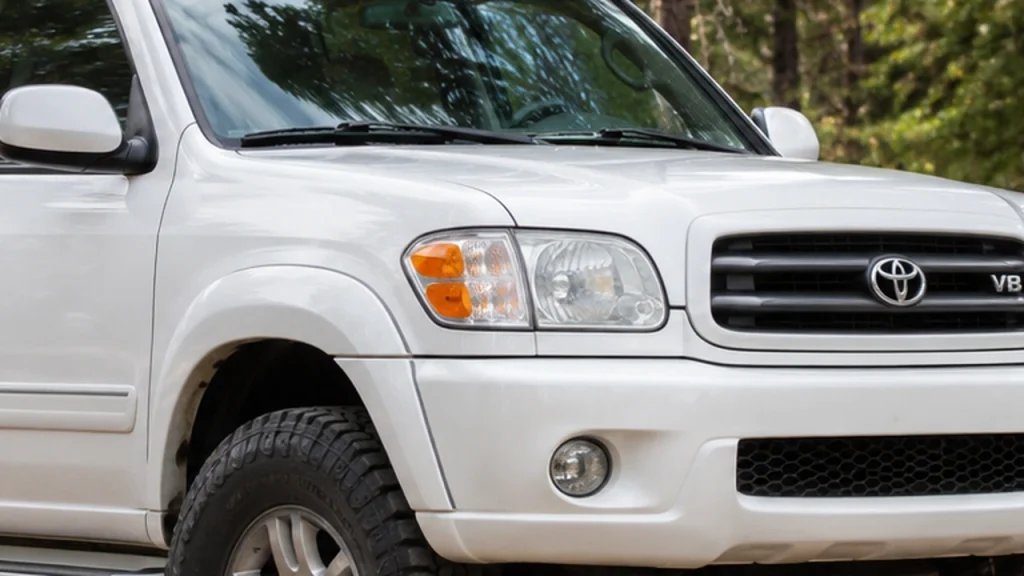
Second-generation 33s and 35s: keep the rear wheel movement in mind
At the rear of an XK60, the tire’s position relative to the body and suspension changes through independent suspension travel. Check both rear wheel openings under passenger or trailer-tongue load rather than measuring only an empty parked vehicle. A three-inch lift and large offset change are not enough evidence to promise clearance for a wide 35-inch tire.
On the third generation, the solid rear axle brings a different articulation pattern. Use the tire and wheel examples for the selected kit, and confirm spare-tire storage, brake clearance and load capacity. A large spare that cannot be secured properly is an overlooked drawback on a three-row vehicle intended for remote travel.
The bolt pattern went from six lugs to five and back again
The first-generation Sequoia uses 6×139.7 mm, the second uses 5×150 mm, and the third returns to 6×139.7 mm. The first and third generations nevertheless have different hub-bore and wheel requirements; a shared bolt pattern is not proof of interchangeability. Check the wheel’s center bore, fastener seat, stud compatibility, brake clearance and load rating. Our wheel offset and backspacing guide explains the relationship between wheel width and mounting position.
Keep the Lift Compatible With the Sequoia’s Real Load
An SUV used to tow a boat or carry six people does not spend much of its life at the empty showroom weight. Higher springs do not raise the certified GVWR, axle ratings or towing capacity. A bumper, winch, roof rack, larger wheels and cargo all consume payload, and a raised hitch or larger tire diameter can change trailer attitude, braking and effective gearing.
What a realistic installed quote should contain
Basic spacers often cost a few hundred dollars in parts. Four-corner spring-and-shock systems commonly reach four figures before labor, while premium coilovers or a tall crossmember-based system can cost considerably more once wheels and tires are included. Instead of comparing the headline kit price, ask the shop to quote the complete build using these details.
- Model year, VIN, 2WD or 4WD, engine, trim and the actual rear spring and damper type.
- Present hub-to-fender measurements, suspension condition and any previous air-to-coil conversion or lift.
- Exact kit revision, front and rear spring ratings, damper lengths, control arms, alignment and relocation hardware.
- Permanent accessories, regular passenger and cargo weight, trailer tongue weight and intended loaded stance.
- Tire model and size, wheel width and offset, spare storage, brake clearance and any documented body clearance work.
- Labor, alignment at the applicable axles, headlight aim, electronic calibration and manufacturer’s post-installation checks.
Do not accept a persistent vibration, poor steering return, suspension clunk or tire rubbing as an unavoidable side effect of a lift. Have the shop investigate the cause before normal use. On the newest trucks, follow Toyota’s service procedures for driver-assistance systems and any required calibration. The end result should be a Sequoia that still works when fully loaded, not merely one that looks level in the driveway.
Toyota Sequoia Lift Kit FAQs
These answers address common buying questions, including the year-specific searches for older Sequoias. Use the exact product application and the condition of the actual vehicle to make the final decision.
What is the best lift kit for a 2002 Toyota Sequoia?
For a conventional-coil 4WD daily driver, a matched two-inch spring-and-damper system is a sound starting point. A 2.5-inch front spacer system may suit healthy original suspension if the rear frame and spring configuration are approved. Inspect the lower ball joints, steering and frame before choosing either route.
Will a 2003 lift kit fit a 2004 or 2005 Sequoia?
Some front and rear components span 2001–2007, but certain lower-control-arm and mid-travel systems split at 2004. Rear air suspension and spacer mounting provisions can also rule out a particular kit. Confirm the component references rather than assuming a complete package transfers.
Can I install a six-inch lift on a first-generation Sequoia?
Only with a documented, complete system approved for the actual model and drivetrain. Current availability of a suitable first-generation six-inch package is not established here. A tall Tundra kit or stacked spacers are not substitutes for correct Sequoia rear hardware and front geometry.
What lift kit works on a 2008 or 2012 Sequoia Platinum?
Identify the rear air springs and electronic damping first. A conventional coil-spring lift may explicitly exclude that equipment. Choose an approved air-retaining system or a documented conversion followed by a compatible suspension setup. Confirm the engine and drivetrain as well.
Can I lift a Toyota Sequoia and keep the rear air suspension?
Yes, when the selected system specifically supports the original height-control equipment and damping configuration. For example, Westcott lists separate AVS/Air Ride applications for the third generation. That does not establish compatibility for the older air-suspension trucks.
Does a 2024 or 2025 TRD Pro need new upper control arms for a lift?
Not with every kit. Some approved FOX-specific collar systems are designed to retain the original upper arms, whereas taller systems may require other geometry hardware. Follow the selected manufacturer’s requirements and check alignment, joint movement and clearance rather than applying a universal lift-height rule.
Will a two- or three-inch Sequoia lift fit 33-inch tires?
Some first-generation combinations and other approved applications can accommodate a 33-inch-class tire. Width, wheel position, body mounts, steering lock and compression clearance determine the actual result. A lift height by itself does not guarantee fitment, particularly for a wide tire.
Can I use a Toyota Tundra lift kit on a Sequoia?
Only use individual components or a complete kit when the manufacturer explicitly lists the Sequoia application. Shared front hardware does not establish rear compatibility. The second-generation Sequoia’s independent rear suspension and the SUV-specific coil or air setups of other generations are important differences.