Steering Angle Sensor Replacement Cost: Parts, Labor & Calibration
Steering angle sensor replacement typically costs $200–$750 in the U.S. for parts and labor. A commonly published breakdown is $100–$250 for the sensor and $100–$500 for installation, although an integrated steering-column assembly can put a particular vehicle outside that range. Calibration, diagnostic work and taxes may be charged separately. These are planning figures, not a quote for your VIN.
Before you agree to replace it, ask whether the sensor is actually broken or simply needs its steering-angle zero point relearned. An ABS or stability-control warning after an alignment can be a calibration problem, and a new sensor will not fix an off-center steering wheel or damaged wiring. That distinction can save far more than shopping around for a cheaper part.
The steering angle sensor (SAS)—sometimes listed as a steering wheel position sensor—reports steering direction and position to electronic stability control and other vehicle systems. Below are the replacement prices, the less expensive alternatives worth checking first, and the questions that should appear on an itemized repair estimate.
Steering Angle Sensor Replacement Cost: Parts, Labor and Extras
AutoNation Mobile Service publishes a general installed range of $200–$750, with parts around $100–$250 and labor around $100–$500. CarParts.com publishes similar component and labor figures. These are broad U.S. estimates; neither is a vehicle-by-vehicle national average, and the top end is not a cap for complex integrated systems.
Here is how to read a quote without adding charges that might already be included in the shop’s labor line.
| Charge | Useful U.S. price reference |
|---|---|
| Replacement steering angle sensor | About $100–$250 for many separately sold sensors |
| Installation labor | About $100–$500, depending on access and labor rate |
| Common replacement total | $200–$750 parts and labor |
| SAS calibration / zero-point relearn | Sometimes included; if billed alone, roughly $50–$150 is an illustrative service range |
| ABS / ESC / EPS diagnostic scan | Ask whether testing is included in the estimate |
| Complete switch module or column assembly | Can exceed the ordinary range; verify the actual part number |
| Wheel alignment / ADAS procedures | Only when separately justified by the vehicle and work performed |
Sources and scope: AutoNation Mobile Service, “Steering Angle Sensor Price: Cost Breakdown for 2026,” and CarParts.com’s steering angle sensor guide for the replacement ranges. The optional $50–$150 calibration-only reference is reported by RepairsAdvisor (June 2026), not a guaranteed national average. A calibration charge may already be part of an installed quote.
A $275 repair for an accessible standalone sensor and a $900 estimate for a larger steering-column switch assembly should not be treated as the same job. Request the VIN-matched part number, the operation being billed and confirmation that the sensor is available separately before deciding a price is unreasonable.
Calibration vs. Replacement: Which Repair Do You Actually Need?
This is the first question I would settle on a car that suddenly displays a stability-control warning. A sensor can be electrically healthy and still report an incorrect straight-ahead reference. Conversely, trying to calibrate a sensor with an internal electronic failure will not bring it back.
These situations call for different next steps; the table is a decision guide, not a substitute for the manufacturer diagnostic tree.
| What the technician finds | More likely next step | What that means for cost |
|---|---|---|
| Angle value is believable but zero point is wrong | Check alignment/centering and perform specified SAS calibration | A calibration-only service may avoid buying a sensor |
| Sensor data missing, implausible or intermittent | Check power, ground, wiring, connections and fault-code details | Diagnosis first; do not automatically replace the SAS |
| Internal sensor failure confirmed | Replace the correct serviceable sensor or assembly, then initialize as required | Parts, installation and required electronic work |
| Steering wheel off-center after steering work | Check mechanical centering and alignment before electronic relearn | Mechanical correction may be needed before calibration |
| Steering rack or column module actually faulty | Diagnose that assembly under its own service procedure | Potentially a different, more expensive repair |
When a Steering Angle Sensor Recalibration May Be Enough
The typical example is a warning that appears immediately after tie-rod work, a wheel alignment, steering-column service or certain electronic repairs. The vehicle may be driving straight, but its control unit no longer agrees that the wheel is at zero degrees. Some manufacturers specify a relearn procedure after these jobs; others do not require one for every alignment.
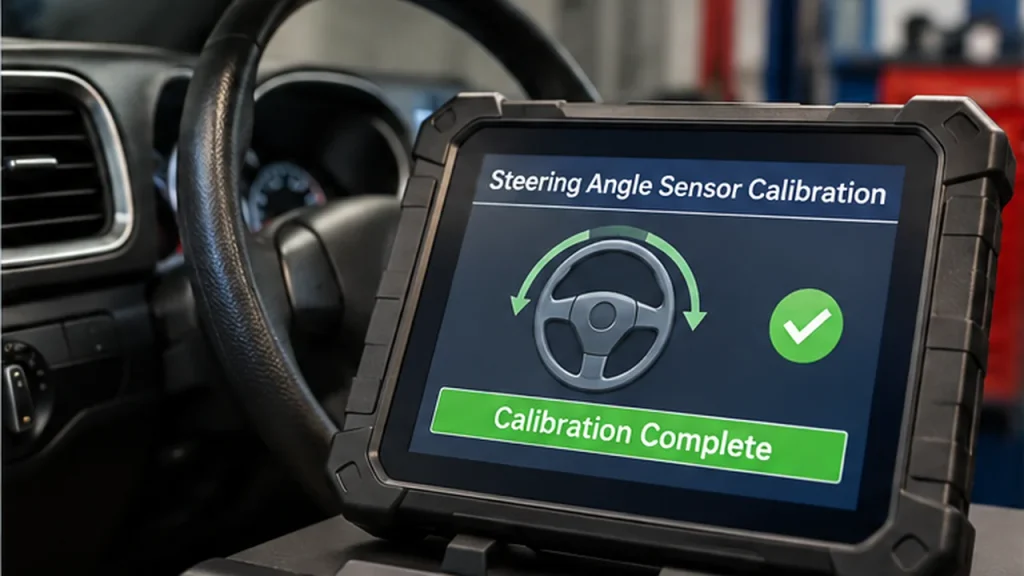
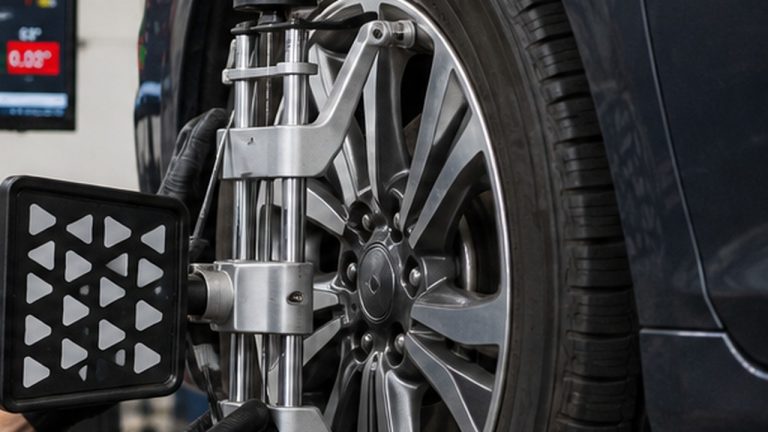
Mevotech’s steering-angle service guidance notes that the angle reading can disagree with yaw-rate and other stability-system inputs after suspension or alignment work. A qualified shop should establish whether the geometry and steering-wheel position are correct before carrying out the applicable recalibration.
A real manufacturer example shows why this matters: a 2025 Jeep service bulletin addresses a C0051-00 steering-wheel-position fault and off-center steering through calibration and initialization checks, not an automatic sensor replacement. A separate Kia service action published in February 2026 addresses calibration on certain 2025–2026 Seltos vehicles. Neither document means every vehicle with a warning light has the same remedy.
When Replacing the Sensor Is Justified
Replacement makes sense when the relevant diagnostic procedure has confirmed failed sensor electronics, an unusable output or a physically damaged unit that is supplied as a service part. A shop may also need a larger assembly when the manufacturer does not sell the sensor separately. Those are very different findings from “the traction-control light came on.”
If a calibration fails, the next step is not necessarily to install a new sensor immediately. The tech should check the fault-code suffix, steering-angle live data, wiring, steering-wheel centering and any model-specific software guidance first.
Why One Steering Angle Sensor Costs More Than Another
The expensive part of this repair is often what the sensor comes attached to. Two cars can use the same name for the function while packaging it in very different assemblies. That is why shopping by the words “steering angle sensor” alone is risky.
Standalone Sensor, Clock Spring or Integrated Switch Module
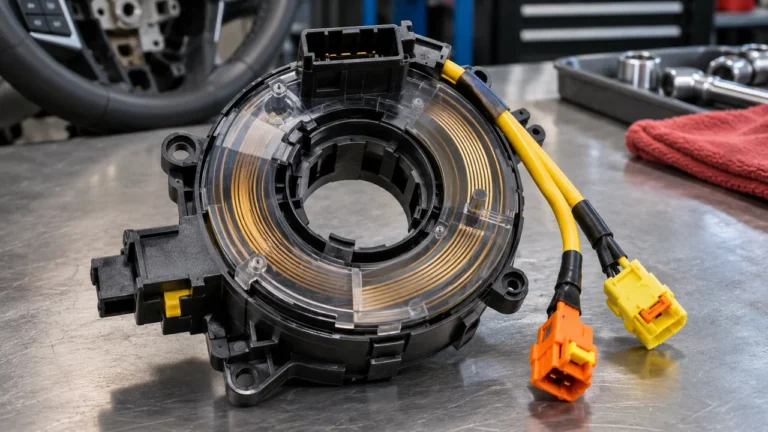
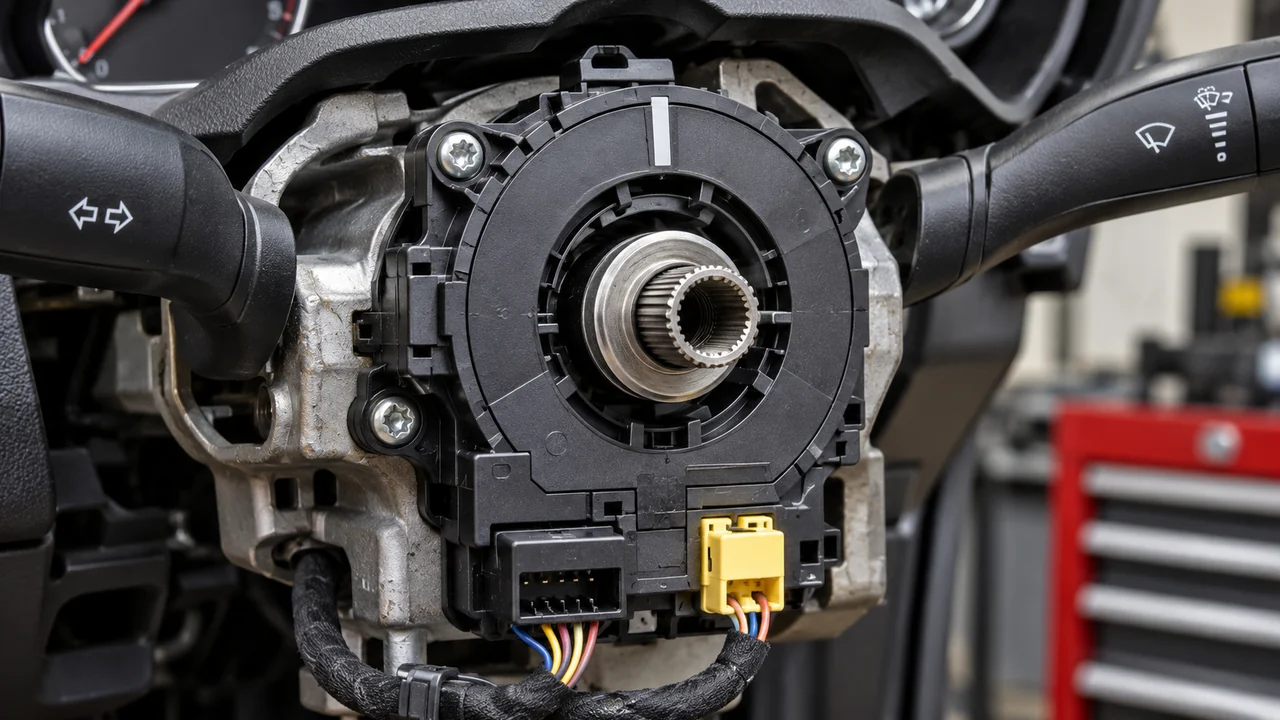
On some vehicles, the SAS is a discrete component near the top of the steering column. On others it is mounted alongside the clock spring or integrated with a steering-column switch module. Still other designs obtain steering-position information from components associated with the electric steering system. Some assemblies contain more than one sensor element, but that does not mean the car necessarily has two individually replaceable sensors.
The clock spring replacement cost guide covers the flexible electrical connection used by the airbag, horn and wheel-mounted controls. It is not interchangeable with the SAS, even when the two components are packaged together. One can fail while the other remains functional.
An online listing that seems inexpensive may be for the clock spring without the angle sensor, the sensor without the combination switch, or an assembly intended for a different steering-wheel option package. Ask for the exact OE number and any supersession before ordering.
Labor Access, Airbag Handling and Scan-Tool Time
A sensor accessible after removing a small amount of trim is a different labor job from one requiring steering-wheel removal, airbag handling and transfer of switch components. Cars with an electronically assisted steering column can add programming or module initialization requirements. The bill should reflect the actual service operations for that vehicle, not a blanket fee for every possible procedure.
If the estimate says “sensor plus steering column,” ask why. A full mechanical or electric-assist column replacement is a separate repair with much higher parts exposure. Our steering column replacement cost guide explains the larger assemblies and the failures that genuinely require them.
Symptoms and Trouble Codes That Can Point to an SAS Problem
The most useful clue is often the combination of warning lights and the repair history, not a particular feeling through the steering wheel. A vehicle can steer mechanically while its stability-control system has disabled features because it does not trust the angle input.
ABS, Traction Control, ESC or Power Steering Warning Lights
An SAS-related fault can illuminate the stability-control or traction-control indicator, an ABS warning, or an electric power steering message depending on the vehicle. Some driver-assistance systems may also be limited because they rely on steering input. None of these warning lights is specific to the SAS: wheel-speed sensors, steering wiring, the ABS control module and other faults can produce similar complaints.
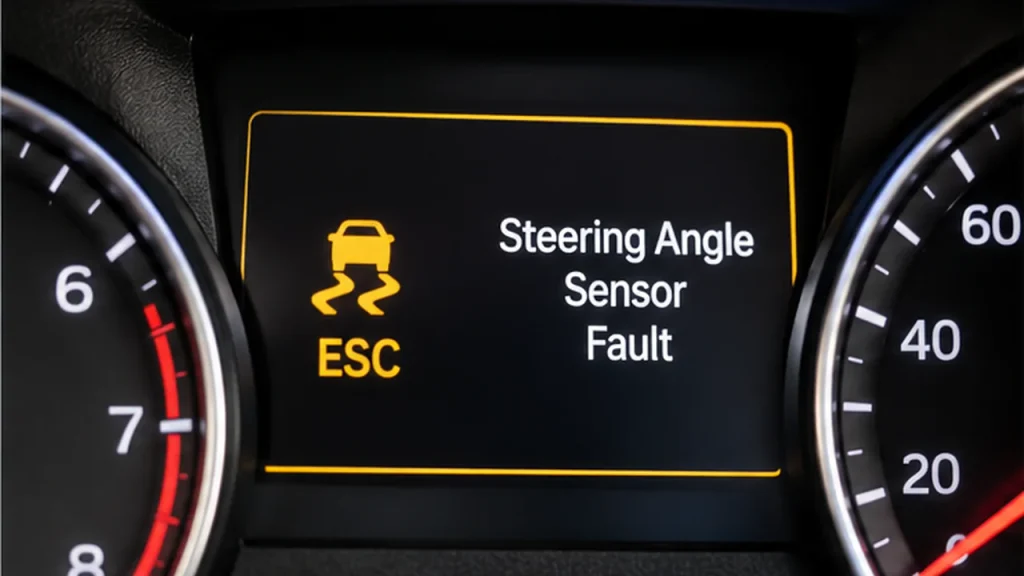
Pay particular attention to when the warning began. “The light appeared the morning after a tire shop aligned the front end” calls for a different first check from “the fault started intermittently six months ago and now the sensor signal disappears during turns.”
C0051, C0710 and C1261: Why the Exact Fault Code Matters
C0051 is commonly associated with steering-wheel position or steering angle in certain manufacturer systems, but its suffix changes the meaning. Stellantis technical guidance distinguishes C0051-54 (missing calibration) from C0051-64 (signal plausibility). General Motors service information also uses C0710 for certain steering-angle-sensor faults; Hyundai/Kia systems may use codes such as C1261 for zero-setting problems. These are examples, not universal code definitions across every make and model.
Chrysler specifically directs technicians to investigate before replacing major steering assemblies when those C0051 subcodes are present; see the manufacturer’s technical tip. A generic scan app may show a short label but miss the manufacturer-specific description or live data required to decide whether the sensor is defective.
Off-Center Steering Wheel or Strange Behavior After Alignment
An off-center wheel can result from incorrect toe adjustment or mechanical indexing, not a broken angle sensor. Some stability systems detect that the reported wheel angle does not match the vehicle’s actual travel. Performing an electronic reset before correcting the geometry can hide the underlying problem temporarily or leave the calibration unable to complete.
If your issue began after replacing a tie rod, control arm or other steering part, the alignment-after-suspension-repair guide covers which mechanical repairs normally require an alignment check. The SAS-related question here is whether the electronic steering reference also needs to be verified afterward.
How a Shop Confirms a Bad Steering Angle Sensor
A responsible diagnosis does more than read the fault code once and write “replace SAS.” The technician needs to distinguish missing calibration from a broken sensor, a harness issue or a problem elsewhere in the steering or brake system.
These are the pieces of evidence worth asking about, even if you are not doing the work yourself.
- Full-system scan: Identify which module set the DTC, including manufacturer subcodes and related ABS, ESC and EPS faults.
- Live steering-angle data: Check whether the reported angle changes smoothly and plausibly as the steering wheel is moved.
- Straight-ahead reference: Compare the angle reading with actual steering-wheel position and vehicle alignment.
- Connector and harness checks: Rule out an open circuit, damaged connector or intermittent supply/communication problem.
- Vehicle-specific service information: Look for calibration procedures, software updates, bulletins or integrated-module requirements.
- Verification afterward: Confirm warning lights, fault codes and steering/stability behavior are satisfactory after the chosen repair.
If the shop recommends a complete column, clock spring and SAS together, ask which test established that each item failed. Bundling can be justified when parts are not sold separately, but the invoice should make that relationship clear.
Does a New Steering Angle Sensor Need Calibration or Programming?
Often yes, but “calibration” and “programming” are not the same charge. A steering angle sensor commonly needs a zero-point or neutral-position relearn after replacement. Some vehicles allow an automatic learning sequence; others require a bidirectional scan tool and a specific routine. The prescribed process can differ even between model years.
Zero-Point Calibration vs. Module Programming
A zero-point calibration establishes what the control unit should read when the steering is straight. Programming installs or configures software for an electronic module. Replacing a sensor does not mean every vehicle needs both, and a routine SAS calibration is not automatically an ADAS camera calibration.
A repair bill that lists “programming” should identify which module and procedure require it. That detail matters if the original sensor was part of a steering-column switch module or electric-assist assembly rather than a standalone sensing element.
Can Battery Disconnects or Tire Alignments Trigger a Relearn?
On some makes, loss of power or a steering-system service can trigger a need to initialize the steering-angle reference. On others the system relearns automatically or requires no manual procedure for that particular job. A universal “turn the wheel fully left and right” trick is not a substitute for the manufacturer method.
Do not assume an alignment shop performed this electronic step merely because the steering wheel looks straight in the before-and-after printout. Conversely, do not approve a sensor replacement just because the electronic reference has to be reset.
Steering Angle Sensor Calibration vs. Wheel Alignment
The two jobs solve different problems. Alignment physically measures and adjusts toe, camber and caster. SAS calibration tells the electronic control system which steering position should represent straight ahead. A car can need one, the other, both or neither depending on what was repaired and what testing reveals.
For normal alignment service pricing and what a shop should include, see our wheel alignment cost guide. This article is deliberately limited to the sensor itself and any electronic procedure needed to make it work correctly.
What If the Steering Rack Was Recently Replaced?
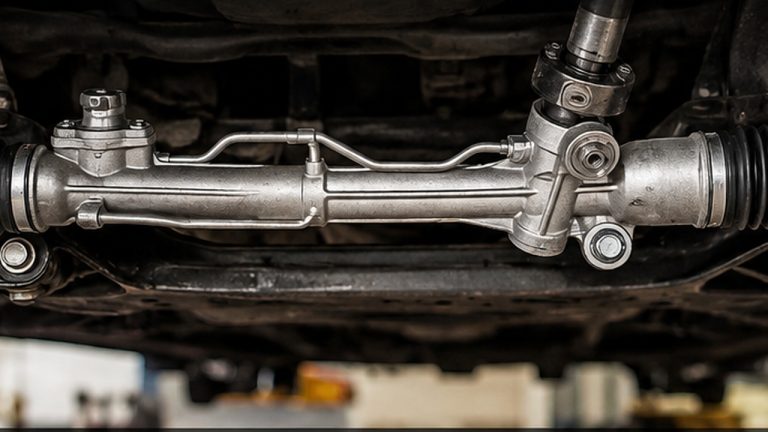
Replacing a rack commonly involves tie rods and steering connections, so both mechanical alignment and a vehicle-specific electronic relearn may become relevant. An SAS fault after rack work does not prove the new rack is defective, and a rack fault does not automatically prove the SAS is bad.
The same is true after an EPS module replacement. Follow the applicable service information to determine whether steering-angle initialization is required and whether existing sensor data is usable before ordering more parts.
Could a Service Bulletin or Warranty Cover the Repair?
A failed sensor is not automatically a safety recall. But some warnings are addressed by manufacturer service communications or calibration campaigns rather than a paid hardware replacement. The precise VIN, model year, build dates and codes matter.
For example, Kia’s February 2026 service action SA641 concerns steering angle sensor calibration on specified 2025–2026 Seltos vehicles produced within defined dates. That is a narrowly defined action, not a free steering-angle-sensor replacement program for every Kia. Other manufacturers have published electronic-calibration guidance when C0051-family faults appear.
Before paying out of pocket, ask a dealer to check for applicable open campaigns, warranty coverage, service bulletins and software remedies using your VIN. A technical service bulletin does not, by itself, guarantee free repair outside the applicable warranty or service action.
Should You Replace the Steering Angle Sensor Yourself?
The part may look simple in an online listing, but gaining access can involve the steering wheel and driver airbag, followed by a precise electronic relearn. On another car, the sensor may be integrated into a module that needs specialized diagnostic equipment. Neither job is a safe place to guess at connector identification or steering-wheel alignment.
If the vehicle’s specific procedure requires SRS disassembly, use a qualified professional rather than general internet instructions. Incorrect handling of an airbag or steering-column component can cause injury or compromise safety-system operation. A generic code reader that can erase faults may not be able to calibrate the SAS or confirm its data.
The straightforward money-saving job for most owners is not dismantling the column; it is getting a firm diagnosis, a VIN-correct parts quote and confirmation that calibration alone will not resolve the issue.
Steering Angle Sensor Replacement Cost: Common Questions
Here are the questions worth answering before approving the work, particularly when you have one quote for calibration and another for replacement.
Is $500 a Fair Price to Replace a Steering Angle Sensor?
It can be. $500 sits within AutoNation’s published $200–$750 parts-and-labor range. The answer depends on the exact sensor or module, labor access, included calibration and diagnostic work. A $500 estimate without a part number or test result is less useful than an itemized one for $600.
How Much Does Steering Angle Sensor Calibration Cost by Itself?
A roughly $50–$150 service charge is a useful initial comparison for a straightforward calibration-only appointment, based on one U.S. repair-resource estimate, but it is not a standardized nationwide price. Manufacturer-specific diagnostics, alignment correction and dealer minimum charges can change the invoice. Ask whether the initial diagnostic fee can be credited toward the procedure.
Can You Drive With a Bad Steering Angle Sensor?
The steering may still feel normal, but stability control, traction control, electric-assist behavior or driver-assistance functions may be limited. Have the vehicle assessed promptly and follow any warning in the owner’s manual. If power steering assist changes unexpectedly or the steering becomes unpredictable, do not continue driving until it is evaluated.
Is the Steering Angle Sensor the Same as the Clock Spring?
No. The SAS measures steering position; the clock spring carries electrical connections through a rotating steering-wheel interface. They may sit in the same area or be sold in a shared assembly, which is exactly why a correct diagnosis and parts number matter.
Will Replacing the Sensor Fix a Crooked Steering Wheel?
Not if the wheel is crooked because the front toe, linkage adjustment or mechanical indexing is wrong. Correct the mechanical cause and follow any required electronic calibration. Replacing a healthy sensor cannot straighten the wheels.
Does a Bad Steering Angle Sensor Mean the Entire Steering Column Must Be Replaced?
No. Some sensors are replaceable separately, some come with a switch module and a few vehicle designs integrate the relevant hardware more deeply. Ask the shop to show the factory parts configuration before accepting a complete-column estimate.
Can a Scan Tool Reset the Fault Without Replacing Parts?
Sometimes, when the issue is a lost zero point or initialization that the manufacturer specifically addresses with a relearn. Simply erasing the code is different: an active hardware, wiring or calibration fault will often return. Proper verification includes live data and a post-repair check, not just a blank warning-light display.
What to Check Before Approving a Steering Angle Sensor Quote
A reasonable bill is one where the part being replaced and the reason for replacing it are both clear. On this repair, it is particularly easy to pay for a sensor when the actual problem was calibration—or to buy a standalone sensor that the vehicle does not use.
Before authorizing the job, ask the shop to put these details on the estimate:
- Diagnosis: The exact DTC with its manufacturer-specific suffix, plus the live-data or circuit test that supports replacement.
- Correct part: The VIN-matched OE or supplier number and whether the SAS is sold separately or only in an assembly.
- Labor: Which removal and installation operations are included, especially if the steering wheel or airbag must be handled.
- Electronic work: Whether SAS zero-point calibration, module programming or other required verification is already in the price.
- Possible alternatives: Whether correcting steering-wheel centering, repairing wiring, updating software or performing a relearn is appropriate.
- Final total: Diagnostic charges, taxes, applicable parts/labor warranty and the plan if the warning returns after repair.
The headline $200–$750 replacement range is a useful budget starting point, not a diagnosis. If the steering-angle reading is merely out of calibration, that can be a much smaller job. If the actual sensor or its integrated module has failed, the right replacement—installed and initialized correctly—is worth paying for. The smartest quote identifies which of those situations you actually have.