Torsion Beam vs. Multi-Link Suspension: Which Is Better?
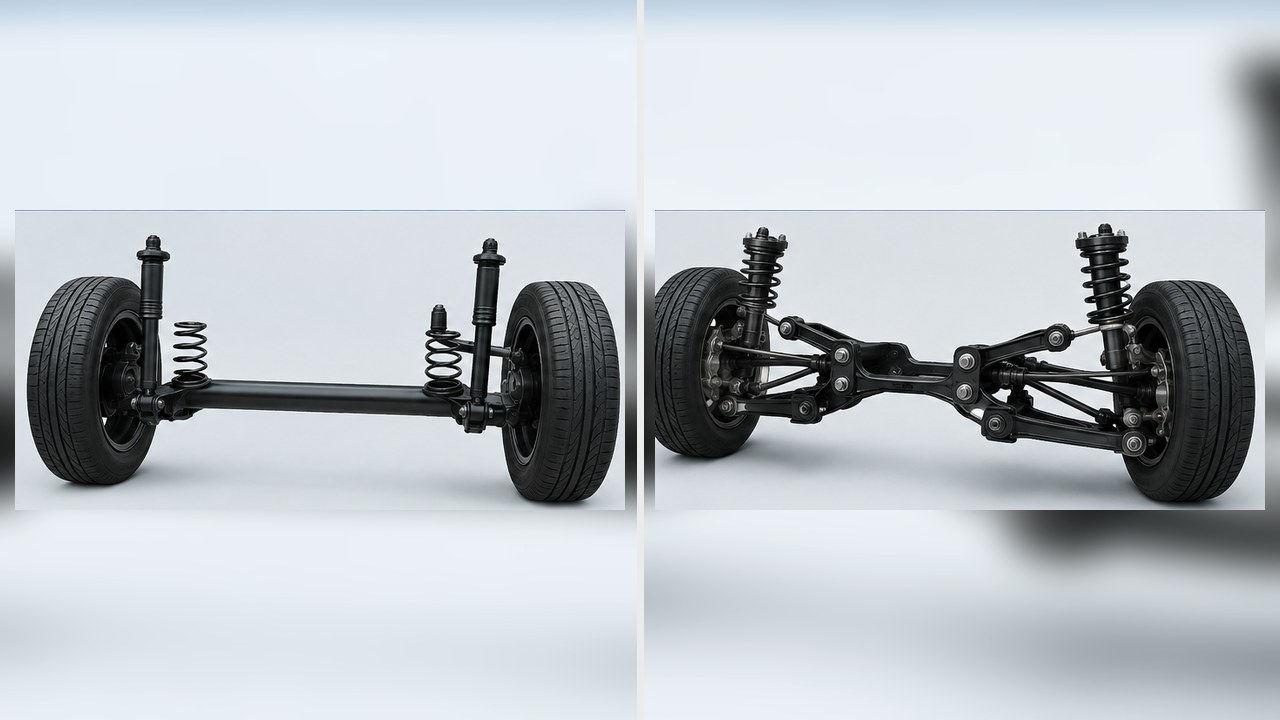
Multi-link suspension generally offers better wheel isolation and more control over camber, toe, and suspension geometry, while a torsion beam is simpler, cheaper, and more compact. For maximum ride refinement and chassis-tuning flexibility, multi-link usually has the advantage. For an affordable everyday car where cost, space, durability, and simplicity matter more, a well-designed torsion beam can work extremely well.
That does not mean every multi-link car handles or rides better than every torsion-beam car. Tires, springs, dampers, bushings, alignment, body stiffness, wheelbase, and the quality of the complete suspension tune can matter more than the basic rear-suspension layout.
Torsion Beam vs. Multi-Link: Quick Comparison
| Factor | Torsion Beam | Multi-Link |
|---|---|---|
| Wheel movement | Semi-independent | Usually independent |
| Parts count | Lower | Higher |
| Manufacturing cost | Usually lower | Usually higher |
| Packaging | Simple and space-efficient | Requires more links and mounting points |
| Camber and toe control | More limited | Much greater tuning freedom |
| Ride isolation | Good when well tuned | Usually greater potential |
| Handling potential | Can be excellent | Greater geometry flexibility |
| Maintenance complexity | Usually lower | More bushings, joints, and links |
| Rear alignment adjustment | Often limited or fixed | May offer more adjustment, depending on design |
| Best fit | Cost-conscious and space-efficient vehicles | Performance, premium, and refinement-focused vehicles |
The important distinction is that these are engineering trade-offs rather than quality grades. A torsion beam is not automatically a “bad” suspension, and multi-link is not automatically a guarantee of better road behavior.
What Is the Main Difference?
A torsion-beam rear suspension connects the left and right wheel-carrying arms through a cross beam. The beam can twist when one wheel moves differently from the other, so the wheels have some freedom to move separately, but they are not fully independent.
That is why torsion beam, also called twist beam, is normally described as a semi-independent suspension.
A multi-link suspension instead uses several individual links to locate each wheel. On a typical independent rear multi-link system, movement at one wheel does not mechanically require the opposite wheel to follow it through a connecting beam.
Those separate links also give engineers more freedom to determine how the wheel’s camber, toe, and position change through suspension travel. Our guide to multi-link suspension explains how those individual links work in more detail.
How a Torsion Beam Works
A typical torsion-beam setup has a trailing arm on each side of the vehicle connected by a transverse beam. Each wheel is attached near the end of its trailing arm.
When both rear wheels rise or fall together, the beam largely moves with the trailing arms. When only one wheel moves, the cross beam twists. Its resistance to twisting contributes to the suspension’s roll stiffness and links the behavior of the two sides.
This arrangement performs several functions with relatively few parts. It can locate the rear wheels, provide a degree of roll resistance, and leave much of the area around the suspension free of multiple individual control links.
The simplicity is a major reason manufacturers continue to use torsion beams even when more sophisticated independent designs are available.
How Multi-Link Is Different
Multi-link takes almost the opposite approach. Instead of connecting both sides through one twistable beam, several arms locate each wheel independently.
The lengths, angles, pivot points, bushings, and stiffness of those links can be chosen to influence how the wheel responds to vertical, lateral, and longitudinal forces.
This means engineers can pursue specific camber and toe behavior during cornering, braking, acceleration, and suspension compression without relying on the characteristics of one transverse beam.
The price for that freedom is additional hardware. A multi-link system requires more arms, bushings or joints, mounting points, fasteners, and often a more complicated subframe.
Which Has Better Ride Quality?
Multi-link generally has greater potential for ride isolation, especially when one rear wheel hits a bump that the other does not.
Because the wheels in a torsion-beam suspension are connected by the cross beam, movement on one side can influence forces at the other side. On uneven surfaces, this can transmit more disturbance through the rear suspension than a fully independent design.
Multi-link allows the two wheels to react more independently. Engineers can also use individual link geometry and bushing compliance to control how different types of impact reach the body.
But suspension architecture alone cannot predict comfort. A softly tuned torsion beam with appropriate tires and dampers can be more comfortable than a stiffly tuned multi-link setup designed around performance.
Spring rates, shock calibration, tire sidewalls, wheel size, suspension travel, seats, and body stiffness still play major roles in what occupants actually feel.
Which Handles Better?
Multi-link provides the higher theoretical ceiling for suspension-geometry control. Its individual links give chassis engineers more freedom to manage camber and toe as the body rolls and the wheel travels through its range of motion.
That can be especially valuable when tire contact and predictable rear-wheel behavior under high cornering loads are major priorities.
A torsion beam has fewer geometric variables available. The relationship between its trailing arms, cross beam, mounting points, and bushings largely defines how the rear wheels behave.
Yet that does not prevent a torsion-beam vehicle from handling very well. Engineers can tune beam stiffness, bushing characteristics, springs, dampers, anti-roll behavior, alignment, tires, and the rest of the chassis to produce sharp and predictable handling.
The better conclusion is therefore not “multi-link handles well and torsion beam handles badly.” Multi-link simply gives engineers more independent variables to work with.
Why Camber and Toe Matter
Camber describes the inward or outward tilt of a wheel when viewed from the front or rear. Toe describes whether the wheels point slightly inward or outward when viewed from above.
Both can change as suspension components move and flex under load.
In a multi-link design, engineers can position the individual arms to deliberately influence these changes during cornering and suspension travel. This gives them considerable control over how the tire meets the road.
A torsion beam has less freedom because the movement of its trailing arms and the twist of the connecting beam constrain the geometry. Manufacturers can still tune the design, but the available choices are more limited.
Which Is Better Over Potholes and Rough Roads?
When only one rear wheel encounters a pothole or sharp bump, a multi-link suspension generally has an advantage because that wheel can react with less direct mechanical influence on the wheel opposite it.
With a torsion beam, the cross beam twists during unequal wheel movement. The system is still far more compliant than a completely rigid connection, but the two sides remain mechanically related.
This difference becomes more noticeable on roads where left and right wheels frequently encounter different surface heights.
On smoother roads or bumps affecting both rear wheels similarly, the practical difference may be much less obvious to the driver.
Why Manufacturers Still Use Torsion Beams
If multi-link offers greater tuning freedom, it may seem surprising that torsion beams remain so common. Vehicle development, however, involves cost, weight, space, production complexity, durability, and interior packaging as well as maximum suspension sophistication.
Fewer Components
A torsion beam can locate both rear wheels using far fewer individual links and joints than a typical multi-link arrangement.
That reduces parts count and the number of mounting points that must be manufactured and assembled.
Lower Cost
Fewer parts and simpler assembly usually make torsion-beam suspension cheaper to manufacture.
That saving can be important in compact and mainstream cars where buyers may value purchase price, cargo space, fuel economy, or standard equipment more than the last degree of rear-suspension tuning freedom.
Efficient Packaging
Without multiple individual control arms extending in different directions around each wheel, a torsion beam can leave useful space around the rear floor and suspension.
The exact packaging advantage depends on the vehicle because the cross beam itself still occupies space. But the basic architecture can simplify the area around the rear suspension compared with a complex independent layout.
Straightforward Durability
Fewer bushings and joints also mean fewer individual wear points.
A torsion beam is not maintenance-free, and its bushings, wheel bearings, springs, dampers, and other components can still wear. The architecture is simply mechanically less complicated than a multi-link system containing several locating links per wheel.
Why Manufacturers Choose Multi-Link Instead
Multi-link becomes more attractive when suspension refinement and chassis behavior justify additional complexity.
A manufacturer may choose it to gain better control over rear-wheel camber and toe, improve the isolation of one-wheel impacts, manage compliance in different directions, or provide the chassis team with more tuning options.
Those characteristics are valuable in premium cars, performance models, larger vehicles, and any application where rear-suspension behavior plays a major role in the vehicle’s intended character.
However, fitting more links does not by itself create better suspension. Geometry and calibration still determine whether the additional complexity is actually used well.
Which Suspension Takes Up More Space?
Multi-link usually requires more separate attachment points around each wheel and may need a substantial rear subframe to support them.
This can complicate the space available for the cargo floor, fuel tank, exhaust system, battery components, electric motors, or other hardware.
A torsion beam consolidates much of the wheel-locating function into the trailing arms and cross beam, reducing the need to position multiple links around the wheel.
That does not mean torsion beam always produces a larger trunk or that multi-link always compromises interior room. Modern vehicle platforms are engineered around their suspension from the beginning, and packaging depends on the complete chassis.
Is Torsion Beam Lighter Than Multi-Link?
A torsion-beam assembly can often achieve its function with fewer components, which creates the potential for a relatively light and simple system.
But the exact weight comparison depends on the beam construction, control arms, subframes, wheel carriers, links, materials, springs, dampers, and the loads each system was designed to carry.
It is therefore safer to say torsion beam has a parts-count and simplicity advantage rather than claiming that every torsion-beam suspension weighs less than every multi-link suspension.
Which Is Cheaper to Repair?
Torsion beam usually has an advantage in repair complexity because there are fewer links, joints, and bushings to inspect.
A multi-link rear suspension may contain several individual control arms on each side. As mileage increases, bushings or joints in those arms can wear individually, potentially requiring several separate repairs.
Actual repair cost still depends on the vehicle. Some manufacturers sell inexpensive individual links, while others package bushings with complete arms or use specialized components that increase parts and labor costs.
A damaged torsion beam can also be expensive if the complete axle assembly requires replacement. Simpler architecture does not guarantee that every possible repair will be cheap.
Which Is Easier to Align?
Many torsion-beam rear suspensions have relatively little factory adjustment for rear camber and toe. Their geometry is largely established by the beam, wheel mounting points, and body attachment locations.
If measurements are substantially outside specification, the cause may be worn mounting components, collision damage, a bent beam, wheel damage, or another mechanical problem rather than an adjustment that can simply be corrected at the alignment rack.
Multi-link systems often provide more opportunities for geometry adjustment, although this varies significantly by vehicle. Some still use fixed links for certain angles.
More adjustability is useful when available, but it also means more components whose condition can influence alignment.
Is Multi-Link Better for Performance Cars?
When maximum chassis-tuning flexibility is a priority, multi-link normally gives engineers more options.
They can shape rear-wheel geometry and compliance according to the forces produced during cornering, braking, and acceleration. That makes the architecture attractive for cars expected to operate under high lateral loads.
But torsion beam should not be dismissed as incapable of performance use. A carefully developed torsion-beam chassis can deliver strong grip, fast responses, and predictable behavior.
Once again, the architecture defines the available engineering tools. It does not determine the quality of the finished car.
Which Is Better for Everyday Driving?
For normal commuting, shopping, highway driving, and occasional enthusiastic driving, either design can work extremely well.
A torsion beam can provide perfectly good comfort and handling while reducing vehicle cost and mechanical complexity. Most drivers are unlikely to identify the rear suspension architecture during ordinary driving without comparing two otherwise very similar vehicles.
Multi-link becomes more valuable when the manufacturer uses its additional tuning freedom to produce better isolation on uneven surfaces, tighter control during aggressive driving, or a specific balance between comfort and handling.
If choosing between two cars, drive the actual vehicles rather than assuming the one with multi-link suspension must be better.
Torsion Beam Is Not the Same as a Solid Axle
A torsion beam connects the two rear sides, but it should not be confused with the type of rigid driven axle commonly found under trucks and off-road vehicles.
The cross beam in a torsion-beam suspension is deliberately able to twist, allowing a degree of independent wheel movement. A conventional solid axle keeps both wheels connected through a rigid axle housing.
This is why torsion beam is usually classified as semi-independent rather than fully dependent. For the broader distinction between connected and independently moving wheel systems, see our solid axle vs. independent suspension comparison.
Torsion Beam Is Also Not the Same as Torsion Bar Suspension
The similar names cause confusion, but torsion beam and torsion bar describe different things.
A torsion beam is a rear-suspension architecture in which the two trailing arms are connected by a beam that twists during unequal wheel movement.
A torsion bar suspension uses a spring element that supports vehicle weight by twisting a long metal bar instead of compressing a coil spring.
A search for “torsion bar vs. multi-link” therefore mixes a spring type with a wheel-locating suspension architecture and should not be treated as the same comparison.
Can You Replace a Torsion Beam With Multi-Link Suspension?
Not as a normal bolt-on suspension upgrade.
Multi-link requires different mounting points, wheel carriers, links, subframes, geometry, and often different springs, dampers, brakes, hubs, exhaust routing, and other surrounding components.
Even when two trim levels of a vehicle family use different rear suspensions, that does not mean the complete systems can safely be swapped between them without extensive engineering.
Changing suspension architecture can also affect alignment, electronic stability-control calibration, load paths, braking behavior, and vehicle certification. It should not be treated like replacing shocks or springs.
How to Tell Which Rear Suspension Your Car Has
The safest method is to check the official specification or service information for your exact year, model, drivetrain, and trim because manufacturers sometimes use different rear suspensions within the same vehicle family.
A visual inspection can also reveal the basic layout:
- Torsion beam: look for two trailing arms joined by a substantial transverse beam running across the car.
- Multi-link: look for several separate arms or links connecting each rear wheel carrier to the body or subframe.
Do not crawl under a vehicle supported only by a jack. Use manufacturer-approved lifting points and properly rated supports whenever an underbody inspection is required.
Torsion Beam Pros and Cons
Advantages
- Simple architecture
- Relatively few components
- Usually inexpensive to manufacture
- Fewer bushings and joints than multi-link
- Space-efficient packaging
- Can be durable and inexpensive to maintain
- Can provide very good road handling when properly engineered
Disadvantages
- Left and right rear-wheel behavior is partially connected
- Less freedom to control camber and toe through suspension travel
- Lower potential for one-wheel bump isolation
- Rear alignment adjustment is often limited
- Fewer geometry variables available to chassis engineers
Multi-Link Pros and Cons
Advantages
- Independent wheel movement in typical passenger-car applications
- Greater control over camber and toe
- More freedom to tune compliance in different directions
- Excellent ride-isolation potential
- High chassis-tuning and handling potential
- Can combine comfort with precise wheel control
Disadvantages
- More links, bushings, joints, and mounting points
- Greater manufacturing complexity
- Usually more expensive
- More potential wear points
- Can complicate packaging around the rear suspension
- More sophisticated architecture does not guarantee better tuning
So, Is Torsion Beam or Multi-Link Better?
Multi-link is generally the better architecture when maximum ride isolation, wheel-geometry control, and suspension-tuning flexibility are the priorities. Torsion beam is generally better when simplicity, cost, durability, and efficient packaging matter more.
That makes multi-link attractive for premium, performance, and refinement-focused vehicles, while torsion beam remains a sensible engineering solution for many compact and mainstream cars.
The distinction should not become a shortcut for judging the entire vehicle. A well-engineered torsion-beam car can ride and handle better than a poorly developed multi-link car.
When buying a car, the suspension specification tells you what architecture the engineers started with. The test drive tells you how successfully they used it.
Frequently Asked Questions
Is multi-link suspension better than torsion beam?
Multi-link generally offers greater control over wheel geometry and better potential for isolating one-wheel impacts. Torsion beam is simpler, cheaper, and uses fewer components. Which is better depends on whether refinement and tuning flexibility or cost and simplicity are the greater priority.
Does torsion beam suspension handle badly?
No. Torsion-beam suspension can provide excellent handling when properly engineered. Its limitation is not an inability to handle well, but that engineers have fewer independent geometry variables available than with a multi-link system.
Is torsion beam suspension independent?
Torsion beam is normally classified as semi-independent. The two sides are connected by a beam, but that beam can twist when one wheel moves differently from the other.
Are twist beam and torsion beam the same?
The terms are commonly used for the same basic family of rear-suspension designs: two trailing arms joined by a transverse beam that twists during unequal wheel movement.
Does multi-link suspension ride better?
It generally gives engineers more freedom to isolate wheel impacts and tune compliance, so it has greater ride-refinement potential. Actual comfort still depends heavily on springs, dampers, tires, bushings, wheel size, and overall chassis tuning.
Why do cheaper cars use torsion beams?
Torsion beams use relatively few components and can be inexpensive, durable, and space-efficient. Those advantages make them particularly attractive in vehicles where keeping cost and complexity under control is more valuable than maximizing suspension-geometry adjustment.
Which suspension is cheaper to maintain?
Torsion beam usually has fewer joints and bushings, so there are generally fewer individual suspension wear points. Actual repair cost depends on the vehicle and the component that needs replacement.