Coilover Spanner Wrench: Find the Right Size & Type
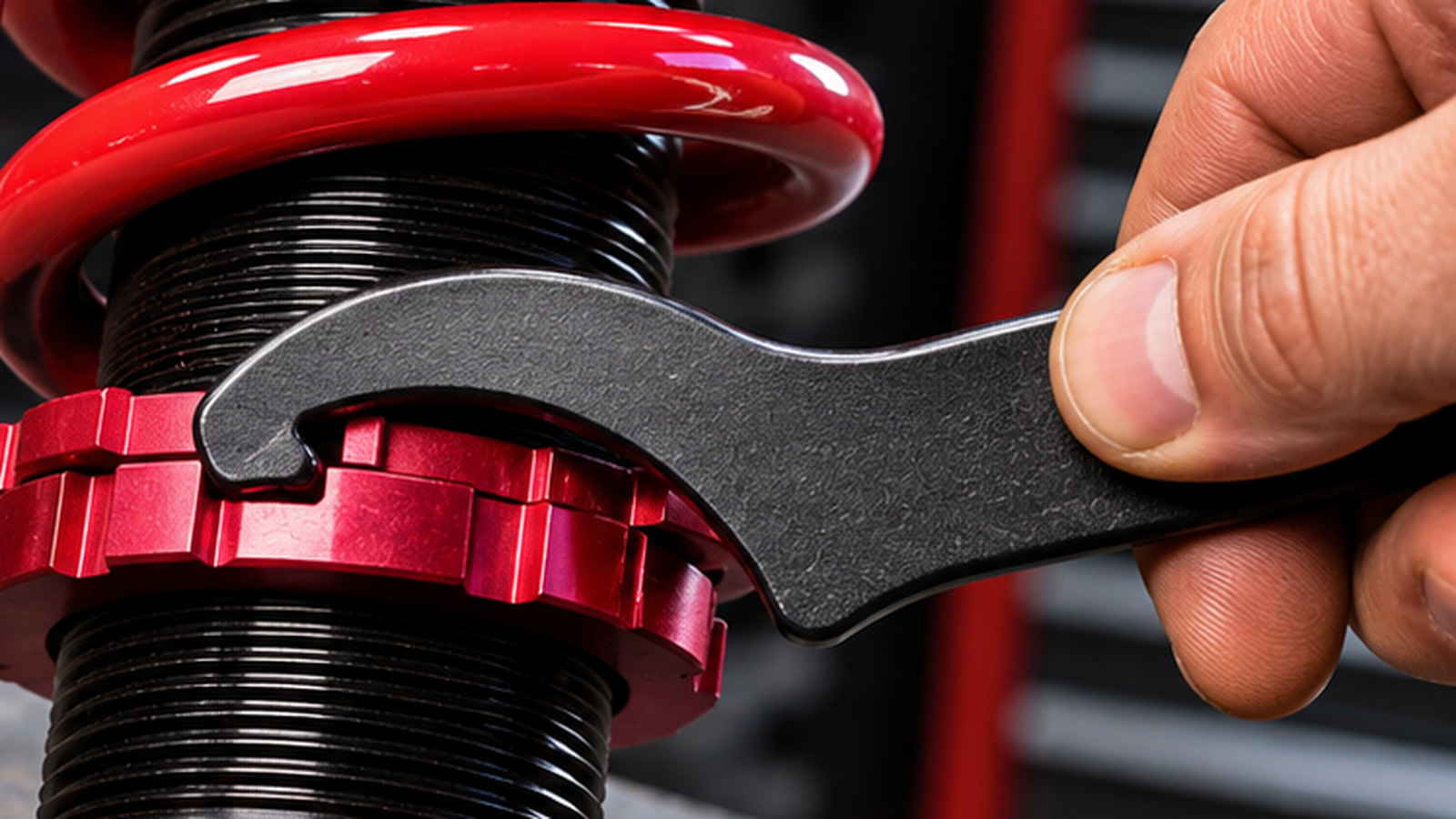
A coilover spanner wrench is the hook- or pin-style tool used to grip a coilover’s adjustment collar without crushing its edges. If you know your coilover brand and model, buy the wrench or wrench pair specified for that kit. If the original tools are missing, identify the ring style and measure the collar before choosing a replacement. A six-piece “universal” set is only a bargain if at least one wrench actually seats in your rings.
For a typical notched collar, look for a C-shaped hook that fully engages the notch and follows the ring’s diameter. A collar with drilled holes may need a pin spanner instead. Check the spring-seat ring and the lock ring: they can be different sizes. Clearance around the tire, brake lines and shock body matters too. The right size on paper is not enough if you cannot get the handle onto the collar.
This is a tool-selection guide, not instructions to change spring preload. There is a difference between loosening a lock ring on an approved adjustable coilover and dismantling a compressed spring assembly. Start by confirming which operation your specific suspension allows.
Which Coilover Spanner Wrench Should You Buy?
The quickest shopping decision is usually between an exact replacement, a properly matched fixed wrench and an adjustable tool. Each solves a slightly different problem. Use this as a buying filter, then verify the exact collar dimensions or manufacturer part number.
| Your situation | Best starting point | What can go wrong |
|---|---|---|
| You still have the kit instructions or part number | Original manufacturer wrench or approved replacement pair | Another series from the same brand may use different collars |
| One known notched ring size | Fixed hook / C-spanner with matching arc and hook | A loose hook can chew up the notch or slip |
| Several notched coilovers to service | Documented multi-size hook set | The listed size range may not match the actual arc or hook |
| Collar with round pin holes | Correct-size pin spanner | The pin may be too large, too small or wrongly spaced |
| Several different pin-hole collars | Adjustable or variable-pin wrench | Wide advertised capacity does not guarantee usable access |
| Tight wheel-well or racing application | Slim or short-handle wrench designed for that collar | A long handle can be blocked by the tire, arm or chassis |
| Two locking collars that must counterhold | Matched pair of appropriate wrenches | One wrench may not fit both ring diameters |
If you can take only one measurement before ordering, measure the collar’s outside diameter at its body and note whether it uses notches or holes. Better yet, find the kit’s original tool part number. The ring, not the car’s badge, determines whether the wrench engages.
Identify the Collar Before Choosing the Tool
From a distance, coilover collars can look like a stack of identical aluminum nuts. Up close, their shapes and jobs differ. The wrong wrench can damage the part even if it fits over the shock body.
Notched Rings Need a Hook That Fully Seats
The familiar coilover C-spanner has a curved jaw and a hooked tooth at one end. The tooth catches a notch or slot along the outer edge of the threaded adjustment ring. The curve should follow the collar closely enough that pressure stays on the intended notch, not on a fragile corner.
An almost-fitting wrench is often worse than an obviously wrong one. If the hook barely touches the ring and rocks sideways when hand pressure is applied, it is not properly engaged. A wide notch may accept several hooks, but that does not mean those hooks all provide a secure bearing surface.
Pin-Hole Collars Need a Different Contact Point
Some shock nuts have drilled holes or pockets rather than exposed edge notches. Those call for a compatible pin-style wrench. You need the correct pin diameter, the right spacing or adjustable range, and enough depth for the pin to seat without bottoming against the shock body.
Do not confuse a face spanner that uses two pins on the top face of a nut with a single-pin hook wrench that acts around its circumference. Both are sold as spanners, but their working ends are different. A pin tool bought for a pulley may or may not fit a coilover collar.
Spring Perch, Lock Ring and Lower Mount Can Look Similar
The spring perch supports the spring. An adjacent locking collar secures it, while some full-length adjustable systems have another locking ring at the separate threaded lower mount. Depending on the kit, these may use different diameters or notch patterns. A small “adjustment wrench included” label does not prove that one tool fits all three.
The distinction is mechanical, not just vocabulary. Our guide to setting coilover preload explains which ring does which job and how preload differs from an independently adjustable lower mount. Keep the actual adjustment procedure there; here the goal is selecting a tool that fits the intended ring.
How to Measure Coilover Spanner Wrench Size
You do not need to guess from a vehicle make or an online photograph. With the suspension secure and the collar accessible, compare the existing ring to the wrench specification. Use a caliper when possible and record the figures in the same units used by the manufacturer.
Start With the Ring Outside Diameter—not the Shock Body Diameter
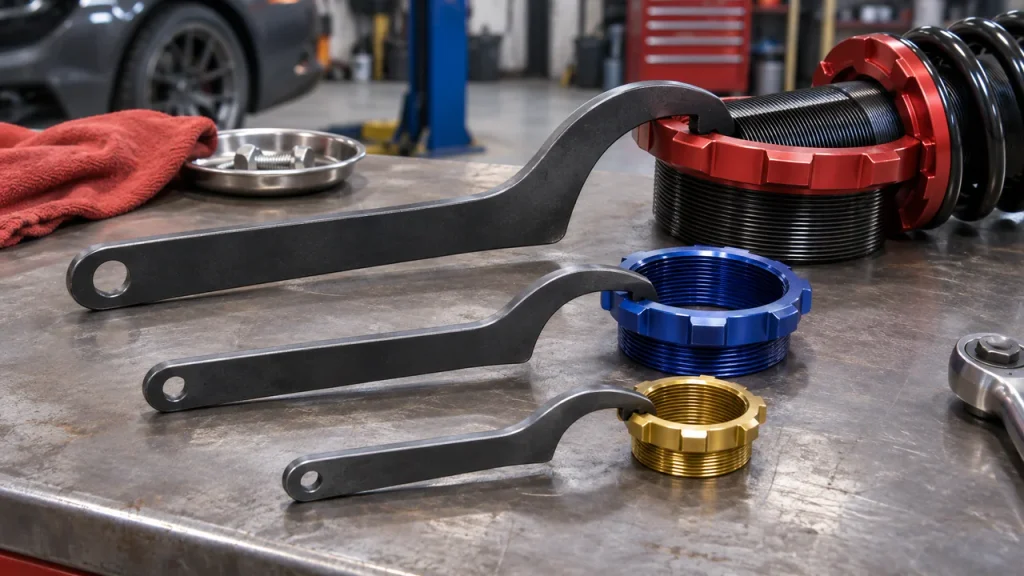
Measure straight across the outer body of the adjustment ring. A collar advertised as 75 mm or 3 inches is not necessarily fitted with a wrench of that exact nominal designation; brands may identify hook-spanner sizes by a usable diameter range, nominal shock body size or their own tool code. Read what the number refers to.
Do not measure the outside of the coil spring and call that the spanner size. Nor should you assume a wrench sold for “2.5-inch coilovers” fits every shock with a 2.5-inch body. Those names can refer to different dimensions and product families.
Match Notch Width, Tooth Shape and Collar Thickness
Two rings of equal outside diameter can have completely different slots. One may have deep, square-edged recesses; another uses narrow cuts in a thin aluminum locknut. The working tooth must fit the opening and contact enough material to transmit load without gouging the edges.
Also compare the thickness of the wrench head with the space between the collars or surrounding components. TEIN, for example, specifies a relatively slim 6 mm wrench on its SST01-K0335-B tool. A thicker general-purpose wrench may match the diameter and still be impossible to slide into the gap.
Check Swing Clearance Before Buying a Long Handle
Imagine the handle at the only position where its hook engages. Can it move a few degrees without striking the tire, sway bar, lower control arm or body? Some coilovers are easy to work on when removed and awkward when installed. A short wrench offers access but less leverage; a long one may give leverage you cannot use.
A square-drive spanner head can help with reach on certain designs, but it is not automatic permission to add a breaker bar or apply whatever torque you can generate. The collar material and maker’s tightening procedure still set the limits.
Record Four Details Before Shopping
A photograph with a ruler next to the rings is useful, but do not let a blurry picture substitute for the actual measurements. Record the following before placing an order:
- Collar outside diameter: measure the ring itself and note millimeters or inches.
- Engagement type: edge notch, single pin pocket, two-pin face holes or a special proprietary shape.
- Tooth or pin fit: notch width and depth, or pin-hole diameter and spacing where relevant.
- Access and quantity: wrench-head thickness, room to swing the handle, and whether a second size is needed for the lock ring.
For a replacement tool ordered online, send these details plus the coilover model number to the seller. If they can answer only “universal fit,” keep looking.
Fixed Hook, Adjustable, Pin and Drive-Style Spanners
These are not interchangeable names for one tool. Their differences become obvious when the collar is recessed, worn, or smaller than a general-purpose wrench can grip.
Fixed Hook Spanner: Best When the Ring Size Is Known
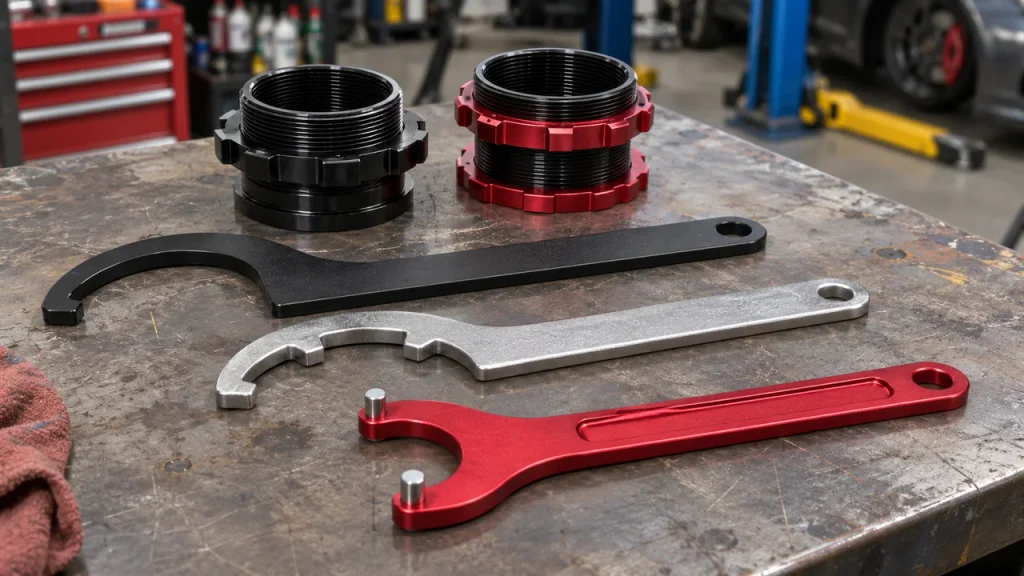
A fixed hook has a defined curvature and working tooth. On a matching ring, it can feel reassuringly positive: the hook settles into the notch without needing an adjustable jaw to be positioned first. That is why many coilover manufacturers include a simple pair of fixed spanners with their kits.
Its weakness is narrow compatibility. A fixed wrench can be excellent on one ring and useless on a second coilover that looks almost identical. If you are servicing only your own car, exact fit matters more than how many nominal sizes a listing claims to cover.
Adjustable Hook Wrench: Useful Range, Not Guaranteed Fit
An adjustable C-spanner changes its effective opening or hook position. For a workshop handling several collars, that can be convenient. But the minimum and maximum sizes are not enough: the hook needs the right profile and the adjustable joint must stay stable under the permitted hand force.
Look for a clearly stated working range and a drawing of the contact end. An adjustable hook that rides high on a shallow notch can still damage the collar. It should not have to be twisted sideways to make contact.
Pin Spanner: Confirm Whether It Uses One Pin or Two
A single pin on a curved head engages one circumferential hole. A variable-pin wrench may use two replaceable pins facing the work. Both appear in search results for “coilover wrench,” yet neither will reliably turn an edge-notched collar just because its advertised range includes the collar diameter.
Harbor Freight’s MADDOX variable-pin spanner, for instance, is cataloged primarily for pulley and nut applications with pin holes. It has an adjustable range and interchangeable pins, but those facts alone do not establish compatibility with a particular coilover ring. Buy it only after confirming the contact geometry.
Ratcheting and Square-Drive Heads: Check the Approved Use
Some specialist spanners include a square-drive opening for a ratchet or other approved handle. They can be easier to position in tight spaces and may reduce the need to remove a wheel for access. They do not eliminate the need to keep the working tooth squarely seated.
A square-drive hole is a convenience feature, not a torque specification. If the collar manufacturer provides a defined tightening method, use that method. Do not infer that a 1/2-inch drive opening means a breaker bar or impact wrench is appropriate.
Manufacturer Examples: TEIN, BC Racing, QA1, Bilstein and ICON
Brand names are useful for finding a replacement wrench, but no brand-wide fitment claim is reliable without a specific tool number. These examples show why collar design, model family and accessories matter more than logo matching.
TEIN SST01-K0335-B: Multiple Arcs and a Slim Profile
TEIN lists the SST01-K0335-B as a two-piece adjust-wrench set. Its US product page describes chromium-vanadium alloy steel, a 6 mm-thick design, a 1/2-inch drive opening, a 17 mm hex feature and compatibility across specified spring-seat outer diameters of 70–150 mm. That wide range belongs to this named product; it is not a universal measurement for all TEIN or aftermarket rings.
For the manufacturer’s original details, see TEIN’s adjust-wrench specifications. Before purchasing, compare its package fitment chart against your exact coilover series, including any lower-body lock rings.
BC Racing: Find the Correct Wrench Group
BC Racing sells replacement spanner groups, including separately named groups rather than one unspecified universal wrench. That matters if the originals were lost after the coilovers changed hands. A wrench from one group may not have the same arc and tooth shape as the pair supplied with another kit.
Locate the series and part information before ordering. A used coilover set can have replacement collars or an updated locking-ring design, so comparing photos and measurements remains worthwhile even after finding a familiar brand name. Damaged, worn-down tips are a reason to replace a wrench rather than force it.
QA1: Wrench Sets and Different Shock Families
QA1 lists tools such as the T114W spanner set and T115W drive-compatible wrench set for specified products. Its shock application literature sometimes calls out the exact wrench part number. That is much more useful than a retailer claim that a tool “fits most coilovers.”
QA1 also sells other wrench styles for specialized shock lines. Do not order a T114W solely because a photograph shows a QA1 shock; verify the model and ring design. The same caution applies when a part description says “pair”—check whether it contains two differently sized pieces or the same type twice.
Bilstein, FOX, King and ICON: Off-Road Collars Differ
Bilstein offers a two-piece hook-type spanner kit identified as 13-337759 for specified applications. FOX and King suspension tools can vary with shock family and body size, particularly on larger off-road coilovers. Do not assume that a wrench fitting one 2.5-inch shock will automatically fit a different manufacturer’s 2.5-inch unit.
ICON’s 198001 two-pin preload tool is a useful example of a design made around a specific adjustment system. It incorporates 3/8-inch dowel contact points, a small Allen-key feature for a collar set screw and measurement markings. Those features are helpful when they match the actual ICON assembly; they are not a reason to use its pins on an unrelated ring.
Racing and Universal Tools: Look Beyond the Color
JOES Racing lists a coilover wrench for nuts approximately 3–3.5 inches in diameter, with an aluminum handle and replaceable steel pin. That is a defined application dimension, not a guarantee that every racing coilover uses that collar. Short and long handle versions solve different access problems.
Anodized aluminum, polished steel and plastic-coated handles all appear in the market. Their color and weight tell you little about whether the tool’s actual contact tip is compatible. Fit comes first, build quality second.
Lost the Original Coilover Wrenches? Use This Order
Losing the included spanner set is common, especially when a car is sold with already-installed coilovers. It is tempting to order the first inexpensive set that shows up under “coilover wrenches.” A short bit of identification work usually saves a return—or a damaged lock ring.
- Find the shock brand and exact series. Read the body label, paperwork, etched part number or installation invoice.
- Photograph every threaded ring. Include the spring perch, locking collar and any lower mount or separate locking ring.
- Ask the manufacturer for the original wrench part number. It is the best starting point when the rings are original.
- Measure ring OD and engagement geometry. Do this before trying a generic hook or pin tool.
- Check what the package includes. One wrench, two differently sized spanners and a multi-piece set are not the same purchase.
- Inspect the condition of the rings. Rounded notches or corroded threads may need professional assessment, not more leverage.
If the previous owner fitted a different spring seat or aftermarket locking collar, model identification alone may not solve the problem. In that case, measure the replacement hardware and ask the component supplier for its intended tool. Never choose a hook only because its tip can catch one corner of a slot.
Do You Need One Coilover Spanner Wrench or a Pair?
The answer depends on the locking arrangement. Two adjacent collars are frequently secured against one another, which can make a second wrench useful or required by the manufacturer. Other systems have a single ring retained by a screw or clamp, and some lower height adjusters use a different ring size.
A Lock Ring May Need to Be Held While Another Turns
On many threaded-perch designs, one spanner engages the spring seat and another engages the neighboring locknut. The two tools may need different hook arcs or teeth. Buying two identical wrenches without checking both diameters is an easy mistake; so is buying just the larger one when the kit specifies a pair.
Conversely, a two-wrench package does not mean the two tools should always be used at once. The correct service sequence is specific to the assembly. Consult the instructions before moving a loaded collar.
A Lower Mounting Bracket May Use Another Size
Full-length adjustable coilovers can have a threaded lower bracket that is locked in position independently of the spring seat. Some packages provide a dedicated smaller or larger wrench for this area. Not every coilover has this feature, and changing its position is not the same as adding spring compression.
A wrench set that fits both spring rings but not the lower mounting lock is incomplete for that particular kit. Compare the working ends before checkout, rather than assuming “two-piece” means every adjustment point is covered.
What Makes a Good Spanner—and What Does Not?
A clean, secure fit can matter more than the biggest handle in the store. Once the tooth shape and diameter are correct, these practical details distinguish a useful shop tool from one that lives in the drawer.
Steel, Aluminum and Replaceable Contact Tips
Steel hooks are durable when properly made and can be comparatively thin for a given design. Aluminum wrenches are light and pleasant to handle, and some use replaceable steel contact pins. Neither material is automatically superior; the geometry, finish, quality control and intended duty are more informative.
Look closely at the working tooth. Poor stamping, burrs, uneven thickness or a thin, blunt hook can damage an aluminum ring. A replaceable pin is convenient only if replacement parts are actually available and the pin matches the collar.
Grip and Length: Enough Control Without Improvisation
A broad, comfortable handle helps keep steady pressure. A narrow stamped wrench can be perfectly adequate on an easy ring but unpleasant when used repeatedly. Longer handles create more leverage and demand more room to swing, so they are not automatically the best choice on an installed street car.
Avoid pipe extensions and other improvised leverage. If the collar will not move with the procedure and tool specified by its manufacturer, investigate why rather than continuing to increase force.
A Tool Should Not Damage the Collar to Prove It Fits
The notch is a working surface, not sacrificial metal. If the wrench leaves curled aluminum, polished gouges or fresh burrs with ordinary approved use, something is wrong with the engagement, the tool condition or the ring. Stop before the ring becomes unusable.
Keeping the tool head clean also matters. A pocket of grit between a steel hook and a soft adjustment ring can behave like an abrasive, even if both pieces are otherwise correctly sized.
Why a Coilover Spanner Slips or the Collar Will Not Turn
A wrench that jumps out of the notch is not merely annoying. It can injure your hand, round off a ring and make the next attempt harder. Treat slipping as a fit or hardware warning, not a reason to swing harder.
The Arc or Hook Does Not Sit Squarely
A wrench may touch the right notch but approach at an awkward angle because the spring, tire or chassis is in the way. Or the tool may be one size too large, so the hook catches only the corner of the recess. Test engagement without force before doing anything else.
If you cannot seat the wrench properly with the vehicle assembled, the safe answer may involve the manufacturer’s prescribed access procedure or a qualified shop. Turning the tool sideways to clear a brake hose is not a compatible fit.
Dirt, Corrosion and Damaged Threads Create Resistance
Road grit collects on exposed coilover threads. Corrosion can further increase resistance, especially when dissimilar metals and poor maintenance are involved. A seized collar can feel like a wrench problem when the real issue is damaged or dirty adjustment hardware.
Follow the coilover maker’s cleaning and lubrication guidance, including whether its collars, set screws or finishes permit a particular product. Never use impact blows to defeat a stuck collar or assume a penetrating oil makes a damaged ring safe to force.
A Locking Screw May Still Be Engaged
Some systems use a small set screw or another locking mechanism in addition to or instead of jammed collars. A spanner cannot overcome a fastener that is still locking the ring without risking damage. Identify the actual retention method from the product instructions before applying force.
A hammer and punch is sometimes suggested online as a substitute for a hook spanner. It concentrates force on a small edge, can deform the notch and may make the ring jump unexpectedly. It is not a sensible substitute for a correctly fitting wrench, especially around a loaded spring.
A Spanner Wrench Is Not a Coil Spring Compressor
The similar names cause a dangerous mix-up. A coilover spanner changes the position of a threaded ring on a system designed for that adjustment. It does not safely contain the energy of a compressed coil spring for disassembly. A spring compressor, where specified, is a separate piece of equipment with its own load and fitment requirements.
Do not loosen the top shaft retaining nut or remove a spring seat merely because you have a coilover wrench in hand. The spring can still be under substantial force with the vehicle lifted. Refer to the exact service manual, and have a properly equipped suspension shop handle work that requires spring removal or specialized compression equipment.
Should You Buy the Wrench or Have a Shop Make the Adjustment?
For an enthusiast who owns adjustable coilovers and expects to maintain the same setup, a correct pair of spanners is a reasonable tool purchase. It is relatively small, useful for future checks and often less costly than paying a shop simply to locate the right tool. The value disappears if you buy several incompatible sets while guessing.
A shop makes more sense when the collars are severely corroded, the original hardware is damaged, the brand cannot be identified or the adjustment requires spring disassembly. If a professional is installing the coilovers anyway, ask whether the quote includes initial ride-height setup and whether the original spanners will be returned with the car. Our coilover installation cost guide separates fitting labor from setup and alignment.
A height change can alter wheel alignment and usable suspension travel. Once the work is completed to the maker’s procedure, check the vehicle’s final geometry rather than assuming that a correctly adjusted collar guarantees a good alignment. Our alignment after suspension work guide explains when measurement is appropriate.
Coilover Spanner Wrench Questions Buyers Ask
Product listings use “C-wrench,” “coilover tool,” “spring perch wrench” and “hook spanner” somewhat loosely. These are the details worth checking before ordering a replacement.
What size spanner wrench do I need for my coilovers?
There is no universal coilover wrench size. Measure the adjustment ring outside diameter, then match the working hook or pin to its notch or hole shape. Also confirm the wrench-head thickness and access around the ring. The manufacturer’s original spanner part number is usually the strongest fitment reference.
Are coilover spanner wrenches universal?
Some are adjustable or sold in multiple-size kits, but “universal” usually means a range of possible applications—not every coilover. Rings can differ in outer diameter, notch width, pin-hole layout and surrounding clearance. Match all of those, not just the advertised diameter range.
Can I use a normal adjustable wrench or channel-lock pliers?
Not as a routine substitute for a correctly fitted spanner. Most coilover collars are round, and conventional jaws may squeeze or mar their edges without stable engagement. If the original tool is missing, identify the ring and purchase a matching replacement instead of gripping it with pliers.
Does Harbor Freight sell a coilover spanner wrench?
Harbor Freight sells pin-style specialty spanners, including the MADDOX variable-pin model. Its published application centers on pulleys and other parts with pin holes, so that does not establish a fit for an edge-notched coilover lock ring. Check the actual pin layout and dimensions before choosing it as a substitute.
Will a BC Racing wrench fit TEIN, Bilstein or QA1 coilovers?
Not on brand alone. Even within one manufacturer, different coilover series can use different collar styles. Compare the exact collar dimensions and the tool’s intended application. A wrench that physically catches a notch is not necessarily the right wrench for safe, repeatable use.
Can I adjust coilover ride height without a spanner wrench?
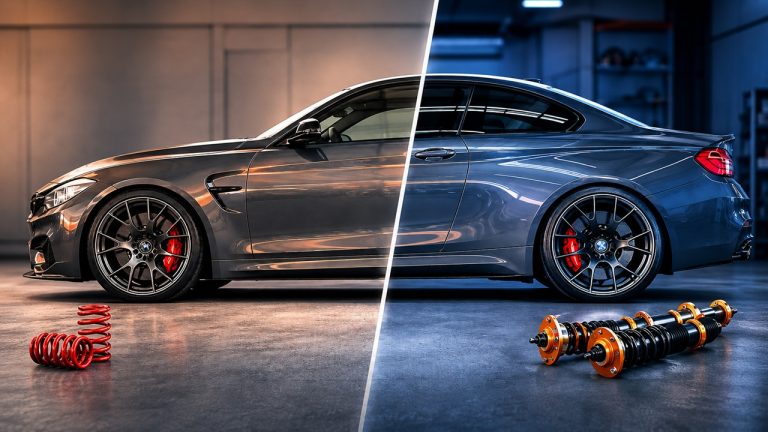
If the assembly uses threaded collars, use the manufacturer-specified adjustment tool. Some suspension systems provide another approved adjustment method, and others have factory-set components that should not be moved. If you are deciding whether you need adjustable coilovers at all, our lowering springs vs. coilovers comparison covers that broader purchase decision.
Can I use an impact wrench with a coilover spanner?
Do not assume so. A square-drive opening or sturdy steel handle does not prove that the wrench or collar is approved for impact loads. Use the tool and tightening method stated by the manufacturer; impact force can damage notches, threads and locking hardware.
Do I need two different spanner wrenches?
Possibly. Spring seats and lock rings can differ in diameter, and a separate lower height adjuster may use another size again. Check whether your kit requires two tools for holding and turning its collars, or provides one wrench and a different locking mechanism. A “pair” listing should state exactly what is included.
Before buying, get the coilover part number, photograph its collars and check the hook or pin against the actual ring—not a generic product illustration. A basic, precisely matched wrench is a better purchase than a complicated set that never sits squarely on the hardware. If the original rings are damaged or seized, solve that issue first; a longer handle will not make the mismatch go away.