Torsion Bar Unloading Tool: Fitment & Safety Guide
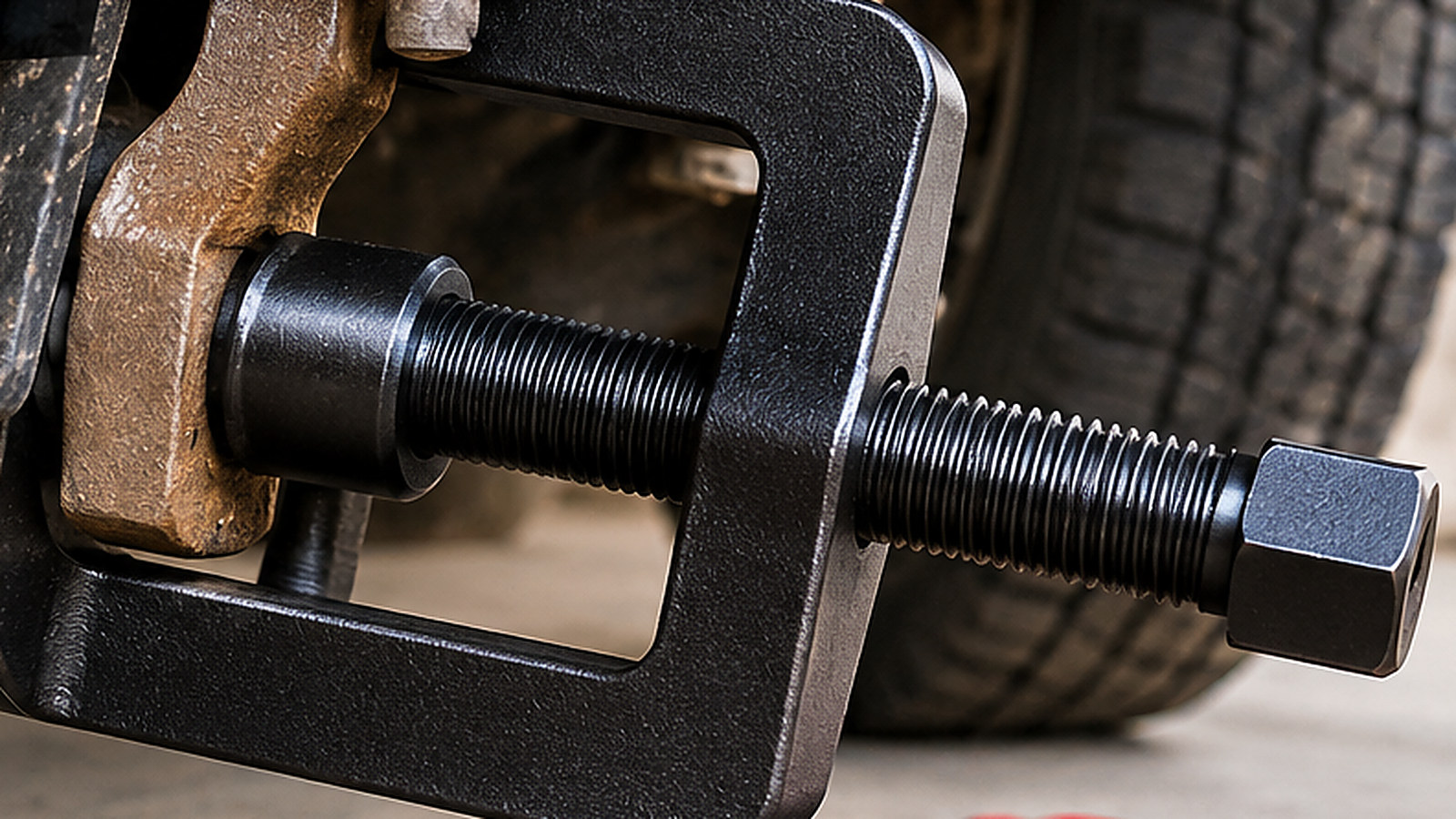
A torsion bar unloading tool is a heavy-duty service clamp that controls the spring force at a torsion key or anchor while that assembly is being serviced. For most GM truck owners, the first buying question is whether the tool reaches the crossmember on their exact model year. OTC 7822A is listed for older GM applications; OTC 7832 is the larger unloader specified for 2011-and-newer GM HD trucks. Those are different tools, not two names for the same universal clamp.
If you have a torsion-bar Ford, Dodge or Hummer, check the contact points and any required adapter before buying a tool advertised for GM. If you only intend to make an ordinary ride-height adjustment, you may not need a key-unloading tool at all. And if the job is pulling a classic Mopar torsion bar out of its socket, that is a different kind of “removal tool.”
Which Torsion Bar Unloading Tool Should You Choose?
Start with the service job and vehicle, not the most impressive-looking C-frame. These are useful examples of manufacturer-described applications; a model year alone is not permission to use a tool without checking its current instructions and the vehicle service manual.
| Vehicle or task | Tool direction to investigate | Important limitation |
|---|---|---|
| Older GM torsion-bar trucks | OTC 7822A or an exact-equivalent GM unloader | OTC lists older GM trucks and applications; confirm chassis and available opening |
| 2011-and-newer GM HD torsion-bar trucks | OTC 7832 or a confirmed later-HD-compatible unloader | A tool intended for the older GM crossmember may lack the required reach |
| Certain older torsion-bar Ford trucks | Ford-specific OTC 7826, 7816 or the specified equivalent | Ford year/series coverage differs between tools; do not treat a GM fit as proof |
| Ford or Dodge using a multi-brand tool | Validated universal tool with the correct contact adapter | The correct adapter may be optional or supplied in a separate vehicle kit |
| One-time service with uncertain future use | Verified loaner/rental tool, if available locally | Check the exact tool number, deposit and return conditions before disassembly |
| Classic Mopar bar stuck in its socket | A bar-extraction tool after the correct unloading procedure | A pulling clamp does not replace a key-load containment tool |
The most expensive mistake is renting a clamp that appears to fit the truck brand but cannot seat squarely against the actual anchor. A closely matched part number and installation sheet tell you much more than “fits most trucks” on a marketplace listing.
What the Unloader Actually Holds
On a common longitudinal torsion-bar front suspension, the bar acts as the spring and transmits load through an anchor key near a crossmember. The key presses against adjustment hardware. During certain repairs the anchor must be held under controlled force so its loaded retainer or adjuster hardware can be serviced according to the factory procedure.
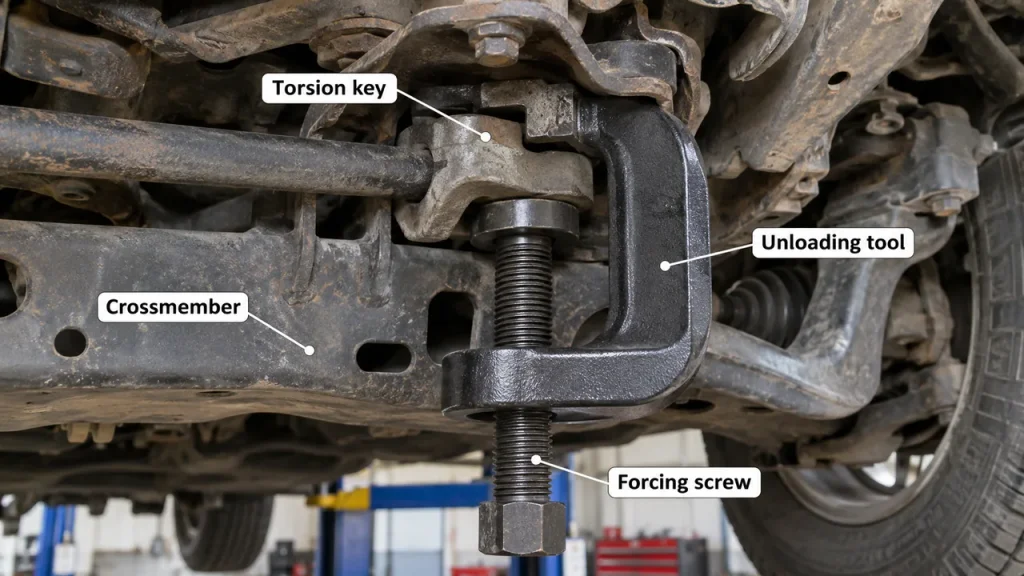
A purpose-built unloader provides a rigid reaction frame and a forcing screw that bears on a specified surface. It is not a lift jack, wheel-alignment tool or replacement for supporting the vehicle. The key point is controlled containment of stored torsion-bar energy; removing hardware before that energy has been managed can release a heavily loaded component. For an explanation of the spring and anchor layout, see our torsion bar suspension overview.
The Key, Retainer and Crossmember Are Different Parts
A torsion key is the suspension lever. The adjuster bolt establishes its installed position. A cross pin, keeper or other retainer may secure the assembly depending on the vehicle. The unloading tool is temporary shop equipment that acts on the mechanism during service. Their names are easy to blur because online stores frequently label a key unloader as a “torsion key removal tool.”
If the part you need is the lever itself, our torsion bar keys buying guide covers OEM versus re-indexed lift keys and their fitment. An unloader should not be selected by asking how many inches a replacement key promises to raise the front.
Changing Ride Height Is Not Automatically a Key-Removal Job
A healthy, adjustable torsion-bar system may have a manufacturer-approved height-setting procedure that does not involve removing the key. Other repairs require spring load to be managed first. Those are not interchangeable operations, and “turn the bolt a few times” is not an adequate description of the second one.
For ride-height measurement, permissible adjustment and the alignment checks afterward, see our separate torsion bar suspension adjustment guide. Here we are choosing the specialist tool for a service operation, not repeating the adjustment procedure.
GM Trucks: Why Older and Newer HD Unloaders Differ
GM is where a shopping search becomes deceptively simple. A Chevrolet or GMC nameplate may span several frame and front-suspension designs, and the service-tool opening is not necessarily the same. On top of that, modern half-ton trucks may have coilover front suspensions rather than the torsion bars found on some older models or HD configurations.
OTC 7822A: Earlier GM Applications
OTC describes the 7822A as a GM torsion bar unloading tool for 2010-and-older K-3500 heavy-duty chassis, along with specified 1988–2003 Chevrolet/GMC trucks, related S-series 4WD vehicles and certain older SUVs. That is an application description, not a blanket fitment guarantee for every GM vehicle built before 2011.
The tool is meant to contain load at the torsion-bar anchor during service. Check the exact vehicle, including whether the crossmember and key are original, before assuming a used 7822A or a similar-looking import will reach the intended points.
OTC 7832: 2011-and-Newer GM HD
OTC identifies its 7832 as the larger GM unloader for 2011-and-newer HD C/K truck applications. The manufacturer expressly calls out a larger design to cover later GM truck hardware. OTC publishes an application description and operating-document reference for that model.
That distinction matters if you are borrowing a “GM torsion bar tool” that worked on an earlier Silverado. A C-frame can look stout enough while having the wrong throat opening, forcing-screw reach or support geometry. The answer is not to extend the screw with stacked sockets or reposition the clamp on a convenient edge.
Do Not Use Wheel Lug Count as the Only Fitment Test
Some multi-brand catalogs describe coverage as GM five-, six- and eight-lug trucks. Lug count is a broad merchandising clue, not a map of the torsion-key crossmember. A 1500, a 2500HD and a 3500HD can differ in the front suspension, and model years matter just as much as the badge.
Before reserving a tool, identify the chassis generation, suspension type and the service-tool number in the applicable workshop information. If a shop parts counter cannot confirm the specific unloading-tool application, the safest decision is to find another source rather than experiment under the truck.
Ford, Dodge and “Universal” Torsion Key Tools
There are genuine multi-vehicle tools, but “universal” rarely means no questions asked. Adapters and particular reaction surfaces determine whether the clamp will remain properly located. Ford applications are a good example of why a familiar shape or an attractive compatibility list is not enough.
Ford Tools Are Not All the Same
OTC lists the 7826 Ford truck torsion bar tool for specific older vehicles, including 1997–2003 F-150 4WD pickups, 1995–2001 Explorer 4WD, 1998–2001 Mountaineer and 1998–2001 Ranger. The same manufacturer separately lists 7816 for certain Explorer and Mountaineer applications. Those published ranges are a starting point; individual vehicle details and the service manual still govern.
A tool rated for an early Ranger is not thereby approved for every Ford truck with a torsion bar. The way it bears against the frame and lever can differ. The needed tool may look less like a conventional GM C-frame than a marketplace photo suggests.
Adapter Plates Are Part of the Safety System
Some Ford and Dodge applications call for an adapter plate between the unloader and the crossmember or key. Its job is not cosmetic: it gives the tool a designed bearing surface so the applied force remains in the intended direction. If an advertisement says “fits Dodge” but the adapter is pictured only with another kit, confirm precisely what is in the box.
A loose washer, random steel plate or improvised spacer should never stand in for a manufacturer-specified adapter. Even a well-made clamp can shift when it pushes against the wrong contour.
ReadyLIFT Part Numbers: Read the Exclusions
ReadyLIFT sells a universal-style torsion key unloader (66-7816A), but its own description excludes 2011-up GM HD use. Its GM-focused 66-7822A is described for pre-2011 GM HD trucks and pre-2007 GM 1500 trucks. The two descriptions are a warning against relying on the word “universal” or transferring coverage from one part number to another.
ReadyLIFT also notes that some products are intended for occasional, rather than commercial, use. If you work on torsion-key suspensions every week, look for documented professional-duty suitability instead of assuming every aftermarket kit is rated for repeated shop service.
OEMTOOLS 37278: Read Beyond the Retailer Headline
O’Reilly lists an OEMTOOLS 37278 torsion bar tool with GM, Ford and Chrysler in its application field. Its longer product description also refers to a different numbered update, so treat the retailer text as a reason to confirm the exact SKU and included adapter with the tool supplier. Broad brand coverage is not proof that a particular kit will fit an older Ford or later GM HD crossmember.
If a listing shows an extended C-frame, an oversized pressure screw or a Ford/Dodge plate, ask which features come with the product being sold rather than another tool mentioned in the description. That small check is worthwhile whether you are ordering online or accepting a loaner from the parts counter.
The Fitment Checks That Matter More Than the Brand
When you can inspect the actual tool or obtain a dimensioned manufacturer drawing, work through the entire contact arrangement. A strong-looking forged C-frame can still be unusable if the screw cannot reach the correct point or the reaction end lands on an unsupported lip.
- Vehicle application: exact year, chassis, drivetrain and torsion-bar front suspension; check for altered crossmembers or earlier repairs.
- C-frame opening and reach: enough room around the specified crossmember and lever without forcing an off-center position.
- Reaction surfaces: the frame or anchor locations named in the tool instructions, not a nearby convenient sheet-metal edge.
- Forcing-screw contact: correct tip or pad, appropriate travel and full, controlled engagement throughout the permitted stroke.
- Adapter contents: required Ford/Dodge or other vehicle-specific pads, plates or spacers must actually be included.
- Tool condition: inspect threads, crossframe, welds or forged body, screw tip and adapters for damage or unauthorized modifications.
- Instructions: an identifiable tool number and vehicle-specific operating sheet, including limitations and support requirements.
- Service context: check whether the intended operation is key removal, anchor service or bar extraction; each may use different equipment.
If the seller cannot provide an application sheet, a clear photograph of both contact ends and a list of included adapters, the listing is not sufficiently specific for a loaded suspension service tool. Looking elsewhere is cheaper than discovering the mismatch with the truck partly disassembled.
C-Frame Depth, Throat and Screw Travel
Depth is not just a measurement from one outside corner to another. A unloader needs room for its frame to pass around the intended structure and for the screw to act on the correct lever surface. The usable range is reduced if the reaction pad or screw tip cannot sit squarely in the design position.
Never treat the screw’s remaining thread length as an invitation to exceed the maker’s permitted travel. A tool that only works when its forcing screw is barely engaged is not the right tool for that crossmember.
Forged, Heat-Treated and Heavy-Duty Claims
Forged or properly engineered steel bodies, durable threads and correctly formed pressure pads are sensible features. So is a manufacturer that publishes replacement components or clear instructions. They do not make a tool safe for an unlisted truck. “Heavy duty” is a marketing phrase unless backed by real application information and the right geometry.
For a used or rental unit, check especially for a bent C-frame, cracked corners, mushroomed screw ends, stripped threads or a missing adapter. A damaged spring-service tool is not a bargain at any deposit amount.
Torsion Bar Unloading Tool vs. Torsion Bar Removal Tool
The search terms overlap, but the hardware may perform opposite stages of the job. A key unloader contains or transfers load at the anchor so a retainer can be serviced safely. A bar-removal puller may instead grip the torsion bar so it can be extracted from a socket after the system has been unloaded correctly.
On some classic Chrysler, Dodge and Plymouth torsion-bar suspensions, a bar extractor is used to shift a stubborn bar rearward out of its mount. Hotchkis, for example, cites the Miller C-3728 type of bar-removal tool for certain Mopar applications. That puller is not interchangeable with a crossmember C-frame unloader on a late-model truck.
Two Tools With Similar Names, Different Contact Points
A product photo can settle the confusion quickly. A keyed-anchor unloader usually has a substantial frame and forcing screw intended to press on the key/anchor mechanism. An extraction tool may clamp around the torsion-bar shaft so it can be driven or pulled out of a splined socket. Neither description is universal, but they should make you ask what part the tool actually touches.
Choose by the factory repair operation, not by the search result headline. If the repair information calls for an unloading fixture and a separate bar extractor, buying only one of them does not complete the tool list.
Rent, Borrow or Buy: What Makes Sense for One Job?
A torsion unloader may be needed once during a key replacement and then spend years in a drawer. For occasional work, a verified loaner can make more sense than purchasing a tool whose useful application ends with one truck generation. The deciding question is whether the rental unit is exactly the one required.
Rental Programs Have Tool-Specific Conditions
O’Reilly’s loaner program lists torsion-bar service tools and generally describes a refundable-deposit model. One listed item, the EverTough 67012, is described for GM torsion-bar unloading; its online listing also gives a 48-hour refund-return condition. Treat that specific term as part of the rental decision rather than assuming every item follows a storewide timetable.
AutoZone’s Loan-A-Tool program publishes a 90-day return window for eligible tools, but that does not establish that the exact torsion unloader you need is available at your local location. Ask for the part number, tool condition, included adapters, deposit and return deadline before taking the truck apart.
When Buying Is the Better Choice
Buying makes more sense if you repeatedly service compatible torsion-bar trucks, need an adapter set the rental program cannot supply or want a known inspection and maintenance history. A fleet or professional shop should also distinguish occasional-use products from tools supported for repeated service.
Buying the cheapest anonymous C-clamp solely because it resembles a purpose-built unloader is poor risk management. If the only documented option is costly, compare that cost with a qualified shop doing the loaded portion of the work. Tool price is not the only cost of getting a damaged anchor wrong.
What a Safe Unloading Job Requires
This article is a buyer’s guide, not a universal set of torsion-bar removal instructions. The manufacturer-approved sequence varies with crossmember shape, retainer design, loading condition and service task. The critical principle is that the spring force must be managed by the specified fixture before any loaded retaining component is disturbed.
The chassis needs appropriate support at the specified points, the tool must sit against the designed surfaces, and the technician must use the vehicle service instructions throughout. Removing a key or cross pin before the load is controlled can release stored energy suddenly. A worker should never place fingers in the path of a loaded key or rely on a jack or improvised clamp as the sole restraint.
Why an Ordinary C-Clamp Is Not a Substitute
A general-purpose C-clamp may have neither the material specification nor the correct pressure pad and frame geometry for the job. A universal jaw that looks secure at first can roll off a curved crossmember when force builds. Larger size alone is not proof of a safe fixture.
The correct tool is designed to meet the particular anchor and reaction surfaces. If it will not sit as illustrated in the approved instructions, stop. Do not weld on extra reach, grind off the contact tip or stack sockets to make it fit.
Stop If the Tool, Anchor or Crossmember Looks Damaged
Cracks near the torsion-key pocket, severely corroded retainers, a twisted crossmember, deformed contact surfaces or a stripped adjuster can turn an apparently routine job into a structural repair. So can a previous installation using mismatched keys. A tool can contain force; it cannot make compromised vehicle hardware sound.
If the source of the load or the required fixture is uncertain, the sensible next step is a shop familiar with that suspension. That is especially true when the available instructions are for another generation of the same truck.
After Key Service, the Truck Still Needs Setup
Once the assembly has been serviced according to its procedure, ride height and left-to-right trim must be verified at normal operating load. Steering, suspension travel and alignment also need assessment where the job changed the front resting position. Our alignment after suspension work guide explains the general checks and when an alignment should be scheduled.
An unloading tool does not set lift height, correct a failed torsion bar or guarantee an alignable truck. Its work is temporary; the condition of the parts and the final geometry determine whether the vehicle is ready to drive.
Common Buying Mistakes That Cost More Than the Tool
These errors come up repeatedly in tool listings and shop-counter conversations. Most are avoidable if you confirm the part number while the truck is still fully assembled.
- Ordering by “Silverado” alone: a half-ton and an HD generation may have different spring layouts and anchor access.
- Assuming universal means adapter-free: an included or optional Ford/Dodge plate may be essential to fit the reaction surface.
- Confusing a bar extractor with a key unloader: one may be used after spring load has already been released.
- Renting a tool without checking its kit: the main clamp may be present but the vehicle-specific pad missing.
- Ignoring service-tool condition: damaged threads and bent frames are reasons not to use even a famous brand.
- Using a tool to bypass worn hardware: no unloader repairs a cracked key, damaged crossmember or failing torsion bar.
When two products look interchangeable, the manufacturer’s exact application list is the tiebreaker. A truck-specific tool that fits correctly beats a larger “universal” option whose reaction points remain a guess.
Torsion Bar Unloading Tool Questions Buyers Ask
The naming in parts catalogs is inconsistent, so it is worth settling a few practical questions before you pay a deposit or open the front suspension.
Is a torsion bar unloading tool the same as a torsion key removal tool?
Often, yes. On many truck product pages both names describe a fixture that contains load at the torsion-key anchor during service. But a tool described simply as a “torsion bar remover” can also be a shaft extractor. Verify where it contacts the suspension and what operation the instructions cover.
Will an OTC 7822A work on a 2015 Silverado 2500HD?
Do not assume it will. OTC positions the 7822A around older GM applications and lists the 7832 for 2011-and-newer GM HD trucks. Confirm the exact vehicle and its current service-tool requirement; an older-style unloader should not be adapted by guesswork.
Can I use a GM torsion unloader on a Ford Ranger?
Only if the exact tool is approved for that Ranger and the necessary contact adapters are present. Ford-specific fixtures such as OTC 7826 exist for certain older applications. A generic seller’s “Ford/GM” claim is not a substitute for model-year coverage and the proper bearing surfaces.
Do I need a torsion bar unloading tool to adjust ride height?
Not necessarily. An ordinary trim-height adjustment and removing the anchor key are different operations. Some vehicles require particular unloading or support steps even during adjustment, so follow the specific procedure rather than assuming either that a tool is always necessary or never necessary.
Can I use an impact wrench on the tool screw?
Follow the tool maker’s operating instructions; do not assume powered operation is approved because a seller calls the tool heavy duty. Impact loading can damage threads or affect control of the mechanism on equipment not designed for it.
Can I rent a torsion bar unloading tool from AutoZone or O’Reilly?
Loaner and rental programs exist, and O’Reilly explicitly lists torsion-bar tools. Actual inventory, adapters, deposit amounts and refund windows vary, so confirm the exact tool with the store before booking the work. A generic loaner listing is not a compatibility endorsement for your truck.
Are torsion bar unloading tools safe for a DIY mechanic?
A correct, undamaged tool used according to vehicle and manufacturer instructions is part of doing the job safely. It does not remove the hazards of a loaded torsion spring. If you cannot positively identify the contact surfaces, unloading procedure and proper support equipment, have a qualified technician handle that part of the repair.
One Correct Fixture Beats a “Universal” Guess
The best torsion bar unloading tool is the one whose maker identifies your precise suspension and whose frame, screw and adapter make the prescribed contact without improvisation. For older GM trucks, the OTC 7822A is a useful reference; for 2011-up GM HD, look at the 7832 application instead. Certain Ford vehicles need their own fixture, and some multi-brand systems require specific adapters.
If you only need the tool once, a complete, inspected rental can be a practical choice. If the fitment chart is vague, the tool is damaged or the repair information is missing, buying a bigger clamp will not solve the uncertainty. Get the correct procedure and equipment first; the spring is under load whether the product listing acknowledges it or not.