Shock Length Calculator: Extended, Compressed & Travel
Use this shock length calculator to find the extended length, compressed length and minimum stroke your suspension needs. Enter the distance between the upper and lower shock mounts at full bump and full droop; add the clearances specified for your setup; then compare those requirements with the extended and collapsed lengths of a shock you are considering. The calculator checks both ends of travel rather than simply recommending a longer damper.
You can work in inches or millimeters, use direct mount measurements or estimate from ride-height travel, and check a catalog shock without leaving the page. A passing length check is not a fitment approval: upper and lower mounts, bump stops, limit straps, springs, brake hoses, steering and drivetrain clearance still need to be verified on the actual vehicle. See the measuring guide below before entering numbers.
Shock Length Calculator: Measure, Calculate and Compare
Start with measurements from one suspension corner. The direct-measurement option is the most reliable; the wheel-travel option is explicitly an estimate because shock movement and vertical wheel movement are rarely identical. The sample button demonstrates the calculator but does not describe any particular truck or car.
Measured mount distances, real clearance margins and optional shock fit check · No sign-up required
Your shock length requirements
Length-only check: this cannot validate mounting hardware, shock body or tire clearance, coil bind, valving, angles, shaft limits, CV joints, brake hoses, bump stops or straps. A professional must cycle the complete suspension safely before final fitment.
Measurement and safety note: The result describes a dimensional operating envelope, not a universal part number or permission to extend suspension travel. Vehicle-specific bump-stop compression, straps, mount geometry and the damper manufacturer’s instructions take priority. If a script-blocking plugin or WordPress security setting prevents the buttons from responding, that must be corrected before publishing the tool as functional.
What Extended, Compressed and Stroke Length Actually Mean
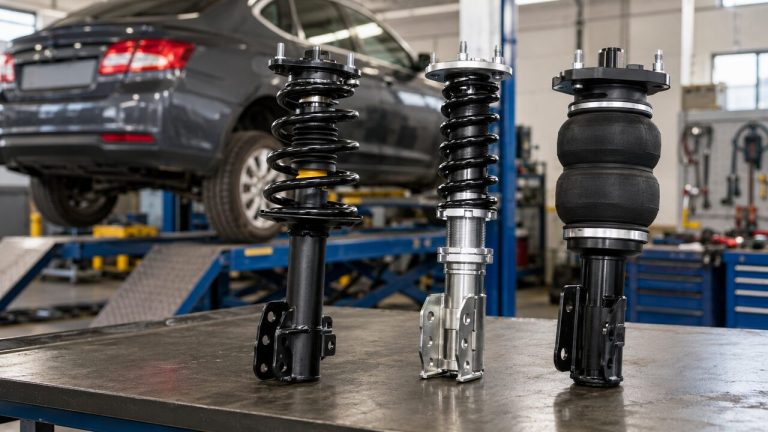
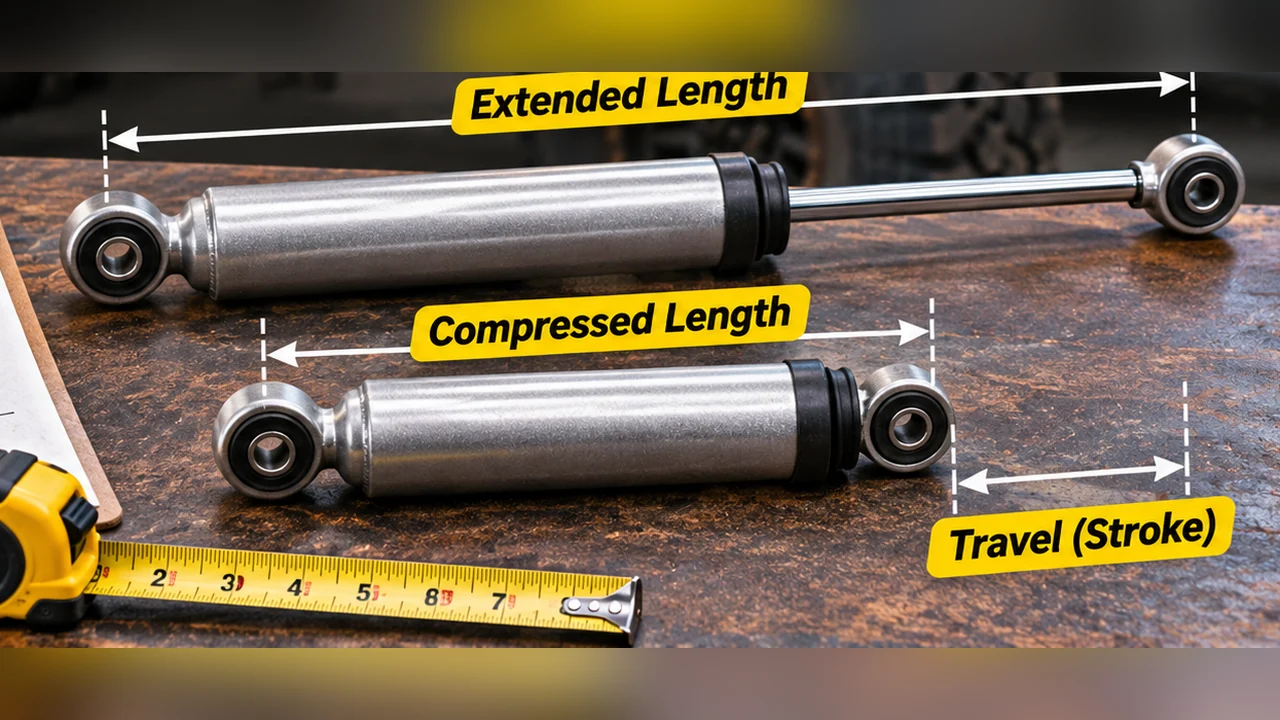
A shock may be listed by its extended length, compressed (collapsed) length and stroke. Those three specifications describe the damper itself. The calculator compares them with the physical distances between the vehicle’s shock mounts as the suspension moves. A nominal 10-inch-travel shock does not necessarily fit a suspension that needs 10 inches of mount movement; its collapsed and extended endpoints must also land in the right places.
Use the following definitions when reading a catalog. The manufacturer’s measurement reference is as important as the number.
| Measurement | What it measures | Why you need it |
|---|---|---|
| Extended length | Mount reference to mount reference with the shock fully extended | A candidate must reach full permitted droop without topping out |
| Compressed / collapsed length | Same reference points with the shock fully compressed | A candidate must be shorter than the full-bump mount gap by the required reserve |
| Stroke / shock travel | Extended length minus compressed length | The damper’s total usable length change; it is not automatically wheel travel |
| Static / ride-height length | Distance between chassis mounts at normal vehicle load | Shows how much travel is available around the normal driving position |
Why Mounting Style Changes the Measuring Points
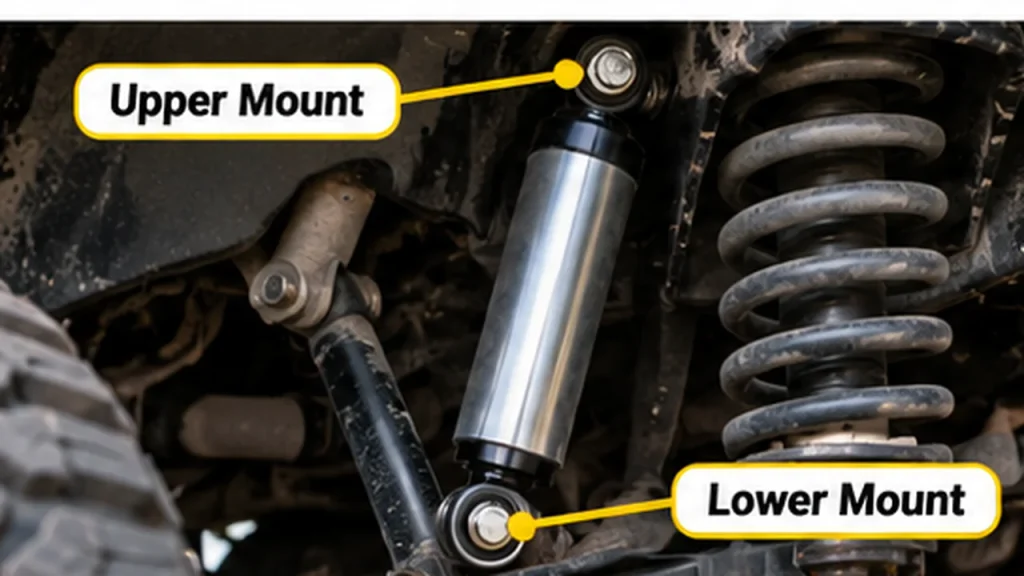
For a conventional eye-to-eye shock, measure from the center of one mounting eye to the center of the other. Eye-to-stem, bar-pin and clevis mounts may use different manufacturer reference points, so the distance to the end of a threaded stud is not automatically the published shock length. BILSTEIN’s application guidance distinguishes eyelet and stem conventions explicitly. If the chart and your tape measure use different endpoints, every calculated clearance will be wrong.
Shock Stroke Is Not the Same as Wheel Travel
On an independent suspension, a shock mounted partway along a control arm often moves less than the tire’s vertical movement. The difference is represented by a motion ratio. Our optional wheel-travel mode defines that ratio as change in shock-mount distance ÷ vertical wheel travel, rather than its inverse. A ratio of 0.80 means that 5 inches of wheel movement is estimated to change the shock length by 4 inches; it does not guarantee that the ratio remains 0.80 at full bump and full droop.
The relationship can change across the suspension’s arc, especially with inclined dampers, multi-link layouts or modified arms. That is why long-travel suspension geometry cannot be reduced to a single shock-stroke number. Directly measured mount distances are more useful for final shock selection than extrapolating from a wheel-travel advertisement.
How to Measure Shock Length on Your Car, Truck or SUV
A worthwhile result begins with three distinct positions: normal loaded ride height, the intended full-compression limit and the intended full-extension limit. Measure at the same mounting points each time. Record front and rear separately and, on modified vehicles, check left and right if the build has non-symmetrical mounts.
Ride Height: Measure Mount to Mount, Not Tire to Fender
At normal ride height on level ground, the shock’s working length is the distance between its upper and lower mounting references. A fender-to-ground reading or advertised two-inch lift does not substitute for that distance. A body lift, spring spacer, longer control arm and relocated shock mount can all affect the relationship differently.
If you are replacing an original-equipment shock with the specified fitment part, a VIN-specific application listing is generally a safer first step than reverse-engineering lengths. The calculator is particularly useful for altered ride heights, custom brackets and builds where the original shock is no longer representative.
Full Bump: Find the Closest Permitted Mount Distance
Full bump is the compressed end of the intended suspension travel, including the actual bump-stop behavior. This is not necessarily the distance when a bump stop first makes contact; progressive stops can compress farther under load. Record the closest safe distance between mounting references through the required travel, allowing for tire and chassis clearance, spring limits and manufacturer-defined bump-stop compression.
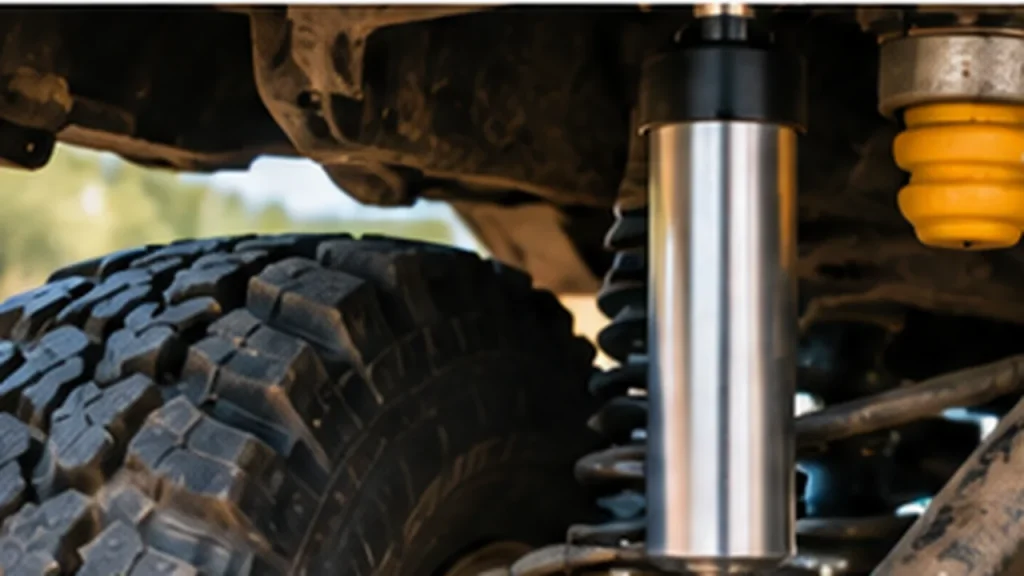
Do not attempt to force the suspension into full compression with a floor jack or remove loaded springs to obtain a number. Full-cycle testing may involve substantial stored energy and an unstable vehicle. A qualified suspension technician with the appropriate support and equipment should establish those end points where they are not already documented by the kit manufacturer.
Full Droop: Check the Real Extension Limit
Full droop is the longest permitted gap between shock mounting points. For a modified setup, it should be controlled by the intended limit strap or mechanical design—not by letting the shock, brake line, CV joint or suspension ball joint become the extension stop. Record that mount-to-mount length rather than assuming the wheel hanging free on an existing shock shows the suspension’s possible droop.
A worn or short old shock may itself limit droop; removing it without safely controlling the axle can expose more movement than the original setup allowed. BILSTEIN’s full-cycle shock measurement guidance recommends checking both bump and droop and treating straps and bump stops as the appropriate limits for ordinary dampers. This is also why the calculator asks for permitted travel rather than unrestricted theoretical articulation.
Shock Length Formulas and a Worked Example
The arithmetic is straightforward once the end-point measurements are trustworthy. What makes the calculation useful is adding separate, application-specific reserves at each end of travel. A shock that reaches the exact same endpoints as the mounts, with zero reserve, could hit an internal stop when the suspension flexes farther than expected.
Using the direct-measurement method, the calculator applies these relationships. All lengths must be measured using the same reference convention and unit.
| Calculated value | Formula |
|---|---|
| Minimum required extended length | Full-droop mount distance + extension reserve |
| Maximum permissible compressed length | Full-bump mount distance − compression reserve |
| Minimum required stroke | Minimum required extended length − maximum permissible compressed length |
| Available compression with a catalog shock | Ride-height mount distance − catalog compressed length |
| Available extension with a catalog shock | Catalog extended length − ride-height mount distance |
Example: 12-Inch Bump, 18-Inch Ride Height and 24-Inch Droop
Imagine an illustrative setup with 12 inches between shock mounts at full bump, 18 inches at ride height and 24 inches at full droop. That is 6 inches of mount movement in compression, 6 inches in extension and 12 inches across the complete range. These are sample measurements for demonstrating the math, not dimensions recommended for a particular vehicle.
Suppose the installer has verified that 0.5 inch of compression reserve and 0.5 inch of extension reserve are appropriate for that specific installation. The minimum extended shock length becomes 24.5 inches, the maximum collapsed length becomes 11.5 inches and the minimum stroke becomes 13.0 inches. A catalog shock with 25 inches extended and 11.5 inches compressed passes these two dimensional checks, yielding 1.0 inch of extension reserve and 0.5 inch of compression reserve.
Notice that the 13-inch minimum stroke is greater than the 12 inches of measured mount travel because the entered reserves cover both ends. More stroke by itself does not guarantee a pass: a different shock can have 14 inches of stroke but still be too long when compressed. That is exactly why the catalog comparison checks both published lengths independently.
How to Check a Catalog Shock Before Buying
For a truck with a lift kit or a custom shock mount, look up the exact manufacturer part number and record its published extended and collapsed dimensions. BILSTEIN and other manufacturers list these alongside mount styles, sometimes using “compressed length” and sometimes “collapsed length.” The calculator does not search a live product catalog; it compares the dimensions you enter.
An Extended Shock That Is Too Short Tops Out
If the shock reaches its maximum length before the suspension reaches its permitted droop, it can repeatedly top out and transfer the load to its internal hardware or mounts. A longer shock may solve that measurement conflict, but it must not allow an axle, brake hose, CV or steering joint to move beyond its safe limit. Limit straps or the kit’s designed stops must remain in charge of droop.
A Shock That Is Too Long When Compressed Bottoms Out
If the collapsed length exceeds the allowable full-bump mounting distance after accounting for the specified reserve, the shock can bottom before the bump stops finish their job. This can damage the damper, mounts or chassis. In some lift applications, the answer is not simply a different brand: the correct kit may require bump-stop extensions or different mounting geometry. Do not alter stops merely to make a product fit without verifying tire and suspension clearances.
Check Both Mounts, Not Just the Length
Two shocks can share 24-inch extended and 14-inch collapsed dimensions but have incompatible upper and lower fittings. Match eye diameter, sleeve width, stud and bar-pin arrangements, bushing, clevis offset, body diameter, reservoir position and the vehicle manufacturer’s installation requirements. Our lifted-truck shock comparison covers how ride quality, intended terrain and model-specific valving influence the choice after basic dimensions are confirmed.
Where Motion Ratio Estimates Go Wrong
It is tempting to take a manufacturer’s quoted 10 inches of wheel travel, multiply by a generic front-suspension ratio and buy the nearest 8-inch-stroke shock. That may give a rough planning number, but the suspension does not necessarily move through a straight line or keep the same ratio at all positions. Shock mounting angle and the control-arm arc both matter.
Front IFS, Rear Solid Axles and Angled Shocks
A front independent suspension with an inboard lower-arm shock often has more wheel movement than shock movement. A rear solid axle with an angled shock also changes the relationship between vertical axle travel and damper stroke. A ratio of 1.0 should never be assumed solely because the vehicle has a solid axle, and a front and rear ratio should not be copied from a different make or model.
If you know only wheel travel, select the calculator’s Wheel travel + measured motion ratio mode to generate a preliminary estimate. It explicitly uses the same ratio through bump and droop and labels the result as approximate. Before spending money, verify the actual full-bump and full-droop mount gaps through the suspension’s intended travel.
A Lift Changes Ride Position, Not Necessarily Total Travel
A taller spring, spacer or adjustable spring perch may change static ride height within the existing suspension range without creating any additional travel. That can reduce available droop while increasing available bump, or the reverse. Long-travel arms and relocated mounts are a different kind of modification. Shock selection needs the geometry of the finished vehicle, not just the lift height printed on a box.
Common Shock Sizing Mistakes That Lead to Broken Parts
Most bad length decisions come from a plausible-sounding shortcut. Before treating the result as a parts recommendation, check whether any of these assumptions slipped into the measurements.
- Using advertised lift height as shock travel: A three-inch lift is not a three-inch increase in shock stroke or droop.
- Comparing eye-to-eye measurements with stem-tip lengths: Different mounting reference points invalidate the comparison.
- Measuring droop against the existing shock: An old shock can be the travel limiter, masking the movement available when it is removed.
- Ignoring bump-stop compression: The end of permitted bump is not always the first contact with a progressive jounce bumper.
- Choosing by stroke alone: Both the extended and collapsed lengths must suit the real mounting envelope.
- Guessing a universal margin or motion ratio: They depend on components, geometry and the manufacturer’s requirements.
- Overlooking full-steering-lock clearance: CV joints, hoses, tires, arms and the shock body need clearance through the relevant combinations of bump, droop and steering.
If your build is aimed at articulation rather than simply a mild lift, our guide to how bump stops control compression explains why those components are part of the shock-sizing calculation rather than optional extras.
Shock Length Calculator Questions
These are the questions that typically come up when the calculator gives you a minimum extended length or rejects a shock whose advertised stroke looked sufficient.
Is Extended Length the Same as Shock Travel?
No. Extended length is the full mount-to-mount dimension at maximum extension. Shock travel, often called stroke, is that number minus the compressed length. A damper measuring 24 inches extended and 14 inches collapsed has 10 inches of stroke—not 24 inches of travel.
How Do I Measure a Rear Shock?
Use the mounting reference points specified for the rear damper, then establish ride-height, full-bump and permitted full-droop distances for that suspension design. Leaf springs, rear links, shackle movement, a diagonal shock mounting angle and a relocated upper mount can change the required dimensions. Measure the rear independently of the front.
Can a Two-Inch Lift Use Stock-Length Shocks?
Sometimes. Some small lifts are engineered to keep factory-length dampers and factory travel limits; others require a different shock or bump-stop arrangement. The correct answer is specific to the lift kit and vehicle. A two-inch lift label by itself cannot tell you how far the shock mounts separate at droop.
Should I Buy the Longest Shock That Fits?
No. More extended length is not automatically better when compressed length, bump stops or mounting geometry are wrong. A longer shock can be acceptable in a design with appropriate droop limits, but the damper should not invite unsupported joint angles or become the vehicle’s extension limiter.
Why Does the Calculator Say a 10-Inch-Stroke Shock Does Not Fit?
Because adequate stroke is necessary but not sufficient. For example, a 25-inch/15-inch shock has 10 inches of stroke, but it cannot fit a suspension that requires the shock to collapse below 14 inches. Both limits have to pass separately, with any specified reserves.
What If I Only Know Wheel Travel and Motion Ratio?
Use the estimated mode for early planning, making sure the ratio you enter represents shock-length change divided by vertical wheel displacement. Treat the output as approximate. Suspension motion ratios can change through the stroke, so actual mount measurements or manufacturer-provided geometry are required for reliable final sizing.
Do Shock Absorbers Have to Be the Same Length on All Four Corners?
No. Many vehicles use different front and rear mounting styles, travel ranges and damper lengths. Even within one axle, custom installations should be checked for symmetry and travel limits rather than assuming one measurement suits every corner. Buy by the correct vehicle application or the verified geometry for that corner.
What to Verify Before You Order the Shock
The calculator can narrow the choices, but the purchase decision rests on the complete suspension. Use this short checklist with your installer or the shock manufacturer before placing an order.
- Measure the correct full-cycle mount gaps. Confirm normal loaded ride height, bump-stop-controlled compression and strap- or design-controlled droop.
- Check both catalog dimensions. Confirm the exact part number’s extended length, collapsed length and stroke using matching mounting reference points.
- Agree on end-of-travel reserves. Use the manufacturer’s or suspension designer’s requirements, not an assumed universal clearance.
- Confirm mounting hardware and physical clearance. Check bushings, eyes, studs, bar pins, body diameter, tire clearance and any reservoir.
- Verify the rest of the suspension. Springs, brake hoses, CV joints, steering pivots, driveshafts, limit straps and bump stops must remain within their safe operating limits.
- Choose damping for the vehicle. Length compatibility does not determine valving, ride comfort, heat capacity or load suitability.
For a stock suspension, the manufacturer’s vehicle-specific part lookup is usually the safest starting point. For a modified suspension, these measured dimensions help you ask informed questions and reject shocks that would hit an end stop too soon. Keep the results with your build notes, but have a qualified installer verify the suspension through its full intended movement before final selection.