Pitman Arm vs. Idler Arm: Differences, Symptoms & Diagram
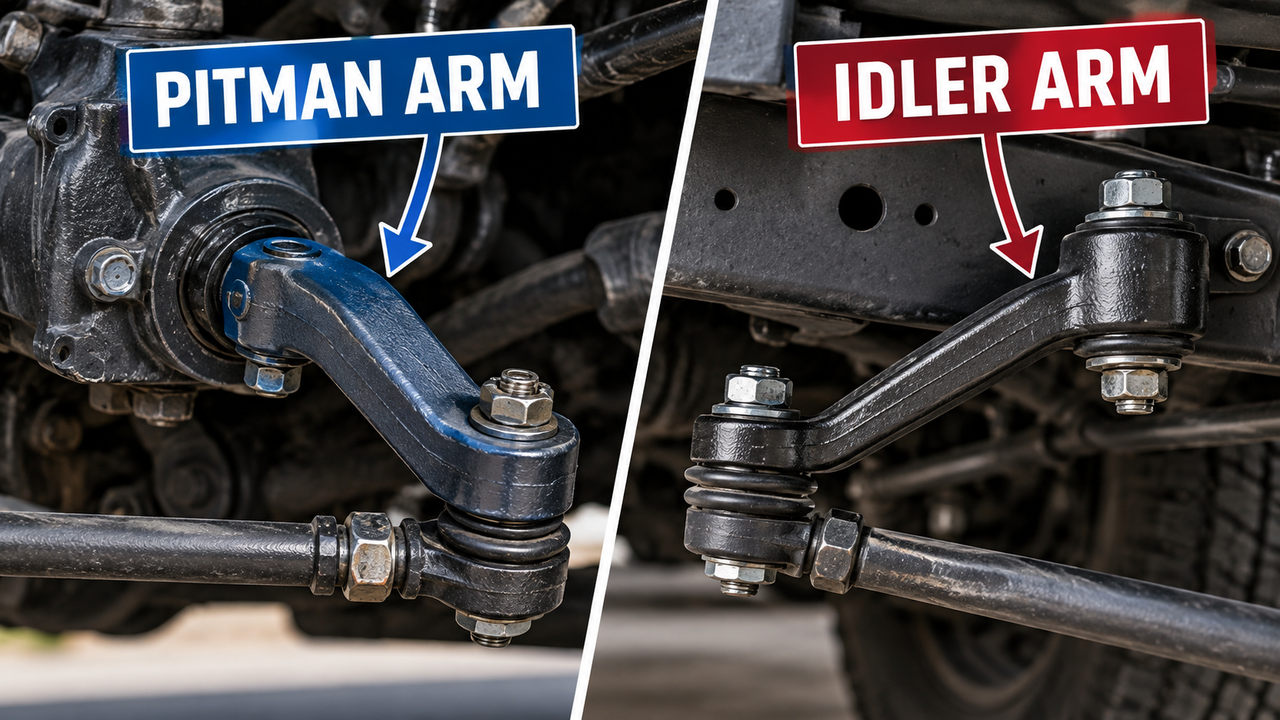
The main difference between a Pitman arm and an Idler arm is their job in the steering system. The Pitman arm transfers movement from the steering gearbox to the center link, while the Idler arm supports the opposite end of that link and allows it to move without losing its intended position. One drives the steering linkage; the other helps keep it properly aligned as it moves.
Both are found on many vehicles with traditional parallelogram steering, including certain trucks, SUVs and older rear-wheel-drive cars. They can produce similar symptoms when worn, but they are not interchangeable parts. And despite what you might assume from a loose steering wheel, you cannot reliably identify the failed arm by symptoms alone.
Pitman Arm vs. Idler Arm: Key Differences
From underneath a truck, these two arms can look surprisingly similar, especially when the steering linkage is covered in road grime. Before identifying either one, compare its mounting points, how it moves, and where wear typically develops. Those details tell you much more than the shape of the arm alone.
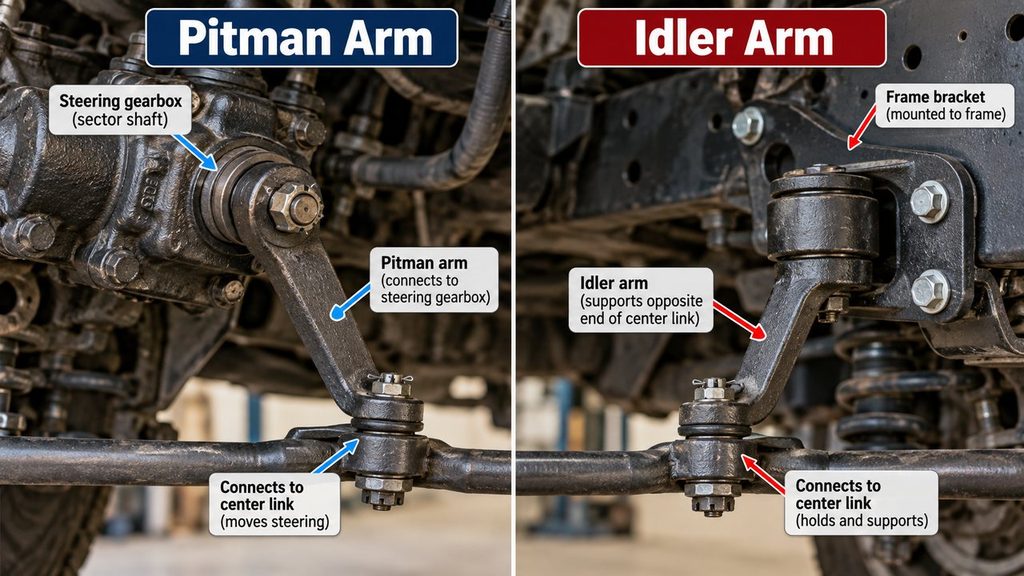
| Feature | Pitman arm | Idler arm |
|---|---|---|
| Main function | Transfers steering gearbox movement to the linkage | Supports and guides the opposite end of the center link |
| Connection to steering gearbox | Direct connection to the gearbox output or sector shaft | No direct connection |
| Other mounting point | Center link or drag link, depending on steering design | Center link |
| Typical location | At the steering gearbox side | Opposite side, mounted through a frame bracket or pivot |
| Steering input | Transmits steering force | Follows linkage movement and provides support |
| Common wear points | Linkage joint, splined connection or mounting hardware, depending on design | Pivot, bearing or bushing, linkage joint and mounting bracket |
| Possible failure symptoms | Excessive steering play, wandering, clunking | Steering looseness, wandering, clunking and abnormal center-link movement |
| Present on rack-and-pinion steering? | Normally no | Normally no |
The easiest way to remember the difference is to follow the steering input. When you turn the wheel, the gearbox moves the Pitman arm. The Pitman arm moves the center link. The Idler arm follows that movement while supporting the other end.
Neither arm sets the vehicle’s alignment by itself, but wear in either one can allow unwanted linkage movement that affects steering precision and tire wear.
Pitman Arm and Idler Arm Diagram: Where Are They Located?
On a typical left-hand-drive vehicle with parallelogram steering, the Pitman arm is attached beneath the steering gearbox, usually toward the driver’s side. The Idler arm is mounted to the frame or a bracket on the opposite side.
Between them runs the center link, sometimes called a relay rod. The inner tie rod assemblies connect to the center link and carry steering movement outward toward the steering knuckles.
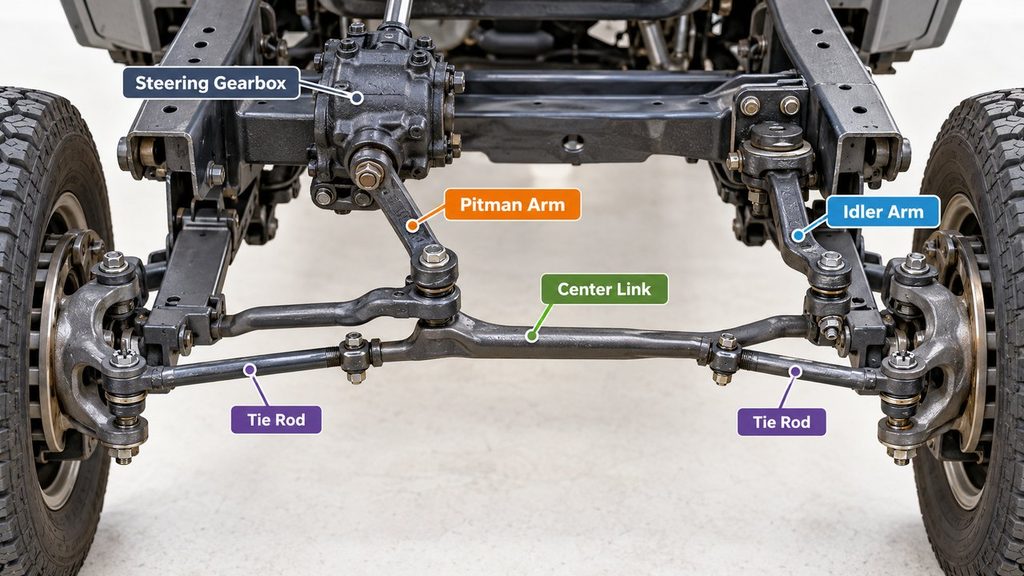
STEERING GEARBOX             FRAME BRACKET
       |                           |
   PITMAN ARM                  IDLER ARM
       |                           |
       +-------- CENTER LINK ------+
            |               |
         TIE ROD         TIE ROD
            |               |
        LH KNUCKLE      RH KNUCKLE
Simplified steering-linkage diagram, viewed conceptually from above. Not to scale. The layout, mounting angles and side locations vary by vehicle.
The diagram shows why the arms are easy to confuse: both connect to the same central linkage and both move when the steering wheel turns. Their upper connections are what distinguish them. The Pitman arm attaches to the gearbox; the Idler arm attaches to a stationary vehicle mounting point through a pivot.
One important detail: some trucks use a Pitman arm and drag link without a matching Idler arm. A diagram for one steering system should never be treated as a universal parts-location guide.
What Does a Pitman Arm Do?
The Pitman arm is the mechanical connection between a steering gearbox and the external steering linkage. It is typically a forged metal lever mounted to the gearbox’s sector shaft, also called the Pitman shaft or output shaft.
Inside a recirculating-ball steering gearbox, the driver’s steering input is converted into rotation of that output shaft. The splined connection holds the Pitman arm in position so it swings through an arc as the shaft turns.
At its other end, the arm connects to the center link or drag link. The connection usually involves a tapered steering joint, although the precise arrangement of the ball-and-socket joint depends on the vehicle.
As the Pitman arm swings, it pushes or pulls the steering linkage. That movement eventually reaches the tie rods and steering knuckles, turning the front wheels.
So the Pitman arm doesn’t simply hold a component in place. It transmits the force that actually moves the linkage. If that connection develops excessive play, the steering gearbox can begin moving before the road wheels respond as they should.
What Is the Sector Shaft?
The sector shaft is the steering gearbox’s output shaft. Its splined end provides the mounting point for the Pitman arm, which is usually retained by a substantial nut and other hardware specified by the vehicle manufacturer.
Those splines are important. An incorrectly fitted arm, damaged shaft or loose retaining hardware can compromise the connection between the gearbox and the steering linkage.
However, a steering complaint near the Pitman arm doesn’t automatically mean the arm itself is worn. The gearbox can develop internal play, and its mounting bolts or surrounding structure can also cause movement that feels similar.
What Does an Idler Arm Do?
The Idler arm supports the end of the center link opposite the Pitman arm. It doesn’t receive torque from the steering gearbox. Instead, it pivots as the center link moves, helping maintain the linkage’s intended height and path.
Imagine a long center link supported only at the gearbox end. Steering forces and road loads could make the unsupported side move in directions it wasn’t supposed to. The Idler arm provides the additional support needed by the parallelogram arrangement.
This is why a worn Idler arm can have such a noticeable effect on steering. If its pivot or joint develops excessive clearance, the center link may move up, down or sideways beyond its designed motion. That unwanted movement can translate into vague steering and changes in wheel direction under load.
Idler Arm vs. Idler Arm Bracket
Parts catalogs sometimes separate the Idler arm from its mounting bracket or pivot assembly. On other vehicles, the replacement part includes more of the assembly.
That’s a useful distinction when diagnosing wear. A loose ball-and-socket connection at the center link is different from a worn pivot bearing or bushing inside the frame-mounted support.
Both can produce steering looseness, but the failed component and replacement procedure may differ. Before ordering parts, identify whether the movement comes from the arm, its bracket, the center-link connection or loose mounting hardware.
How the Pitman Arm and Idler Arm Work Together
The traditional parallelogram steering system uses the Pitman arm and Idler arm at opposite ends of the center link. Their jobs are different, but the geometry depends on both functioning properly.
- You turn the steering wheel. The steering column delivers the input to the steering gearbox.
- The gearbox turns its sector shaft. The Pitman arm swings with that shaft.
- The Pitman arm moves the center link. The movement is transmitted through the linkage connection.
- The Idler arm pivots. It follows the center link’s intended motion while supporting the opposite end.
- The tie rods move the steering knuckles. Both front wheels change direction according to the steering geometry.
Notice that the Idler arm isn’t another steering gearbox or a second source of steering force. It is a support and pivot point.
The system also relies on properly functioning tie rod ends, a correctly mounted steering gearbox and sound frame attachment points. A worn component anywhere in that chain can introduce delay or unintended movement.
Center Link, Relay Rod and Drag Link: Are They the Same?
In parts catalogs and repair literature, the center link in a parallelogram system may also be called a relay rod or sometimes a drag link. The terminology isn’t perfectly consistent.
But not every drag link is a center link. On some solid-axle trucks and Jeeps, a drag link runs from the Pitman arm directly toward a steering knuckle or steering arm. That arrangement may have no Idler arm at all.
The name alone isn’t enough to identify the layout. Follow the actual connections under the vehicle and consult the correct steering diagram for its model year and configuration.
Bad Pitman Arm vs. Bad Idler Arm: Symptoms Compared
Here’s where diagnosis gets less straightforward. A worn Pitman arm connection and a worn Idler arm assembly can both make a vehicle wander, feel loose or produce a clunk when steering direction changes.
These symptoms tell you to inspect the steering linkage. They do not tell you which part to buy.
| Symptom | Pitman arm problem | Idler arm problem |
|---|---|---|
| Excessive steering wheel play | Possible if the gearbox-to-linkage connection has play | Possible if the supported end of the center link moves excessively |
| Wandering or frequent corrections | Possible | Possible |
| Clunk when reversing steering direction | Possible at a loose connection | Possible at a worn pivot or joint |
| Abnormal vertical center-link movement | Can occur with linkage wear | Particularly worth checking at the Idler support |
| Uneven front tire wear | Possible if wear affects dynamic toe | Possible if wear affects dynamic toe |
| Visible play at gearbox output connection | Inspect arm splines, retaining hardware and gearbox | Not an Idler arm connection |
| Movement at frame-mounted Idler pivot | Not a Pitman arm connection | Inspect Idler arm, bearing, bushing and bracket |
One clue deserves special attention: unwanted movement at the Idler arm support. Because that support is supposed to control the position of its end of the center link, excessive movement there can explain a truck that feels imprecise even though the Pitman arm looks intact.
However, the amount and direction of permissible movement are design-specific. A pivot naturally moves through its intended arc; that isn’t the same thing as excessive play. Don’t condemn an Idler arm using a universal visual rule or an arbitrary measurement.
Steering Wheel Play and Delayed Response
Turn the steering wheel slightly in a parked vehicle and you may notice a delay before the front tires begin responding. Some of that movement may be normal for the system, but excessive free play can point to wear.
The important question is where the movement is being lost. If the steering input reaches the gearbox but the output shaft has excessive delay, the gearbox needs attention. If the output shaft and Pitman arm move together while the center link hesitates, inspect their linkage connection. If the center link moves abnormally at the opposite support, inspect the Idler assembly.
This distinction is more useful than assuming every loose steering wheel means a bad Pitman arm.
Wandering, Clunking and Tire Wear
A vehicle that wanders across a lane or needs frequent corrections may have wear in either arm. Loose tie rods, tire issues, steering gearbox wear and alignment problems can produce similar complaints.
A clunk during a slow turn can come from a joint that shifts under load. If the looseness allows the steering geometry to change as the vehicle moves, abnormal tire wear may follow, particularly when toe varies.
These signs are reasons to inspect the system as a whole, not proof that one particular arm has failed. Our guide to a car feeling loose while driving covers other steering and suspension faults that can create much the same sensation.
How to Tell Whether the Pitman Arm or Idler Arm Is Bad
The most useful inspection follows the movement through the actual steering components. Rather than shaking a wheel and guessing, look for the connection where movement appears that should not be there.
Safety first: Steering components are safety-critical. Use the vehicle manufacturer’s inspection procedure, including the specified wheel loading and support conditions. Never crawl beneath a vehicle supported only by a jack, and never position yourself beneath a running or moving vehicle. If you cannot see the linkage safely, have a qualified technician inspect it.
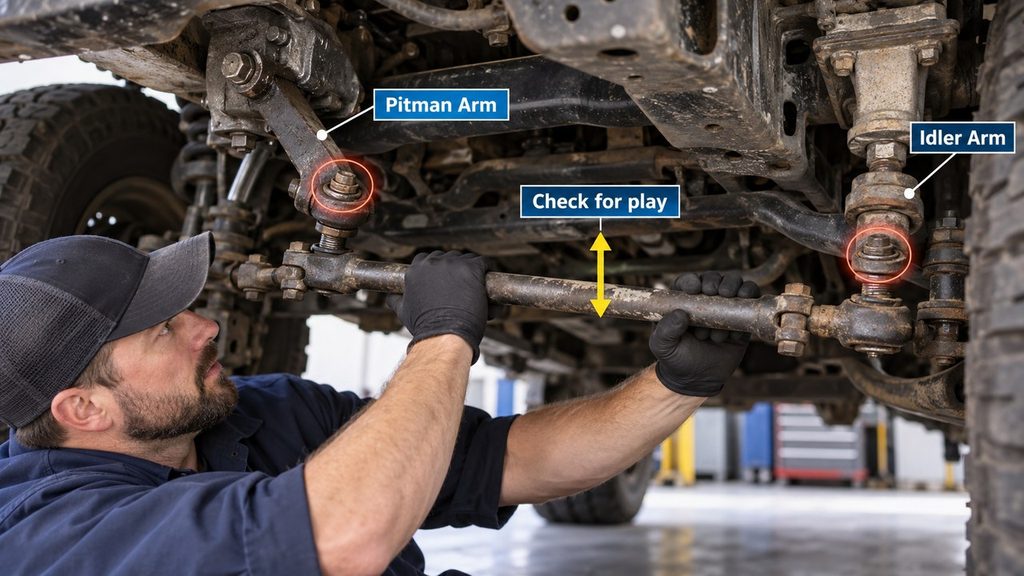
1. Locate Both Arms and Check Their Mountings
Identify the steering gearbox, Pitman arm, center link and Idler arm bracket. On a typical left-hand-drive parallelogram arrangement, the gearbox and Pitman arm are on one side, with the Idler assembly opposite.
Look for damaged boots, displaced grease, corrosion, cracked mounting areas, missing retaining hardware and visible distortion. Also inspect the steering gearbox mounting points and Idler bracket bolts.
A torn boot is evidence that contamination can enter a joint. It isn’t, by itself, a measurement of joint looseness.
2. Observe the Pitman Arm as Steering Input Changes
During an inspection performed under the vehicle manufacturer’s specified conditions, a helper may be asked to apply small, controlled steering inputs while a technician observes the linkage from a safe position.
Watch the gearbox output shaft, the Pitman arm and its connection to the center link. The purpose is to find relative movement between components that should be securely connected.
Movement of the Pitman arm through its intended steering arc is normal. A loose splined connection, shifting mounting hardware or excessive free play at the linkage joint is not.
Do not assume movement at the gearbox end always means the Pitman arm needs replacing. The steering gear itself may be the source of the delay or looseness.
3. Inspect the Idler Arm Pivot and Center-Link Support
Next, watch the end of the center link supported by the Idler arm. Check the pivot or bearing area, the connection to the center link and the bracket attachment.
The Idler arm should follow the intended steering motion without excessive movement through worn joints or supports. Depending on the design, a technician may check for unwanted vertical or lateral deflection using a manufacturer-prescribed method.
There is no reliable one-size-fits-all amount of acceptable Idler arm movement. Some systems have a specified deflection limit or inspection force. Use the correct service information rather than declaring the part defective because it moves slightly.
Pay attention to where the movement occurs. Play in a ball stud is not the same as movement in the frame-mounted pivot. That distinction may determine which part or assembly needs replacement.
4. Check the Tie Rods and Center Link Before Deciding
If both arms appear sound, continue along the linkage. Inner and outer tie rod joints can develop play that produces nearly identical steering complaints.
Our guide to bad tie rod symptoms explains how joint looseness can cause wandering, vibration, clunking and uneven tire wear, and how to distinguish inner from outer tie rod problems.
Inspect the center link itself, its joints and the steering gearbox mounting. A correct diagnosis identifies the actual point of unwanted movement instead of replacing the most familiar component in the area.
Do All Trucks Have a Pitman Arm and an Idler Arm?
No. The steering system matters more than whether the vehicle is called a truck, SUV or car.
A traditional parallelogram steering layout normally has both a Pitman arm and an Idler arm. This arrangement appeared in numerous older rear-wheel-drive cars and remains relevant to some pickup and heavy-duty truck applications.
A vehicle with rack-and-pinion steering generally has neither component. The steering rack performs the movement that a gearbox-and-linkage arrangement would otherwise transmit through a Pitman arm and center link.
There is another important exception. Some solid-front-axle vehicles use a steering gearbox, Pitman arm and drag link without a conventional parallelogram center link or Idler arm.
These systems may also have a track bar, which controls lateral axle location rather than transmitting steering input. Our guide to what a track bar does explains that separate component and why its condition matters to solid-axle handling.
In short: a Pitman arm does not automatically mean there must be an Idler arm.
What About Chevrolet Silverado, GMC Sierra and Other Trucks?
Searches for Pitman and Idler arm diagrams often involve Chevrolet Silverado and GMC Sierra trucks. Some generations and configurations use traditional steering linkage with both arms, while other pickups use different steering arrangements.
For example, applications of the Silverado 2500 HD have used a steering center link together with Pitman and Idler arms. But that does not establish fitment for every Silverado or Sierra 1500, 2500 or 3500, across every model year and drive configuration.
Before ordering a replacement or using a diagram found online, verify the vehicle’s exact year, model, drivetrain and steering system. The original-equipment parts catalog or VIN-specific service information is more reliable than matching a part solely by the truck’s name.
Pitman Arm and Idler Arm Replacement: Do You Need Both?
Not necessarily. If one arm has confirmed excessive play and the other meets the manufacturer’s inspection specifications, replacing both isn’t automatically required.
That said, inspecting both during the same repair makes good sense. They operate in the same steering linkage, may have accumulated similar mileage and are often exposed to the same road conditions.
Replacing both may be reasonable when both show wear, when a kit offers a practical repair solution, or when accessing the linkage makes additional work economical. The decision should come from condition, service recommendations and fitment—not the assumption that the parts always fail together.
Are They Difficult to Replace?
The work can be more involved than the size of the parts suggests.
Pitman arm removal may require a dedicated Pitman arm puller to release the arm from the gearbox’s splined shaft. Corrosion and limited access can complicate the job, and some vehicle procedures require additional components to be moved for clearance.
Idler arm replacement may involve removing a frame-mounted bracket, separating a tapered joint and replacing the pivot or complete assembly, depending on the design.
Both repairs require the correct fastener specifications and approved separation and installation procedures. Improperly seated tapers, damaged threads or incorrectly secured retaining hardware can create a serious steering hazard.
Don’t use universal torque values from a forum or assume an aftermarket replacement has exactly the same hardware requirements as the original part. Follow the vehicle and component manufacturers’ instructions.
Do Pitman Arms and Idler Arms Need Grease?
Some replacement Idler arm joints, pivots and Pitman-linkage joints have grease fittings. Others are sealed and are not intended for routine lubrication.
When a fitting is present, use the specified lubricant and maintenance procedure. Grease fittings on certain truck Idler brackets can be awkward to reach, which makes them easy to overlook during routine service.
Adding grease will not restore a worn bearing, loose ball stud or damaged splined connection. If the joint exceeds its allowable play, lubrication is not a substitute for repair.
Do You Need an Alignment After Replacing a Pitman Arm or Idler Arm?
Have the steering geometry and front-end alignment checked after replacing either arm. Wear in the old linkage, replacement-part tolerances and changes in component position can affect the way the wheels track.
A Pitman or Idler arm usually isn’t a direct toe-adjustment component in the same way an adjustable tie rod is. If the replacement preserves the intended geometry and nothing else was disturbed, the alignment might already be within specification.
But the correct approach is to measure first rather than assume. The technician should confirm that the steering wheel is centered, the linkage moves correctly and the wheel angles meet the vehicle manufacturer’s specifications.
If tie rod adjustments were disturbed, checking toe becomes particularly important. Our guide to alignment after replacing suspension or steering parts explains when an alignment check is appropriate and when actual adjustment is necessary.
Most importantly, alignment cannot compensate for a steering joint that still has excessive play. Any mechanical looseness should be corrected before the final measurements are taken.
Frequently Asked Questions
What is the main difference between a Pitman arm and an Idler arm?
The Pitman arm transfers motion from the steering gearbox to the center link. The Idler arm supports the opposite end of the center link and allows it to follow the intended steering movement. Only the Pitman arm connects directly to the gearbox output shaft.
Which is on the driver’s side, the Pitman arm or Idler arm?
On many left-hand-drive vehicles with parallelogram steering, the Pitman arm is on the driver’s side near the steering gearbox and the Idler arm is on the opposite side. This is a typical layout, not a universal rule. Identify them by their mounting connections rather than position alone.
Can a bad Idler arm cause steering wheel play?
Yes. Excessive wear at the Idler pivot or center-link connection can permit movement that reduces steering precision. Similar symptoms can result from Pitman arm connections, tie rods or the steering gearbox, so the actual source of play must be inspected.
Can a bad Pitman arm cause a truck to wander?
Yes, if there is excessive play at the Pitman arm or its linkage connection. Wandering can also come from an Idler arm, worn tie rods, incorrect alignment or tire problems. A diagnosis should locate the looseness rather than rely on the wandering symptom alone.
What connects the Pitman arm to the Idler arm?
In a conventional parallelogram steering system, both arms connect to a center link, also called a relay rod. The center link carries steering movement to the tie rod assemblies while the Idler arm supports its opposite end.
Can a vehicle have a Pitman arm without an Idler arm?
Yes. Some steering gearbox systems, particularly certain solid-axle arrangements, use a Pitman arm and drag link without a conventional Idler arm. Vehicles with rack-and-pinion steering typically use neither component.
Should Pitman and Idler arms be replaced together?
Only when their condition or the applicable service procedure justifies it. If both have excessive play, replacing them together is sensible. If just one is worn and the other passes inspection, replacement of the good component isn’t automatically necessary.
Is it safe to drive with a bad Pitman arm or Idler arm?
Excessive play in either component can compromise steering control, particularly if a joint or mounting connection is at risk of separating. If steering becomes suddenly loose, unpredictable or difficult to control, stop driving and arrange professional inspection or towing. Do not continue driving a vehicle with a suspected severely worn steering connection.
The Difference That Matters Most
When you’re looking underneath a truck, the Pitman arm and Idler arm can seem like two versions of the same part. Both are metal arms, both move with the linkage and both can cause trouble as they wear.
But trace each arm back to its mounting point and the distinction becomes obvious. The Pitman arm connects the steering gearbox to the linkage. The Idler arm connects the other side of that linkage to a supporting pivot.
If the steering feels loose, don’t choose a replacement based on which side seems noisier or which part appears first in a search result. Find where the unwanted movement begins, inspect the rest of the linkage and repair the component that actually fails its specification. That’s how you avoid replacing a perfectly good arm while leaving the steering problem untouched.