Suspension Limit Straps Explained: What They Do & When You Need Them
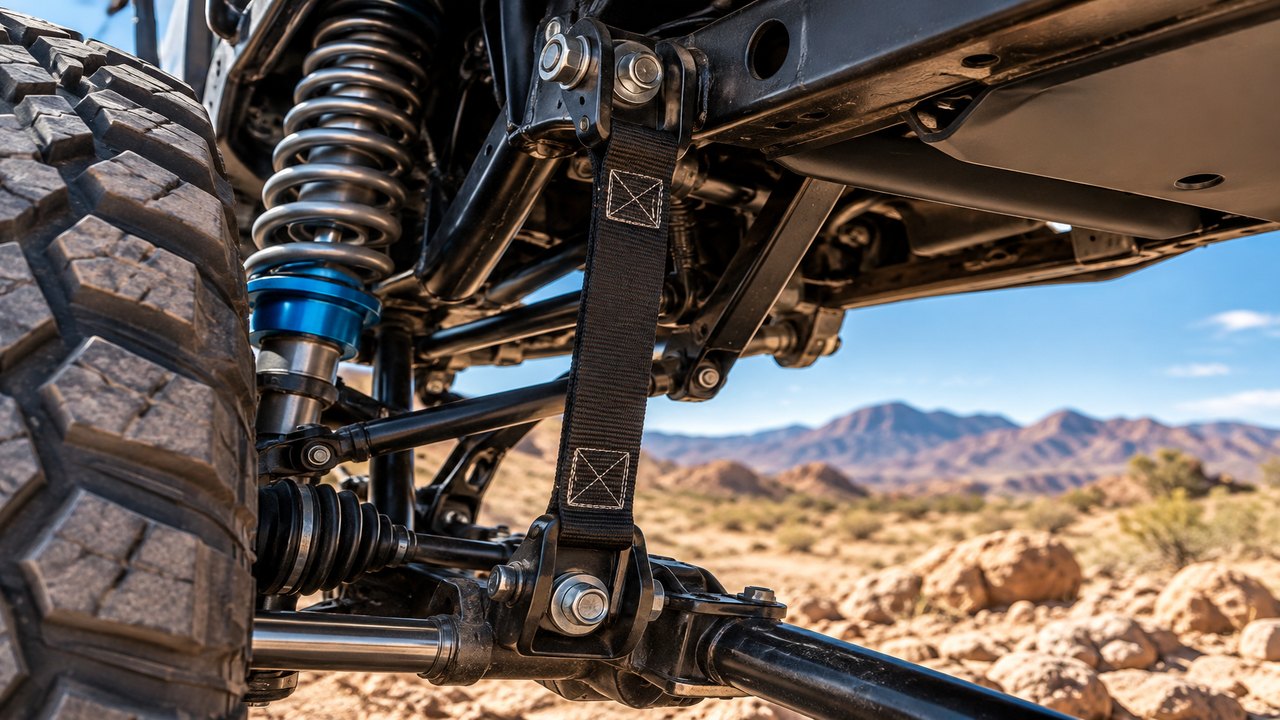
Suspension limit straps are heavy-duty flexible straps that stop a suspension from extending beyond a safe maximum droop position. They become taut near full extension and prevent shocks, CV joints, U-joints, brake hoses, ABS wiring, ball joints and other components from being forced past the travel they were designed to handle.
Most of the time, a limit strap hangs relatively loose and does nothing. It becomes important only as the wheel approaches full droop—the opposite end of suspension travel from the bump stop.
That distinction explains their job better than anything else: bump stops protect the suspension at maximum compression; limit straps protect it at maximum extension.
They are most common on lifted trucks, Jeeps, UTVs, prerunners, rock crawlers and custom long-travel suspensions. A stock vehicle does not automatically need them, and adding straps that are too short can unnecessarily sacrifice usable suspension travel. The correct setup limits droop just before another component reaches an unsafe limit.
Suspension Limit Straps at a Glance
| Question | Short Answer |
|---|---|
| What do limit straps do? | Limit maximum suspension droop or extension |
| When do they work? | Near full droop, when the strap becomes taut |
| What do they protect? | Shocks, CV joints, U-joints, brake hoses, wiring and suspension joints |
| Do they work in compression? | No; they normally hang slack as the suspension compresses |
| Do all vehicles need them? | No; they are most useful when another component would otherwise become the droop limiter |
| Are they the same as bump stops? | No; bump stops control compression, limit straps control extension |
| Can they reduce wheel travel? | Yes, if sized too short |
| Should the shock be the droop stop? | Not unless that specific shock and suspension are designed for it |
What Is Full Droop?
Full droop is the suspension’s maximum downward or extended position. It occurs when the wheel moves away from the chassis as far as the suspension allows.
You may see this when a truck lifts a wheel over a ledge, becomes airborne, crosses deeply uneven terrain or is raised by the chassis with the wheels hanging.
Droop is the opposite of bump or compression:
- Bump/compression: the wheel moves upward toward the chassis.
- Droop/extension: the wheel moves downward away from the chassis.
A properly designed suspension needs controlled limits at both ends. Our guide to what bump stops do covers the compression side; limit straps handle the opposite extreme.
How Suspension Limit Straps Work
A limit strap typically connects a point on the chassis or frame to the axle, control arm or another moving suspension member.
At ride height and during compression, the distance between those mounting points is shorter than the strap, so the webbing hangs slack.
As the suspension extends, the two mounting points move farther apart. Eventually the strap straightens and begins carrying tension.
Once loaded, the strap prevents the suspension from extending farther than its designed limit.
That means the strap becomes the deliberate droop limiter instead of leaving the job to whichever component happens to run out of movement first.
Why a Flexible Strap Is Used Instead of a Rigid Stop
A suspension reaching full droop can create a substantial dynamic load. The axle, wheel, tire, brake assembly and other unsprung components are moving away from the chassis and must eventually be stopped.
A flexible webbing strap can absorb part of that load through controlled stretch instead of producing the abrupt impact that a completely rigid link could create.
That does not mean every strap stretches the same amount. Material, construction, length, moisture, temperature, age and load can all affect elongation, which is why manufacturer-specific sizing information matters.
Why Shocks Should Not Automatically Be the Droop Limit
A common mistake is assuming that because a shock absorber can extend only so far, it should automatically be the component that stops the suspension.
At full extension, the shock has reached the end of its stroke. If the axle, control arm and wheel assembly continue moving downward with significant momentum, that load is transferred into the shock’s internal extension stop, shaft, piston assembly and mounting points.
This is commonly called shock top-out.
An occasional gentle extension event is very different from repeatedly letting a heavy off-road axle slam against the shock at speed.
Bilstein’s suspension guidance specifically notes that shocks without dedicated zone control should not be used as droop limiters or bump stops; the complete suspension should instead be cycled to determine safe full bump and full droop limits.
A correctly positioned limit strap lets the strap and its mounts accept the extension load before the shock reaches a damaging top-out condition.
What Components Can Limit Straps Protect?
The shock is only one possible reason to limit droop. The correct droop limit is determined by the first component that reaches its safe operating limit.
Shock Absorbers and Coilovers
A strap can prevent repeated shock top-out and reduce the load transferred through shock mounts when the suspension reaches maximum extension.
CV Axles and CV Joints
Independent suspension can place CV joints at increasingly severe angles as the wheel droops. Excessive angle can increase joint stress, boot distortion and binding risk.
This makes limit straps especially useful on some modified IFS trucks and UTVs where aftermarket shocks or control arms provide more droop than the driveline can safely use.
Driveshafts and U-Joints
On solid-axle vehicles, extreme axle droop can increase driveshaft and universal-joint operating angles. Depending on geometry, the driveshaft may also have plunge or slip-yoke limits that need to remain within a safe range.
Brake Hoses
A flexible brake hose needs enough length for steering and suspension movement, but it should never become the device that physically stops droop.
If a hose becomes tight at full extension, the suspension either needs more hose length or less allowable droop—or both, depending on the design.
ABS and Sensor Wiring
ABS sensor wires, electronic damper wiring and other harnesses routed to the wheel or axle also need slack through the complete travel range.
A torn wire may be less dramatic than a broken CV joint, but it still means the suspension was allowed to move beyond the safe envelope of the vehicle.
Ball Joints, Uniballs and Heim Joints
Suspension joints have finite angular misalignment. A long-travel control arm may physically continue moving even after a joint approaches its safe articulation angle.
A limit strap can stop motion before a joint binds against its housing or is loaded at an extreme angle.
Limit Straps vs Bump Stops
These components are often discussed together because they control opposite ends of the same suspension travel envelope.
| Limit Strap | Bump Stop |
|---|---|
| Controls extension/droop | Controls compression/bump |
| Becomes loaded as the wheel moves downward | Becomes loaded as the wheel moves upward |
| Helps prevent shock top-out | Helps prevent shock bottom-out |
| Can protect CVs, brake hoses and droop-sensitive joints | Can protect tires, chassis, shocks and compression-sensitive components |
| Normally flexible webbing | Usually rubber, foam, polyurethane or hydraulic |
| Normally slack during compression | Inactive until compression reaches its engagement point |
On a well-developed off-road suspension, the bump stop and limit strap define the safe compression and extension endpoints while the springs, shocks and links control what happens between them.
Do Limit Straps Reduce Suspension Travel?
Yes—but that can be exactly what they are supposed to do.
A limit strap intentionally prevents the suspension from reaching a position that would otherwise be possible mechanically.
The important question is whether that lost movement was safe usable travel in the first place.
If allowing another inch of droop causes the CV joint to bind or the brake hose to stretch tight, that inch should not be considered useful suspension travel simply because the shock can extend that far.
Conversely, a strap that engages far too early wastes safe articulation and can unnecessarily lift a tire off the terrain.
The goal is not maximum droop at any cost. It is maximum safe usable droop.
Do You Need Suspension Limit Straps?
Not every vehicle needs aftermarket limit straps.
A stock suspension may already control extension safely through factory shock design, suspension geometry, internal droop stops or other components engineered as part of the original system.
Limit straps become increasingly relevant when suspension modifications allow more droop or increase the loads seen at full extension.
They are worth considering when:
- longer-travel shocks or coilovers have been installed
- aftermarket control arms allow additional droop
- a lifted IFS vehicle approaches excessive CV angles
- a solid axle hangs from the shocks at full extension
- brake hoses or ABS wiring approach their maximum safe length
- the vehicle repeatedly becomes airborne or unloads suspension at speed
- rock crawling regularly brings individual corners to full droop
- custom suspension geometry no longer has an appropriate factory droop stop
If the suspension never approaches an unsafe extension limit, adding straps merely because the vehicle is lifted may provide no useful benefit.
Lifted Trucks Do Not Automatically Need Limit Straps
A suspension lift by itself is not enough information to decide whether limit straps are required.
Two trucks with the same advertised lift height can have completely different droop capability depending on shocks, control arms, radius arms, springs, sway bars, brake hoses and driveline geometry.
A spacer lift using factory-length shocks may retain nearly factory extension limits. A suspension using longer coilovers and redesigned control arms may allow dramatically more droop.
That is why a blanket rule such as “every 3-inch lift needs limit straps” is unreliable.
Cycle the actual suspension—or use the limits specified by the suspension manufacturer—to find out what component reaches its safe limit first.
Limit Straps on Long-Travel Suspension
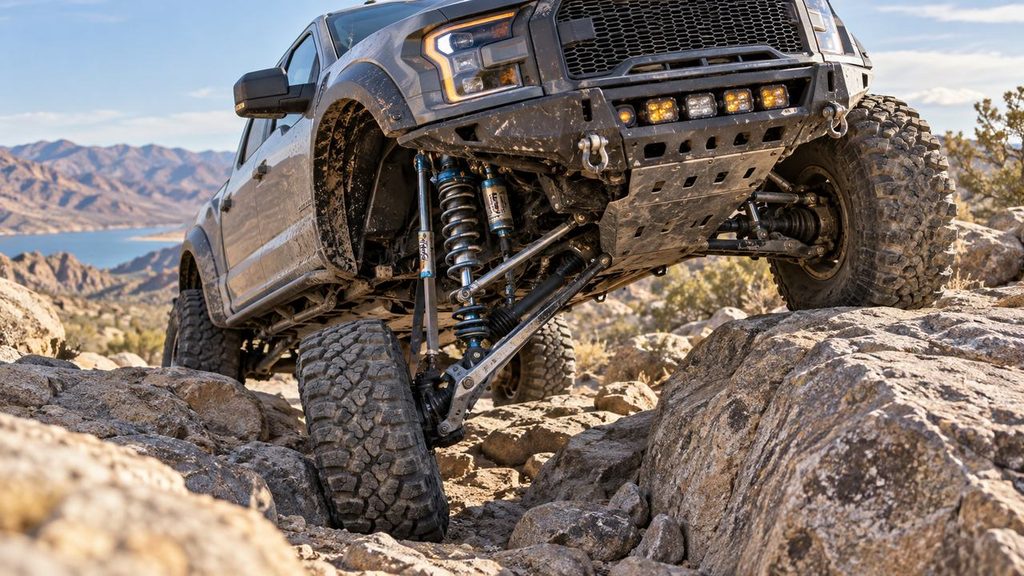
Long-travel suspension makes droop control particularly important because the whole point of the system is to increase usable wheel movement.
More travel means every hose, joint, axle shaft, steering component and shock must remain within its operating range over a larger arc.
A purpose-built long-travel suspension system therefore needs clearly defined full-bump and full-droop limits rather than simply allowing the shock to determine both ends of travel.
The limit strap protects the extension side of that envelope without changing the system’s intended travel everywhere else.
IFS vs Solid Axle: Where Limit Straps Matter
Independent Front Suspension
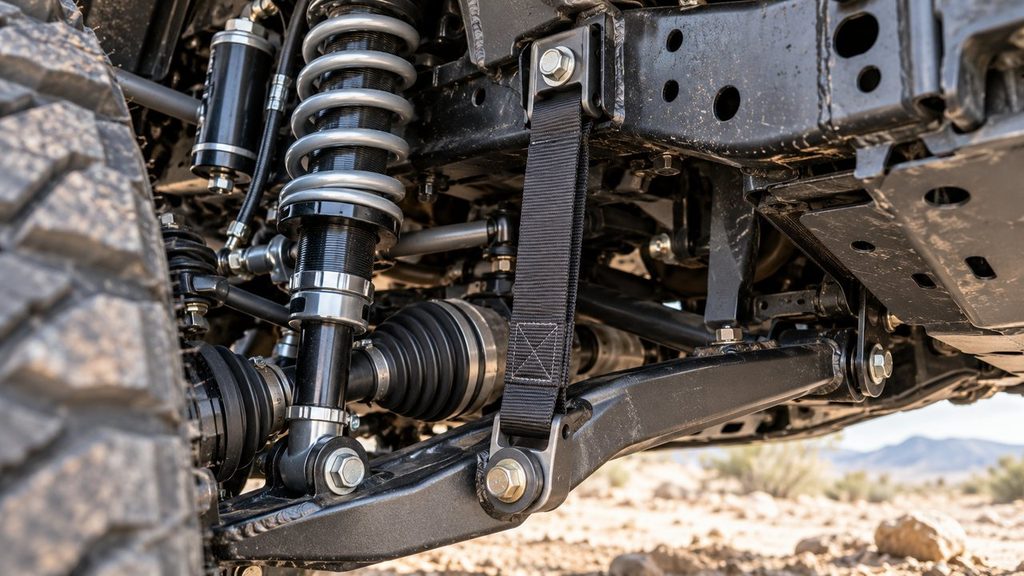
On IFS, each wheel moves through an arc defined by its control arms. As the wheel droops, the CV axle, ball joint or uniball, tie rod and shock all approach different geometric limits.
One component may reach its safe angle before the shock reaches full extension.
That is why modified IFS vehicles often use an individual limit strap at each front corner. The strap can cap droop before CV bind, joint misalignment or shock top-out becomes the mechanical stop.
Solid Axle Suspension
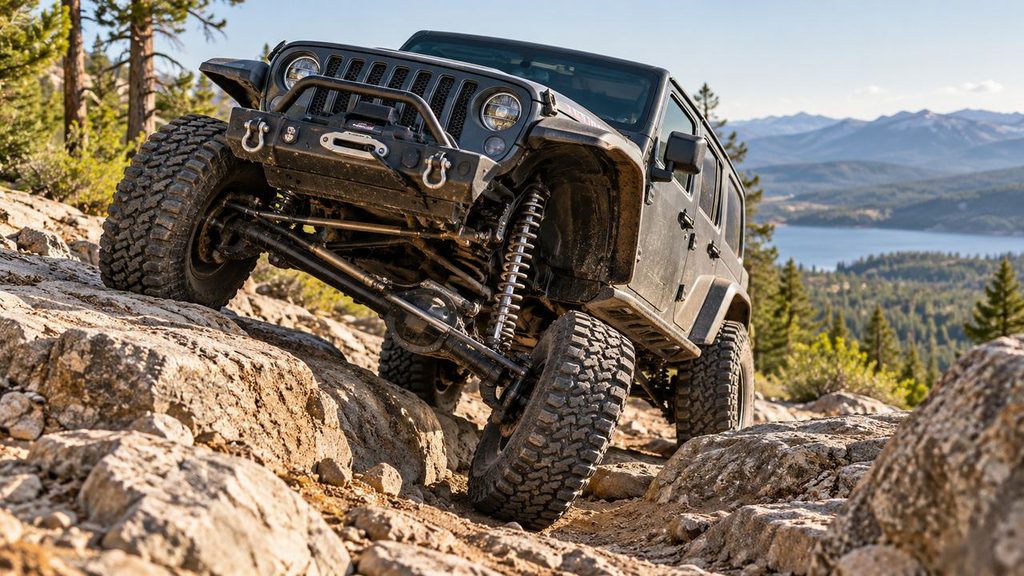
A solid axle moves differently because the left and right wheels are connected by the axle housing.
Droop can still stress shocks, driveshafts, brake hoses and suspension joints, especially when the axle hangs far below the chassis or one side articulates deeply.
Depending on the design, straps may be installed per side or positioned to control axle droop in another way.
If you want the broader differences between these architectures, see our solid axle vs independent suspension guide.
How to Determine the Correct Limit Strap Length
This is where overly simple internet advice causes problems.
You will often see recommendations to measure at full droop and order a strap a fixed amount shorter. That can be a useful starting principle for a specific product, but there is no universal number that works for every strap and suspension.
The correct length depends on:
- the exact mounting points
- shock extended length
- CV and U-joint limits
- ball-joint or uniball angle
- brake-hose and wiring length
- strap material and construction
- expected strap stretch under load
- mounting angle
- adjustable clevis range
- manufacturer measurement convention
The safe approach is to determine the suspension’s maximum allowable droop first, then select the strap and mounting geometry that stop movement before that limit.
Measure at Full Droop, Not Ride Height
Ride-height measurements do not tell you the distance between the strap mounts at maximum extension.
Suspension geometry changes as the wheel moves, so the chassis needs to be safely supported while the relevant corner or axle is cycled toward its intended full-droop position.
Measure between the exact mounting points the strap will use. Many suspension straps are specified center-of-hole to center-of-hole, but you should verify the convention used by the actual manufacturer before ordering.
Find the Real Mechanical Limit First
Do not simply let the shock fully extend and assume that position is correct.
Slowly cycle the suspension and check what happens to:
- shock stroke
- CV and U-joint angles
- ball joints and uniballs
- brake hoses
- ABS wiring
- tie rods and steering links
- driveshaft slip travel
- springs and retainers
The safe full-droop position is whichever point occurs before the first component reaches an unacceptable limit.
How Much Should a Limit Strap Stretch?
Do not assume a universal stretch percentage or inches-per-foot value.
Different manufacturers use different webbing materials, layer counts, stitching patterns and hardware. Nylon, polyester and other constructions can behave differently under dynamic load.
Some manufacturers publish meaningful loaded-stretch figures for their own straps. Those numbers are useful for that specific product, but they should not automatically be applied to another brand.
Straps can also settle or lengthen slightly after initial use, which is why adjustable mounting hardware can be helpful for maintaining the intended droop limit over time.
Why Adjustable Clevises Are Useful
An adjustable clevis or adjustable mounting system lets you fine-tune the effective strap length without replacing the strap or welding new mounting tabs.
This is useful when:
- the strap beds in after initial use
- a suspension setup changes
- you need small droop adjustments during testing
- the available strap lengths do not perfectly match the required geometry
Adjustment does not eliminate the need to measure correctly. It simply gives you a practical way to refine the final engagement point.
Where Should Limit Straps Be Mounted?
The ideal mounting points depend on the suspension architecture, but the strap should generally connect a strong chassis point to the suspension member whose droop you need to control.
Common lower mounting points include:
- solid axle housing or dedicated axle tabs
- lower control arms
- upper control arms on certain IFS designs
- purpose-built brackets near existing shock mounts
The mounting tabs should be aligned with the direction in which the strap pulls so the hardware is not heavily side-loaded as the strap becomes taut.
The mounting structure itself also needs to be strong enough for dynamic suspension loads. A high-strength strap attached to a weak tab merely moves the failure point from the webbing to the bracket.
Watch for Chafing Through the Entire Travel Range
When the suspension compresses, the strap becomes loose and can move around.
Check that it cannot become trapped between a bump stop and strike pad, rub against a tire, contact an exhaust component, wrap around a shock or repeatedly scrape a sharp bracket.
A strap that is perfectly positioned at full droop may hang somewhere completely different at full compression.
One Limit Strap per Wheel or One for the Whole Axle?
There is no single arrangement for every vehicle.
Independent suspension commonly uses an individual strap for each corner because each wheel moves independently.
Solid-axle vehicles can also use one strap per side, especially when cross-axle articulation needs to be controlled independently.
Some specialized builds use different arrangements based on suspension links, axle movement and racing requirements.
High-load race vehicles may even use multiple straps at one location for load distribution or redundancy, but that should not be interpreted as a requirement for ordinary recreational builds.
Limit Straps and Off-Road Articulation
A common concern is that limit straps will hurt articulation.
They can—if they engage before the suspension reaches its true safe droop limit.
A properly sized strap should normally remain slack through the useful portion of suspension travel and become loaded only as the suspension approaches the maximum extension you deliberately chose.
This is different from a sway bar, which resists left-to-right suspension movement throughout parts of the normal travel range. Our sway bar disconnect guide explains why disconnecting that component can increase usable cross-axle articulation.
The limit strap’s job is not to make the suspension less flexible. Its job is to stop flexibility before flexibility becomes component overextension.
Springs Can Add Force at Full Droop
The weight of the wheel and axle is not always the only force trying to extend the suspension.
Depending on the spring arrangement, a coilover, air shock or other spring element may still be exerting extension force as the suspension approaches droop.
That means the strap and its mounting points may experience more than the static hanging weight of the wheel or axle assembly.
Dynamic events such as a wheel dropping off a ledge or a vehicle becoming airborne can increase loads further.
This is why mounting strength and strap construction matter just as much as choosing the correct length.
Do Limit Straps Improve Handling?
They are not a conventional handling upgrade in the way shocks, springs or anti-roll bars are.
During normal operation a correctly sized strap is usually slack, so it contributes essentially no spring or damping effect.
Its benefit is consistency at the edge of the suspension envelope: the wheel cannot suddenly extend beyond the chosen limit and load other components unpredictably.
For racing, jumping or aggressive off-road driving, that predictable maximum droop position can be valuable. For ordinary street driving, the strap should rarely be active at all.
Limit Straps vs Longer Shocks
Installing a longer shock does not automatically mean the suspension can safely use every additional inch of shock extension.
A longer shock may expose limitations elsewhere:
- CV angles
- brake-hose length
- joint articulation
- driveshaft travel
- ABS wiring
- spring retention
- control-arm geometry
If one of those becomes unsafe before the shock reaches full extension, a limit strap may be needed to establish a shorter usable droop limit.
That is also why shock selection should be based on the complete suspension geometry rather than simply choosing the longest damper that physically bolts in.
What Happens If Limit Straps Are Too Short?
A strap that is too short engages too early and prevents the suspension from using droop that would otherwise be safe.
Possible effects include:
- reduced wheel travel
- less off-road articulation
- a tire lifting sooner over uneven terrain
- additional load being transferred into strap mounts unnecessarily
- a suspension that feels constrained at full extension
If the strap is dramatically too short, it can become loaded during normal suspension movement rather than only near the designed travel limit.
What Happens If Limit Straps Are Too Long?
A strap that is too long may not become taut until after the component you intended to protect has already reached its limit.
For example, the shock might top out first, or the CV joint may already be operating at an excessive angle before the strap carries meaningful load.
At that point the strap is present, but it is not actually functioning as the suspension’s droop limiter.
How to Inspect Suspension Limit Straps
Limit straps are wear components. They operate in an exposed environment and can be affected by dirt, water, UV exposure, sharp debris, heat and repeated high-load cycles.
Inspect them regularly for:
- frayed fibers
- cuts or torn stitching
- abrasion along an edge
- heat damage or melting
- UV degradation or material cracking
- damaged end hardware
- loose bolts or clevises
- bent or cracked mounting tabs
- unexpected permanent length change
Replacement should be based on condition and manufacturer guidance rather than an invented universal mileage or time interval.
After installing new straps, recheck their engagement point and mounting hardware after the first few off-road cycles because the webbing and hardware may settle.
Common Limit Strap Setup Mistakes
Choosing Length From Lift Height Alone
Lift height does not tell you full-droop geometry. Measure or follow the suspension manufacturer’s specification.
Letting the Shock Top Out Before the Strap
If the shock reaches its extension limit first, the strap is not doing the job you installed it to do.
Sizing From an Unloaded Strap Without Accounting for Stretch
Webbing can elongate under load. Use the actual manufacturer’s specifications rather than assuming every strap behaves identically.
Weak or Misaligned Mounting Tabs
The strap can only protect the suspension if the mounts can safely carry the load and the hardware is aligned with the direction of pull.
Forgetting About the Strap at Full Compression
When slack, the strap still needs somewhere safe to go. It should not become trapped under a bump stop, against a tire or around a hot exhaust component.
Limiting Droop Before Finding the Actual Weakest Component
The strap length should come from the suspension’s safe operating envelope—not from a generic recommendation copied from another vehicle.
Frequently Asked Questions
Are suspension limit straps only for off-road vehicles?
They are most common in off-road and competition applications because those vehicles frequently approach full droop, but any custom suspension that requires a dedicated extension limit can potentially use them.
Can limit straps protect brake lines?
Yes, a correctly configured strap can prevent the suspension from extending far enough to stretch a brake hose beyond its safe length. However, the brake hose itself still needs sufficient length and correct routing for the suspension’s intended travel.
Do limit straps protect CV axles?
They can help by preventing suspension droop from pushing CV joints beyond an acceptable angle or plunge position. The correct limit must be established from the actual CV and suspension geometry rather than assuming a strap automatically makes an aggressive CV angle safe.
Can I use the shock as a limit strap?
Only if the shock and suspension manufacturer specifically designed the damper to act as the extension limiter. Many performance suspension setups use dedicated straps so the shock does not repeatedly absorb full-droop impact loads.
Should a limit strap be tight at ride height?
No, not in a conventional setup. It should normally remain slack through normal ride-height movement and become loaded only as the suspension approaches its intended maximum droop position.
Can limit straps get wet?
Off-road limit straps are designed for exposed environments, but moisture can affect the behavior of some webbing materials and dirt can accelerate abrasion. Follow the manufacturer’s specifications and inspect the straps after mud, water or severe trail use.
How many limit straps do I need?
It depends on the suspension layout. Independent suspension commonly uses one per controlled corner, while solid-axle systems can use different arrangements. High-load race applications may use multiple straps, but more straps are not automatically better for a normal trail vehicle.
Do limit straps stretch over time?
They can. Webbing may settle or elongate under repeated loading, and the amount depends on construction and material. This is why the engagement point should be rechecked after installation and periodically during service.
The Right Droop Limit Protects Travel Instead of Wasting It
Suspension limit straps are simple components, but their job is more precise than merely “stopping the axle from dropping too far.”
They define the point where useful suspension extension must end because continuing farther would place the shock, CV joint, driveshaft, brake hose, wiring or suspension joint outside its safe operating range.
A good setup therefore starts with the suspension—not with the strap catalog.
Cycle the suspension, identify the first real limitation, determine the safe maximum droop position, then choose and mount the strap so it becomes loaded just before that limit.
Done correctly, a limit strap does not rob the vehicle of valuable articulation. It removes only the movement that was never safely usable in the first place.