What Are Bump Stops? What They Do & How They Work
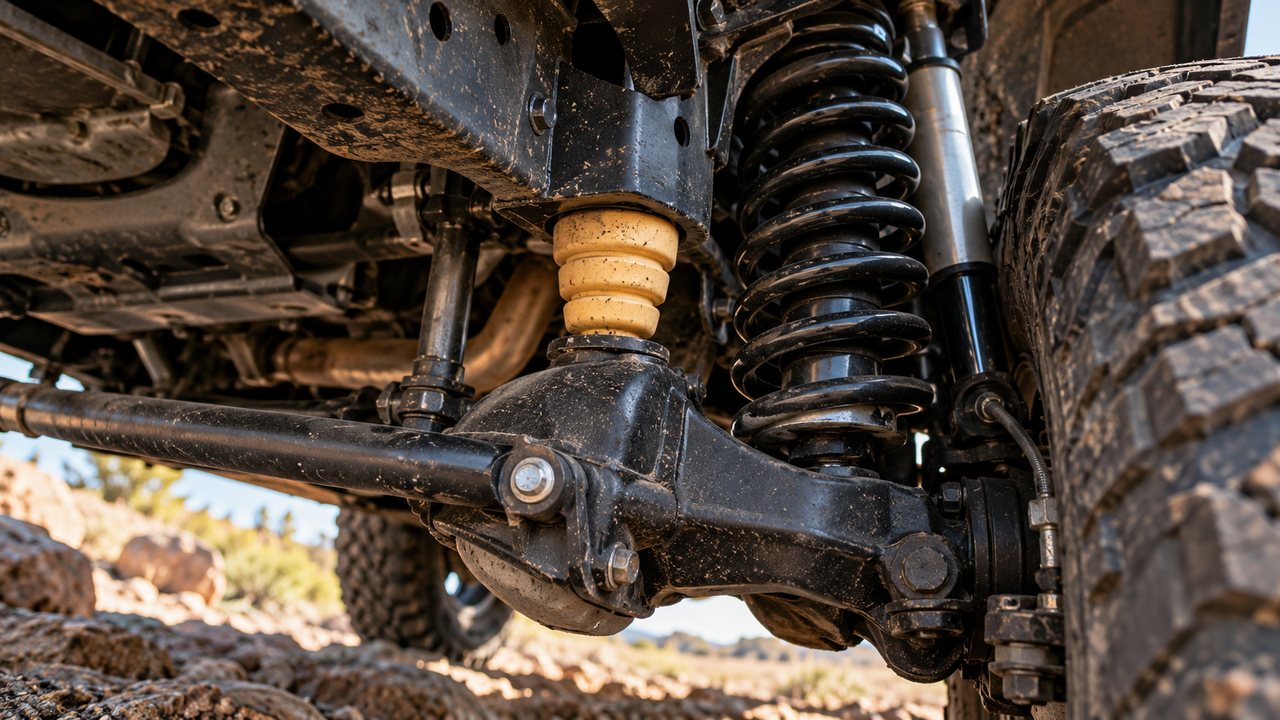
Bump stops are suspension components that control the final stage of compression travel before the suspension reaches a damaging mechanical limit. Also called jounce bumpers, they cushion hard compression events, help prevent metal-to-metal contact and can protect shocks, struts, control arms, axles, tires and the chassis when the suspension approaches full bump.
They are more sophisticated than simple rubber blocks. Many modern bump stops are designed to compress progressively, adding increasing resistance as the suspension moves deeper into its travel. In that sense, the bump stop can act like a secondary spring near the end of compression rather than an emergency part that works only during a catastrophic impact.
For most drivers, the important takeaway is simple: your suspension needs enough bump travel to absorb normal impacts, but it also needs a controlled way to stop before something expensive becomes the hard limit. That is the bump stop’s job.
Bump Stops at a Glance
| Question | Short Answer |
|---|---|
| What are bump stops? | Compressible suspension limiters that control the end of compression travel |
| What are they also called? | Jounce bumpers, suspension bumpers or compression stops |
| What do they protect? | Shocks, struts, control arms, axles, tires, springs and chassis components |
| When do they engage? | Near the later portion of compression travel; exact timing depends on the suspension design |
| What are they made from? | Commonly rubber, polyurethane or microcellular foam; performance vehicles may use hydraulic designs |
| Do they affect ride quality? | Yes, especially once they begin contributing to the suspension’s effective spring rate |
| Are they optional? | Not on a suspension engineered to rely on them for travel control and component protection |
How Do Bump Stops Work?
Every suspension has a finite range of motion. When the wheel moves upward relative to the body, the suspension is in compression, also called jounce or bump travel.
During normal driving, the main spring supports the vehicle while the shock absorber controls how quickly the suspension moves. As compression increases, however, the suspension eventually approaches physical limits imposed by the shock, strut, control arms, axle, tire clearance or other components.
The bump stop is positioned so it engages before an unacceptable limit is reached.
Once contact begins, the bump stop compresses. That compression adds resistance to further wheel movement and decelerates the suspension before it reaches a harsh mechanical stop.
Instead of the axle slamming directly into the frame—or the shock piston reaching its internal limit at full speed—the bump stop absorbs and redirects part of that energy over a controlled distance.
Why Progressive Compression Matters
A good bump stop does not necessarily behave like a solid block.
Many designs become progressively harder to compress. Initial contact can be relatively soft, then resistance rises rapidly as the material is squeezed farther.
This creates a rising effective spring rate near the end of suspension travel. The result is a smoother transition from the normal spring into the travel limit than you would get from an abrupt hard stop.
That principle is similar to the way progressively wound springs change their effective behavior through compression, although the bump stop operates over a much smaller portion of the suspension cycle. Our linear vs progressive springs comparison explains that broader spring-rate concept separately.
Where Are Bump Stops Located?
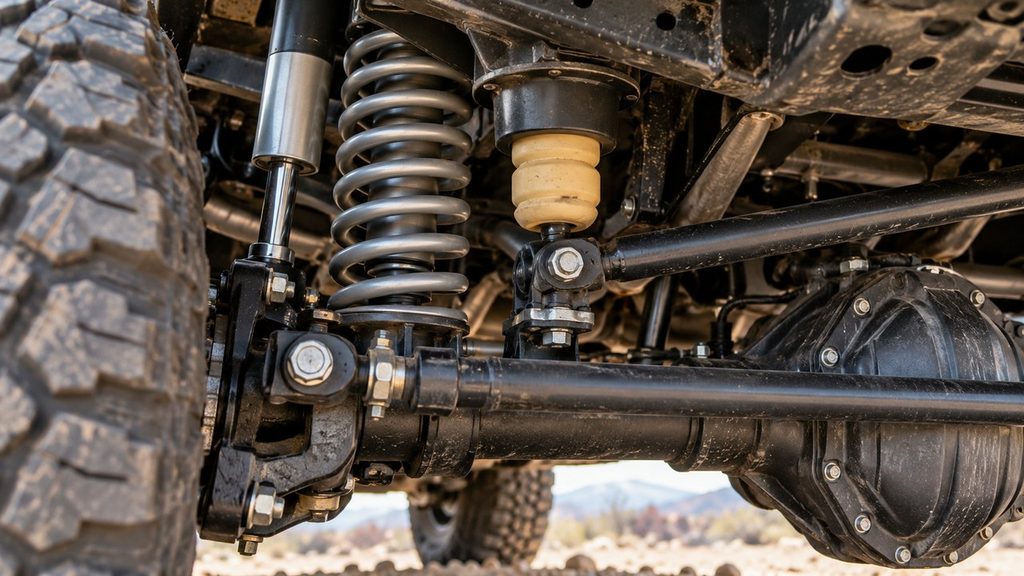
The exact location depends on the suspension layout.
- Solid axle: commonly mounted to the frame or inside a spring tower so the stop eventually contacts the axle or a dedicated strike pad.
- Control-arm suspension: may be positioned so a control arm contacts the stop near full compression.
- Shock or strut: some bump stops fit around the damper shaft beneath the dust boot.
- Coilover: the bump stop may be incorporated into the shock assembly and engage as the shaft approaches maximum compression.
- Performance off-road suspension: a separate hydraulic bump stop may contact a reinforced strike pad on the axle or control arm.
Regardless of location, the design goal is similar: intervene before another component becomes the uncontrolled suspension stop.
Bump Stop vs Jounce Bumper: Is There a Difference?
In everyday automotive use, bump stop and jounce bumper are often used interchangeably.
“Jounce” is the technical term commonly used for upward wheel movement or suspension compression, so “jounce bumper” describes a bumper that controls the compression end of travel.
Some engineers and manufacturers use the term jounce bumper specifically for sophisticated progressive elements that participate in suspension tuning, while “bump stop” may also describe a simpler mechanical cushion. In parts catalogs and normal repair discussions, however, both terms frequently refer to the same general component.
The important distinction is not the name. It is how the component is designed to engage and what role it plays in that particular suspension.
Why Bump Stops Are More Than an Emergency Cushion
Older or simpler designs may function mainly as protection against a severe bottom-out. Modern suspension engineers can use the jounce bumper much more deliberately.
By choosing its material, height, shape and engagement point, engineers can determine when the bump stop starts contributing and how rapidly its resistance rises.
This allows a vehicle to use relatively compliant main springs for normal ride comfort while adding much more resistance as compression becomes severe.
That additional rate can help control events such as:
- deep potholes
- large road dips
- hard landings
- heavy payload compression
- large suspension inputs off road
- hard cornering or braking on designs where the jounce bumper engages during those events
So while “it stops metal hitting metal” is technically true, it does not describe the complete role of a properly tuned progressive bump stop.
What Does Bottoming Out Mean?
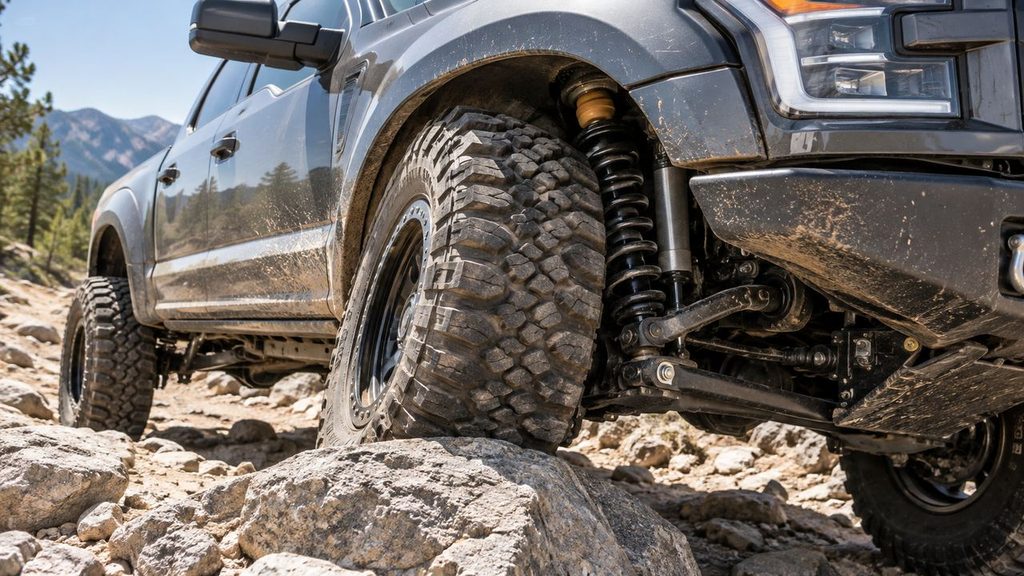
Bottoming out means the suspension has consumed essentially all of its available compression travel and has reached a limiting component.
That limiting component should ideally be a bump stop designed to absorb the event.
Without correct travel control, the limit could instead become:
- the shock absorber reaching full internal compression
- a strut running out of stroke
- an axle contacting the frame
- a control arm hitting the chassis
- a coil spring becoming excessively compressed
- a tire contacting the fender, inner wheel well or body
- another suspension or steering component reaching an unsafe angle
A correctly configured suspension is designed so those components are not asked to act as the primary bump stop.
Bump Travel vs Droop Travel
Suspension movement is often discussed in two directions:
- Bump or compression: the wheel moves upward toward the chassis.
- Droop or rebound: the wheel moves downward away from the chassis.
A conventional bump stop manages the compression side.
Droop is limited by other components depending on the vehicle, such as the shock’s extended length, suspension geometry or purpose-built limit straps.
This distinction is important because increasing one direction of travel does not automatically increase the other. A vehicle can have plenty of droop while having very little available compression travel at static ride height—or the reverse.
For a deeper explanation of actual wheel travel rather than end-of-travel protection, see our long-travel suspension guide.
Bump Stops vs Shock Absorbers
Bump stops and shocks both influence suspension movement, but they are not interchangeable.
| Bump Stop | Shock Absorber |
|---|---|
| Primarily manages the later stage of compression | Controls suspension velocity throughout normal travel |
| Adds resistance as the suspension approaches its limit | Uses damping to control compression and rebound motion |
| May behave like a secondary spring | Is primarily a damper, not the vehicle’s main spring |
| Protects against harsh bottom-out | Controls oscillation and unwanted suspension motion |
| Can be rubber, foam, polyurethane or hydraulic | Typically uses a piston, fluid and valving |
A shock should not routinely be used as the hard mechanical stop for the suspension. Repeatedly slamming a damper into the end of its stroke can damage shafts, seals, pistons or internal components.
This becomes especially important after lifting or modifying a truck. Shock length, bump-stop engagement and actual axle travel need to work together. If the damper is changed, our guide to the best shocks for lifted trucks explains why correct extended and compressed length matter as much as the shock brand itself.
Types of Bump Stops
Bump stops range from inexpensive factory rubber pieces to tunable hydraulic units used in serious off-road builds.
Rubber Bump Stops
Rubber is common because it is simple, durable, quiet and inexpensive.
The shape of the part can be engineered to change how quickly resistance builds. Hollow sections, ribs, cones and tapered profiles can all influence the compression curve.
Polyurethane Bump Stops
Polyurethane is commonly used in aftermarket suspension components because it can be durable and resistant to environmental degradation.
Depending on formulation and shape, it may feel firmer than an equivalent rubber design. “Polyurethane” alone does not tell you the complete spring-rate curve, so choosing solely by material is a mistake.
Microcellular Foam Jounce Bumpers
Microcellular elastomer or foam bumpers contain a cellular structure that can produce highly progressive compression behavior.
These are commonly used when the bump stop is intended to participate smoothly in the suspension’s effective spring rate rather than simply provide a final hard cushion.
Hydraulic Bump Stops
Hydraulic bump stops are common on high-performance off-road vehicles where the suspension must absorb large amounts of energy near full compression.
They operate more like compact dampers than simple rubber cushions. A piston moves through fluid and valving as the bump stop compresses, generating velocity-sensitive resistance that can slow a hard compression event in a more controlled way.
Some designs can be tuned through pressure, valving or engagement position, making them useful on vehicles that repeatedly use most of their suspension travel at speed.
That sophistication comes with additional cost, fabrication, setup and maintenance. A daily-driven stock vehicle does not automatically benefit from replacing its factory jounce bumpers with hydraulic units.
What Are Bump Stop Extensions?
A bump stop extension changes when the bump stop contacts the axle, control arm or strike pad by effectively reducing the available compression distance before engagement.
Extensions are common in lifted suspension kits, but the name can make their purpose seem backwards. A taller vehicle does not necessarily need a longer bump stop simply because the body sits farther from the axle.
The reason is usually component protection.
A lift may introduce longer springs, different shocks, larger tires, relocated brackets or altered steering and driveline angles. The bump stop may need to engage earlier so one of those components does not reach its own limit first.
Why Lifted Trucks May Need Longer Bump Stops
Lifting a truck changes more than ride height.
Depending on the setup, maximum safe compression may now be determined by:
- compressed shock length
- larger tire clearance
- fender or inner wheel-well clearance
- steering-linkage clearance
- control-arm or radius-arm contact
- driveshaft or CV-joint operating angle
- spring compression
- aftermarket reservoir or hose placement
If the tire can hit the body before the original bump stop engages, for example, an extension may deliberately stop compression sooner.
Likewise, installing a longer shock does not automatically mean the suspension should be allowed to compress until that shock reaches its shortest possible length.
The bump-stop position needs to protect the complete system, not just maximize a travel number.
More Bump Travel Is Not Always Better
Suspension travel is valuable, especially off road, but allowing unrestricted compression until something collides is not useful travel.
The correct amount of bump travel is the amount the complete suspension can safely use while maintaining clearance and keeping all components within their operating limits.
A shorter bump stop may increase available compression in one sense, but it can also allow:
- a tire to damage a fender
- a shock to bottom internally
- a driveshaft or CV joint to exceed a safe angle
- a coil spring to bind
- steering or brake components to contact nearby hardware
That is why randomly trimming bump stops to “gain travel” can create more problems than it solves.
Bump Stops and Off-Road Articulation
Off-road suspension setup is a balance between allowing useful wheel movement and protecting the vehicle at the extremes.
A bump stop limits upward movement on a compressed corner. It does not directly determine how far the opposite wheel can droop, although the overall suspension geometry connects those movements on many vehicles.
This is different from a sway bar, which directly resists differences in left-to-right wheel movement. If cross-axle flex is the issue, our sway bar disconnect guide explains that separate limitation.
On serious off-road builds, bump stops, limit straps, shock lengths, driveshaft angles, brake lines and tire clearance should all be considered together when defining the suspension’s usable travel envelope.
Bump Stops vs Limit Straps
Bump stops and limit straps work at opposite ends of suspension travel.
| Bump Stop | Limit Strap |
|---|---|
| Controls compression | Controls extension or droop |
| Works as the wheel moves upward | Works as the wheel moves downward |
| Prevents harmful bottom-out | Prevents harmful overextension |
| Can protect shocks at full compression | Can protect shocks, CV joints, driveshafts and brake lines at full droop |
A properly designed off-road suspension may use both because a shock absorber should not necessarily be the sacrificial mechanical limit at either end of travel.
Bump Stops With Leaf Springs and Coil Springs
Both leaf-sprung and coil-sprung vehicles can use bump stops.
On a solid axle, the stop is often mounted between the frame and axle housing regardless of which spring type supports the vehicle.
With leaf springs, preventing excessive compression can also help keep the spring pack from being forced into undesirable shapes under a severe impact.
Coil-sprung systems may place the bump stop inside the coil, above the axle or at another suspension contact point depending on the layout.
If you are comparing the spring systems themselves rather than their compression limiters, see our leaf spring vs coil spring comparison.
Are Bump Stops Necessary?
Yes, if the suspension was engineered to use them.
Removing a bump stop does not simply unlock harmless extra travel. It changes which part becomes the next compression limit.
That could be the shock absorber, tire, spring, control arm, axle or chassis.
Even if the vehicle does not frequently hit its bump stops during ordinary driving, they still provide protection when a large pothole, road dip, heavy load or emergency maneuver uses more suspension travel than usual.
On vehicles where the jounce bumper is deliberately integrated into the spring-rate curve, removing or substantially shortening it can also change handling before the suspension reaches absolute full compression.
What Happens If You Drive Without Bump Stops?
A missing bump stop may not be obvious on a perfectly smooth road because the suspension may never reach that part of its travel.
The problem appears when a large compression event occurs.
Depending on the design, driving without functioning bump stops can lead to:
- harsh metal-to-metal impacts
- shock or strut bottoming
- damaged shock seals or shafts
- tire-to-body contact
- damaged suspension brackets
- excessive stress on springs or control arms
- poor control during severe compression
How urgent the repair is depends on the vehicle and the failure, but a missing or disintegrated stop should not be considered normal simply because the car still drives.
Signs of Worn or Damaged Bump Stops
Bump stops age through repeated compression, heat, dirt, moisture and environmental exposure.
Possible signs of deterioration include:
- cracked or split rubber
- foam crumbling into pieces
- missing sections of the bumper
- a stop that has detached from its mount
- hard banging over large bumps
- visible axle, frame or control-arm impact marks
- tire rubbing that appears only at deep compression
- a harsh transition near the end of suspension travel
A loud impact does not automatically prove the bump stop is bad. Incorrect ride height, overloaded springs, mismatched shocks or insufficient bump travel can produce similar symptoms.
Why a Vehicle May Hit the Bump Stops Too Often
Bump stops are meant to be used when required, but repeatedly spending large amounts of time on them can indicate another issue.
Possible causes include:
- worn or sagging springs
- excessive vehicle load
- insufficient spring rate for added accessories
- lowered ride height
- incorrect bump-stop length
- too little static bump travel
- a suspension modification that changed the engagement point
On some vehicles, deliberate early engagement is part of the factory tuning, so seeing contact marks does not automatically indicate a fault. The problem is diagnosing every bump-stop contact as “bottoming out” without understanding the original design.
Do Bump Stops Carry Vehicle Weight?
The main suspension springs normally carry the vehicle at static ride height.
However, a progressive jounce bumper can contribute additional spring force once the suspension compresses far enough to engage it.
Under heavy loading, a vehicle may therefore spend more time close to or in contact with the bump stop.
That does not mean bump stops should be used as a workaround for routinely exceeding payload capacity. Suspension helpers cannot increase the manufacturer’s GVWR, GAWR or payload rating.
How Much Gap Should a Bump Stop Have?
There is no universal correct bump-stop gap.
The required distance depends on:
- vehicle weight
- spring rate
- motion ratio
- shock stroke
- bump-stop material and rate
- tire clearance
- suspension geometry
- intended road or off-road use
A soft progressive jounce bumper can be designed to engage relatively early, whereas a harder protective stop may have a larger free gap and engage only near maximum compression.
This is why copying another vehicle’s gap measurement or cutting a bump stop to an arbitrary length is poor suspension setup practice.
How to Check Bump-Stop Clearance After Modifying Suspension
After installing larger tires, new shocks, coilovers, control arms or a lift kit, the safest approach is to consider the suspension through its actual range of motion rather than measuring only at static ride height.
At maximum intended compression, verify that:
- the shock still has adequate compressed-stroke margin
- the tire clears the body and inner fender through steering lock
- brake hoses are not pinched or stretched
- steering components do not contact the frame or suspension
- the spring is not coil-bound or otherwise over-compressed
- driveline components remain within safe operating angles
- the bump stop contacts its intended strike surface correctly
Suspension kits engineered as complete systems normally specify the required bump-stop extensions or mounting changes. Mixing components from different systems requires more careful checking.
When Hydraulic Bump Stops Make Sense
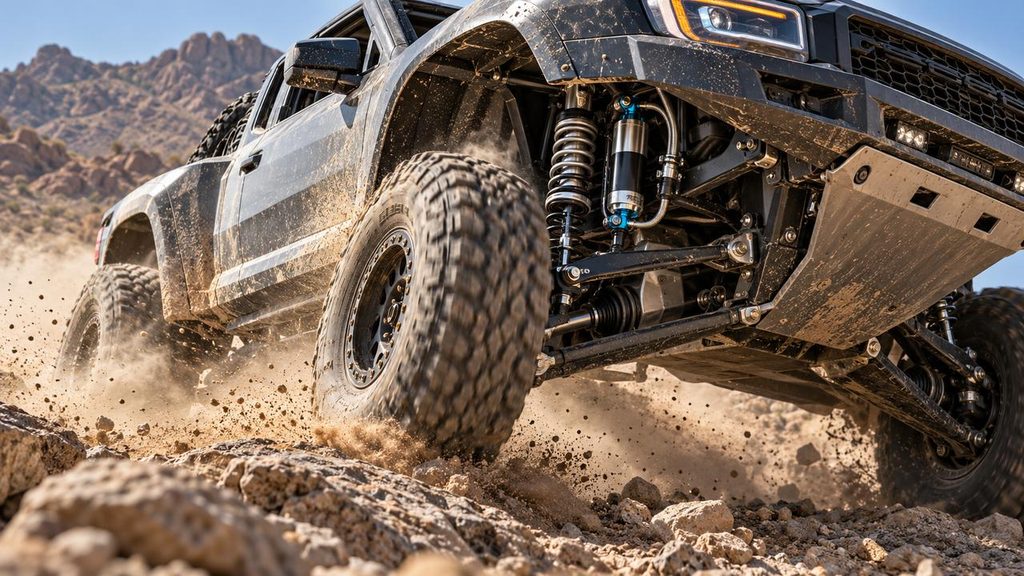
Hydraulic bump stops make the most sense when the suspension repeatedly reaches deep compression with substantial energy.
Typical applications include:
- high-speed desert driving
- off-road racing
- aggressive prerunner builds
- heavy vehicles driven quickly over repeated whoops or large impacts
- custom long-travel suspension where final-stage damping requires additional control
For slow trail driving, commuting or a stock pickup, properly designed conventional bump stops may already provide everything the suspension needs.
Hydraulic stops should therefore be viewed as a tuning tool for high-energy suspension events rather than an automatic upgrade for every off-road truck.
Common Bump Stop Mistakes
Cutting Them Just to Gain Travel
Shortening a bump stop may increase compression before contact, but that extra movement is only useful if every other component has safe clearance and travel remaining.
Using the Shock as the Travel Stop
A shock reaching full compression repeatedly can suffer internal damage. Bump-stop engagement should be coordinated with compressed shock length.
Assuming a Lift Automatically Needs the Tallest Extension
Too much extension removes usable bump travel. The correct extension is the amount required to protect tires, shocks and suspension components—not simply the largest spacer available.
Ignoring Tire Clearance at Steering Lock
A tire that clears the fender with the wheels straight may contact the body when the suspension is compressed and the steering is turned.
Treating Every Bump Stop as the Same Spring Rate
Material, shape, internal voids and dimensions all affect compression behavior. Two bump stops of identical height can respond very differently under load.
Frequently Asked Questions
Can bad bump stops cause a rough ride?
Yes. A deteriorated stop can allow harsh bottoming, while an incorrect or overly tall stop can engage too early and make the suspension feel unusually firm over larger bumps. Ride quality depends on when the stop engages and how progressively it compresses.
Can bump stops cause clunking?
A damaged or missing bump stop can allow other components to make hard contact, producing a bang or clunk during deep compression. However, suspension clunks can also come from bushings, ball joints, sway-bar links, shocks or loose hardware.
Do new shocks come with bump stops?
It depends on the suspension design and the shock or strut kit. Some assemblies include an internal or shaft-mounted stop, while other vehicles use a separate chassis-mounted bump stop that is not part of the replacement shock.
Can you trim a bump stop?
Some aftermarket suspension manufacturers provide specific instructions for trimming particular bump stops, but it should not be done simply to gain travel. The remaining clearance must still protect shocks, tires, springs, steering and driveline components at full compression.
Do bigger tires require bump stop extensions?
Sometimes. Larger tires may contact the fender or body sooner during compression, so earlier bump-stop engagement can be required. Tire diameter, width, wheel offset, steering angle and suspension geometry all affect the required clearance.
Are hydraulic bump stops better?
They can control high-energy compression events better in demanding applications because they add tunable damping near the end of travel. For ordinary street driving or moderate trail use, conventional progressive bump stops are simpler and may be entirely adequate.
Are front and rear bump stops the same?
Not necessarily. Front and rear suspensions can have different loads, motion ratios, available travel and mounting arrangements, so bump-stop dimensions and rates are often specific to each axle and vehicle application.
The Real Job of a Bump Stop
A bump stop is not there merely because engineers expect the suspension to fail occasionally.
It is part of the designed travel envelope.
At its simplest, it prevents damaging metal-to-metal contact. In a more sophisticated suspension, it also adds a carefully controlled progressive spring rate that helps manage the last portion of compression travel.
That makes bump-stop height, material and engagement point important whenever ride height, shocks, tires or suspension geometry are changed.
The goal is not to keep the suspension as far away from the bump stops as possible. The goal is to make sure that when the suspension reaches them, the bump stop becomes the controlled limit before a tire, shock, spring, axle or chassis component becomes the uncontrolled one.