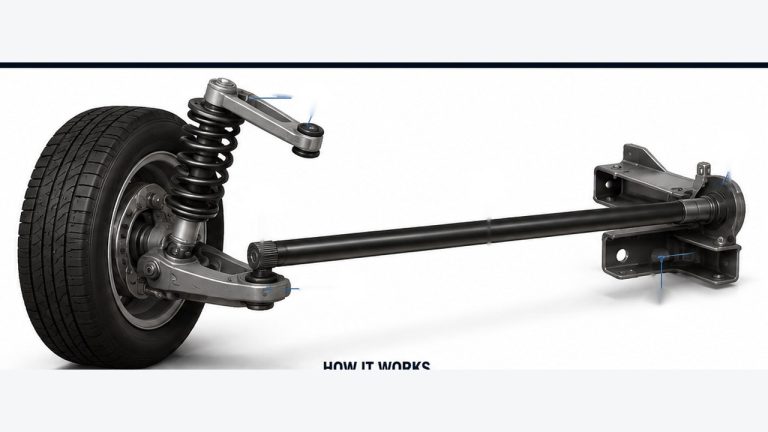
What Does a Track Bar Do? How It Works & Why It Matters
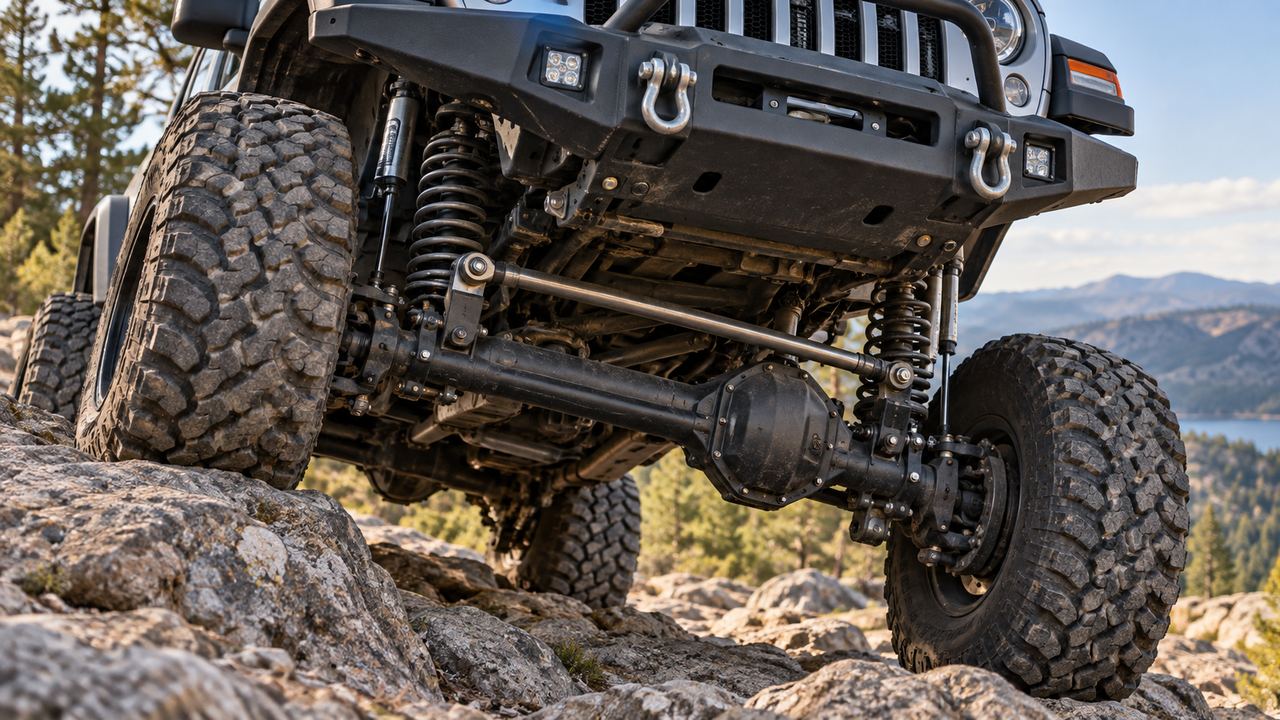
A track bar keeps a solid axle centered side-to-side underneath the vehicle while still allowing the axle to move up and down with the suspension. It connects the axle to the frame from opposite sides, preventing uncontrolled lateral movement when you steer, corner, hit bumps or drive across uneven terrain.
It is also commonly called a Panhard bar, Panhard rod or track rod. On a front solid axle, the track bar also becomes part of the steering geometry because its movement needs to work correctly with the drag link.
A track bar does not control body roll like a sway bar, absorb bumps like a shock, or locate the axle front-to-back like control arms or radius arms. Its main job is much simpler: keep the axle laterally positioned under the chassis.
What a Track Bar Does at a Glance
| Track Bar Function | What It Means |
|---|---|
| Controls lateral axle movement | Prevents the axle from shifting excessively left or right under the chassis |
| Keeps the axle centered | Maintains the intended relationship between the wheels, body and steering |
| Allows vertical suspension travel | Pivoting ends let the axle move through bump and droop |
| Guides the axle through an arc | The fixed-length bar causes a small side-to-side movement as suspension height changes |
| Affects lifted suspension geometry | A lift can move the axle off-center and increase track-bar angle |
| Works with the drag link on many front axles | Their movement needs to be compatible to minimize bump steer |
If you only remember one thing, remember this: control arms position the axle longitudinally, while the track bar positions it laterally.
How Does a Track Bar Work?
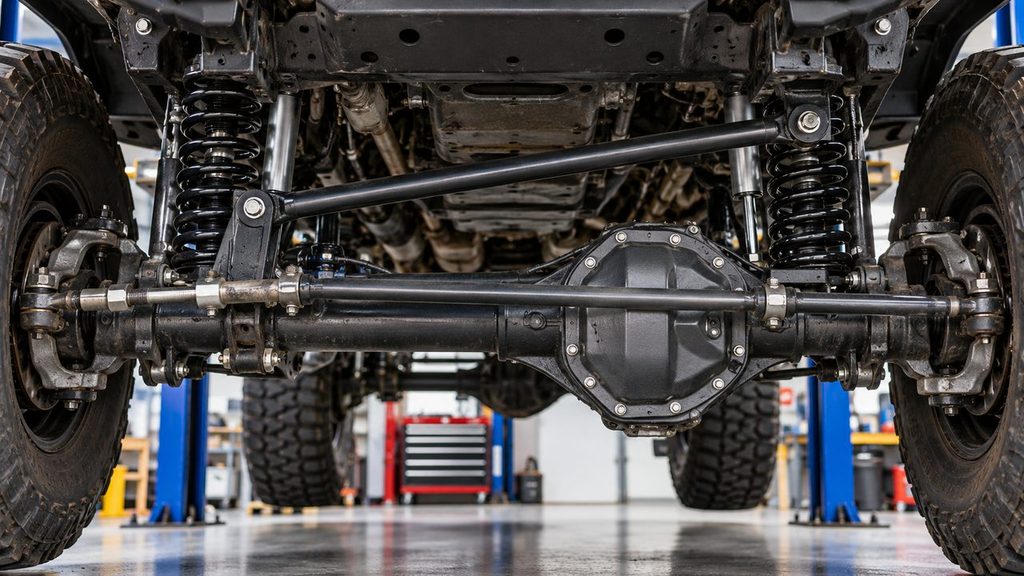
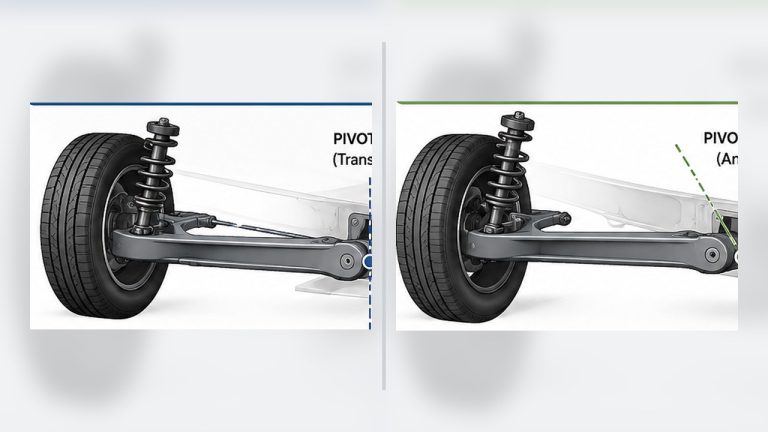
A conventional track bar is a rigid link with a pivoting connection at each end. One end attaches to the axle housing and the other attaches to the frame or chassis on the opposite side of the vehicle.
Because the bar has a fixed effective length, it prevents the axle from simply sliding sideways beneath the vehicle.
The joints or bushings at each end still allow the bar to rotate as the suspension compresses and extends. This lets the axle travel vertically while remaining laterally controlled.
However, the axle does not move in a perfectly straight vertical line.
The Track Bar Makes the Axle Move Through an Arc
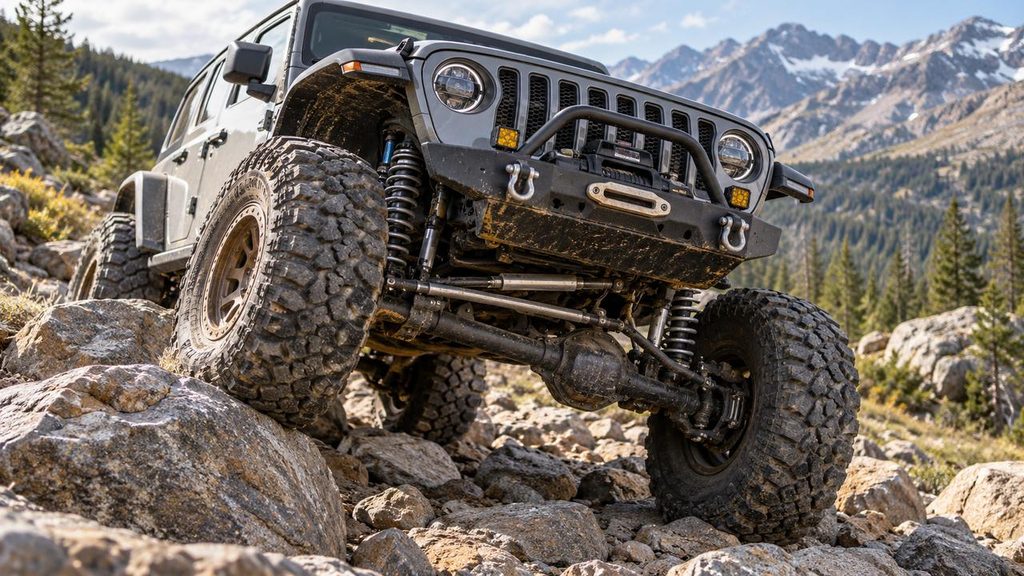
One end of the track bar is fixed to the chassis, so the opposite end must follow an arc around that pivot as suspension height changes.
That means the axle shifts slightly sideways during bump and droop.
With a relatively long, nearly level track bar and normal suspension travel, the lateral movement can be small. With a shorter or more steeply angled bar, the sideways movement through the same vertical travel becomes more noticeable.
This arc is not automatically a defect. It is an inherent characteristic of Panhard-bar geometry. Suspension designers manage it by choosing appropriate bar length, mounting height and operating angle.
Where Is a Track Bar Used?
Track bars are especially common on vehicles with solid or live axles, including many Jeeps, heavy-duty trucks and off-road vehicles.
They are frequently used with coil springs and link-type suspension because the coils support vehicle weight but do not, by themselves, precisely locate the axle side-to-side.
For example, a solid axle may use radius arms, a three-link or parallel four-link to control fore-aft position and axle rotation, while the track bar provides the missing lateral location.
If you want to understand the difference between that axle architecture and independent suspension, see our solid axle vs independent suspension comparison.
Not Every Solid Axle Uses a Track Bar
A solid axle does not automatically require a Panhard bar.
Other suspension layouts can provide lateral location in different ways. A triangulated four-link, for example, can use angled links to control side-to-side movement without a separate track bar. A Watts linkage is another alternative.
Leaf springs can also contribute substantially to lateral axle location because the springs themselves are attached longitudinally to the chassis.
Some leaf-sprung vehicles still use additional lateral control for specific geometry or steering reasons, so the correct rule is not “solid axle equals track bar.” The complete suspension design determines whether one is required.
Track Bar vs Panhard Bar: Is There a Difference?
In normal automotive usage, track bar and Panhard bar describe the same basic suspension component.
You may also see the terms Panhard rod or track rod. Terminology varies by manufacturer, region and enthusiast community, but the basic function is the same: a lateral link connecting the chassis to the axle.
Do not assume a parts catalog is describing a different component simply because it uses “Panhard bar” instead of “track bar.” Verify the mounting points and vehicle application rather than relying only on the name.
Track Bar vs Sway Bar: They Do Completely Different Jobs
This is one of the most common suspension terminology mix-ups.
| Track Bar / Panhard Bar | Sway Bar / Anti-Roll Bar |
|---|---|
| Keeps the axle positioned laterally | Controls body roll |
| Connects axle to chassis | Connects left and right suspension movement |
| Essential axle-locating link on systems designed around it | Handling and roll-control component |
| Should not be disconnected to gain articulation | Can be intentionally disconnected on certain off-road systems |
| Controls where the axle sits | Controls how strongly left and right suspension movement is coupled |
A sway bar resists differences in suspension movement between the left and right sides, helping reduce body roll in corners.
A track bar does not perform that function. It keeps the complete axle from shifting sideways relative to the chassis.
This also explains why off-roaders can use a sway bar disconnect to gain articulation, while disconnecting a track bar would remove a critical axle-locating link on a suspension that depends on it.
Track Bar vs Control Arms and Radius Arms
Control arms and radius arms usually handle a different axis of axle movement.
On a typical linked solid axle:
- Track bar: controls side-to-side axle location.
- Control arms or radius arms: control fore-aft axle position and help manage axle rotation.
- Springs: support vehicle weight and establish ride height.
- Shocks: control the rate of suspension movement.
- Sway bar: adds roll stiffness by coupling left and right suspension movement.
These parts work together rather than replacing one another.
For a closer look at the longitudinal axle links themselves, our radius arm vs 4-link suspension guide explains how those layouts control caster, articulation and axle rotation.
Track Bar vs Traction Bar: Similar Name, Different Component
A traction bar is also different from a track bar.
Traction bars are typically mounted lengthwise and are used to control axle rotation or axle wrap, especially on powerful leaf-sprung trucks.
Under hard acceleration, torque can try to twist a driven axle housing and deform the leaf springs into an S-shape. A traction bar resists that rotation.
A track bar runs primarily across the vehicle and controls lateral axle position.
The easiest distinction is:
- Track bar: stops the axle moving sideways.
- Traction bar: helps stop the axle housing rotating under torque.
Why Suspension Lifts Affect the Track Bar
A suspension lift changes the vertical distance between the chassis-side and axle-side track-bar mounts.
Since a factory track bar has a fixed length, changing that distance also changes where the axle sits along the bar’s arc.
The result can be an axle that is no longer centered beneath the body at the new ride height.
Why the Axle Shifts Sideways After a Lift
Picture the track bar as the radius of a circle.
At factory ride height, the axle sits at one point on that arc. Raise the chassis without changing the bar length or mounting positions and the axle has to move to another point on the same arc.
That new point is not directly below the old one, so the axle shifts laterally.
The amount depends on track-bar length, original angle, lift height and mounting geometry.
What Does an Adjustable Track Bar Do?
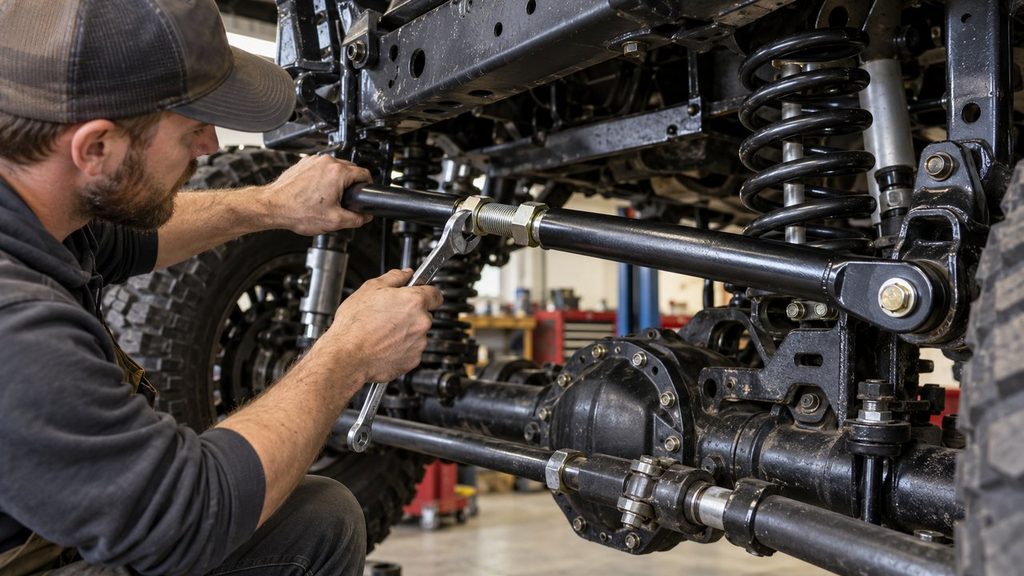
An adjustable track bar lets you change its effective length so the axle can be re-centered beneath the vehicle at the new ride height.
This is why adjustable track bars are common on lifted Jeeps and solid-axle trucks.
But there is an important limitation:
An adjustable track bar can correct axle centering without necessarily correcting track-bar angle.
If the lift has made the bar significantly steeper, changing its length may put the axle back in the center while the suspension still experiences increased lateral movement as it cycles.
Those are two different geometry problems.
Adjustable Track Bar vs Relocation Bracket
An adjustable bar and a relocation bracket do not necessarily solve the same problem.
| Modification | Main Purpose |
|---|---|
| Adjustable track bar | Changes bar length to re-center the axle |
| Track-bar relocation bracket | Changes mounting position to alter bar angle and suspension geometry |
| Both together | May be used when both axle centering and geometry correction are required |
Which solution is correct depends on the vehicle, lift height, steering arrangement and suspension kit design.
Do not install a track-bar drop or raise bracket simply because the vehicle is lifted. On a front steering axle, changing track-bar height can also change its relationship with the drag link, which is critical to steering behavior.
Track Bar and Drag Link: Why Their Geometry Matters
On many solid-front-axle trucks and Jeeps with a steering gearbox, the track bar and drag link both move through arcs as the suspension travels.
The track bar controls lateral movement of the axle relative to the chassis. The drag link connects steering movement from the pitman arm to the steering knuckle or steering linkage.
Ideally, those two arcs are compatible.
If the axle moves sideways according to one arc while the drag link follows a substantially different arc, suspension movement can push or pull the steering linkage even when the driver is holding the steering wheel steady.
That is one mechanism behind bump steer.
Do the Track Bar and Drag Link Have to Be Parallel?
Keeping the track bar and drag link close to parallel is a useful visual rule on many solid-axle steering systems, but parallel appearance alone does not guarantee perfect geometry.
Their effective lengths and pivot locations also determine the arcs they follow.
Two links can look parallel at ride height and still have significantly different arc radii if one is much shorter than the other.
The real goal is compatible movement throughout suspension travel, not simply making two bars look similar while the vehicle is parked.
Can a Track Bar Cause Bump Steer?
Incorrect track-bar geometry can contribute to bump steer, especially on a lifted solid-front-axle vehicle.
Common causes include:
- a track bar and drag link operating at substantially different angles
- large differences in their effective lengths or pivot locations
- incorrectly matched track-bar and pitman-arm relocation
- excessive track-bar angle after a lift
- loose track-bar bushings, joints or mounting hardware
However, bump steer is a steering-geometry symptom, not a diagnosis of one specific component. Tie rods, steering linkage, ride height and other geometry changes also need to be considered.
Symptoms of a Bad or Worn Track Bar
A healthy track bar can pivot at its joints but should not allow uncontrolled movement between its mounts.
Common warning signs include:
- Clunking over bumps or during steering inputs — worn bushings, a loose joint or moving mounting hardware can create a knock.
- Loose or wandering steering feel — the axle may move slightly before steering force reaches the tires as intended.
- Delayed steering response — excessive lateral play can make the chassis and axle feel disconnected.
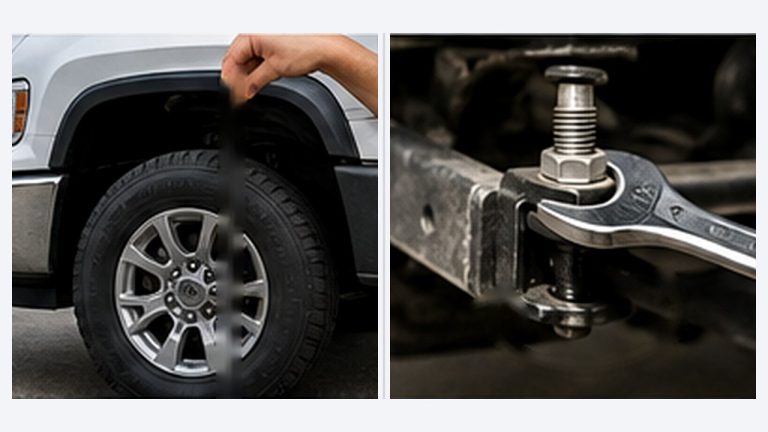
- Visible movement at a track-bar mount — the bolt, bushing or bracket should not shift independently under steering load.
- Axle visibly off-center after a lift — this may indicate geometry rather than component wear, especially with a fixed-length factory bar.
- Steering shake or oscillation — track-bar play can contribute to severe front-end instability, although it should not be assumed to be the only cause.
These symptoms overlap with worn tie-rod ends, ball joints, wheel bearings, steering-box play and other suspension problems, so diagnosis matters before replacing parts.
Can a Bad Track Bar Cause Death Wobble?
Track-bar looseness can be an important contributor to death wobble, but it is not correct to assume that every case has one single track-bar cause.
Severe steering oscillation can involve several interacting issues, including worn joints, loose mounting hardware, tire or wheel problems, alignment and steering geometry.
The track bar deserves particular attention because it controls the lateral relationship between the axle and chassis. If that connection has measurable play, the front axle can move in a direction the suspension was designed to restrain.
Replacing a steering stabilizer without finding loose suspension or steering components does not correct that underlying movement.
How to Check a Track Bar for Play
A useful inspection starts with the vehicle at normal ride height, where the track bar is carrying load in its normal operating position.
Inspect:
- bushings or flex joints at both ends
- mounting bolts and nuts
- frame-side and axle-side brackets
- cracks around welded mounts
- elongated or damaged bolt holes
- a bent or damaged bar
A common diagnostic technique is to have a helper move the steering wheel gently left and right while you observe the track-bar mounts from a safe position.
The axle, bar and chassis will react to steering load, but the bolt should not visibly shift inside its bracket and a worn bushing should not allow obvious uncontrolled movement before the bar follows.
Do not place yourself beneath a vehicle that is inadequately supported, and do not reach into moving steering or suspension components during the test.
Can You Drive With a Bad Track Bar?
Driving with a track bar that has significant looseness, damaged mounts or a failed joint is not something to ignore.
This component helps control where the axle sits under the vehicle. Excessive play can affect steering response and vehicle stability, particularly when the front axle is involved.
If the vehicle has severe wandering, violent steering shake, a visibly moving mount, a loose bolt, a cracked bracket or a track bar that appears partially detached, stop driving and have the suspension inspected.
A minor bushing crack with no measurable play is different from a connection that is actively moving, so the condition needs to be evaluated rather than judged only by mileage.
Can You Drive Without a Track Bar?
If the suspension was designed to use a track bar as its lateral locating link, no—you should not remove it and drive normally.
Without it, the axle is no longer properly constrained side-to-side by the system that was designed to locate it.
This is fundamentally different from temporarily disconnecting a sway bar on a purpose-designed off-road setup.
A track bar should therefore never be treated as a component you remove to gain additional articulation.
Front Track Bar vs Rear Track Bar
The basic function is the same at either end of the vehicle: control lateral axle location.
Front Track Bar
On a steerable solid front axle, the track bar has an additional geometric relationship with the steering linkage.
This makes track-bar angle, drag-link angle and mounting position especially important after suspension lifts or steering modifications.
Rear Track Bar
A rear Panhard bar still controls lateral axle position, but there is no steering drag link to match.
Its length and angle still influence how much the rear axle shifts sideways as the suspension compresses and extends.
On performance applications, changing rear Panhard-bar mounting height can also influence roll-center behavior, but that is a chassis-tuning topic beyond the basic function most truck and Jeep owners need to understand.
Does a Track Bar Affect Wheel Alignment?
A track bar does not directly adjust toe, camber or caster in the way conventional alignment adjustments do.
However, it determines where a solid axle sits laterally beneath the vehicle, and on the front axle its relationship with the steering linkage can affect steering-wheel position and dynamic steering behavior.
After changing ride height, track-bar length, track-bar mounting position or steering geometry, the complete setup should be checked rather than assuming axle centering is the only adjustment that matters.
Do You Need an Adjustable Track Bar After a Lift?
Often, but not universally.
If a suspension lift causes a fixed-length track bar to pull the axle visibly off-center, an adjustable bar is a straightforward way to restore lateral centering.
Some lift kits instead change the mounting location with brackets, and some combine a relocation bracket with an adjustable bar.
The correct solution depends on how the manufacturer intends the track bar, drag link and suspension links to operate at the new ride height.
Do not choose solely by lift height or assume that an adjustable bar automatically fixes every steering problem caused by a lift.
Frequently Asked Questions
What does a track bar do on a truck?
A track bar keeps a solid axle laterally positioned beneath the truck’s frame. It prevents excessive left-to-right axle movement while its pivoting ends allow normal vertical suspension travel.
What does a track bar do on a Jeep?
On Jeeps that use a track-bar-located solid axle, it keeps the axle centered under the body while control arms locate the axle in other directions. On the front axle, its movement also needs to remain compatible with the steering drag link.
Is a track bar the same as a Panhard bar?
Yes, in normal automotive terminology a track bar, Panhard bar and Panhard rod describe the same basic type of lateral axle-locating link.
Is a track bar the same as a sway bar?
No. The track bar controls lateral axle position, while the sway bar controls body roll by resisting differences in movement between the left and right sides of the suspension.
Is a track bar the same as a traction bar?
No. A track bar controls side-to-side axle position. A traction bar generally controls axle wrap or housing rotation under acceleration and braking.
Can a worn track bar cause clunking?
Yes. Worn bushings, loose bolts, damaged joints or movement inside an elongated mounting hole can produce a clunk as steering or suspension load changes direction.
Why is my axle off-center after a lift?
A fixed-length track bar moves through an arc. Raising the chassis changes the bar’s resting position on that arc, which can pull the axle laterally. An adjustable track bar or correctly engineered relocation system may be used to restore the intended geometry.
Does a longer track bar reduce lateral axle movement?
For otherwise comparable geometry, a longer track bar generally produces a larger-radius arc and can reduce lateral displacement through a given amount of vertical suspension travel. Mounting angle and pivot locations still matter, so length cannot be evaluated by itself.
Why This Simple Bar Matters So Much
A track bar looks simple because mechanically it is: one rigid link between the axle and chassis.
But that link controls one of the most important freedoms a solid axle must not have—uncontrolled side-to-side movement beneath the vehicle.
At stock ride height, a properly designed track bar quietly keeps the axle where it belongs. Once ride height changes, bushings wear or mounting geometry is modified, its importance becomes much more obvious.
For lifted trucks and Jeeps, the key is to separate three questions: Is the axle centered? Is the track bar operating at an appropriate angle? And does its movement remain compatible with the steering drag link?
Answering all three produces a much better suspension than simply installing an adjustable bar and assuming the job is finished.