Bypass Shocks Explained: How They Work & When You Need Them

Bypass shocks are high-performance dampers that change how much damping they provide depending on where the piston is within the shock travel. Instead of relying only on oil flowing through the main piston, a bypass shock gives some of that oil an additional path around the piston during selected portions of the stroke.
The result is position-sensitive damping: the shock can remain relatively compliant around normal ride height, then increase damping as the suspension moves toward full compression or full extension.
That makes bypass shocks especially useful on long-travel trucks, prerunners, desert vehicles and race-oriented builds that need both compliance over smaller terrain and much stronger control during large impacts. The tradeoff is cost, packaging, maintenance and a much greater need for correct tuning.
What Are Bypass Shocks?
A bypass shock is a hydraulic shock absorber that uses additional oil passages to create different damping zones throughout its travel.
In a conventional external-bypass design, those passages are visible as tubes running along the outside of the shock body. Each tube connects two points in the shock and allows hydraulic oil to bypass the main damping piston while that piston is within a specific section of its stroke.
Once the piston moves beyond that bypass section, the additional oil path is no longer available. More fluid must then pass through the piston valving, increasing damping force.
This ability to change damping according to piston position is what separates a true bypass shock from an ordinary smooth-body damper.
How Bypass Shocks Work
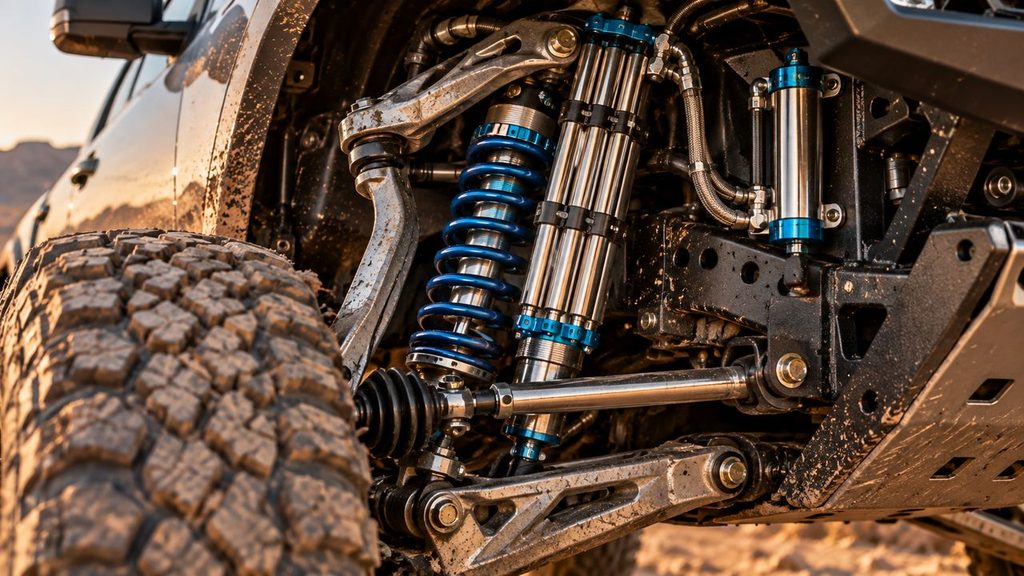
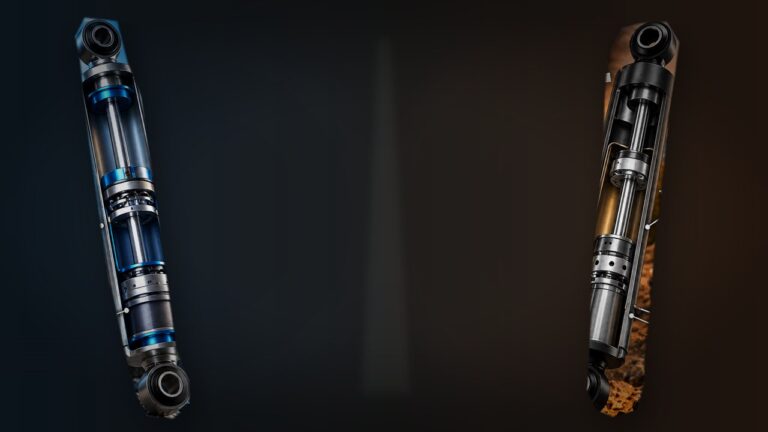
At its core, an external bypass shock still contains the familiar parts of a performance damper: a piston, piston rod, hydraulic oil, compression and rebound valving, pressurized gas and usually an external reservoir.
The bypass system adds another route for oil to move from one side of the piston to the other.
1. Oil Can Flow Through the Main Piston
Like a conventional shock, the main piston contains valves that resist oil flow during compression and rebound. This internal valving remains important even on a bypass shock.
2. Bypass Tubes Create an Alternate Oil Path
When the piston is positioned between the inlet and outlet ports of an active bypass tube, some hydraulic fluid can travel through that tube instead of being forced entirely through the piston valving.
Allowing more oil to bypass the piston generally reduces damping in that section of the stroke. Restricting that flow increases damping.
3. Check Valves Control Direction
External bypass circuits commonly use one-way check valves so a particular tube can affect compression or rebound without necessarily affecting movement in the opposite direction.
This allows separate control over how the suspension compresses into an impact and how quickly it extends afterward.
4. The Piston Eventually Moves Past the Bypass Port
As the suspension moves farther through its travel, the piston passes one or more bypass ports. Those circuits stop carrying oil, forcing a greater proportion of the flow through the main piston.
That is how a bypass shock can become progressively more controlled as the suspension approaches the ends of its travel without needing the entire stroke to feel excessively firm.
Position-Sensitive vs Velocity-Sensitive Damping
This distinction explains why bypass shocks exist.
A conventional hydraulic shock is primarily velocity-sensitive. Damping force changes with piston or shaft speed because faster movement forces oil through the valves at a higher rate.
A bypass shock still uses that velocity-sensitive piston valving, but adds another variable: where the piston is in the stroke.
| Type of damping | What changes the damping force? |
|---|---|
| Velocity-sensitive | How quickly the shock piston is moving |
| Position-sensitive | Where the piston is within the shock travel |
| Bypass shock | Uses velocity-sensitive valving plus position-sensitive bypass zones |
This is why describing bypass shocks simply as “softer shocks that get stiffer” misses part of the picture. Their piston valving still reacts to shaft speed while the bypass circuits change the available oil flow according to piston position.
For a deeper explanation of piston speed, compression and rebound, see our guide to how suspension damping works.
The Three Main Bypass Zones
A well-designed bypass shock can behave differently near normal ride height than it does near full compression or full extension.
Ride Zone
Around normal ride height, multiple bypass circuits may be available to move oil around the piston. That can reduce damping and help the suspension remain compliant over smaller bumps, chop and uneven terrain.
Compression or Bottom-Out Zone
As the shock compresses farther, the piston passes compression bypass ports and fewer bypass paths remain active.
More oil is then forced through the main piston valving, increasing damping near the end of compression. This helps control large impacts and reduce harsh bottoming.
Rebound or Top-Out Zone
A similar principle can be used near full extension. Rebound bypass circuits can control how quickly the suspension extends and provide additional damping as the shock approaches its top-out limit.
The exact number, length and position of these zones depends on the shock design. A bypass shock is therefore not defined simply by its number of external tubes.
External Bypass vs Internal Bypass Shocks
Both designs create position-sensitive damping, but they package the bypass passages differently.
| Feature | External Bypass | Internal Bypass |
|---|---|---|
| Bypass passages | Visible tubes outside the shock body | Passages incorporated inside the shock body |
| External adjustment | Often extensive | Depends on design |
| Packaging | Requires more surrounding space | Can fit tighter factory-style locations |
| Typical application | Race trucks, prerunners, custom long-travel builds | Performance 4x4s, UTVs and more integrated applications |
| Visual identification | External bypass tubes are obvious | Can resemble a conventional shock or coilover |
External Bypass Shocks
External bypass shocks use tubes attached to the outside of the shock body. Their main advantage is tunability: tube location determines where a damping zone operates, while external adjusters can change how much oil flows through individual circuits.
They are common on high-speed desert vehicles because large shocks, custom mounting and extensive suspension travel provide enough room for the external tubes and reservoirs.
Internal Bypass Shocks
Internal bypass designs move the additional oil passages inside the shock body instead of using large external tubes.
The exact internal construction varies by manufacturer, but the objective is similar: allow oil to bypass the main piston during selected portions of the stroke and increase damping as the piston moves into different zones.
This packaging can make bypass technology practical where a traditional external-bypass body would be difficult to fit, including coilover-style front suspension locations.
What Are 2-Tube, 3-Tube and 4-Tube Bypass Shocks?
The tube count on an external bypass shock refers to the number of external bypass circuits—not the same thing as the twin-tube construction used in conventional shock absorbers.
Common layouts include:
| Configuration | Common layout | Main advantage |
|---|---|---|
| 2-tube bypass | Often one compression and one rebound circuit | Simple position-sensitive control |
| 3-tube bypass | Often two compression circuits and one rebound circuit | More control over compression zones |
| 4-tube bypass | May add further compression or rebound control | More independent tuning zones |
These are common configurations rather than universal rules. Manufacturers can arrange bypass circuits differently depending on the intended vehicle and shock travel.
What Is a Triple Bypass Shock?
“Triple bypass” usually refers to a shock with three external bypass tubes. A common configuration uses two compression circuits and one rebound circuit.
The additional compression circuit can create a more gradual transition from a softer ride zone into stronger damping deeper in the compression stroke.
It does not mean the shock is automatically three times stronger or better than a single- or two-tube design. Tube placement and tuning matter far more than the number printed in the product description.
More Bypass Tubes Do Not Automatically Mean a Better Shock
Adding another bypass tube gives the tuner another circuit and potentially another damping zone to control. It does not automatically improve performance.
A poorly positioned or incorrectly adjusted extra circuit can make a shock harder to tune without providing useful additional control.
The shock still needs to match:
- Vehicle weight and weight distribution
- Spring rate
- Suspension geometry
- Wheel travel
- Shock stroke and motion ratio
- Tire and wheel mass
- Typical terrain
- Driving speed
A correctly configured two- or three-tube bypass shock can therefore outperform a more complicated shock that was never designed or tuned for the vehicle.
Bypass Shock vs Remote Reservoir Shock
A remote reservoir does not make a shock a bypass shock. This is one of the most common points of confusion when comparing off-road dampers.
A remote reservoir primarily provides additional fluid and gas volume, helps separate the nitrogen charge from the working oil and increases thermal capacity.
A bypass system performs a different job: it creates alternate oil paths that change damping according to piston position.
| Feature | Remote Reservoir | Bypass System |
|---|---|---|
| Main purpose | Oil/gas volume and thermal management | Position-sensitive damping |
| Changes damping zones? | Not by itself | Yes |
| External hose/reservoir? | Usually | Often, but not what defines bypass |
| Can both be used together? | Yes—external bypass shocks commonly also use reservoirs | |
A conventional remote-reservoir monotube can be an excellent high-performance shock without having any position-sensitive bypass system at all.
If you are comparing conventional shock architectures first, our monotube vs twin-tube shocks guide explains those designs separately.
Bypass Shocks vs Coilovers
These terms describe different things and should not be treated as opposites.
A coilover combines a coil spring and shock absorber into one assembly. A bypass shock describes the damper’s position-sensitive hydraulic system.
A vehicle can therefore use:
- A conventional coilover by itself
- A coilover plus a separate external bypass shock
- An internal-bypass coilover
- Separate springs with bypass dampers
On many custom long-travel trucks, the coilover supports vehicle weight while a second bypass shock adds additional damping capacity and position-sensitive control.
Why Long-Travel Suspensions Often Use Bypass Shocks
Bypass technology becomes especially useful when the suspension has enough travel for several distinct damping zones to operate effectively.
A long-travel suspension may need to remain compliant around ride height, absorb repeated medium-sized terrain through the middle of the stroke and then generate much more control near full bump.
A bypass shock gives the tuner more ability to shape those different portions of the travel independently.
That is one reason external bypass shocks are strongly associated with prerunners, trophy trucks and other high-travel off-road vehicles. For the geometry side of that setup, see our guide to long travel suspension.
What Bypass Shocks Feel Like Off Road

A correctly tuned bypass system can feel surprisingly compliant through smaller terrain while still providing much stronger support during large suspension events.
For example, while traveling quickly across uneven desert terrain, the shock may operate within a relatively soft ride zone during smaller wheel movements. When the vehicle hits a larger compression event, the piston moves past one or more bypass ports and damping increases.
This helps reduce the compromise between making a shock compliant enough for repeated chop and firm enough to resist hard bottoming.
However, a bypass shock cannot compensate for the wrong spring rate, insufficient suspension travel or poor geometry. The entire suspension still has to work as a system.
How External Bypass Shocks Are Tuned
External bypass shocks provide more tuning options than most conventional dampers, but that also means there are more ways to get the setup wrong.
Bypass Adjusters
External adjusters commonly control how far a bypass circuit’s check valve can open.
Allowing more oil through the bypass generally softens damping while that circuit is active. Restricting the flow generally increases damping in that portion of the stroke.
Tube Position
The location of the inlet and outlet ports determines where in the shock travel a bypass circuit operates.
This is critical. Turning an external adjuster can change damping within an existing zone, but it cannot move that zone to a completely different part of the stroke.
Main Piston Valving
The internal piston still contains compression and rebound valving. Near portions of the stroke where bypass circuits are no longer active, that internal valving can become the dominant restriction to oil flow.
Major tuning changes can therefore involve internal revalving as well as external bypass adjustment.
Why You Should Not Randomly Adjust Bypass Tubes
A bypass adjuster is not simply a global “soft/hard” knob.
Each circuit may operate only during a specific section of compression or rebound. Changing one adjuster can therefore alter one part of the suspension stroke without fixing a problem occurring elsewhere.
Before making changes, identify what the vehicle is actually doing:
- Harsh over small chop
- Bottoming on large impacts
- Kicking after compression
- Too much rebound speed
- Excessive body movement near ride height
- Instability after successive whoops
Start from the shock manufacturer’s or suspension tuner’s baseline, change one circuit in small increments and record the result. If the base valving, springs or zone positions are wrong, external adjustment alone may not solve the problem.
What Are the Benefits of Bypass Shocks?
- Position-sensitive damping: different portions of the suspension travel can have different damping characteristics.
- Better end-of-travel control: damping can increase as the shock approaches compression or rebound limits.
- Ride-zone compliance: selected bypass circuits can reduce damping around normal ride height.
- External tunability: many external-bypass designs allow individual circuits to be adjusted without disassembling the shock.
- High-performance potential: large bypass shocks can provide substantial oil volume, heat capacity and damping control for demanding terrain.
- Rebuildability: race-oriented bypass dampers are commonly designed to be serviced and revalved rather than discarded.
The Downsides of Bypass Shocks
The additional performance is not free.
- Cost: bypass shocks are substantially more expensive than basic replacement dampers.
- Packaging: external tubes and reservoirs need space around the suspension.
- Tuning complexity: more circuits create more opportunities for incorrect setup.
- Installation requirements: large external bypass shocks may require custom mounts, shock hoops or chassis fabrication.
- Maintenance: hard off-road use can require inspection, seal service, oil changes or rebuilds.
- Limited benefit on mild builds: many trucks never use enough suspension travel or generate enough sustained shock load to justify them.
For a conventional lifted truck that does not need position-sensitive race-style damping, a well-matched monotube or reservoir shock may offer much better value. Our lifted-truck shock guide covers those more conventional options.
Are Bypass Shocks Good for Daily Driving?
They can be, but daily driving by itself is not a good reason to buy them.
An internal-bypass shock designed specifically for a street-driven 4×4 can provide comfortable ride-zone damping while adding more control near the ends of travel.
A large external-bypass race shock is a different proposition. It may add noise, maintenance, packaging difficulty and cost that provide little benefit during normal commuting.
If the vehicle regularly switches between pavement and demanding off-road terrain, a vehicle-specific internal-bypass system can make more practical sense than building around large externally tubed race shocks.
Do Bypass Shocks Make Noise?
External bypass shocks can produce more audible mechanical and hydraulic noise than conventional street shocks.
One-way check valves inside the external bypass assemblies open and close as fluid changes direction, and spherical mounting joints can transmit more mechanical sound than soft rubber bushings.
Some clicking or fluid-related noise may therefore be characteristic of a particular race-oriented design. New, excessive or rapidly worsening clunks should still be inspected rather than dismissed as normal bypass operation.
Do Bypass Shocks Replace Bump Stops?
No. A bypass shock can provide much more damping near the end of compression, but it should not be treated as a replacement for a correctly designed bump-stop system.
Hydraulic or conventional bump stops still provide protection and additional energy absorption near the end of suspension travel.
On high-performance builds, bypass shocks and hydraulic bump stops are often tuned to complement one another rather than compete for the same job.
Do Bypass Shocks Need a Remote Reservoir?
External race-style bypass shocks commonly use piggyback or remote reservoirs because the added oil and gas volume is useful in demanding off-road conditions.
But the reservoir itself is not what creates bypass damping. Position-sensitive behavior comes from the bypass passages and their relationship to piston position.
Internal-bypass products can also use reservoirs for additional cooling and fluid capacity while packaging the bypass passages inside the main shock body.
How to Know if Your Truck Actually Needs Bypass Shocks

Start with the terrain and the limitation you are trying to solve rather than choosing the most complicated shock available.
| Vehicle use | Bypass shocks? |
|---|---|
| Daily commuting and highway use | Usually unnecessary |
| Occasional dirt roads | Usually unnecessary |
| Overlanding at moderate speeds | Optional; quality reservoir shocks may be enough |
| Slow recreational trail driving | Depends on travel and vehicle setup |
| Fast washboard and rough desert roads | Potentially very useful |
| Repeated whoops and large impacts | Strong use case |
| Prerunner or desert race build | Often highly beneficial |
| Long-travel competition vehicle | Common and often integral to the setup |
If your current suspension never reaches the limits of a quality conventional shock, bypass technology may add complexity without solving a real problem.
If the truck repeatedly uses large portions of its travel and needs different damping behavior near ride height, mid-stroke and end-of-travel, that is where bypass shocks become much easier to justify.
What to Check Before Buying Bypass Shocks
- Measure usable suspension travel. Shock travel must match the suspension rather than becoming the mechanical limit.
- Check compressed and extended length. The shock needs safe clearance at both ends of travel.
- Understand the motion ratio. Shock travel and wheel travel are not necessarily equal.
- Confirm mounting space. External tubes and reservoirs need room through the complete suspension cycle.
- Match body diameter to the job. Larger shocks provide more oil volume and thermal capacity but require more space.
- Choose the correct bypass configuration. More tubes should solve a tuning requirement rather than simply increase the specification count.
- Account for vehicle weight. Bumpers, spare tires, fuel, tools and cargo affect spring and damping requirements.
- Plan the springs at the same time. Bypass tuning cannot compensate for a fundamentally incorrect spring rate.
- Consider bump stops and limit straps. End-of-travel control must be designed as a system.
- Budget for tuning and maintenance. The purchase price is only part of a serious bypass setup.
Common Bypass Shock Mistakes
Choosing by Tube Count Alone
A triple bypass is not automatically better than a two-tube shock. Tube location, valving and vehicle setup determine whether the additional circuit provides useful control.
Confusing a Reservoir With a Bypass Tube
The reservoir and bypass system perform different functions. A shock can have a reservoir without any position-sensitive bypass damping.
Installing Too Much Shock for the Suspension
A huge bypass shock cannot create wheel travel that the control arms, links, axles or chassis do not provide. Build the damper around the suspension geometry, not the other way around.
Trying to Fix Spring Problems With Bypass Adjustment
If the spring rate, preload or ride height is fundamentally wrong, changing bypass adjusters may only mask part of the problem.
Adjusting Every Tube at Once
Changing several circuits simultaneously makes it difficult to identify which adjustment improved or worsened the suspension. Work from a known baseline and change one variable at a time.
Frequently Asked Questions
What does a bypass shock do differently?
A bypass shock changes damping according to piston position by routing oil around the main piston through additional passages during selected portions of the shock travel. This allows different damping characteristics in the ride, compression and rebound zones.
What is a triple bypass shock?
A triple bypass usually has three external bypass circuits. A common layout uses two compression tubes and one rebound tube, giving the tuner more control over different parts of the compression stroke than a basic two-tube configuration.
Are bypass shocks better than regular shocks?
They offer greater position-sensitive tuning potential, but that does not make them universally better. For normal road use and moderate off-roading, a correctly matched conventional monotube or reservoir shock can provide excellent performance with less cost and complexity.
Can bypass shocks be too stiff?
Yes. Incorrect internal valving, overly restricted bypass circuits or poor zone placement can make a bypass shock harsh. The advantage of bypass technology is tunability, not automatic softness.
Can you adjust bypass shocks without removing them?
Many external bypass shocks allow individual bypass circuits to be adjusted while installed. Major changes to internal piston valving, oil, gas pressure or tube placement require more involved service or shock modification.
Do bypass shocks help prevent bottoming out?
They can provide substantially more damping near full compression by reducing or eliminating bypass flow as the piston enters the bottom-out zone. Proper springs, bump stops and sufficient suspension travel are still necessary.
Are internal bypass shocks the same as external bypass shocks?
No. Both provide position-sensitive damping, but an external bypass routes oil through visible tubes outside the body while an internal bypass incorporates the additional flow paths inside the shock assembly.
Who Bypass Shocks Are Really For
Bypass shocks make the most sense when a vehicle uses enough suspension travel that one damping characteristic throughout the entire stroke becomes a meaningful limitation.
They are particularly effective on long-travel trucks, prerunners and off-road vehicles that repeatedly encounter whoops, high-speed rough terrain and large compression events. Position-sensitive damping lets the suspension remain more compliant where comfort and traction matter while adding much stronger control near the ends of travel.
For most daily-driven trucks, however, the additional cost, packaging and tuning requirements are difficult to justify. A good conventional or remote-reservoir shock matched to the vehicle will usually be simpler and more than capable enough.
The important decision is therefore not whether bypass shocks are more advanced. They are. The question is whether your suspension, terrain and driving style actually create a problem that position-sensitive damping is designed to solve.